Viking 1
NASA · United States · Lander · 1976 · The Viking yearsSuccess
Landed in western Chryse Planitia on 20 July 1976 and worked 2,245 sols against a 90-day design life. Killed on 19 November 1982 by a command from Earth that overwrote its antenna-pointing memory.
TL;DR· 15 min read
Viking 1 was the first spacecraft to land on Mars and then keep working. It touched down in western Chryse Planitia on 20 July 1976 and returned the first sustained pictures, soil chemistry and weather data from the Martian surface, running 2,245 sols against a 90-day design life. What killed it was a command from Earth: a battery-charging sequence sent up on 19 November 1982 overwrote the antenna-pointing memory, and nothing answered again.
Viking 1 was not the first spacecraft to soft-land on Mars. The Soviet Mars 3 did that in December 1971 and fell silent within a minute. Viking 1 was the first to land and then keep working: it touched down in western Chryse Planitia on 20 July 1976, returned the first sustained pictures, soil chemistry and weather data from the Martian surface, and outlived its 90-day design life by more than six years. In the end it was not Mars that killed it. It was a command from Earth.
- 1stspacecraft to land on Mars and go on working
- 2,245sols on the surface, against a 90-day design life
- 36,622pictures from its orbiter, of 52,663 from the pair
Viking was the largest and most expensive thing NASA had ever sent to another planet: two orbiters and two landers, about 1.06 billion dollars in 1970s money, built around a question that Mariner 4 had made look naive in 1965 and Mariner 9 had made respectable again in 1971. Is there life on Mars? NASA's Langley Research Center managed the project, the Jet Propulsion Laboratory built the orbiters from the Mariner 9 design and flew the mission, and Martin Marietta built the landers. Each orbiter-lander pair weighed 3,527 kg fully fuelled, the heaviest planetary spacecraft the United States had launched. Because the landers were going to test Martian soil for life, they had to arrive sterile: each was sealed inside a pressurised bioshield and baked in nitrogen at 232 degrees Fahrenheit, about 111 Celsius, for forty hours, and engineers spent years screening more than 40,000 parts in 232 types of material for ones that would survive the oven. The launch campaign was less orderly than the hardware. The first attempt, on 11 August 1975, was scrubbed when a thrust vector control valve on the Titan IIIE-Centaur misbehaved in tests. The second, on 14 August, was called off when the orbiter's batteries read 9 volts instead of 37. Rather than lose more of the launch window, managers swapped the two vehicles. The spacecraft built as Viking B flew as Viking 1 on 20 August 1975 at 21:22 UT, and the one built as Viking A became Viking 2. NSSDCA's catalogue still carries "Viking-B Lander" among Viking 1's alternate names.
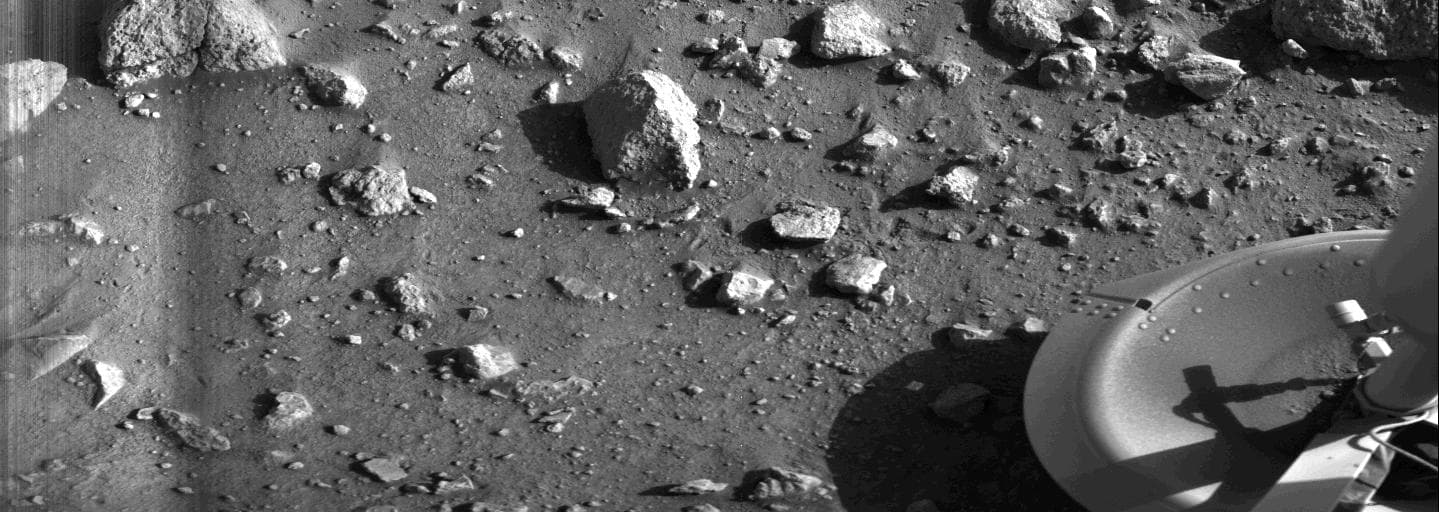
Viking 1 reached Mars orbit on 19 June 1976 after a 304-day cruise, and then did something no Mars mission had done before: it looked before it leapt. The landing had been aimed at 4 July 1976, the American bicentennial, but the orbiter's own pictures of the chosen ground in Chryse Planitia showed terrain far rougher than Earth-based radar had suggested. The site certification effort, written up afterwards in Science by Harold Masursky and Norman Crabill, was drastically lengthened while a survivable site was hunted for, and the landing slipped by more than two weeks. On 20 July 1976, by coincidence the seventh anniversary of Apollo 11, the lander separated at 08:51 UT and fell through the thin air behind an aeroshell, then under a 16 metre parachute deployed at about 6 km, then on three throttleable hydrazine engines lit at 1.5 km. Each engine sprayed its exhaust through eighteen small nozzles, a showerhead arrangement chosen so that the landing would not cook the soil the biology package was about to sample. Touchdown came at 11:53:06 UT spacecraft time, about 28 km from the aim point, on a plain of rocks and drifted dust. Mars was then roughly 340 million km away, so the confirmation did not reach Earth until 12:12 UT, twelve minutes past eight in the morning on the United States east coast and twelve minutes past five in the morning in Pasadena. Twenty five seconds after landing, camera 2 began scanning the first picture: the ground beside a footpad, sharp, sunlit, on another planet, and still there when the scan finished.
What the landers found was a world that was chemically busy and biologically ambiguous. Instruments on the aeroshell gave the first in-place measurement of Martian air, about 95.3 per cent carbon dioxide, 2.7 per cent nitrogen and 1.6 per cent argon, and the meteorology booms recorded a surface pressure that rose and fell by roughly a third across the year as carbon dioxide froze onto one polar cap and came back off the other. Then there was the biology package. Three experiments, gas exchange, labeled release and pyrolytic release, went looking for metabolism. Labeled release returned exactly the signal a biologist would want: add nutrient tagged with carbon-14 to Martian soil, get tagged gas back. But the gas chromatograph mass spectrometer, the instrument meant to find the organic molecules any life would have to be made of, found essentially none. Most of the team concluded that a powerful chemical oxidant was eating the nutrient, and that nothing living was involved. That reading held for thirty years and then got sharper. NASA's Phoenix lander found perchlorate in Martian soil in 2008, and Rafael Navarro-Gonzalez and colleagues showed in 2010 that perchlorate heated in a Viking-style oven would burn organics and generate precisely the chlorinated compounds Viking had reported. A 2025 Icarus paper by Chris McKay, Richard Quinn and Carol Stoker lays out the current mainstream position: perchlorate chemistry accounts for both the missing organics and the reactive soil. It is not unanimous. Steven Benner and colleagues argued in Astrobiology in February 2026 that the field has been misreading Viking for fifty years.
Viking 1 was built for 90 days on Mars and worked for more than six years. Its orbiter went first. Running low on the nitrogen that held its attitude, it spent July 1980 on a series of four propulsion-system test burns, on the 15th, 17th, 18th and 31st, which raised its orbit far enough that, under planetary quarantine rules, it would not fall on Mars and contaminate the ground before 2019, and on 7 August 1980 at 20:15 GMT the Deep Space Station at Madrid commanded its transmitters off, on revolution 1489, after 1,488 orbits and 36,622 pictures. The lander carried on alone as the Viking Lander Monitor Mission, waking about once a week to dump stored weather and imaging data, its stored program set to keep the high-gain antenna tracking Earth until December 1994. Jim Tillman's group at the University of Washington rebuilt enough of JPL's mission operations computing to keep the data flowing, work that Tillman credits with stretching the lander mission from about sol 1,000 to sol 2,245. By 1982 three of its four nickel-cadmium batteries were badly degraded, and after an expert review in August JPL prepared a new charging strategy. The command sequence that implemented it was written into the memory locations occupied by the high-gain antenna pointing parameters, on which both the uplink and the downlink depended. Canberra sent it on 19 November 1982. On 20 November the expected downlink did not appear and the project declared a spacecraft emergency; on 26 November engineers worked out what had happened. Four months of manual commanding at 80 kilowatts followed, aimed at a dish that was no longer pointed at Earth. Nothing answered.
Nobody laid eyes on the lander again until 22 November 2006, when the HiRISE camera on Mars Reconnaissance Orbiter resolved a roughly three metre object in a frame centred on 22.273 N, 312.054 E in western Chryse and confirmed it by overlaying contours derived from the lander's own panoramas, along with likely positions for the heat shield, backshell and parachute. Its 2,245-sol surface record had by then stood for twenty-four years, and it stood another three and a half, until Opportunity passed it on 19 May 2010. In January 1981 the lander had been renamed the Thomas A. Mutch Memorial Station for the imaging team leader who disappeared climbing in the Himalayas in 1980, and a stainless steel plaque was cast to be fixed to it by whoever gets there first. On 18 May 1984 NASA administrator James M. Beggs handed that plaque to the National Air and Space Museum and, in the same letter, transferred ownership of the lander on Mars to the museum, which is how a Smithsonian annual report came to describe itself as interplanetary. The plaque is still in Washington. The lander is still in Chryse, its dish aimed at a patch of sky that is not Earth, with four decades of dust on it, and its fiftieth landing anniversary passed on 20 July 2026.
Mission facts
Launch
20 August 1975, 21:22:00 UT (5:22 p.m. EDT), on a Titan IIIE-Centaur from Launch Complex 41, Cape Canaveral Air Force Station, Florida↗
The spacecraft swap
The first attempt on 11 August 1975 was scrubbed when a Titan IIIE-Centaur thrust vector control valve failed to respond in tests; a second attempt on 14 August was called off when the orbiter's batteries read 9 volts instead of 37. Managers substituted the twin vehicle, so the spacecraft built as Viking B flew as Viking 1. NSSDCA still lists "Viking-B Lander" and "Viking B" among the lander's alternate names.↗
Mass
3,527 kg for the fully fuelled orbiter-lander pair (7,776 lb), the heaviest planetary spacecraft the United States had launched to that date. The lander alone was 657 kg at launch including 85 kg of propellant, 572 kg dry, and roughly 600 kg standing on Mars with about 22 kg of propellant unused. NSSDCA is not self-consistent here: its two orbiter pages give the pair as 3,527 kg and both of its lander pages, Viking 1's included, give 3,530 kg.↗
Sterilisation
The lander and its aeroshell were sealed inside a pressurised bioshield and baked in nitrogen at 232 degrees Fahrenheit (about 111 Celsius) for 40 hours. Engineers studied more than 40,000 parts in 232 types of material to find ones that would survive the process.↗
Arrival and landing
304-day cruise. Mars orbit insertion on 19 June 1976, trimmed on 21 June to a 1,513 x 33,000 km, 24.66-hour site certification orbit. Lander separation on 20 July at 08:51 UT; touchdown at 11:53:06 UT spacecraft time, 4:13 p.m. local Mars time. Confirmation reached Earth about 19 minutes later at 12:12 UT (8:12 a.m. EDT), the one-way light time at that Mars-Earth distance.↗
Landing site
Western Chryse Planitia, 22.273 N, 312.054 E planetocentric, about 17 miles (28 km) from the aim point. Older sources give the same spot as 22.483 N, 47.94 W or 22.480 N, 47.968 W, which is planetographic latitude in the pre-2000 west-longitude convention.↗
Descent
Aeroshell entry, a 16 m parachute at about 6 km altitude and 250 m/s, aeroshell jettison 7 seconds later, legs out 8 seconds after that, three throttleable hydrazine engines lit at 1.5 km, touchdown 40 seconds later at about 2.4 m/s. Each engine sprayed exhaust through 18 small nozzles so the landing would not heat the soil by more than 1 degree C or strip more than 1 mm of it.↗
Lander instruments
Two facsimile cameras, a gas chromatograph mass spectrometer, a three-experiment biology package (gas exchange, labeled release, and pyrolytic release or carbon assimilation), an X-ray fluorescence spectrometer, a meteorology boom, a three-axis seismometer, magnets and reference charts, and a surface sampler arm with a collector head and backhoe. About 91 kg of science payload.↗
Power
Two radioisotope thermoelectric generators fuelled with plutonium-238, each 28 cm tall and 58 cm across, 13.6 kg, giving 30 W continuously at 4.4 volts and charging four sealed 8 amp-hour, 28-volt nickel-cadmium batteries. Waste heat from the generators warmed the instrument compartment.↗
First hours on Mars
Transmission of the first surface image began 25 seconds after touchdown, from camera 2. The seismometer failed to uncage and returned no data for the whole mission. A locking pin jammed the surface sampler arm and took 5 days to shake out, a fix worked out on the Proof Test Capsule lander in Denver by extending the arm to 14 inches.↗
Atmosphere measured in place
The Viking landers gave the first in-place measurement of Martian air composition: about 95.3 per cent carbon dioxide, 2.7 per cent nitrogen, 1.6 per cent argon, with about 0.15 per cent oxygen and 0.03 per cent water vapour. Surface pressure was found to rise and fall by roughly 30 per cent across the Martian year as carbon dioxide froze out at one pole and returned from the other.↗
Orbiter end of mission
Commanded off on 7 August 1980 at 20:15 GMT by Deep Space Station 61 in Spain, on revolution 1489, after 1,488.0 completed orbits and 36,622 pictures. The orbiter was by then running low on the compressed nitrogen it used for attitude control. Four propulsion-system test burns, on 15, 17, 18 and 31 July 1980, raised the orbit so that under planetary quarantine rules it would not strike Mars before 2019; the 18 July burn failed to exhaust the propellant as intended and the 31 July burn, on revolution 1485, finished the job. The 370 x 34,000 km to 350 x 56,000 km figures widely quoted for this manoeuvre come from JPL's pre-flight news release; NSSDCA gives the achieved change as 357 x 33,943 km to 320 x 56,000 km.↗
Lander end of mission
The last direct-link pass scheduled before the loss was 12 November 1982, sol 2245, at DSS 14 Goldstone. That entry comes from the pass schedule in Appendix D of JPL Publication 82-107, which is a record of requested and assigned passes rather than of which passes returned data, so it fixes the last opportunity rather than certifying the last data return; NSSDCA gives 13 November 1982 for the loss of contact and NASA's Viking 1 mission page gives 11 November 1982. A revised battery-charging command sequence was uplinked by DSS 43 in Australia on 19 November 1982 and was written into the memory locations holding the high-gain antenna pointing parameters, on which both uplink and downlink depended. The project declared a spacecraft emergency on 20 November 1982 and identified the overwrite on 26 November. Recovery commanding at 80 kW ran until the Viking Lander Monitor Mission was terminated in March 1983; JPL announced on 12 April 1983 that contact could not be re-established, and the Viking program formally ended on 21 May 1983.↗
How much longer it could have run
The lander's stored antenna-pointing program was written to keep the high-gain dish tracking Earth until December 1994, and a 1979 JPL release described the Survey Mission as scheduled to continue through 1990. Jim Tillman's group at the University of Washington rebuilt enough of JPL's mission operations computing to keep the data flowing, work Tillman credits with extending the lander mission from about sol 1,000 to sol 2,245.↗
Names, records and ownership
Renamed the Thomas A. Mutch Memorial Station in January 1981 for the lander imaging team leader, who died climbing in the Himalayas in 1980. Its 2,245-sol surface record stood until NASA's Opportunity rover passed it on 19 May 2010. On 18 May 1984 NASA administrator James M. Beggs presented the Mutch plaque to the National Air and Space Museum and, in the same letter, transferred ownership of the lander on Mars to the museum.↗
Cost
About 1.06 billion US dollars in then-year money for the whole Viking project, orbiters and landers together. Inflation-adjusted estimates in circulation vary widely with the index and base year used, from roughly 6 billion to roughly 7 billion in 2020s dollars, so the then-year figure is the one to quote.↗
Mission timeline
- 11 Aug 1975The first launch attempt is scrubbed when a thrust vector control valve on the Titan IIIE-Centaur, which steers the vehicle, fails to respond correctly during tests
- 20 Aug 1975Launch at 21:22:00 UT from Launch Complex 41 at Cape Canaveral, on the third attempt and with the twin spacecraft substituted
- 19 Jun 1976Mars orbit insertion after a 304-day cruise; the orbiter begins photographing candidate landing sites
- 20 Jul 1976Touchdown in western Chryse Planitia at 11:53:06 UT, more than two weeks later than the planned 4 July date because orbital images showed the original site was too rough; the first picture starts scanning 25 seconds later
- 25 Jul 1976Viking Orbiter 1 frame 035A72, taken while scouting Viking 2 landing sites in Cydonia, records the mesa that a JPL press release at the end of the month described as looking like a face, an effect of shadow
- 15 Nov 1976The lander Primary Mission ends at solar conjunction; the Extended Mission begins the same day at a much lower staffing level
- 7 Aug 198020:15 GMT: Deep Space Station 61 in Spain commands the Viking 1 orbiter's S-band and X-band transmitters off, on revolution 1489, after 1,488 orbits and 36,622 pictures
- 12 Nov 1982Last successful downlink pass from the lander, sol 2245, tracked by DSS 14 at Goldstone
- 19 Nov 1982DSS 43 in Australia uplinks a revised battery-charging sequence that lands in the memory holding the antenna-pointing parameters; the expected downlink never comes and a spacecraft emergency is declared the next day
- 21 May 1983The Viking program formally ends, after JPL announced on 12 April that communications with the lander could not be re-established
- 22 Nov 2006The HiRISE camera on Mars Reconnaissance Orbiter photographs the lander in a frame centred on 22.273 N, 312.054 E, confirming its position by matching lander-derived topographic contours to the orbital image
- 19 May 2010NASA's Opportunity rover passes Viking 1's 2,245-sol record for the longest-operating spacecraft on the surface of Mars
A filled dot marks something that physically happened. A hollow one marks an announcement, a naming or a target.
In pictures
Tap a photo to enlarge.
Sources
- NSSDCA Master Catalog: Viking 1 Lander (1975-075C), archived
- NSSDCA Master Catalog: Viking 1 Orbiter (1975-075A), archived
- Mudgway, D. J., Telecommunications and Data Acquisition Systems Support for the Viking 1975 Mission to Mars, JPL Publication 82-107 (1983)
- Guinness, E. A., Archive of Viking Lander 1 and 2 EDR Images, NASA Planetary Data System
- HiRISE PSP_001521_2025: Viking Lander 1 (Thomas Mutch Memorial Station) imaged from orbit, 22 November 2006
- NASA Science: Viking 1 mission summary
- Benner, S. A., Schulze-Makuch, D., Spacek, J., and Abraham, C., Viking Mars, Now 50 Years Old, Still Needs a Scientific Analysis, Astrobiology 26(2), 148-153 (February 2026)
- JPL news release, 7 August 1980: Viking Orbiter 1 Mission Concluded
- JPL news release, 12 April 1983: Attempts to Communicate to Viking Lander 1 Concluded
- National Air and Space Museum: Viking and the National Air and Space Museum
- McKay, C. P., Quinn, R. C., and Stoker, C. R., The Viking biology experiments on Mars revisited, Icarus (2025)
- Navarro-Gonzalez, R., et al., Reanalysis of the Viking results suggests perchlorate and organics at midlatitudes on Mars, J. Geophys. Res. Planets (2010)
Facts on this page were verified on 23 August 2026. Where sources disagree, the disagreement is stated rather than resolved silently.
-47.9460 E, 22.2730 N · Western Chryse Planitia