The Viking biology results
NASA · United States · Program · 1976 · The Viking yearsPartial
All three Viking life-detection experiments returned signals in 1976. As of 24 September 2026 most of the field explains them by soil chemistry, one control still has no reproduced chemical explanation, and the case is open.
TL;DR· 17 min read
All three of Viking's 1976 life-detection experiments returned signals, and the fourth instrument, the gas chromatograph mass spectrometer, found no organic molecules it could attribute to Mars, which decided the argument at the time. Most of the field now explains the results by soil chemistry, helped by the discovery of perchlorate in martian soil in 2008. One labeled-release control, the loss of activity after 141 sols in storage, has still not been reproduced in the laboratory, and the case is still argued in print.
In the summer of 1976 the two Viking landers carried the first instruments ever sent to another planet to look directly for metabolism, and all three of the biology experiments returned signals that their designers had to take seriously. A fourth instrument, the gas chromatograph mass spectrometer, found no organic molecules it could attribute to Mars, and that absence decided the argument at the time. The discovery of perchlorate in martian soil in 2008 reopened it. Half a century later most of the field explains Viking chemically, one labeled-release control has still not been reproduced without biology, and a minority argue in print that the 1976 verdict was reached too fast.
- 3life-detection experiments flown, each testing a different definition of life
- 9labeled-release cycles run, at two sites about 6,500 km apart
- 0.5%perchlorate later found in martian soil, the basis for the chemical explanation
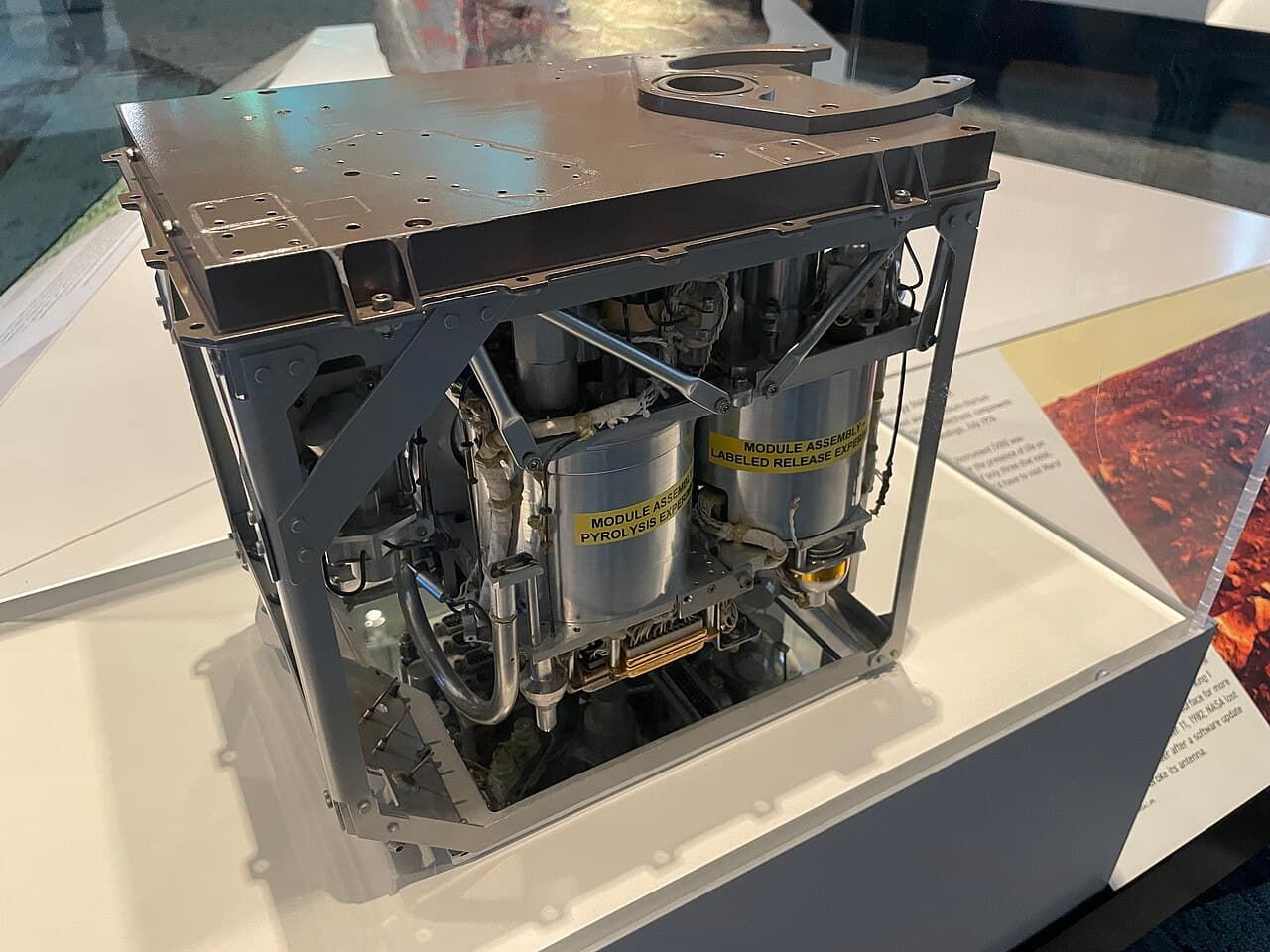
The Viking biology package cost about $59 million, more than the $41 million gas chromatograph mass spectrometer beside it, and it gave the project years of trouble. Three separate life-detection experiments had to fit inside a container smaller than 0.027 cubic meters, about a cubic foot, weighing about 15.5 kg and holding some 40,000 parts, half of them transistors, along with about 50 valves, sealed nutrient ampules, bottled radioactive gases, small ovens and a xenon arc lamp standing in for the Sun. TRW built it under Martin Marietta and watched the estimate climb from $13.7 million. The reason for the complexity was that nobody could agree on what life would do. Norman Horowitz assumed martian organisms would build organic matter out of the atmosphere, so his pyrolytic release experiment offered them nothing but carbon-14 labeled carbon dioxide, carbon monoxide and light, then baked the soil afterwards to see whether any carbon had been fixed. Vance Oyama assumed they would breathe, so his gas exchange experiment watched the headspace over a soil sample for gases appearing or vanishing. Gilbert Levin assumed they would eat, so his labeled release experiment fed the soil a dilute broth of simple organic compounds with every carbon atom radioactively tagged, and listened for radioactive gas coming back out. Harold Klein led the team. Klaus Biemann's gas chromatograph mass spectrometer, a separate instrument entirely, was there to say what organic molecules the soil contained. Everyone treated it as the court of appeal.
For about a week in the summer of 1976 it looked as though the oldest question in planetary science had just been answered. Then it went wrong. A shroud locking pin stuck in the sampler arm on 22 July and took five days from landing to shake out. On 28 July 1976, sol 8 and on schedule, soil reached the instruments. On 29 July the gas exchange experiment merely humidified its sample, without wetting it, and oxygen poured off: about fifteen times more than any known source could account for, still rising a day later. On 30 July at about 1:45 p.m. PDT, roughly 20:45 UTC, two drops of Levin's nutrient went onto martian soil, and the beta counter climbed steeply and leveled off near 10,000 counts per minute. On Earth, that curve is what a living soil does. On 31 July Klein stood up in the Von Karman Auditorium at JPL and told reporters that the labeled release was producing something that to a first approximation looked like a biological signal, then spent the rest of the briefing explaining why that was not the same as finding life. Levin, asked directly, said it was far too early to call it positive. On 7 August Horowitz reported that his experiment had fixed carbon too. Three experiments, three different definitions of life, three signals.
What broke the case was the instrument that was not looking for life at all. The GCMS analyzed its first sample on 6 August at 200 C and again on 12 August at 500 C, and found no organic compounds of martian origin at detection limits of a few parts per billion. Later runs at both sites agreed. That mattered because of a simple terrestrial expectation: living communities leave behind a hundred to ten thousand times more organic debris than the cells themselves weigh, so a soil with organisms in it should be visibly dirty with carbon. By that yardstick Mars looked barer than Antarctic desert soil, which the GCMS could have read comfortably. The biology results then began to look explicable without biology. The labeled release gave nothing on a second injection, exactly as it would if a finite chemical oxidant had been used up. About half the gas exchange oxygen release survived heating to 145 C for three and a half hours, which is not how a population adapted to a planet that rarely climbs above freezing should behave. The pyrolytic release survived 90 C for two hours untouched and needed 175 C to knock it down by 90%, and Horowitz concluded that a reaction that thermostable was unlikely to be biological. Klein's 1978 summary in Icarus put it plainly: some results fit biology, most did not, and several classes of oxidant in the soil would account for nearly everything. That became the textbook answer for thirty years.
The labeled release never fitted the chemical answer as neatly as the others, which is why it is still argued about. Levin and Straat listed what their active agent did: it responded like a viable terrestrial soil, it was destroyed by 3 hours at 160 C, it was cut to roughly 15% and 30% of the active response by 3 hours at only about 51 C and 46 C, it was destroyed completely by 141 sols of storage in the dark at 10 to 26 C, it was not created by ultraviolet exposure because soil taken from under a rock responded just as strongly, and it was present at two sites 6,500 km apart. Chemical oxidants are not usually fussy about the difference between 10 C and 46 C. Levin argued this to the end of his life, in a 2016 review in Astrobiology with Straat and in a Scientific American opinion piece on 10 October 2019 calling for a panel of expert scientists to review the labeled-release data alongside everything learned since. Straat died in October 2020, Levin in July 2021. It is worth being precise about what he was and was not claiming: not that life had been proved, but that biology remained a live explanation which had been discarded on the strength of an instrument that could not have detected a million bacteria per gram of soil, a limitation Klein himself had pointed out.
Then Mars changed the question. In 2008 the Phoenix lander found perchlorate at 0.4 to 0.6% by mass in arctic soil, published in Science in July 2009 and confirmed since by Curiosity. Perchlorate decomposes when heated and releases reactive oxygen, so a martian sample heated to 500 C inside a GCMS oven could incinerate its own organics on the way to being measured. Navarro-González and colleagues argued in 2010 that the chloromethane and dichloromethane Viking saw were made in the oven from martian ingredients rather than left over from cleaning fluid; Biemann and Bada disputed it hard, and the exchange is still worth reading on both sides. Curiosity has since found chlorobenzene and dichloroalkanes at Gale crater and organic matter preserved in three-billion-year-old mudstone, and a 2018 reanalysis found chlorobenzene in Viking's own Utopia data at 0.08 to 1.0 ppb. Quinn's 2013 demonstration that irradiated perchlorate yields hypochlorite, which oxidizes the labeled release nutrient with roughly the right kinetics and dies at 160 C, gave the chemical camp a mechanism that finally fitted the thermal controls. McKay, Quinn and Stoker's 2025 reassessment in Icarus argues that perchlorate accounts for all nine Viking puzzles with no biology required, while stating openly that one of the nine, the loss of activity after months in storage, has not been reproduced in a laboratory within the perchlorate model; their answer to it, calcium hypochlorite decomposing out of a metastable state, is offered as reasonable rather than demonstrated. That is where it stands in September 2026: a strong, specific, non-biological explanation that most of the field accepts, one control whose chemical explanation has never been reproduced in a laboratory, a fresh 2026 paper by Benner, Schulze-Makuch, Spacek and Abraham arguing the whole 1976 framing was wrong, and no metabolic life-detection experiment flown to Mars in the fifty years since to settle it.
Mission facts
What flew
One integrated biology instrument on each of the two Viking landers, holding three separate life-detection experiments: pyrolytic release (PR), labeled release (LR) and gas exchange (GEx). The gas chromatograph mass spectrometer (GCMS) was a fourth, separate instrument and was not a life-detection experiment, though everyone treated it as the tiebreaker.↗
The instrument, and what it cost
About 15.5 kg in a container of less than 0.027 cubic meters, about a cubic foot, holding some 40,000 parts (half of them transistors), about 50 valves, tiny ovens, sealed nutrient ampules, bottled radioactive gases, Geiger counters and a xenon arc lamp. NSSDCA lists 15 kg and 15 W average power; the NASA history gives about 15.5 kg. TRW built it under prime contractor Martin Marietta, having beaten Bendix for the work, and the estimate for the flight instruments and test articles rose from $13.7 million to more than $59 million; by launch, the NASA history records, the GCMS bill read $41 million.↗
Who ran it
Harold P. Klein of NASA Ames was biology team leader. Norman H. Horowitz (Caltech) led pyrolytic release, Gilbert V. Levin (Biospherics, with co-experimenter Patricia Ann Straat) led labeled release, Vance I. Oyama (Ames) led gas exchange. Joshua Lederberg and Alexander Rich were team members. Klaus Biemann (MIT) led the separate molecular analysis team that ran the GCMS.↗
Labeled release: the design
0.115 mL of nutrient injected onto a 0.5 cc soil sample in a 3.5 cc chamber held at 10 plus or minus 2 C. The nutrient held seven substrates (sodium formate, glycine, calcium glycolate, D- and L-alanine, D- and L-lactate) at 2.5 x 10⁻⁴ molar each, 17 carbon atoms in total, every carbon uniformly labeled with carbon-14. Any carbon gas released by metabolism would separate itself from the liquid and register on a beta counter.↗
Labeled release: the result
Radioactivity rose sharply within hours of the first injection and leveled off at about 10,000 counts per minute in Viking 1 cycle 1. Similar positives came from Viking 1 cycle 3 and from Viking 2. A second nutrient injection produced no further gas; instead about 25% of the gas already evolved vanished from the detector, consistent with reabsorption into wetted alkaline soil. McKay, Quinn and Stoker put the implied oxidant level at roughly 1 ppm.↗
Labeled release: the controls
Heating a duplicate sample to 160 C for 3 hours eliminated the response. Heating to about 50 C for 3 hours (51 C in Viking 2 cycle 2, 46 C in cycle 4) reduced the response without eliminating it: the first peak of cycle 2 carried only about 15% as much gas as Viking 2 cycle 1 over an equivalent period, and cycle 4 reached about 30% of the unheated amplitude. Levin and Straat add that cycle 2 also evolved a series of small peaks seen in no other run, which the engineers could not trace to any instrument fault. A sample stored in the dark in the lander's distribution box for about 141 sols at 10 to 26 C gave nothing at all. A sample scooped from under a rock, shielded from ultraviolet light, still responded strongly, which killed the UV-activation hypothesis.↗
Labeled release: how many runs
Nine cycles in total, four at Chryse Planitia and five at Utopia Planitia, at sites about 6,500 km apart (Levin and Straat quote 4,000 miles). The instrument carried only four test cells per lander; the ninth run was improvised by tipping untested soil, collected for the fourth Viking 2 cycle and stored for 84 sols, on top of an already-used sample.↗
Gas exchange: the result
Merely humidifying the soil, without wetting it, released oxygen. McKay, Quinn and Stoker restate the yield as 70 to 700 nanomoles per gram (3 to 35 ppm); Quinn and colleagues (2013) give 70 to 700 nanomoles released from 1 cubic centimeter soil samples. Both cite Oyama and Berdahl (1977), and the two restatements differ in normalization, per gram of soil against per cubic centimeter of soil; Oyama and Berdahl's paper is paywalled and this page has not checked which one is original. At the 31 July 1976 briefing Klein said the first Chryse measurement showed about 15 times more oxygen than known sources could account for, rising another 30% over the next 24 hours; Horowitz, writing in 1977, described the oxygen as increasing about 200-fold in little more than a sol.↗
Gas exchange: the control that mattered
Heating the sample to 145 C for about 3.5 hours left roughly half the oxygen release intact. Oyama and most of the team read a reaction that survives 145 C as inorganic, and attributed it to peroxides or superoxides in the soil decomposing on contact with water vapor.↗
Pyrolytic release: the result
Seven of the nine tests run on Mars gave positive results, all negatives coming from the Utopia site. The quantity of carbon fixed was tiny, enough organic matter for something between 100 and 1,000 bacterial cells, and far below what the GCMS could have seen. Heating to 90 C for nearly 2 hours had no effect on the reaction; heating to 175 C for 3 hours reduced it by nearly 90%. Horowitz concluded that a reaction that survives 90 C is unlikely to be biological.↗
GCMS: what it found
100 mg samples heated in steps to 50, 200, 350 and 500 C. No organic compounds of martian origin at detection limits generally in the parts per billion range. The instrument did register chloromethane at about 15 ppb at the Viking 1 site and dichloromethane at 0.04 to 40 ppb at the Viking 2 site, only in the 500 C runs; in 1977 these were attributed to residues of terrestrial cleaning solvent.↗
GCMS: what it could not have found
Klein noted that the Viking GCMS would not have detected Escherichia coli present at 10 to the 6 cells per gram. The instrument's sensitivity was set for bulk organic matter rather than a sparse population: a soil with a million bacteria in every gram would have looked empty to it. Biemann defended the instrument in 2007, maintaining it reached about 1 ng/g (1 ppb) and that his critics' own apparatus was a thousand times less sensitive (PNAS 104:10310-10313, doi 10.1073/pnas.0703732104).↗
The 2008 discovery that reopened it
NASA's Phoenix lander found 0.4 to 0.6% perchlorate by mass in the soil at its arctic site, published in Science on 3 July 2009 and later confirmed by Curiosity at Gale crater. Perchlorate decomposes exothermically when heated and releases reactive oxygen, so a perchlorate-bearing sample heated to 500 C in an oven can destroy the very organics the oven was meant to detect.↗
The current chemical explanation
Quinn and colleagues showed in 2013 that calcium perchlorate exposed to ionizing radiation yields hypochlorite, trapped oxygen and chlorine dioxide, and that hypochlorite added to the labeled-release nutrient reproduces the observed kinetics and is destroyed by 160 C. McKay, Quinn and Stoker (Icarus, 2025) argue that perchlorate can explain all nine of the Viking puzzles with no biological component required. On the one that resists them, the loss of labeled-release activity after 141 sols of storage at 10 to 26 C, they state plainly that it has not been duplicated in the laboratory within the perchlorate model, and offer instead a proposal: that the labeled-release reactant was calcium hypochlorite decomposing out of a metastable state under storage conditions they call poorly constrained.↗
Organics on Mars, found later
Curiosity's SAM instrument identified chlorobenzene at 150 to 300 parts per billion by weight, plus C2 to C4 dichloroalkanes up to 70 ppbw, in the Cumberland drill sample at Gale crater (Freissinet et al., 2015), and in 2018 reported thiophenic, aromatic and aliphatic organic matter preserved in three-billion-year-old mudstone (Eigenbrode et al., Science, doi 10.1126/science.aas9185). A 2018 reanalysis of Viking's own Utopia GCMS runs found chlorobenzene at 0.08 to 1.0 ppb in the 350 C and 500 C heatings, with a chlorine component the authors call martian and a carbon component consistent with a martian origin, though instrument contamination could not be fully excluded.↗
The dissent, and the people
Levin never accepted the chemical reading, restating the case with Straat in Astrobiology in October 2016 and in a Scientific American opinion piece on 10 October 2019. Straat died on 23 October 2020, aged 84; Levin died on 26 July 2021, aged 97. The argument outlived them: Benner, Schulze-Makuch, Spacek and Abraham argued in Astrobiology in February 2026 that the 1976 interpretation was mistaken and propagated for fifty years, and the journal's Viking anniversary supplement, published 30 June 2026, carries a first-hand perspective on the labeled release by Jon J. Calomiris (Astrobiology 26, 1_suppl, doi 10.1177/15311074261463026).↗
Mission timeline
- 20 Jul 1976Viking 1 lands in western Chryse Planitia at 11:53:06 UTC. A shroud locking pin in the sampler arm sticks during the sol 2 deployment on 22 July and takes five days from landing to shake out; photographs on sol 5, 25 July, show it lying on the ground. Soil sampling still goes ahead on sol 8 as planned.
- 29 Jul 1976The gas exchange experiment humidifies its sample. Oxygen appears in quantities that known sources cannot account for, and keeps rising for a day. The soil is chemically alive in some way nobody predicted.
- 30 Jul 1976At about 1:45 p.m. PDT (roughly 20:45 UTC) on Sol 10, two drops of carbon-14 nutrient go onto martian soil in the labeled release cell. Counts climb steeply and settle near 10,000 per minute. On Earth that curve means metabolism.
- 31 Jul 1976Harold Klein tells the press at JPL that the labeled release is measuring something that to a first approximation looks like a biological signal, and immediately warns that the soil's chemical activity means it must be viewed very carefully. Levin says it is far too early to call it positive.
- 6 to 12 Aug 1976The GCMS runs its first sample, at 200 C on 6 August (Sol 17) and again to 500 C on 12 August. No organic compounds of martian origin, at detection limits of a few parts per billion. Project scientist Gerald Soffen took it as the end of the argument.
- 3 Sep 1976Viking 2 lands in Utopia Planitia at 22:37:50 UTC (the confirming signal reached Earth at 22:58:20 UTC), about 6,500 km from Viking 1. Its labeled release repeats the Chryse result, including a strong positive from soil scooped out from under a rock, where ultraviolet light had not reached for a very long time.
- Sep 1977The Journal of Geophysical Research devotes an issue to the Viking results, publishing all four data sets side by side. Klein's summary in Icarus the following year concludes that some findings fit biology but most are inconsistent with a biological basis.
- 3 Jul 2009Science publishes the Phoenix lander's detection of 0.4 to 0.6% perchlorate by mass in martian soil. A powerful oxidizer that destroys organics when heated had been sitting in the ground all along, unmeasured at either Viking site.
- 2010 to 2011Navarro-González and colleagues reanalyze the Viking GCMS data and argue the chlorinated compounds were made in the oven from martian perchlorate and martian organics, and were not residues of cleaning fluid. Biemann and Bada publish a sharp comment; the authors reply; a correction is issued that does not change the conclusion.
- Jun 2013Quinn and colleagues show that irradiated calcium perchlorate produces hypochlorite, which reacts with the labeled-release nutrient to release carbon dioxide with roughly the right kinetics and is destroyed at 160 C. Curiosity's SAM team reports its own evidence for perchlorate at Gale crater later the same year (Glavin et al., JGR Planets 118:1955-1973).
- 26 Jul 2021Gilbert Levin dies at 97, still arguing that his instrument detected martian life. Patricia Ann Straat, who ran the experiment with him and co-authored the case for it, had died on 23 October 2020 at 84.
- May 2025McKay, Quinn and Stoker publish a fifty-year reassessment in Icarus (vol 431, article 116466; online since 30 January 2025), concluding that perchlorate chemistry explains all nine Viking puzzles with no biology required, while conceding that one of them, the loss of activity after 141 sols in storage, has never been reproduced in the laboratory. In February 2026 Benner, Schulze-Makuch, Spacek and Abraham publish the opposite reading in Astrobiology.
A filled dot marks something that physically happened. A hollow one marks an announcement, a naming or a target.
In pictures
Tap a photo to enlarge.
Sources
- NSSDCA: Viking 1 Lander biology experiment, GEX/LR/PR (1975-075C-03), archived
- NASA SP-4212, On Mars: Exploration of the Red Planet 1958-1978, ch. 11
- McKay, Quinn and Stoker, The Viking biology experiments on Mars revisited, Icarus 431:116466, May 2025 (doi 10.1016/j.icarus.2025.116466)
- Levin and Straat, The Case for Extant Life on Mars and Its Possible Detection by the Viking Labeled Release Experiment, Astrobiology 16(10):798-810, 2016
- Horowitz, Hobby and Hubbard, Viking on Mars: the carbon assimilation experiments, JGR 82(28):4659-4662, 1977
- Oyama and Berdahl, The Viking gas exchange experiment results from Chryse and Utopia surface samples, JGR 82(28):4669-4676, 1977
- Biemann et al., The search for organic substances and inorganic volatile compounds in the surface of Mars, JGR 82(28):4641-4658, 1977
- Hecht et al., Detection of perchlorate and the soluble chemistry of martian soil at the Phoenix lander site, Science 325(5936):64-67, 3 July 2009
- Navarro-González et al., Reanalysis of the Viking results suggests perchlorate and organics at midlatitudes on Mars, JGR Planets, 2010
- Quinn et al., Perchlorate radiolysis on Mars and the origin of martian soil reactivity, Astrobiology 13:515-520, 2013
- Guzman, McKay and Quinn, Identification of chlorobenzene in the Viking GCMS data sets, JGR Planets 123:1674-1683, 2018
- Benner, Schulze-Makuch, Spacek and Abraham, Viking Mars, Now 50 Years Old, Still Needs a Scientific Analysis, Astrobiology 26(2):148-153, Feb 2026
- Calomiris, NASA Viking Mission: A Perspective of the Labeled Release Biological Experiment on Mars, Astrobiology 26(1_suppl), 30 June 2026
- Glavin et al., Evidence for perchlorates and the origin of chlorinated hydrocarbons detected by SAM at the Rocknest aeolian deposit in Gale Crater, JGR Planets 118:1955-1973, 2013
- NSSDCA: Viking 2 Orbiter (1975-083A), archived 20 Jul 2025
- NASA SP-4212, On Mars: Exploration of the Red Planet 1958-1978, ch. 10
- NASA Astrobiology, In Memoriam, Dr. Gil Levin, 30 July 2021
- Patricia Ann Straat, PhD, Astrobiologist, March 28, 1936 to October 23, 2020, Astrobiology 20(12):1389, December 2020
- Levin, I'm Convinced We Found Evidence of Life on Mars in the 1970s, Scientific American, 10 October 2019
Facts on this page were verified on 24 September 2026. Where sources disagree, the disagreement is stated rather than resolved silently.