Life detection: the missions NASA did not fly
NASA · United States · Program · 1976 · The long occupationCancelled
One life-detection payload has flown to Mars, Viking's in 1976. The Astrobiology Field Laboratory and Icebreaker were studied and never started, and as of September 2026 the next Discovery call is not expected before 2028.
TL;DR· 15 min read
NASA has flown one dedicated life-detection payload to Mars, the Viking biology instrument of 1976, and nothing like it since. The Astrobiology Field Laboratory was designed on paper twice and priced at 1.55 billion dollars, then disappeared from the plan with no cancellation notice anyone can find. Icebreaker went to the Discovery programme in 2015 and 2019, was rated Category II and selectable, and was not chosen. The next Discovery call is not expected before 2028.
This is an entry about absence. Since the Viking landers ran their three biology experiments in 1976, NASA has repeatedly studied, costed and been offered missions whose stated purpose was to look for life on Mars, and has flown none of them. Two lines dominate the record between 2004 and 2019. The Astrobiology Field Laboratory was a laboratory rover that NASA's own analysis group designed on paper twice, priced at 1.55 billion dollars, and then quietly dropped. Icebreaker was a small ice-drilling lander that a team at NASA Ames built prototypes for, tested at Mars-analogue field sites between 2016 and 2019, and offered to the Discovery programme twice without being selected. Neither was cancelled in a press release. Both simply stopped appearing in the plan.
- 1dedicated life-detection payload design NASA has flown to Mars, on both Viking landers in 1976
- 2Discovery competitions Icebreaker entered, in 2015 and 2019, without being selected
- $1.55bnthe Astrobiology Field Laboratory's own 2006 cost estimate for a 2013 launch
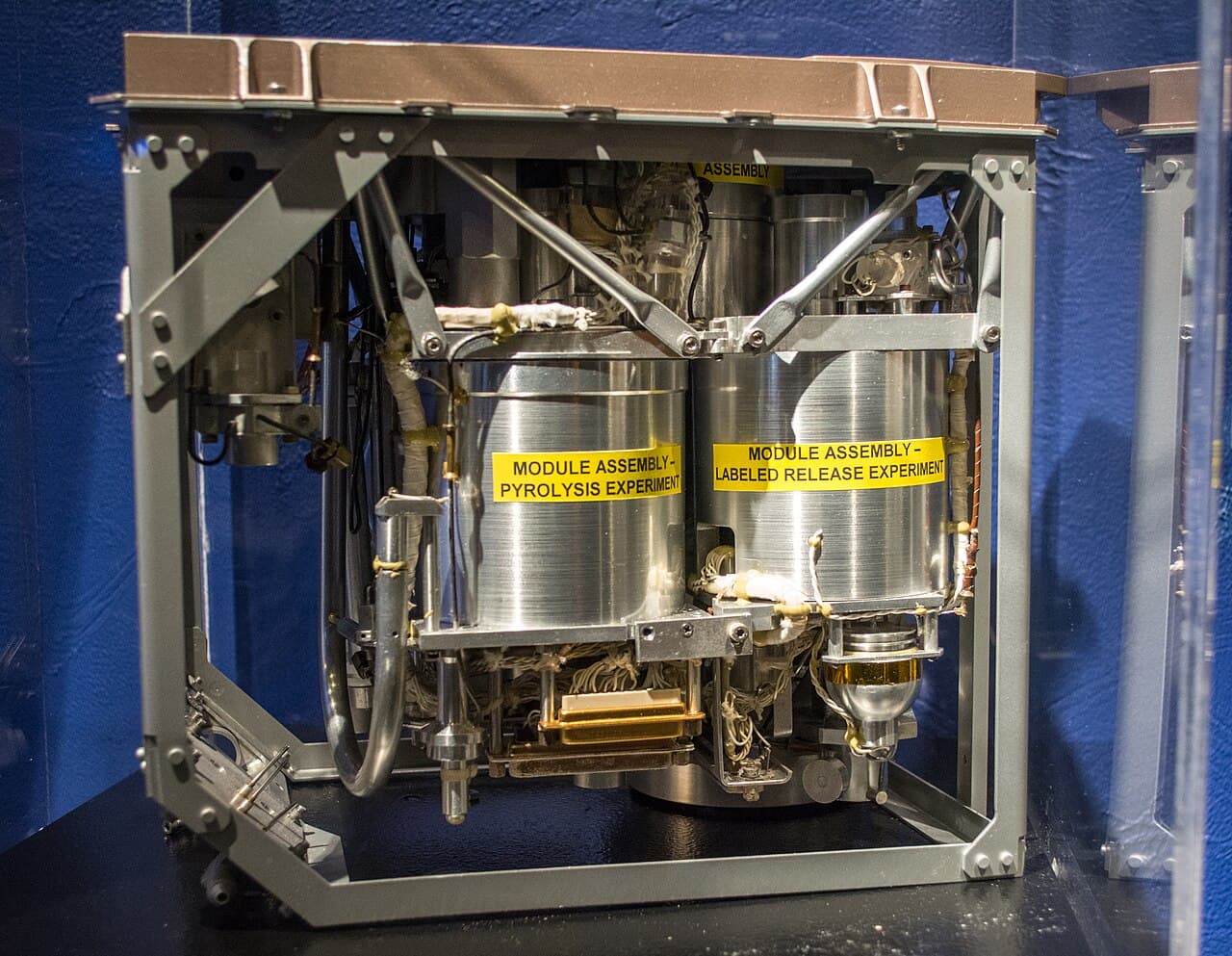
The Viking landers did the hardest thing first. In the summer of 1976, on the first two spacecraft ever to work on the Martian surface, NASA ran three simultaneous biology experiments looking for metabolism in a scoop of soil. Pyrolytic release watched for carbon fixation from labelled CO2 and CO. Labelled release added labelled nutrients and listened for radioactive gas coming back. Gas exchange measured whether an incubated sample produced or consumed CO2, nitrogen, methane, hydrogen or oxygen. Samples were heat-sterilised and rerun as controls. All three returned signals. The fourth instrument, a gas chromatograph mass spectrometer, found essentially no organic molecules at all, and that absence is what settled the argument for most of the field: no organics, no life, and the signals were unfamiliar soil chemistry. Half a century later that reading has been partly undone, because Phoenix found perchlorate in 2008 and laboratory work since has shown that heating perchlorate-bearing soil can destroy the very organics an instrument is heating it to detect. The scientific case for going back with better instruments has been strong for close to twenty years. The programmatic record of what NASA then did about it is the subject of this entry, and it is mostly a record of studies that ended without a decision.
The Astrobiology Field Laboratory is the clearest case, and its origin is the part usually left out. It was not born from a scientific priority list. The National Research Council's 2007 astrobiology strategy states plainly that AFL's origins were more programmatic than scientific: in 2001 MEPAG had been told to lay out Mars pathways under explicit instruction from the Office of Management and Budget that at least one of them contain no sample return, and AFL was what a serious in situ answer looked like if samples were never coming home. That did not make it a bad mission. A science steering group under Andrew Steele and David Beaty worked it twice, presenting findings in April 2004 against a possible 2013 launch and completing a 72-page report on 26 September 2006. The design was an MSL-derived rover carrying a real laboratory, radioisotope-powered, able to drive 10 to 15 km to a chosen site anywhere from 85 north to 60 south, returning 1 to 3 gigabits a sol through a Mars telecom orbiter. Its payload rule was that no single measurement counts: at least three mutually confirming astrobiology measurements were required before anything could be claimed. The group priced it at 1.55 billion dollars for 2013 and 1.78 billion for 2018.
Then it disappeared. There is no cancellation notice for the Astrobiology Field Laboratory that we could find, no dated decision, no named official. In 2006 its own report described the schedule as an AFL flight as early as 2016 with sample return some time after 2020. In 2007 the NRC still listed it as one of three candidates for the 2016 slot. By March 2011, when the planetary decadal survey Vision and Voyages was published, the words Astrobiology Field Laboratory do not appear in the document at all. We checked every chapter. What the decadal recommended instead was a three-step sample return campaign starting with a caching rover, the Mars Astrobiology Explorer-Cacher, and that rover did not survive either: in April 2011, with NASA saying the decadal's 2.5 billion dollar target was still too steep, NASA and ESA abandoned the twin-rover plan and merged MAX-C's objectives into a single joint rover, and the caching objective surfaced years later in Perseverance. This is how large unfunded concepts usually die in the American planetary programme. Nobody kills them. The architecture is redrawn around a different top priority, the slot they were aimed at is given to something else, and the next decadal survey simply does not list them. The practical consequence is that the mission NASA designed to look for life while sample return was politically impossible was dropped in favour of sample return, which as of 2026 has still not happened.
Icebreaker took the other route, the competitive one, and lost repeatedly on a technicality of arithmetic rather than merit. Conceived in 2006 by Chris McKay's group at NASA Ames as a Phoenix follow-on, it was a small solar-powered lander that would drill into ice-cemented ground and look directly for amino acids and fatty acids, the molecules that are common to all terrestrial life. The 2012 point design targeted a December 2018 launch, a landing between 60 and 70 north, 90 days of summer operation and a 1 metre drill. In the current version it would land in the mid-latitudes and drill 2 metres with Honeybee Robotics' TRIDENT. A Discovery proposal was prepared in 2010 and not submitted. Proposals went in for the 2015 and 2019 rounds and neither won, though the team records that in 2019 the mission was rated Category II and selectable, which is to say good enough to fly and not chosen. Discovery is a small-mission line with a cost cap near 500 million dollars and roughly five selections a decade against dozens of proposals, so being selectable and being selected are very different things. The drill itself has now operated on another world, reaching the Moon aboard IM-2 on 6 March 2025 and working for about ten hours before the tipped-over lander lost power.
The position in September 2026 is worse than at any point in this story. NASA's planetary science division received 2.54 billion dollars for fiscal 2026, well above the 1.89 billion the administration requested but below the 2.72 billion it had in each of the two preceding years, and division director Louise Prockter told the community on 16 March 2026 that not everything could continue. Mars sample return was not funded in that bill at all. The Mars Exploration Program has since been directed to absorb the Skyfall helicopter payload on the Space Reactor-1 nuclear propulsion demonstration inside its own budget, largely against a Mars Future Missions line holding about 110 million dollars, which the group that speaks for the Mars science community described in June 2026 as effectively eliminating any new developments or missions until after that launch. In July 2026 the same group wrote that the planned Mars activities do not reflect either NASA's own Mars Future Plan or decadal survey priorities, and that the United States faces a ten-year gap in competed science mission and payload opportunities at Mars. Icebreaker's next possible call, a Discovery announcement of opportunity, is not expected before 2028. Fifty years after Viking, the count of flown NASA life-detection payloads at Mars remains one.
Mission facts
What actually flew
One life-detection payload has operated on Mars. Each Viking lander carried a biology instrument holding three separate experiments: pyrolytic release, which looked for fixation of carbon-14 labelled CO2 and CO with and without simulated sunlight; labelled release, which added carbon-14 labelled nutrients and watched for radioactive gas; and gas exchange, which measured production or uptake of CO2, N2, CH4, H2 and O2 from an incubated soil sample. Some samples were heat-sterilised and rerun as controls.↗
The instrument that complicated everything
Alongside the biology package, each Viking lander carried a gas chromatograph mass spectrometer that heated soil and looked for organic compounds across masses 12 to 200, taking a spectrum every 10 seconds for the 84 minutes of the chromatogram. Its near-null result for organics is the reason most scientists read the biology results as chemistry rather than life.↗
Where the Astrobiology Field Laboratory came from
Not from a scientific priority list. The 2007 National Research Council report An Astrobiology Strategy for the Exploration of Mars states that AFL's origins were more programmatic than scientific: in 2001 MEPAG was asked to build Mars pathways under explicit instructions from the Office of Management and Budget to devise at least one that did not include sample return. AFL, the report says, was conceived as a scientific response to an anticipated budgetary and political climate that would preclude returning samples in the decade 2011 to 2020.↗
AFL, first pass
On 22 April 2004 Andrew Steele of the Carnegie Institution and David Beaty of JPL presented the findings of the AFL Science Steering Group on behalf of a group of about twenty scientists and engineers, working to the assumption that AFL had to be ready to launch as early as the 2013 opportunity. The group defined the mission's objective as investigating one high-habitability environment and beginning, not completing, the process of life detection.↗
AFL, final report
The AFL Science Steering Group's 72-page final report is dated 26 September 2006, co-chaired by Steele and Beaty. It set the payload strategy as four functions: acquire the right samples, know the geological context, identify the best place on the sample, and make at least three mutually confirming astrobiology measurements, on the grounds that no single observation would be conclusive.↗
AFL as designed, and what it would have cost
An MSL-derived rover carrying an in situ laboratory. The engineering concept assumed launch in 2013 or 2018, radioisotope power sized at about 50 watts electric, go-to mobility of 10 to 15 km, landing anywhere from 85 N to 60 S below 2.5 km MOLA elevation inside a 10 by 10 km three-sigma ellipse, and a Mars telecom orbiter for a 1,024 kbps relay carrying 1 to 3 gigabits of science a sol. English Wikipedia gives a 450 kg maximum launch mass; we could not find that figure in the steering group report. The steering group's own costing exercise returned 1.55 billion dollars in real-year dollars for a 2013 mission and 1.78 billion for a 2018 mission, of which roughly 200 million was instruments and infrastructure and roughly 500 million the rover subsystems.↗
The slot AFL was aimed at
By 2006 the report records the schedule as an AFL flight as early as 2016 with sample return some time after 2020. The 2007 NRC review lists NASA's architecture through 2016 as Phoenix in 2007, MSL in 2009, a second Scout in 2011, a science and telecommunications orbiter in 2013, and in 2016 either AFL, two Mid Rovers, or a long-lived lander network. In August 2007 Luther Beegle and colleagues published a full concept in Astrobiology under the title A concept for NASA's Mars 2016 astrobiology field laboratory.↗
How AFL ended
With no announcement we can find. It never received a new start, and the phrase Astrobiology Field Laboratory does not appear anywhere in the 2011 planetary decadal survey Vision and Voyages, which we searched chapter by chapter. What the decadal did recommend for Mars was a three-step sample return campaign beginning with a caching rover, the Mars Astrobiology Explorer-Cacher. MAX-C did not survive either. On 18 April 2011 NASA's planetary science division director Jim Green told the NASA Advisory Council's planetary science subcommittee that NASA and ESA had returned to the drawing board in early April and would combine MAX-C's objectives with Europe's ExoMars rover in a single vehicle. The decadal had endorsed MAX-C only if its 3.5 billion dollar independent estimate could be cut to 2.5 billion, which SpaceNews reported NASA still considered too steep.↗
Where Icebreaker came from
Brian Glass and colleagues at NASA Ames date the concept to 2006, as a follow-on to Phoenix designed to penetrate the ice-cemented ground that stopped the Phoenix scoop. The premise, as the team put it in 2012, is that ground ice may preserve organic molecules for extended periods, so anything preserved there is worth drilling for.↗
Icebreaker, the 2012 point design
A near-copy of the Phoenix lander built by Lockheed Martin, targeted at the 2018 opportunity: launch December 2018, a Type II cruise of nine months, arrival over the northern plains in August 2019, landing between 60 N and 70 N, 90 days of solar-powered operation in the polar summer, and a drill reaching 1 metre. The core instrument was SOLID, an immunoassay microchip, backed by a Phoenix-derived wet chemistry laboratory, an alpha proton X-ray spectrometer, a Phoenix-derived stereo imager and a laser desorption mass spectrometer.↗
The proposal that was never sent
Glass and colleagues record that a 2010 Discovery proposal was prepared but not submitted. Their abstract gives no reason and we found none elsewhere. Mars had only recently become eligible: the 2011 decadal notes that NASA did not intend to continue the Mars Scout line beyond MAVEN and had folded principal-investigator-led Mars missions into Discovery instead.↗
Discovery, 2015
NASA's Discovery programme asked for proposals in November 2014 and reviewed 27 submissions. On 30 September 2015 it named five for concept studies, all of them aimed at Venus, near-Earth objects or asteroids, each funded at 3 million dollars against a mission cost of roughly 500 million excluding launch. Icebreaker was not among them.↗
Discovery, 2019
Icebreaker was submitted again under the 2019 Discovery announcement of opportunity. Glass and colleagues state that in 2019 the mission was rated as a Category II and selectable, meaning it passed the bar for selection on merit. On 13 February 2020 NASA picked four other concepts for nine-month studies, and in 2021 chose two of those. Icebreaker has not been selected in any round.↗
Icebreaker as it stands in 2024
In the current design the lander would come down in the ice-rich mid-latitudes rather than the far north and drill to 2 metres using Honeybee Robotics' TRIDENT rotary-percussive drill. No Icebreaker spacecraft has flown, though the drill has since worked on the Moon. The analytical payload is ChROMA, a mass spectrometer drawing on MSL's SAM and ExoMars's MOMA, which would measure amino acid abundance and enantiomeric excess plus fatty acid structure, together with SOLID from the Centro de Astrobiologia in Spain.↗
The drill has now flown, but not to Mars
TRIDENT reached the Moon on 6 March 2025 aboard Intuitive Machines' IM-2 lander as part of NASA's PRIME-1 payload. The lander came to rest on its side inside a crater and the mission lasted roughly 10 hours instead of 10 days, but NASA reported that TRIDENT and its companion mass spectrometer both started up and performed.↗
The next opportunity
At NASA's planetary science town hall during the Lunar and Planetary Science Conference on 16 March 2026, division director Louise Prockter said the agency expects a New Frontiers announcement of opportunity in 2027 and that the Discovery programme will not seek proposals before 2028. Any further Icebreaker proposal therefore has no call to answer before 2028.↗
Mission timeline
- 20 Jul to 3 Sep 1976Viking 1 and Viking 2 land, each carrying three biology experiments and a gas chromatograph mass spectrometer. The biology results are ambiguous, the organics result is nearly null, and most of the field concludes that no organics means no life. Science News, writing fifty years later, describes the European Rosalind Franklin rover as aiming to make the first life detection measurements since Viking.
- 22 Apr 2004Andrew Steele and David Beaty present the findings of the Astrobiology Field Laboratory Science Steering Group, working to an assumption that AFL must be ready for the 2013 launch opportunity.
- 26 Sep 2006The AFL Science Steering Group's 72-page final report is completed. It costs the mission at 1.55 billion dollars for 2013 or 1.78 billion for 2018, and records the current schedule as an AFL flight as early as 2016.
- 2006Chris McKay's group at NASA Ames conceives Icebreaker as a follow-on to Phoenix, aimed at the ice-cemented ground the Phoenix scoop could not break.
- 8 Jan 2007NASA picks MAVEN and The Great Escape from 26 Mars Scout proposals, and separately funds two life-detection instrument studies at 1.5 million dollars in total: the Urey Mars Organic and Oxidant Detector under Jeffrey Bada and the Mars Organic Molecule Analyzer under Luann Becker. Urey never flew. MOMA was built and is on the Rosalind Franklin rover, which had not launched as of September 2026.
- Aug 2007Luther Beegle and colleagues publish A concept for NASA's Mars 2016 astrobiology field laboratory in Astrobiology, volume 7 issue 4, pages 545 to 577. It is the fullest published statement of a mission that was already losing its slot.
- 2007The National Research Council's astrobiology strategy for Mars records that AFL's origins were more programmatic than scientific, tracing it to a 2001 Office of Management and Budget instruction that MEPAG devise at least one Mars pathway with no sample return.
- Mar 2011Vision and Voyages, the planetary decadal survey for 2013 to 2022, makes a three-step Mars sample return campaign the highest Mars priority, notes that NASA does not intend to continue the Mars Scout line beyond MAVEN, and folds principal-investigator-led Mars missions into Discovery. The Astrobiology Field Laboratory is not mentioned anywhere in the report.
- Apr 2011The caching rover that replaced AFL in the plan, the Mars Astrobiology Explorer-Cacher, is abandoned as a separate vehicle. NASA and ESA merge its objectives with Europe's ExoMars rover into one joint rover on cost grounds; Jim Green briefs the NASA Advisory Council on 18 April. The caching objective resurfaces in Mars 2020 and the Perseverance rover.
- 30 Sep 2015NASA names five Discovery concept studies out of 27 proposals. All target Venus, near-Earth objects or asteroids. Icebreaker is not selected.
- 13 Feb 2020NASA selects four Discovery concept studies from the 2019 round. Icebreaker, rated Category II and selectable, is not among them, and NASA picks two of the four in 2021.
- 16 Mar 2026At the LPSC planetary science town hall, NASA planetary science division director Louise Prockter says the division is running about 200 million dollars below its 2025 funding, that hard strategic choices are coming, and that Discovery will not seek proposals before 2028.
A filled dot marks something that physically happened. A hollow one marks an announcement, a naming or a target.
In pictures
Tap a photo to enlarge.
Sources
- NSSDCA experiment record: Viking Lander 1 Biology (1975-075C-03)
- NSSDCA experiment record: Viking Lander 1 Molecular Analysis, the gas chromatograph mass spectrometer (1975-075C-04), archived 16 Dec 2024
- Steele, Beaty et al., The Astrobiology Field Laboratory: final report of the MEPAG AFL Science Steering Group, 26 September 2006, 72 pp (archived MEPAG copy, .doc)
- Steele and Beaty, Findings of the Astrobiology Field Lab Science Steering Group, presentation version, 22 April 2004 (archived MEPAG copy)
- National Research Council, An Astrobiology Strategy for the Exploration of Mars (2007)
- National Research Council, Vision and Voyages for Planetary Science in the Decade 2013-2022 (2011)
- Beegle, Wilson, Abilleira, Jordan and Wilson, A concept for NASA's Mars 2016 astrobiology field laboratory, Astrobiology 7(4):545-577, August 2007
- McKay et al., The Icebreaker Life Mission to Mars, Concepts and Approaches for Mars Exploration (LPI, 2012), abstract 4091
- Glass, Heldmann, McKay, Stoker and Davila, The Icebreaker Mars Mission, Mars Polar Conference 2024 (NASA NTRS)
- Glass et al., The Icebreaker Life Mission, 45th COSPAR Scientific Assembly 2024 (NASA NTRS)
- NASA news release, 30 September 2015
- SpaceNews (18 March 2026): NASA grappling with planetary science funding shortfall
- Science News (16 June 2026): NASA seems to be backing away from hunting for life on Mars
- NASA release 07-03, 8 January 2007: MAVEN and The Great Escape selected
- NASA news release, 13 February 2020
- NASA (29 April 2025): NASA's lunar drill technology passes tests on the Moon
- SpaceNews (18 April 2011): U.S., Europe plan single-rover Mars mission for 2018
- Ezell and Ezell, On Mars: Exploration of the Red Planet 1958-1978 (NASA SP-4212, 1984), ch. 11 (archived)
- NASA news release, 2 June 2021: DAVINCI+ and VERITAS chosen from the four Discovery 2019 concepts
- The Planetary Society (15 January 2026): FY2026 NASA budget, Planetary Science Division 2,541.2 million dollars enacted against a 1,891.5 million request
- The Planetary Society: NASA's FY 2025 budget (Planetary Science Division 2,716.7 million dollars enacted in FY2024)
- MEPAG memo on the Mars Exploration Program budget and Skyfall, 17 June 2026 (Astrobiology.com)
- MEPAG statement of concerns on the Mars Exploration Program, July 2026 (Astrobiology.com, 6 July 2026)
- ESA: ExoMars (the Rosalind Franklin rover targets launch in 2028)
Facts on this page were verified on 24 September 2026. Where sources disagree, the disagreement is stated rather than resolved silently.