Mars 5M
USSR · Soviet Union · Sample return · 1973 · The Viking yearsCancelled
Cancelled with flight vehicles already in manufacture. Russian sources close this Soviet sample return on 17 November 1977, the week its chief designer lost his job; Perminov, who worked on it, dates the end to 1978.
TL;DR· 17 min read
Mars 5M got closer to being built than any other cancelled Soviet Mars mission: by the second half of 1977 the design documentation was complete, flight vehicles were in manufacture and mock-ups were in test. It was to launch on two Protons a fortnight apart, dock in Earth orbit, land under an eleven-metre umbrella, drill, and return a 7.8 kg capsule that would fall as an artificial meteorite. Russian sources date the closure to 17 November 1977 and Perminov to 1978, and everything already built went for scrap.
Of the Soviet Mars missions that were cancelled, 5M is the one that got closest to being built. It was designed to launch on two Proton rockets a fortnight apart, dock the two halves in Earth orbit, cross to Mars, land under an eleven-metre umbrella, drill, and fly a capsule of Martian soil back into Earth's atmosphere at 12 kilometres per second with no parachute on it at all. By late 1977 there was drawing-office documentation, there were technological mock-ups under test and there were flight articles in assembly. Then it was stopped, and everything already built was scrapped. Why it was stopped is still argued over, and the two best-informed accounts do not agree.
- 17 Nov 1977the date Russian accounts give for the closure, with flight hardware in assembly
- 2Proton launches per spacecraft, docking in Earth orbit; four launches for the pair planned
- 7.8 kgfinal Earth-return capsule, with no parachute: it would arrive as an artificial meteorite
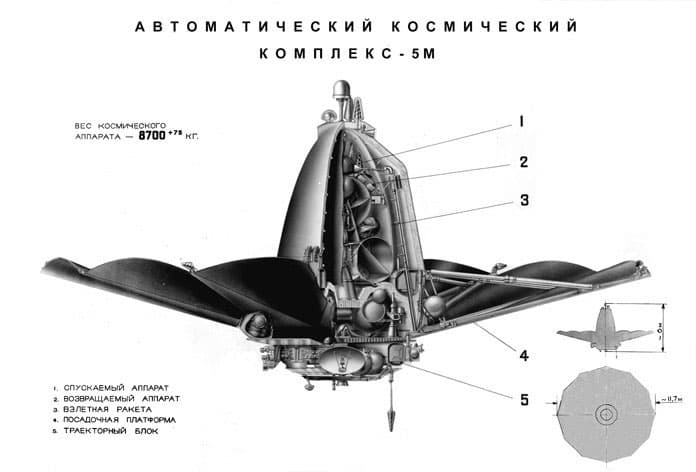
When the N1 died, the Soviet Mars sample return did not die with it. It shrank. Sergei Kryukov, who had taken over at Lavochkin after Babakin's death, proposed in 1973 to rebuild the whole idea around the rocket that actually existed, the Proton, and the project was approved at the beginning of 1974. The trouble was arithmetic. A Proton could put roughly 22 tonnes into low Earth orbit including its Block D upper stage, and no arrangement of that mass gets a lander to Mars, off Mars again and home. So the mission was cut in two. One Proton would launch a fully fuelled Block D fitted with rendezvous and docking gear. A second Proton, a fortnight later, would launch a partially fuelled Block D with the spacecraft on top. The two would find each other in Earth orbit and dock, and then the stages would fire in sequence, the stack turning through 180 degrees between burns, to throw the spacecraft at Mars. V. P. Panteleyev, who took the project over when Perminov withdrew from it in the belief that it was too complex to work, added a refinement: plumb the two Block D stages so propellant could be transferred from one to the other after docking. That single change lifted the spacecraft's allowance from 8,500 kg to 9,135 kg, and the whole design breathed. The mass is worth dwelling on, because four different figures circulate for it and they are not all measuring the same thing.
What that 9,135 kg bought was strange and rather beautiful. The trajectory stage was 1,680 kg; the lander was 7,455 kg, of which 3,190 kg was a two-stage rocket to fly back off the surface. The lander's heat shield had started as a headlight-shaped lifting body, close in concept to an Apollo capsule, flying a guided entry with a pop-up manoeuvre partway down. It was replaced by something simpler and much larger: an umbrella. A rigid metal disc 3 m across would carry thick tubular beryllium spokes sheathed in fibreglass, folded along the vehicle's axis for launch and opened once the spacecraft was clear of Earth. Deployed it would have spanned somewhere between 11 and 12 m, depending on which account you read. Folded it would have been 4.26 m, which is wider than a standard Proton fairing, so a 4.7 m fairing was developed for it. Entry would be ballistic, at 5.7 to 6.35 km/s, at about minus 11.5 degrees, coming down at 2 degrees south, 179.5 degrees east, near the boundary of Elysium Planitia, between an hour and a half and four and a half hours after nightfall. A drill descended from the Luna 24 design would take the sample. And the capsule that would bring it home weighed 7.8 kg, because Vinogradov's idea of sterilising the soil in Mars orbit made a parachute, a landing radar, a battery and a control unit all unnecessary. It would hit Earth's atmosphere at 12 km/s and fall the rest of the way as an artificial meteorite, found by helicopters sniffing for the radioactive source packed inside it.
By the autumn of 1977 this was no longer a study. Lantratov records that the design documentation had been produced, that experimental and flight vehicles were in manufacture and that technological and electrical mock-ups were in test; Russian Wikipedia says the preliminary design had been defended, technological mock-ups built and assembly of flight articles begun; Encyclopedia Astronautica says that by 1978 the spacecraft was in fabrication. Departments at Lavochkin that had been working on Venus and on lunar projects were reassigned wholesale onto it. Two spacecraft were to fly, requiring four Proton launches, and the dates were on the manifest: 30 October and 14 November 1979 in Zak's account, mid-November 1979 in Lantratov's, with Mars arrival in 1980 and the samples due back three years after launch. One caution belongs here. The published architectures do not match. Lantratov describes the orbiter braking into Mars orbit, choosing the landing site from above, relaying for the lander and then rendezvousing and docking with the ascent rocket in Mars orbit. Perminov and Zak describe a final design in which precisely that Mars-orbit rendezvous had been engineered out, the trajectory block flying past after a 200 m/s avoidance burn while the ascent rocket sent the capsule straight home. These are most likely successive variants rather than a contradiction, but no source we found says so.
The cancellation is where this entry has to be careful, because the popular story is tidier than the evidence. That story runs: Soyuz 25 failed to dock with Salyut 6 on 10 October 1977, the Igla rendezvous system was blamed, 5M used an Igla analogue, and on 17 November 1977 the whole thing was closed. Each link needs handling. Soyuz 25 did fail, three times, and came home on 11 October with its propellant gone. But Russian Wikipedia's own article on that flight, quoting the docking hardware's designer Vladimir Syromyatnikov, describes Igla bringing the ship to within 150 m and the final approach being flown by hand, with the probe missing the receiving cone by two or three centimetres on the second attempt, and states that the true cause was never established because the docking unit burned up on re-entry. Russian Wikipedia's article on 5M, meanwhile, carries an unsourced tag on the sentence blaming Igla, and carries a banner saying the article has no references at all. What Lantratov adds is the mechanism that makes the story cohere: the Military-Industrial Commission named Igla's low reliability among the causes, removed the head of NII TP, and recommended stopping work on projects using Igla or its analogues. He adds two further causes that have nothing to do with docking. Kryukov's reorganisation of Lavochkin around this one project had made him enemies inside his own bureau, and Ustinov, who had backed 5M from the Central Committee, had become Minister of Defence in April 1976 and moved away from space.
So who is right about the date? Perminov, the deputy chief designer, says the head institute issued a statement in 1978 on the project's complexity, cost and low probability of success, that Minister Afanasyev discontinued it on that basis, and that Kryukov, saying he was guilty of mismanaging it, resigned. Encyclopedia Astronautica tells the same story and says Afanasyev fired him. Lantratov and Russian Wikipedia say 17 November 1977, and that Kryukov was removed. English Wikipedia, following Brian Harvey's Russian Planetary Exploration, also puts the end at the close of 1977, which makes 1978 the minority date rather than half of an even split. The tiebreaker is not in any Mars source: Kryukov's own biography records his transfer to NPO Energia by ministerial order in December 1977, and Kovtunenko's records his appointment at Lavochkin in December 1977. That is hard to reconcile with a decision taken in 1978, and it is why this entry leads with 17 November 1977 while stating Perminov's account in full. Everything already built was scrapped. Kovtunenko turned the bureau toward a universal Moon, Venus and Mars platform, and the Mars ambition surfaced again in the Phobos project, which Kryukov had proposed in 1976 as the follow-on to 5M and which finally flew as Phobos 1 and Phobos 2 in July 1988. Russia tried once more with Fobos-Grunt, launched from Baikonur at 20:16:03 UT on 8 November 2011 to bring about 200 grams back from Phobos. It never left Earth orbit.
Mission facts
Designations
5M (Cyrillic 5М) was the internal project designation at NPO Lavochkin. M-79 (М-79) was the designation used in Soviet scientific circles, taken from the 1979 launch window, and Марс-79 is the name Russian Wikipedia files it under. Lantratov's history splits the flight vehicles as 5M-1 (the lander) and 5M-2 (the orbiter). Anatoly Zak's account instead names the two elements 11S824M, the passive space tug also called 3GK, and 11S86, the active tug also called 2GK, which together formed the 4GK vehicle. Encyclopedia Astronautica also records a 4M: the 4NM precursor idea carried over to the Proton architecture, a 5M with the return rocket swapped for a Lunokhod-derived rover, to fly in the window before the sample return. No source we consulted describes any work on it beyond that sentence.↗
Where it came from
The N1 rocket died and took the single-launch 5NM Mars sample return with it. What replaced it depends on which account you read. Perminov and Encyclopedia Astronautica say Minister of General Machine Building Sergei Afanasyev ordered the work continued. Lantratov says the new Lavochkin chief designer Sergei Kryukov proposed the Proton-based variant in 1973, and Russian Wikipedia dates the project's approval to the beginning of 1974. English Wikipedia, citing Brian Harvey, instead credits Dmitry Ustinov in 1975 at the urging of Academician Alexander Vinogradov, and gives a 1980 launch. The 1975 attribution sits badly with Ustinov's own dates: he did not become Minister of Defence until 29 April 1976.↗
Why two launches
The Proton could place about 22 tonnes in low Earth orbit including the Block D upper stage, which was not enough to send a sample return to Mars and back. The answer was to launch two payloads and dock them. Encyclopedia Astronautica describes one Proton putting up a fully fuelled 22 tonne Block D with rendezvous and docking equipment, and the second putting up a partially fuelled 13.5 tonne Block D with the 8,500 kg spacecraft on top. The two stages would dock, then fire one after the other; Lantratov adds that the stack would turn through 180 degrees between the two burns.↗
The refuelling trick
V. P. Panteleyev, whose first name none of our sources gives, took over the project's development after Perminov withdrew from it. He proposed modifying the Block D stages with fuel lines and connectors so propellant could be transferred from the active stage to the passive one after they docked. That alone raised the spacecraft mass from 8,500 kg to 9,135 kg. Perminov's English text says 9,335 kg in one sentence and 9,135 kg two paragraphs later, and since his own breakdown of 1,680 kg plus 7,455 kg comes to exactly 9,135 kg, the higher figure looks like an error in that edition.↗
Mass, and why four numbers circulate
8,500 kg is the spacecraft before the in-orbit refuelling scheme was adopted. 9,135 kg is the final figure and equals the published breakdown of a 1,680 kg cruise or trajectory stage plus a 7,455 kg lander. 9,335 kg appears once in the English edition of Perminov and is almost certainly a typographical error. 8,700 kg is the figure in Russian Wikipedia's unreferenced article. One possible reconciliation, which we have not seen stated anywhere: both Perminov and Zak record that the project's second design phase found a further four percent of mass saving, and four percent off 9,135 kg is about 8,770 kg. We flag that as our own arithmetic and claim no source for it.↗
The lander
7,455 kg, including a two-stage ascent rocket of 3,190 kg. The ascent rocket had grown from 2,000 kg in the earlier three-launch version; the extra mass is what would have let the soil be sent straight home, and it removed the need for a third Proton launch from the design. The lander was also to carry a deep-drilling unit which Lantratov describes as similar to the one on the Ye-8-5M lunar sample return vehicles, the design that flew as Luna 24.↗
The umbrella
The first design used a headlight-shaped lifting aeroshell, close in concept to the American Apollo capsule, which would fly a guided entry with a pop-up manoeuvre. It was replaced by a purely ballistic umbrella: a rigid metal centre 3 m across with thick tubular beryllium spokes covered in fibreglass, to be folded along the vehicle's axis for launch and opened once on the interplanetary trajectory. The deployed diameter is given as 11 m by Encyclopedia Astronautica, 11.35 m by Perminov, 11.7 m by Zak and 12 m by Lantratov. Folded, it would have been 4.26 m across, which is why a custom 4.7 m payload fairing was developed for the Proton.↗
The entry
Ballistic, at between 5.7 and 6.35 km/s depending on the launch year, at a flight path angle of about minus 11.5 degrees with a tolerance of about 2.5 degrees either way. Initial deceleration was to come from the braking umbrella device, the ТЗУ. Landing was to be timed between 1.5 and 4.5 hours after the onset of Martian night, depending on the season at arrival, and the site had to give at least two hours of direct radio contact with Earth.↗
Landing site
Given in the sources as 2 degrees south, 180.5 degrees west, which is 179.5 degrees east. The name is unstable, and none of the sources we consulted writes Apollinaris: Zak renders it Apollonium, and the Novosti Kosmonavtiki forum thread gives область Аполлоний, Apollonius. Those coordinates are not on Apollinaris Mons, which lies several hundred kilometres to the southwest; they fall in the plains near the boundary between the southern uplands and Elysium Planitia. A near-equatorial site is what a mission that has to launch a rocket back off the surface wants.↗
The capsule that had nothing on it
Academician Alexander Vinogradov proposed sterilising the soil samples thermally while they were still in Mars orbit, which solved the back-contamination problem that had blocked 5NM. Because every kilogram saved on the return craft saved about ten on the spacecraft as a whole, the design team then stripped the capsule of its parachute, landing radar, battery and automatic control unit, bringing it to 7.8 kg. It would enter Earth's atmosphere at 12 km/s as a passive artificial meteorite, be slowed aerodynamically to a few tens of metres per second and simply fall. The landing scatter was calculated as a circle of 40 km radius, and helicopters would find it by detecting a radioactive source carried aboard. Encyclopedia Astronautica's opening summary paragraph gives 8.7 kg; its own body text, Zak and Perminov all give 7.8 kg.↗
A dating problem with Vinogradov
Vinogradov died on 16 November 1975. Both Perminov and Zak narrate his sterilisation proposal after Kryukov's approval of the preliminary design in January 1976, which cannot be right as written; the proposal must predate his death even if the mass savings were worked through afterwards. English Wikipedia, citing Harvey, goes further and links the 1977 cancellation to Vinogradov's death, which is two years earlier. We flag the sequence as unresolved rather than pick one.↗
The sample
About 500 grams, according to Russian Wikipedia. That article carries a banner saying it has no references at all, and no other source we consulted gives a sample mass for 5M. For scale, the 5NM design it descended from was to bring back 200 grams, and Luna 16 actually returned 101 grams.↗
Two published architectures
The accounts do not describe the same mission. Lantratov has the orbiter braking into Mars orbit, surveying the surface to pick a landing site, relaying for the lander, then rendezvousing and docking with the ascent rocket in Mars orbit before flying the capsule home. Zak and Perminov describe a final design in which the Mars-orbit rendezvous was deliberately eliminated and the ascent rocket sends the capsule directly to Earth; the Novosti Kosmonavtiki forum thread adds that the trajectory block performs an avoidance manoeuvre of about 200 m/s some 45 minutes after separation, and flies past. The most likely explanation is that these are successive variants of the same project rather than a factual dispute, but no source we found says so.↗
Planned launch dates
Zak gives 30 October 1979 for 5M No. 1 and No. 2 and 14 November 1979 for No. 3 and No. 4, with cruises of 337 and 329 days on a slow trajectory making one and a half orbits of the Sun. Lantratov gives mid-November 1979 for two stations, four Proton launches in all, with arrival at Mars in July 1980. Russian Wikipedia says November 1979 and return three years later. English Wikipedia, following Harvey, says 1980. A Venus gravity assist on the return leg was considered as a way of shortening the round trip.↗
How far it got
Into hardware. Lantratov: by the second half of 1977 the design documentation had been produced, experimental and flight vehicles were being manufactured, and testing of technological and electrical mock-ups had begun. Russian Wikipedia: by the end of 1977 the preliminary design had been defended, technological mock-ups were built and assembly of flight articles was beginning. Encyclopedia Astronautica: by 1978 the spacecraft was in fabrication. Whole departments at Lavochkin that had worked on Venus and on lunar topics were reassigned to it.↗
What happened to the hardware
Scrapped. Lantratov states that the entire 5M backlog, including completed technological specimens and parts of flight vehicles, went for scrap. Russian Wikipedia says all mock-ups and flight articles of the station were destroyed. We have not found any record of a surviving 5M article in a museum or a bureau collection.↗
Mission timeline
- 1973N1 work is suspended. Sergei Kryukov, chief designer at Lavochkin since Babakin's death in 1971, proposes a Mars sample return sized for the Proton-K instead. The two-launch architecture with Earth-orbit docking dates from here.
- 1974The project is approved at the beginning of the year according to Russian Wikipedia. Encyclopedia Astronautica dates development from 1974 to 1978. Perminov, who had presented the earlier three-launch scheme to Kryukov and argued it was too complex to succeed, withdraws, and development passes to V. P. Panteleyev.
- 16 Nov 1975Academician Alexander Vinogradov dies. His proposal to sterilise the samples thermally in Mars orbit is what eventually allows the return capsule to be stripped to 7.8 kg, so the published accounts, which narrate the proposal after January 1976, cannot be in the right order.
- Jan 1976Kryukov approves the preliminary design. Its governing requirement is that the return rocket must not exceed two percent of the total spacecraft mass, because every kilogram on the return craft costs about ten on the spacecraft.
- 29 Apr 1976Dmitry Ustinov becomes Minister of Defence. Lantratov names this as one of the three causes of the project's fall: the man who had overseen space in the Central Committee and backed 5M moves away from space matters.
- Jun 1976The official schedule for testing the space tug system is ready. Experimental testing of the tugs, both derived from the Block D stage, has been delegated to NPO Energia.
- 1977By the second half of the year the design documentation is complete, experimental and flight vehicles are in manufacture, and technological and electrical mock-ups are under test. Departments across Lavochkin have been pulled onto the project.
- 9 to 11 Oct 1977Soyuz 25 launches at 02:40:35 UTC with a crew of two first-time cosmonauts. The next day the Igla radar brings it to within 150 m of Salyut 6 and the final approach is flown by hand. Three contacts, no capture, no propellant left for a fourth. The crew lands at 03:25:20 UTC on the third day. The docking unit burns up on re-entry and, as Russian Wikipedia puts it, the true cause of the failure was never established.
- Oct to Nov 1977The Military-Industrial Commission investigates. Lantratov records that it named the low reliability of the Igla system among the causes, that the head of NII TP, Alexander Mnatsakanyan, was removed, and that it recommended stopping work on projects using Igla or its analogues. 5M used an Igla analogue to dock in Earth orbit. The probability of one 5M returning soil was being quoted at around 20 percent.
- 17 Nov 1977The 5M programme is closed. Kryukov is removed as chief designer of NPO Lavochkin. The whole backlog, including completed technological specimens and parts of flight vehicles, is sent for scrap.
- Dec 1977Kryukov is transferred by ministerial order to NPO Energia as first deputy general designer, where he will work on Energia and Buran. Vyacheslav Kovtunenko arrives from KB Yuzhnoye in Dnepropetrovsk to take over at Lavochkin. Both dates are documented independently of the 5M story and are the strongest corroboration that the decision fell in late 1977 rather than in 1978.
- 30 Oct and 14 Nov 1979The launch dates assigned to 5M No. 1 and No. 2 and to No. 3 and No. 4 pass with nothing on the pads.
A filled dot marks something that physically happened. A hollow one marks an announcement, a naming or a target.
In pictures
Tap a photo to enlarge.
Sources
- V. G. Perminov, The Difficult Road to Mars (NASA Monographs in Aerospace History No. 15, 1999)
- Anatoly Zak, RussianSpaceWeb: Final design of the 5M Mars sample-return project
- Russian Wikipedia: Устинов, Дмитрий Фёдорович
- Mark Wade, Encyclopedia Astronautica: Mars 5M
- K. Lantratov, «На Марс!», Novosti Kosmonavtiki no. 21 (1996), part II
- Russian Wikipedia: Марс-79
- Russian Wikipedia: Союз-25
- Russian Wikipedia: Крюков, Сергей Сергеевич
- Russian Wikipedia: Ковтуненко, Вячеслав Михайлович
- Novosti Kosmonavtiki forum thread on 5НМ, 4НМ, 5М and 4М
- English Wikipedia: Mars 5M
- Wikidata: Alexander Pavlovich Vinogradov (Q907372)
Facts on this page were verified on 24 August 2026. Where sources disagree, the disagreement is stated rather than resolved silently.