Mars 4, 5, 6 and 7
USSR · Soviet Union · Lander · 1973 · Reaching MarsPartial
None of the four 1973 probes completed its mission: Mars 4 flew past without braking, Mars 5 leaked air in orbit, Mars 7 missed the planet, and Mars 6 sent the first data from inside the atmosphere on 12 March 1974.
TL;DR· 16 min read
The Soviet Union sent four spacecraft to Mars in 1973, knowing before launch that a faulty transistor in all four would probably kill them on arrival. Mars 4 sailed past without braking, Mars 5 reached orbit and started leaking air the same day, and Mars 7's descent module missed the planet by more than a thousand kilometres. Only Mars 6 delivered: 224 seconds of pressure and temperature readings from inside the Martian atmosphere, ending at 09:11:05 UT on 12 March 1974 with the machine seconds from the ground.
In 1973 the Soviet Union sent four spacecraft to Mars at once, the largest interplanetary flotilla it ever flew, knowing before launch that a faulty transistor in all four would probably kill them on arrival. It did. Mars 4 sailed past the planet without braking, Mars 5 reached orbit and started leaking air the same day, and Mars 7's lander missed Mars by more than a thousand kilometres. Only Mars 6 delivered: 224 seconds of pressure and temperature readings radioed up from inside the Martian atmosphere as its descent module fell, the first such data ever returned, ending abruptly at 09:11:05 UT on 12 March 1974 with the machine a few seconds from the ground.
- 4spacecraft in one interplanetary expedition, a first for the Soviet programme
- 224 sof data from inside the Martian atmosphere (NSSDCA; Lavochkin counts 150 s on the parachute leg)
- 0 of 4completed the mission they were assigned
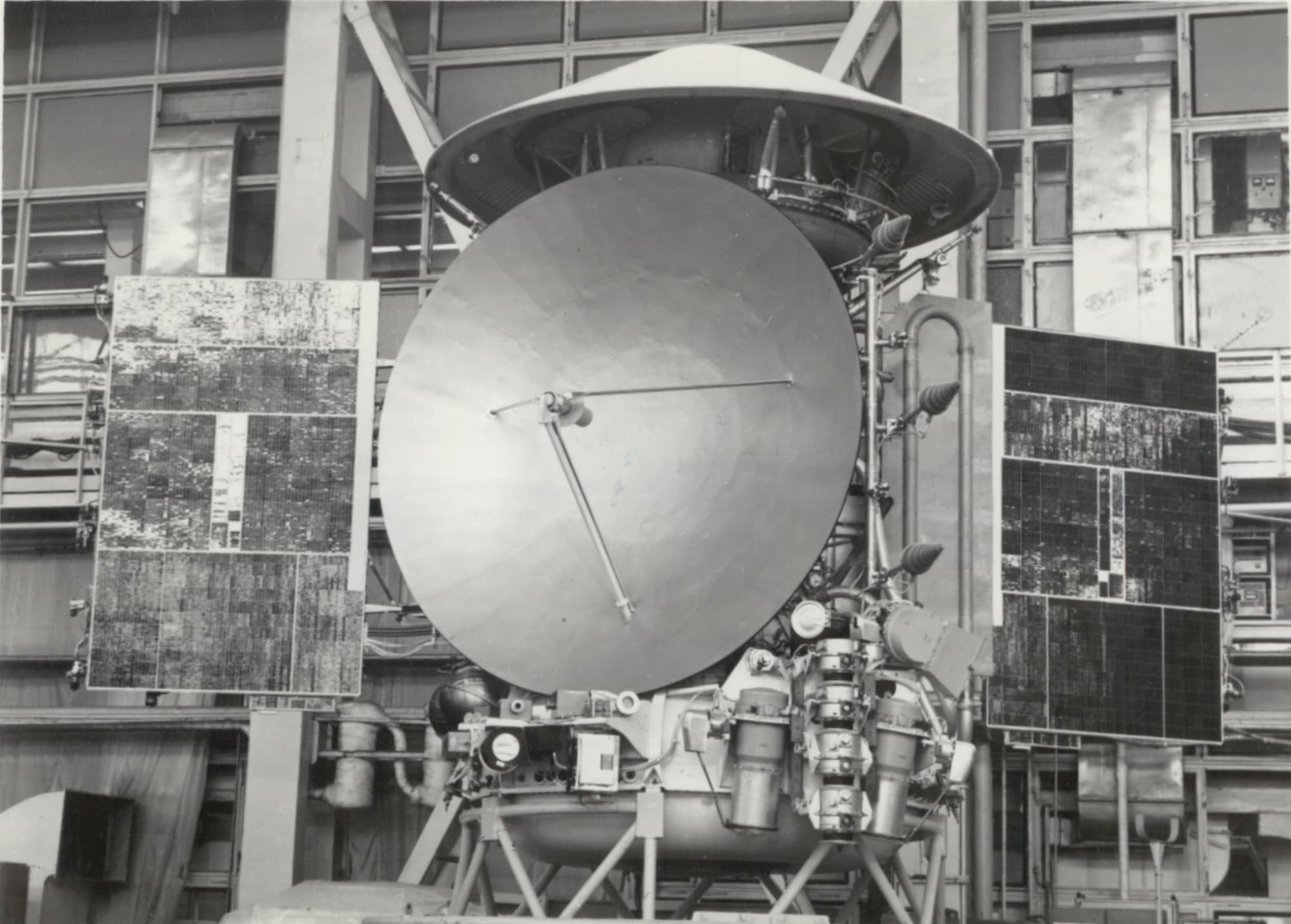
Earth and Mars line up for a transfer every 26 months, but the line-ups are not equal, and 1973 was a bad one. Reaching Mars that year needed a departure 250 to 300 metres per second faster than in 1971, and a Proton-K could not lift an orbiter and a lander together on that trajectory. So Soviet planners split the standard pairing in two. Mars 4 and Mars 5, of the M-73S type, would fly alone and brake into orbit around the planet. Mars 6 and Mars 7, of the M-73P type, would each carry a descent module, drop it on the way past, and let the orbiters relay its signals home. Each type was flown twice for redundancy, which is why four spacecraft left Baikonur in 19 days: Mars 4 on 21 July 1973 at 19:30:59 UT, Mars 5 on 25 July at 18:55:48 UT, Mars 6 on 5 August at 17:45:48 UT, Mars 7 on 9 August at 17:00:17 UT. Soviet paperwork records those moments in Moscow time, three hours later. Lavochkin's own history calls it the first occasion on which four Soviet spacecraft took part in a single interplanetary expedition. The pressure was not only celestial. NASA was building the Viking landers for the following window, and the Soviet Union badly wanted a working machine on the Martian surface first.
The flotilla was compromised before it left the ground, and the people who launched it knew. Ground testing found that one component, the 2T312 transistor made at the Voronezh semiconductor plant, was degrading. Academician Mikhail Marov, who worked on these missions and described the episode to RIA Novosti in 2011, said a cost-saving change had replaced the transistors' gold leads with aluminium, and that the aluminium oxidised after about six months. Asif Siddiqi's NASA chronology tells it differently: testing less than four months before launch showed failure rates climbing after 1.5 to 2 years of operation, which was roughly when the spacecraft would reach Mars. The accounts disagree about the clock and agree about the consequence. The transistors were scattered through the onboard electronics, replacing them would have taken about six months, and the window would not wait. Marov remembered the argument being settled at a meeting chaired by Mstislav Keldysh with Lavochkin representatives present, with the decision pushed down by the Central Committee and the Council of Ministers: fly them anyway, na avos, a Russian phrase meaning on the off-chance. Siddiqi records that roughly even odds of success were accepted. Marov's verdict decades later was blunt. They saved kopecks on precious metal, he said, and destroyed the colossal sums spent on the project.
Mars 4 arrived first and could not stop. Two of the three channels of its onboard computer had already failed, the second midcourse correction could not be loaded, and the braking burn never happened. Sources differ on whether the engine failed or the command was simply never given, but the computer was the cause either way. On 10 February 1974 the spacecraft swept past at 15:34 UT and 1,844 kilometres, and the ground team salvaged what it could: the cameras came on at 15:32:41 UT for about six minutes, taking a 12-frame photographic cycle from 1,900 to 2,100 kilometres out, plus two scanned panoramas begun 27 minutes before closest approach. Passing behind the planet afterwards gave a dual-frequency radio occultation, which produced the first detection of Mars's night-side ionosphere. Mars 5 did better, briefly. Its engine fired at 15:44:25 UT on 12 February 1974 and put it into an orbit of roughly 1,760 by 32,586 kilometres, inclined about 35 degrees, taking nearly 25 hours to circle. Almost immediately, controllers saw the pressurised instrument compartment losing air, most likely punctured by a particle during or just after the burn. The estimate was three weeks. The science team tore up its schedule and ran everything at once: five imaging sessions between 17 and 26 February, gamma spectra of the surface, water vapour, ozone, infrared radiometry. The last session was on 28 February 1974, about two weeks after arrival.
Mars 6 had been half-deaf since 3 September 1973, when its telemetry system failed and controllers lost the ability to see what the spacecraft was doing. For the rest of the cruise they sent every command two or three times, blind, and inferred success from side effects. The machine did its job regardless. On 12 March 1974 it released the descent module at a range of 48,000 kilometres; the module's own retro fired about 15 minutes later to bend it onto an impacting path; and at 09:05:53 UT it met the atmosphere at 5.6 kilometres per second, 11.7 degrees below horizontal. The heat shield took the worst of it, and at 09:08:32 UT, at about 600 metres per second and roughly 20 kilometres up, the parachute opened. From then until 09:11:05 UT the module measured pressure, temperature and deceleration and radioed the numbers to the bus overhead for immediate relay to Earth. NSSDCA counts 224 seconds of data; Lavochkin's own account says 150 seconds on the parachute leg. Both describe the same thing: the first measurements ever made inside the Martian atmosphere and sent home. Much of what arrived was unusable. NSSDCA says a large part of the data was unreadable because of the degraded computer chip, and Lavochkin records that useful information could be pulled only from the descent module's own radio set, the second link being too weak to decode. The last telemetry confirmed that the soft-landing engine had been commanded to fire. The next signal was expected 143 seconds later. It never came, and the Soviet investigation never settled between a crash, a radio failure, and the module swinging too violently under its parachute in a dust storm.
Mars 7 had already failed, three days earlier. The Russian record blames incorrectly computed settings for the turn the spacecraft made before releasing its descent module; Siddiqi's account says the module's main retro-rocket never fired. Either way it sailed past Mars, missing by 1,300 kilometres in the American telling and 1,400 in Lavochkin's, and went into orbit around the Sun, transmitting for a while to a bus that could do nothing with it. Contact with the bus held until 25 March 1974. Lavochkin's own summary of the expedition reads like a ledger of loss: Mars 4, programme not fulfilled; Mars 5, not fulfilled in full; Mars 6, partially fulfilled; Mars 7, not fulfilled. Yet real science survived. Mars 6 gave the first vertical profile of the Martian troposphere and a surface pressure near 6 millibars, and its numbers underpinned the first Soviet model of the atmosphere. Mars 5's photographs, some of them comparable to Mariner 9's, showed channels cut by running water. Most of the harvest filled a special issue of Kosmicheskie Issledovaniya in 1975, although the index to that issue notes that Surkov's gamma spectrometry and Krupenio's 3 cm radio measurements were left out of it. The descent module itself, meanwhile, is still missing: HiRISE went looking in December 2011 and found bedrock, and a candidate crater proposed by Russian enthusiasts in 2018 has never been confirmed. The flotilla also settled the Soviet Mars programme's fate. Two years later NASA's Viking 1 and Viking 2 landed and worked for years, and the USSR did not send another spacecraft to Mars until Phobos 1 and 2 in 1988. Mars 6's descent was the last time a Soviet spacecraft entered the Martian atmosphere at all: Mars 2 crashed in 1971, Mars 3 made the first confirmed soft landing on Mars later that year and fell silent within seconds, and Mars 6 went quiet with the ground in sight.
Mission facts
Programme
M-73 series, built by the S. A. Lavochkin machine-building plant in two versions: M-73S orbiters (Mars 4, article no. 52S; Mars 5, no. 53S) and M-73P flyby buses carrying a descent module (Mars 6, no. 50P; Mars 7, no. 51P). Russian sources write the names as Mars-4 through Mars-7 with a hyphen; this page uses the English convention without one.↗
Why four spacecraft
The 1973 transfer window was worse than 1971: departure needed 250 to 300 m/s more velocity, so a Proton-K could not send an orbiter and a lander together. Planners split the pair into two orbiters and two lander carriers, and flew each type twice for redundancy. Lavochkin records this as the first time four Soviet spacecraft took part in one interplanetary expedition.↗
Launches (UT)
Mars 4, 21 July 1973 at 19:30:59; Mars 5, 25 July at 18:55:48; Mars 6, 5 August at 17:45:48; Mars 7, 9 August at 17:00:17. Soviet documents record these as Moscow time, three hours later (Mars 4 at 22:30:59.2 MSK, for example). All four flew on a Proton-K (8K82K) with a Blok D upper stage.↗
Launch site
NIIP-5 Tyuratam, now Baikonur, Site 81. Mars 4 and Mars 6 from the left pad (81/23), Mars 5 and Mars 7 from the right pad (81/24). The Russian Wikipedia infobox lists 81/23 for Mars 7, which contradicts the Lavochkin text describing a right-pad launch.↗
Mass
Sources disagree. Lavochkin design documentation gives a total launch mass of 4,000 kg for each orbiter (Mars 4 dry mass 2,187 kg, 1,692.47 kg of propellant, 82.1 kg of nitrogen) and 3,880 kg for each lander carrier. NSSDCA and Siddiqi's NASA chronology give 3,440 kg for the orbiters and 3,260 kg for the lander carriers. We quote both rather than choose.↗
Descent module
Lavochkin figures: 1,000 kg at launch including the separation frame, 844 kg entering the atmosphere, and 355 kg for the automatic Mars station after landing, of which 19.1 kg was scientific instruments. NSSDCA instead states a landed mass of 635 kg. Design impact tolerance was 180 g, up to 240 g at the periphery.↗
The 2T312 transistor
Ground testing before launch found that the 2T312 transistor, made at the Voronezh semiconductor plant, was degrading. Academician Mikhail Marov says a cost-saving change substituted aluminium for gold in the transistor leads and the aluminium oxidised after roughly six months. Siddiqi's NASA chronology instead reports failure rates rising after 1.5 to 2 years of operation, detected less than four months before launch. Replacing them all would have taken about six months, which the window did not allow.↗
The decision to launch
Marov recalls the question being argued at a meeting chaired by Mstislav Keldysh with Lavochkin present, and the decision to fly anyway coming under pressure from the Central Committee and the Council of Ministers: launch na avos, on the off-chance. Siddiqi records roughly 50 percent odds of success being accepted.↗
Mars 4 at Mars
Arrived 10 February 1974, 204 days after launch. Two of the three onboard computer channels had failed, the second midcourse correction could not be loaded, and no orbit insertion burn took place. Closest approach 1,844 km at 15:34 UT. There were two separate imaging runs. The single-line scanning telephotometers were switched on 27 minutes before closest approach and swept panoramas of two areas in orange and red-infrared (Lavochkin). The short-focus phototelevision camera came on about two minutes before pericentre, at 15:32:41 UT, for a session of about six minutes that ran one 12-frame cycle from 1,900 to 2,100 km at a scale of 1:5,000,000 (Lavochkin and Siddiqi). The long-focus camera had failed five days earlier and was not used.↗
Mars 5 in orbit
Main engine fired at 15:44:25 UT on 12 February 1974, braking impulse 1,198.45 m/s. Lavochkin gives the resulting orbit as 1,760 by 32,586 km, inclination about 35 degrees, period 1,492.5 minutes (24 h 52 min 24 s); NSSDCA gives 1,755 by 32,555 km, 24 h 53 min, 35.3 degrees. The design period had been 1,440 minutes.↗
Mars 5's leak
Depressurisation of the pressurised instrument compartment was detected immediately after orbit insertion, attributed to a particle impact during or just after the braking burn. Engineers calculated about three weeks of remaining life and ran a compressed science programme: five imaging sessions between 17 and 26 February 1974, and a final session on 28 February 1974 after which pressure fell below working levels.↗
Mars 5's harvest
43 usable photographs, from 108 frames exposed (Lavochkin) or 180 frames (Siddiqi); NSSDCA says about 60 images. The frequently quoted 108 frames out of 960 available comes from the Russian Wikipedia article; the Lavochkin text gives only the 108. Also four or five surface panoramas, gamma spectra indicating uranium, thorium and potassium similar to terrestrial mafic rocks, a surface temperature range of 272 K by day to 200 K at night, roughly 100 precipitable microns of water vapour south of Tharsis, and an ozone layer near 40 km at about one thousandth of Earth's concentration.↗
Mars 6's descent
Descent module released at 05:01:56 UT on 12 March 1974 at 48,000 km; its own retro fired about 15 minutes later to bend the path onto an impacting trajectory. Entry at 09:05:53 UT at 5.6 km/s and an entry angle of 11.7 degrees below horizontal; parachute at 09:08:32 UT at about 600 m/s and roughly 20 km altitude; contact lost at 09:11:05 UT. The whole descent lasted 5.2 minutes. The bus passed 1,600 km from Mars and continued into solar orbit.↗
What Mars 6 measured
A tropospheric profile from the base of the stratosphere at 25 km and 150 K down to about 230 K near the ground, atmospheric density from 82 to 12 km, and a surface pressure near 6 millibars. NSSDCA and Marov both describe this as the first data returned from inside the atmosphere of Mars. NSSDCA counts 224 seconds of data. Lavochkin and the Russian Academy of Sciences Space Council both say results were transmitted to the bus for 150 seconds on the parachute leg; the sharper 149.22 seconds out of 151.6 seconds of parachute descent appears in the Russian Wikipedia article and in no primary source we could open. NSSDCA also records that much of the data was unreadable because of the degraded computer chip, and Lavochkin adds that useful information came only from the descent module's own radio set, the KD-1 link being too weak to decode, and that the MX 6408M instrument returned no digital data at all.↗
Mars 7's failure
The descent module was released on 9 March 1974 and flew past Mars at 1,300 km (NSSDCA and Siddiqi) or 1,400 km (Lavochkin), then entered solar orbit. Siddiqi says the module's main retro-rocket failed to fire; Lavochkin and the Russian Academy of Sciences Space Council blame incorrectly computed settings for the spacecraft turn before separation, with the underlying fault a 2T312 failure in the command memory of the S-530 onboard computer. The intended landing site was 50 S, 28 W. Contact with the Mars 7 bus was held until 25 March 1974.↗
Ground segment and publication
All four were flown through the Pluton radio complex at NIP-16 near Yevpatoria (also transliterated Evpatoria) in Crimea, combining two ADU-1000 antennas with a KTNA-200 dish for reception, and transmitting up to 200 kW through Garpun-4 transmitters. The scientific results filled a dedicated issue of the Soviet journal Kosmicheskie Issledovaniya, volume XIII issue 1, in 1975.↗
Mission timeline
- 21 Jul 1973Mars 4 lifts off at 19:30:59 UT on a Proton-K from the left pad at Site 81, Baikonur, the first of four spacecraft aimed at Mars in 19 days
- 25 Jul 1973Mars 5, the second orbiter, launches at 18:55:48 UT
- 5 to 9 Aug 1973The two lander carriers follow: Mars 6 on 5 August at 17:45:48 UT and Mars 7 on 9 August at 17:00:17 UT
- 3 Sep 1973Mars 6's telemetry system fails. For the rest of the seven-month cruise, controllers send every command two or three times blind and infer success from indirect signs
- 10 Feb 197415:34 UT: Mars 4 flies past at 1,844 km without braking, two of its three computer channels dead. It photographs the surface anyway and its radio occultation gives the first detection of Mars's night-side ionosphere
- 12 Feb 197415:44:25 UT: Mars 5 brakes into a 1,760 by 32,586 km orbit. Within hours controllers detect the instrument compartment losing air and calculate about three weeks of life
- 17 to 26 Feb 1974Five rushed imaging sessions from Mars 5 yield 43 usable photographs, some comparable to Mariner 9's, showing channels cut by flowing water
- 28 Feb 1974Last communication session with Mars 5, ending with a final panorama; cabin pressure then falls below working levels
- 9 Mar 1974Mars 7 releases its descent module, which fails to turn onto an entry path and passes Mars at 1,300 to 1,400 km before drifting into solar orbit
- 12 Mar 197409:05:53 UT: Mars 6's descent module hits the atmosphere at 5.6 km/s. Parachute at 09:08:32 UT. It radios pressure, temperature and deceleration to the passing bus until 09:11:05 UT, when contact stops with the soft-landing engine just commanded
- 26 Dec 2011MRO's HiRISE camera photographs a bright spot near the Mars 6 target area flagged by the Context Camera team. At full resolution it turns out to be bedrock rather than hardware
- 20 Jul 2018Anton Gromov, working in Vitaly Egorov's volunteer search group, proposes a small crater in the Mare Erythraeum lowland as the Mars 6 impact point, matching a simulated crater 4 to 5 m across. It remains unconfirmed
A filled dot marks something that physically happened. A hollow one marks an announcement, a naming or a target.
In pictures
Tap a photo to enlarge.
Sources
- NSSDCA Master Catalog: Mars 4 (1973-047A), archived
- NSSDCA Master Catalog: Mars 5 (1973-049A), archived
- NSSDCA Master Catalog: Mars 6 (1973-052A), archived
- NSSDCA Master Catalog: Mars 7 (1973-053A), archived
- NPO Lavochkin: AMS serii M-73 (the manufacturer's own project history, in Russian), archived
- Russian Academy of Sciences Space Council: Kosmicheskie apparaty Mars-4, 5, 6, 7 (Russian), archived
- Asif A. Siddiqi, Deep Space Chronicle: A Chronology of Deep Space and Planetary Probes 1958-2000, NASA SP-2002-4524, pp. 103-106
- RIA Novosti (21 Feb 2011): Academician Mikhail Marov on the 2T312 transistors and the decision to launch (Russian)
- Kosmicheskie Issledovaniya XIII(1), 1975: the special M-73 issue (Moroz, Sokolov, Istomin, Avduevsky, Krasnopolsky and others), scan index, archived
- HiRISE ESP_025387_1555: Search for Soviet Mars 6 Lander (caption by Alfred McEwen, 15 Feb 2012)
- RIA Novosti (20 Jul 2018): volunteers propose a candidate Mars 6 crash site (Russian)
- Russian Wikipedia: Mars-6
Facts on this page were verified on 23 August 2026. Where sources disagree, the disagreement is stated rather than resolved silently.
-19.4200 E, -23.9000 N · Samara Valles · position estimated, never confirmed from orbit