Mars 3
USSR · Soviet Union · Lander · 1971 · Reaching MarsPartial
First confirmed soft landing on Mars, at about 13:50:35 UT on 2 December 1971. It began transmitting 90 seconds later and stopped almost immediately; how long it spoke and why it stopped are still unsettled in 2026.
TL;DR· 15 min read
Mars 3 made the first confirmed soft landing on Mars, touching down on the floor of Ptolemaeus crater at about 13:50:35 UT on 2 December 1971. It began transmitting 90 seconds later and returned 79 television lines showing no detail before the signal collapsed. How long it spoke, most often quoted as 14.5 seconds but argued to run past 62, and why it stopped are both still unsettled. None of it was live: the orbiter recorded the lander and replayed the tape to Earth.
Mars 3 reached the surface of Mars alive, which nothing had managed before, and then it stopped. Its four petals opened, its antennas came up, its two panoramic cameras started scanning, and about twenty seconds into the picture the signal fell apart into noise. What came back was a grey field with no horizon in it. Fifty-five years later the two things everyone quotes about Mars 3, how long it transmitted and why it went silent, are both still open.
- 1stconfirmed soft landing on Mars, 2 December 1971
- 14.5 smost-quoted transmission time; published readings run from 14.5 to over 62 seconds
- 79television lines received, from a panorama designed to run to 6,000
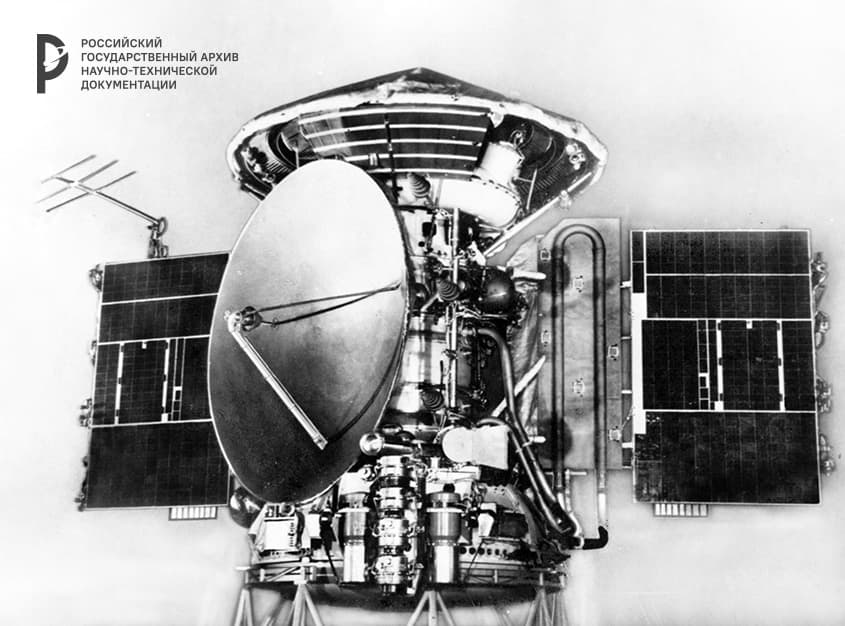
Mars 3 flew the same hardware as Mars 2 and had the same job, and it got the part its twin had failed. On 2 December 1971 the descent module separated on the approach hyperbola at 09:14 UT, fired a solid motor fifteen minutes later to add about 120 metres per second and drop itself out of the flyby, spun up for stability and coasted for four and a half hours while the orbiter manoeuvred clear. Entry came at about 5.7 kilometres per second at an angle under ten degrees. The conical shield did the bulk of the braking, a drogue chute pulled out a reefed main chute that opened fully once the module dropped below the speed of sound, the shield was jettisoned and a radar altimeter woke up. At a few tens of metres the parachute was cut away and shoved aside by a small rocket so it would not settle over the station, the soft-landing engine fired, and the sphere separated and dropped the last stretch into thick foam padding. It hit at a reported 20.7 metres per second at about 13:50:35 UT. Four petals opened and righted it. Whatever else is disputed about Mars 3, this part is not: it survived, on a planet that had never let anything survive before.
Then it spoke, and the trouble started. Ninety seconds after touchdown, on schedule, the station switched on both radio channels and both Ya-198 panoramic cameras together and began scanning. What came back was a grey field with nothing in it. Perminov, who was in the room, writes that the signal disappeared in 14.5 seconds, that the same thing happened on the second telephotometer, and that they never worked out why two cameras on independent bands would fail together within a hundredth of a second. NASA's catalogue says twenty seconds, from 13:52:05 to 13:52:25. A 1973 Soviet report gives 19.7 seconds. The 2024 reanalysis by Gektin and Kostachuk argues that all of these measure the same thing, the length of the fragment with a properly formed video structure and a scanning-mirror retrace pulse in it, and that the surviving print of the signal runs at least 62 seconds. Their reading of the record is stranger than either number suggests: for the first twenty seconds or so both cameras were in an abnormal mode, putting out one or two brightness levels instead of the designed 64 and no retrace pulse at all; then some unidentified electrical event occurred and the cameras produced about nineteen seconds of normal video, 77 lines from one and 78 from the other; then the quality collapsed again and the signal effectively vanished.
One correction is worth making before anything else, because it changes the shape of the story. None of this was live. The lander talked to the orbiter, which was simultaneously performing its own orbit insertion burn, recorded the signal on magnetic media, and replayed it to Earth at one quarter speed during sessions between 2 and 5 December. Every dramatic retelling of engineers watching the picture from Mars die on the screen is describing a playback of a recording made hours earlier. That matters because it widens the list of suspects. The Soviet explanation, and the one NASA still repeats, is corona discharge: Perminov found that British radio operators in the Lebanese desert had suffered transmitter failures in dust storms during the Second World War, and reasoned that the same thing could happen on Mars in the middle of a planet-encircling storm. Other candidates on the record are a station tipped over or draped by its own parachute, battery damage, and a touchdown with dangerous horizontal velocity into winds Mariner 9 measured at more than 140 metres per second. And there is a fifth, which cannot be dismissed: the relay itself. NASA's own page concedes that it is not known whether the fault originated with the lander or with the orbiter's communications relay, and the orbiter that night was busy, mispointed after its burn, and had already lost three-axis stabilisation once to contamination on a star sensor.
What was actually in those 79 lines is now a live scientific argument rather than a settled disappointment. The original magnetic recordings are, as far as anyone knows, lost. What survives are scanned phototelegraph prints kept by Arnold Selivanov, who built the cameras, plus a longer and worse fragment that appeared in a BBC documentary. Gektin and Kostachuk rotated the signal ninety degrees, stripped the retrace region, rejoined the split halves of each line, mirrored the print and stretched it, on the assumption that the cameras were running in the faster 1,500-line survey mode, which sweeps a full circle in a little over six minutes, rather than the 6,000-line detailed mode, which would have taken about twenty-five minutes and outlasted the eleven to sixteen minutes the orbiter was above the horizon. Out of that came two small fragments that look like uneven rocky ground, shot through an orange filter and a yellow-green one, with non-overlapping fields of view. Their reconstructed geometry has the station sitting tilted by fifteen to twenty degrees toward the cameras, which would put the horizon above the field of view and leave both cameras staring at dirt between roughly 0.9 and 3.8 metres away. One dark patch might be a dent left by a petal opening. It is a plausible story that explains why Soviet analysts, who knew perfectly well they had camera signal, could not recognise a textured scrap with no horizon, no rock outlines and no piece of their own spacecraft in it. It is also a chain of assumptions applied to a much-copied paper print, and the authors of the 2026 review that summarises it say so.
The lander site itself was found, probably. In late 2012 Vitaly Egorov, who ran the largest Russian-language Curiosity community online, divided a 1.8 billion pixel HiRISE image of the landing ellipse taken in November 2007 into twenty pieces and handed them to volunteers. Phil Stooke told him the flight had been to the east, which cut the search area in half. The group found four objects with the right sizes, shapes and relative arrangement for a parachute, heat shield, retrorocket and four-petalled lander. Alexander Basilevsky put the case to HiRISE principal investigator Alfred McEwen, a follow-up image was taken on 10 March 2013 at different lighting, and Lavochkin engineer Vladimir Molodtsov dug the retrorocket chain length out of the archives at 4.52 metres against 4.8 metres measured on Mars. NASA announced it on 11 April 2013 with McEwen calling it a remarkable match while stating that alternative explanations could not be ruled out. That caveat has never been lifted. The lander is a few pixels across and each petal is two or three, so the imagery cannot settle the tilt, the camera pointing or anything else the signal reconstruction depends on. In August 2013 the IAU named three craters there, Reutov, Tyuratam and Belyov, which is as close to an official acknowledgement as an unconfirmed find gets.
Mission facts
Launch
28 May 1971, 15:26:30 UT (18:26:30 Moscow time), Proton-K with a Blok D upper stage (8K82K no. 249-01) from Site 81/23 at Baikonur (Tyuratam), nine days after its twin Mars 2.↗
Spacecraft
Project M-71, vehicle 4M no. 172, built by NPO Lavochkin. Orbiter plus attached descent module, 4.1 m tall and 5.9 m across the deployed solar wings. About 4,650 kg at launch in NASA sources, 4,625 kg in Russian ones; the landed station was 358 kg (NASA, Perminov) or 355 kg (Lavochkin).↗
Cruise
Mid-course corrections on 8 June and 14 November 1971, then a third correction on 2 December computed and executed by the spacecraft's own autonomous astro-navigation system, which put it on a trajectory passing 1,500 km from the surface.↗
Separation
09:14 UT on 2 December 1971 (12:14 Moscow). Fifteen minutes later a solid motor added about 120 m/s to move the module from a flyby path onto an impact path. The module was then spun up for stability and its support truss jettisoned. Coast to entry lasted about 4 hours 35 minutes.↗
Entry
13:47 UT at about 5.7 km/s at an entry angle under 10 degrees per NASA. Russian sources give 16:44 Moscow time (13:44 UT) and about 5.8 km/s. Drogue then main parachute, reefed until subsonic, heat shield jettisoned, radar altimeter on. The whole entry took a little over three minutes.↗
Touchdown
13:50:35 UT, at a reported 20.7 m/s, on the flat floor of Ptolemaeus crater at about 45 S, 158 W (202 E). NASA's own page warns of an uncertainty of about three minutes in all these absolute times. The parachute was pulled aside by a small rocket so it would not fall on the station.↗
Transmission start
13:52:05 UT, 90 seconds after touchdown. In that interval the station cast off its cover, righted itself on its four petals, raised its antennas and deployed instruments, then switched on both radio channels and both Ya-198 panoramic cameras at once.↗
How long it transmitted
Contested. Perminov, the deputy chief designer, says the signal disappeared in 14.5 seconds, and that is the figure NASA JPL, HiRISE and most English sources use. NASA's NSSDCA gives 20 seconds (13:52:05 to 13:52:25). Gektin and Kostachuk's 2024 paper notes that the published values run 14.5 s, 20 s and 40 s, counts the lines on the two surviving prints at 77 (19.25 s) and 78 (19.5 s), and argues that all of these measure only the fragment carrying clean video structure, while the full print runs at least 62 seconds and the lander worked somewhat longer still. A further figure of 19.7 s, credited to a 1973 report by Rozhdestvenskiy and Shkirina (NASA TT F-14,907), reaches us only through the mars3image line-count analysis; we have not seen that report, and the 2024 paper does not list it. We lead with 14.5 seconds because it is the most-cited number, and treat the longer figure as the better answer to the actual question.↗
It was never live
There was no real-time transmission from the surface to Earth. Gektin and Kostachuk state it outright: the recording was replayed at one quarter speed to cut errors, and there was no live relay. The lander talked to the orbiter, which recorded the signal on magnetic media while performing its own orbit insertion; Perminov describes the wait for three-axis stabilisation, delayed by contamination on a star sensor, before the tape could be sent at all. The contemporaneous TASS account places the playback in communication sessions on 2 to 5 December. Every story of engineers watching the signal die describes watching a playback.↗
The picture
79 lines of phototelevision signal at 4 lines per second, the right-hand edge of an intended panorama. NASA describes a partial panoramic image showing no detail at a very low illumination of 50 lux, a figure Gektin and Kostachuk trace to Selivanov's 2013 note and its reading of the retrace-pulse width. Their 2024 reanalysis argues that the 50 lux estimate ignored the very dark yellow-green ZhZS-13 filter on that camera, which passes at least twenty times less light than the orange OS-14 on the other, and that the site illumination was nearer 480 lux, just below the 500 lux threshold at which the cameras' automatic sensitivity control cut out.↗
Why it stopped
No agreed answer. Candidates on the record: corona discharge in the transmitter antennas induced by the dust storm (Perminov's own hypothesis, drawn from British wartime radio failures in the Lebanese desert); the station toppled or covered by its parachute; battery damage; dangerous horizontal velocity at touchdown in winds that Russian Wikipedia, citing Sagan, puts at over 140 m/s near the surface on Mariner 9 data; and a relay-side loss, with the orbiter mispointed or out of view. NASA states it is not known whether the fault was in the lander or in the orbiter's relay.↗
The awkward detail
Two telephotometers working through independent radio channels failed together within a hundredth of a second. Perminov writes that they could not find an answer to this. It argues against a camera fault and toward either a common power or transmitter failure on the lander, or a loss on the relay side.↗
Planned surface programme
Cycles of 4 minutes 34 seconds, of which 4 minutes 22 seconds was panorama and the last 12 seconds other science: five cycles in the first session, about 23 minutes, and ten in a second session a day later. On the cyclogram as Russian Wikipedia and the 2026 Habr review read it, the transmitters, both cameras and the PrOP-M drive switched on together at the start of each cycle, with the rover halting half a cycle in to measure; the same Habr piece elsewhere puts the rover deployment and the weather and soil telemetry after the panorama, around minute six. None of it was ever received, and whether PrOP-M was ever set down on Mars is not known.↗
Orbiter
Entered a far more elliptical orbit than intended when its braking burn was cut short: roughly 1,500 by 211,400 km at 60 degrees, period about 12.7 to 12.8 days, against a planned 25 hours. Perminov attributes it to the control system miscalculating gyro-integrator impulses during rapid speed changes and shutting the engine down early; NSSDCA instead blames a partial loss of fuel, and gives the inclination as probably the same 48.9 degrees as Mars 2 rather than 60. It completed 20 orbits.↗
French experiment
Mars 3 carried Stereo-1, a Soviet-French radio-astronomy experiment observing solar radiation at 169 MHz in concert with ground receivers. Siddiqi records it operating successfully for 185 hours across nearly seven months and returning about a megabyte of data on solar radiation.↗
End of mission
The joint Mars 2 and Mars 3 programme was declared complete on 22 August 1972, announced by TASS on 23 August. Lavochkin records last contact with both orbiters in July 1972. Between them the two orbiters returned 60 pictures.↗
Mission timeline
- 28 May 1971Launch at 15:26:30 UT (18:26:30 Moscow) on a Proton-K with a Blok D upper stage from Site 81/23 at Baikonur.
- 8 Jun 1971First mid-course correction. A second follows on 14 November.
- 22 Sep 1971The dust storm that will define the mission begins in Noachis. By late November it covers the planet, and Mars 3 cannot wait it out: the descent module is on a ballistic approach with no way to change its arrival date.
- 2 Dec 197109:14 UT: the descent module separates on the approach hyperbola. Fifteen minutes later a solid motor adds about 120 m/s to put it on an impact trajectory, and the orbiter manoeuvres clear.
- 2 Dec 197113:47 UT: entry at about 5.7 km/s at an angle under 10 degrees. Aeroshell, drogue chute, reefed main chute, heat shield off, radar altimeter on. The whole sequence takes a little over three minutes.
- 2 Dec 197113:50:35 UT: touchdown at a reported 20.7 m/s on the floor of Ptolemaeus crater, the first confirmed soft landing on Mars. NASA flags about three minutes of uncertainty in this time.
- 2 Dec 197113:52:05 UT: after 90 seconds of righting itself and raising antennas, the station switches on both transmitters and both cameras and begins sending. Roughly twenty seconds later the video structure collapses. 79 lines came back, showing nothing.
- 2 to 5 Dec 1971The orbiter, now in its unplanned 12-day orbit, replays the recorded lander signal to Earth at quarter speed across several sessions. This is when engineers actually see it, and when the argument about what it contains begins.
- 22 Aug 1972The Mars 2 and Mars 3 programme is declared complete after 20 Mars 3 orbits, announced by TASS the following day.
- Dec 2012Vitaly Egorov's crowdsourced search through HiRISE image PSP_006154_1345, taken in November 2007, turns up candidate objects matching a parachute, heat shield, retrorocket and lander. Begun in late November with the image cut into twenty pieces for volunteers, it was narrowed by Phil Stooke's advice that the flight had been to the east, which halved the search area.
- 11 Apr 2013NASA announces the candidate identification after a follow-up HiRISE image on 10 March 2013. Alfred McEwen calls it a remarkable match but says alternative explanations for the features cannot be ruled out. Lavochkin drawings, dug out by Vladimir Molodtsov and reported by The Planetary Society rather than by NASA, put the retrorocket chain at 4.52 m against 4.8 m measured in the image.
- 5 Aug 2013The IAU adopts names for three craters at the candidate site: Reutov (18.02 km), Tyuratam (0.30 km) and Belyov (0.20 km), all named for towns connected to the Soviet space programme.
A filled dot marks something that physically happened. A hollow one marks an announcement, a naming or a target.
In pictures
Tap a photo to enlarge.
Sources
- NSSDCA Master Catalog: Mars 3 Lander (1971-049F), archived 15 Aug 2025
- NSSDCA Master Catalog: Mars 3 orbiter (1971-049A), archived 15 Aug 2025
- V. G. Perminov, The Difficult Road to Mars (NASA Monographs in Aerospace History No. 15, 1999)
- Asif A. Siddiqi, Beyond Earth: A Chronicle of Deep Space Exploration 1958-2016 (NASA SP-2018-4041)
- Russian Wikipedia: Mars-3 (Марс-3)
- mars3image (LiveJournal, 7 Sep 2020): Длительность передачи сигнала «Марс-3»
- Habr (18 Aug 2026): Призрачный сигнал «Марса-3»
- Yu. M. Gektin and A. V. Kostachuk, Анализ и обработка сигналов, полученных со спускаемого аппарата «Марс-3», Raketno-kosmicheskoye priborostroyeniye i informatsionnye sistemy, 2024, vol. 11 no. 1, pp. 3-12 (journal published by Russian Space Systems)
- Don P. Mitchell (24 May 2013): 20 Seconds on Mars
- NASA JPL (11 Apr 2013): NASA Mars Orbiter Images May Show 1971 Soviet Lander
- HiRISE ESP_031036_1345: Could This Be the Soviet Mars 3 Lander? (10 Mar 2013)
- The Planetary Society (12 Apr 2013): Vitaly Egorov's own account of the crowdsourced search, translated by Emily Lakdawalla
Facts on this page were verified on 23 August 2026. Where sources disagree, the disagreement is stated rather than resolved silently.
-158.0000 E, -45.0000 N · Ptolemaeus crater · position estimated, never confirmed from orbit