Mars 2
USSR · Soviet Union · Lander · 1971 · Reaching MarsPartial
Crashed on 27 November 1971, the first human-made object to reach the surface of Mars; the orbiter it rode on flew 362 orbits before the mission was declared over on 22 August 1972. The wreck has never been located.
TL;DR· 11 min read
Mars 2's descent module struck Mars on 27 November 1971 and became the first human-made object to reach the planet's surface, arriving as wreckage. Untested autonomous navigation software corrected a trajectory error that did not exist, so the capsule entered far too steeply and its parachute sequence never ran. The orbiter it separated from worked, flying 362 orbits before the programme was declared complete on 22 August 1972. The wreck has never been located, and published crash coordinates disagree by tens of degrees.
Mars 2 was half a triumph and half a lesson in software testing. On 27 November 1971 its descent module entered the Martian atmosphere far too steeply, because the onboard computer corrected a trajectory error that was not there. The parachute never opened and the capsule struck the ground. That wreck was the first human-made object to reach the surface of Mars. The orbiter it separated from went into orbit the same day and worked for eight months.
- 1sthuman-made object to reach the surface of Mars
- 362orbits flown before the mission was declared complete
- 0pieces of the wreck ever identified in orbital imagery
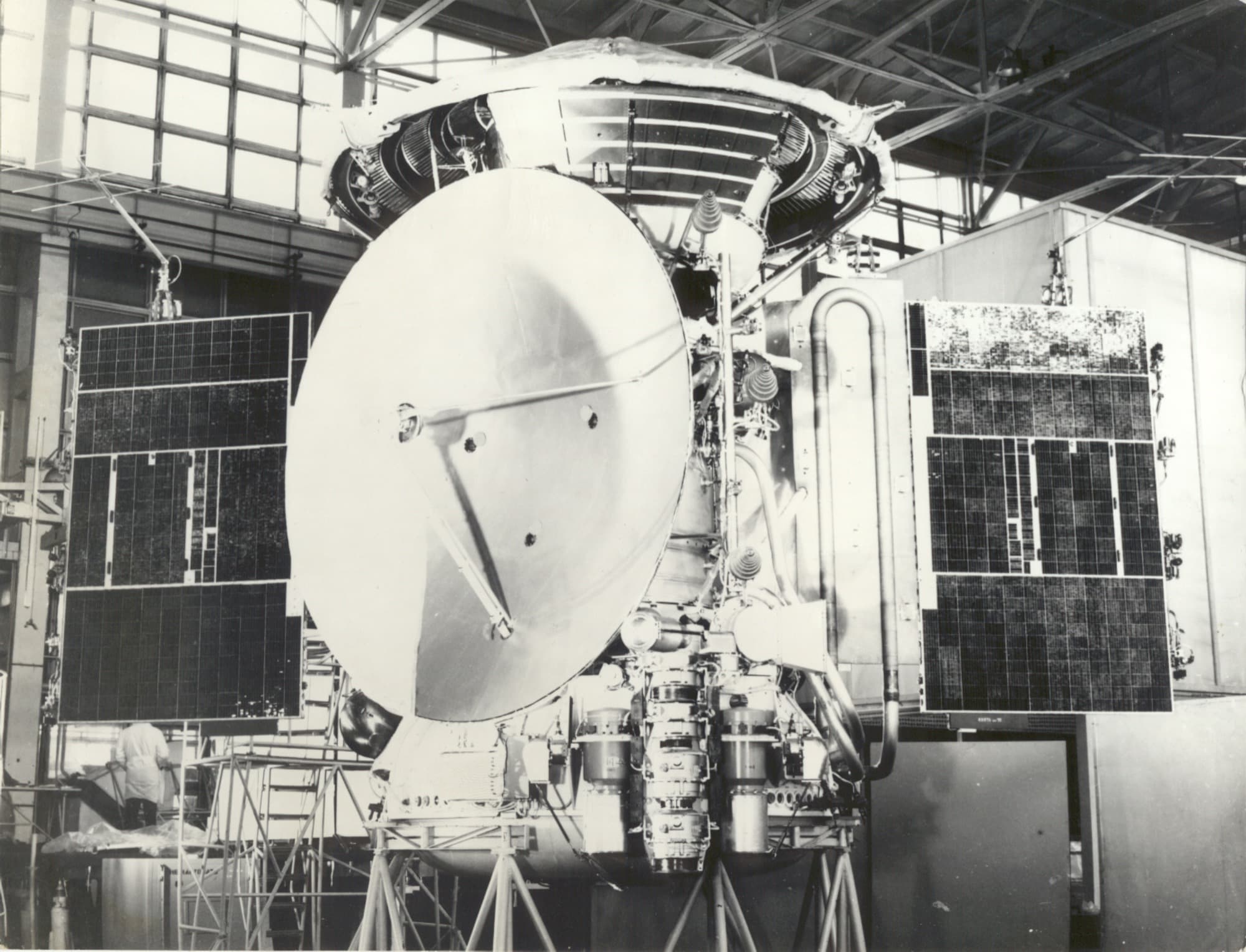
The Soviet Union arrived at the 1971 Mars window with the most ambitious interplanetary hardware anyone had yet built. Project M-71 was not a flyby probe: two of its three vehicles were 4.6 tonne stacks combining an orbiter and a full entry, descent and landing system, and the plan was to put a working station on the surface and a satellite around the planet in the same afternoon. The third, added to the window to beat the American Mariners into Mars orbit, was a 4,549 kg orbiter with no lander at all, and it never left Earth orbit: it was stranded on 10 May 1971 by a mis-programmed timer in the Blok D stage and quietly relabelled Kosmos 419. Mars 2 went up nine days later, on 19 May, and Mars 3 nine days after that. The two survivors were effectively identical twins, which is why their stories are usually told together and why the differences between them matter so much. Mars 2 carried a 1.2 metre sealed sphere with four petals that would open on the ground and right it, a pair of panoramic cameras, a mass spectrometer, weather sensors, soil instruments and a 4.5 kg skiing robot called PrOP-M tethered to the lander by a 15 metre cable. Nothing like it had ever been sent anywhere. The cruise went well. Corrections on 17 June and 20 November put the spacecraft almost exactly where it was supposed to be.
That accuracy is what killed the lander. Mars 2 carried an autonomous navigation system, an optical angle-measuring device that sighted Mars seven hours out, fed the result to an onboard computer, and let the spacecraft compute and fly its own final correction with no involvement from Earth. It was genuinely advanced for 1971. But as Vladimir Perminov, deputy chief designer on the project, wrote afterwards, the software was never fully tested, and the specific case it was never tested for was the case that occurred: the real trajectory and the predicted trajectory coinciding. The algorithm assumed a deviation existed and manoeuvred to cancel it. When the descent module separated on 27 November and fired the solid motor that would drop it out of the flyby hyperbola, it was pointing wrongly. It hit the atmosphere at roughly 6 kilometres per second at an angle far steeper than the aeroshell was designed to survive, ran out of altitude before it had run out of speed, and the parachute sequence never got the chance to start. Perminov adds a bitter footnote: had the Soviet and American exchange of precise Mars ephemeris data happened a year earlier, controllers would have known the trajectory was good and simply flown the approach from the ground.
So the first object humans ever put on Mars arrived as debris. That is worth stating precisely, because a lot of writing about Mars 2 blurs it. This was not a landing, hard or otherwise. It was an uncontrolled impact by a capsule whose descent sequence had already failed, and the only part of the programme it fulfilled was the delivery of a metal pennant bearing the Soviet coat of arms. Nobody has ever found it. NASA's own catalogue contradicts itself, listing the impact at 4 degrees north, 47 degrees west on the page for the lander and at 45 degrees south, 313 degrees west on the page for the orbiter, which is to say on opposite sides of the equator and roughly a quarter of the way around the planet from each other. A third figure, 45 south and 302 west, circulates too. HiRISE has gone looking twice, in July 2014 and August 2015, at the two southern candidates, and NASA's caption on the first of those images says flatly that the debris field has not been located. Fifty-five years on, the first human artefact on another planet's surface is a rumour with three addresses.
The orbiter is the half of Mars 2 that worked, and it is the half that gets forgotten. The same day the lander was lost, the main bus fired its engine and entered a 1,380 by 24,940 kilometre orbit at 48.9 degrees, becoming the second spacecraft ever to orbit another planet, thirteen days behind Mariner 9. It then spent eight months circling a planet it could barely see. A dust storm that Russian sources trace to 22 September 1971 in Noachis had grown to cover the whole globe, and the Soviet imaging system had no answer to it: the phototelevision unit exposed film, developed it aboard and scanned the negatives, and its exposure settings had been chosen before launch using the wrong brightness model for Mars. The frames came back washed out, the camera was abandoned after a few series of twelve, and Mars 2 and Mars 3 returned 60 pictures between them against Mariner 9's 7,329. What the non-imaging instruments returned was real science all the same: surface temperatures from minus 110 to plus 13 Celsius, surface pressures of 5.5 to 6 millibars, an ionosphere base at 80 to 110 kilometres, dust lofted 7 kilometres up, and water vapour thousands of times scarcer than Earth's. Mars 2 flew 362 orbits before the programme was closed on 22 August 1972.
Mission facts
Launch
19 May 1971, 16:22:49 UT (19:22:49 Moscow time), Proton-K with a Blok D upper stage (8K82K no. 255-01), Site 81/24 at Baikonur (Tyuratam). Asif Siddiqi's NASA chronicle gives 16:22:49 UT in its text but 16:22:44 UT in its launch table, and English Wikipedia follows the second figure. We use 16:22:49 because it matches the Moscow-time value in Russian sources.↗
Spacecraft
Project M-71, vehicle 4M no. 171, built by the Lavochkin machine-building plant (NPO Lavochkin) under Georgi Babakin. An orbiter bus with a descent module bolted to the top, 4.1 m tall, 2 m across the body, 5.9 m across the deployed solar wings.↗
Mass
About 4,650 kg at launch. That figure is given by NSSDCA, by Siddiqi's text and by Perminov, who was deputy chief designer on the project. The split differs: NSSDCA says orbiter 3,440 kg and descent module 1,210 kg fuelled, while Perminov and Siddiqi both give a 1,000 kg descent module. Lavochkin and Russian Wikipedia give 4,625 kg total, orbiter 3,625 kg, descent module 1,000 kg, and Siddiqi's own launch table repeats 4,625 kg against his text. The landed station itself is 358 kg (NSSDCA, Perminov) or 355 kg (Lavochkin, Russian Wikipedia; Siddiqi's earlier edition prints 350 kg).↗
Descent module
A 1.2 m sealed sphere inside a conical aerodynamic brake shield, plus parachutes and retro-rockets. The shield diameter is given as 2.9 m by NASA and as 3.2 m with a 120 degree apex angle by Russian sources. Four triangular petals were to open after touchdown and right the sphere. The capsule was sterilised before flight.↗
Lander instruments
Two panoramic television cameras giving a 360 degree view, a mass spectrometer for atmospheric composition, temperature, pressure and wind sensors, and instruments for the mechanical and chemical properties of the soil. Roughly 16 kg of science per lander. A pennant carrying the Soviet coat of arms was fixed to the capsule.↗
PrOP-M rover
A 4.5 kg walking robot (4 kg in some sources), 21.5 by 16 by 6 cm, riding on two skis and tethered to the lander by a 15 m cable. It moved at about 1 metre per minute (Siddiqi), stopping to measure every 1.5 metres, and carried a penetrometer and a radiation densitometer. Developed by Alexander Kemurdzhian's team at VNIITransmash. It was never deployed.↗
Cruise
Mid-course corrections on 17 June and 20 November 1971, a dating NSSDCA, Siddiqi and Russian Wikipedia all share. A third correction was computed and executed by the spacecraft itself on 27 November, without help from Earth. Perminov's text instead dates the first correction to 5 June and the third to 21 November, but he folds that third correction into the same operation as the orbit insertion, which every source places on 27 November, so we follow the three that agree.↗
Why the lander crashed
The final approach had been so accurate that no third correction was needed. The autonomous navigation software assumed a deviation existed and manoeuvred to cancel it, leaving the descent module pointed wrongly when its solid motor fired. Entry came at roughly 6.0 km/s at an angle far steeper than the design allowed, the aeroshell could not shed enough speed, and the parachute sequence never ran.↗
Root cause
Perminov states plainly that testing of the autonomous navigation programs was never finished for lack of time, and that the specific case where the real and predicted trajectories coincide was never modelled.↗
Impact
27 November 1971. No precise impact time appears in the sources we could consult. The orbiter's insertion burn that day is timed at 20:19 UT, and the descent module separated about 4.5 hours before Mars arrival.↗
Impact site
Disputed and unverified. NASA's lander page gives 4 N, 47 W (Nanedi Valles in Xanthe Terra); NASA's orbiter page gives 45 S, 313 W (which is 47 E); other references give 45 S, 302 W (58 E). HiRISE has searched two of these areas and found nothing conclusive.↗
Mars orbit
Insertion at 20:19 UT on 27 November 1971 into an orbit of about 1,380 by 24,940 km at 48.9 degrees inclination, period 18 hours. The planned period was 24 hours. Mars 2 was the second spacecraft to orbit another planet, 13 days after Mariner 9.↗
Imaging failure
The orbiter's film-based phototelevision unit had been programmed with the wrong brightness model for Mars, so its exposures were wrong and the frames came back washed out. After a few series of 12 frames the camera system was simply left switched off. Mars 2 and Mars 3 returned 60 pictures between them.↗
The dust storm
Both M-71 craft arrived into a planet-encircling dust storm. Russian sources date its start to 22 September 1971 in Noachis, spreading across 200 degrees of longitude by 29 September and covering the south polar cap on 30 September, clearing around 10 January 1972. Siddiqi cites later analysis putting the start in the first ten days of October and the duration at three months.↗
End of mission
The joint Mars 2 and Mars 3 programme was declared complete on 22 August 1972 after 362 Mars 2 orbits, with TASS announcing it on 23 August. Lavochkin records last contact in July 1972. The orbiter ran until the nitrogen for its attitude control was exhausted and is still in Mars orbit.↗
Searches for the wreck
HiRISE imaged 44.810 S, 47.546 E on 17 July 2014 explicitly to look for the Mars 2 debris field, and 44.999 S, 58.001 E on 1 August 2015. Neither found it. NASA's caption on the 2014 image states that to date the debris field has not been located.↗
Mission timeline
- 10 May 1971The first of the three Soviet M-71 craft, the lander-less M-71S orbiter added to the window to reach Mars orbit before the American Mariners, is stranded in Earth orbit when the Blok D stage's timer is mis-programmed. It is quietly renamed Kosmos 419, and the Soviet Union never admits it was a Mars mission.
- 19 May 1971Launch at 16:22:49 UT (19:22:49 Moscow) on a Proton-K with a Blok D upper stage from Site 81/24 at Baikonur, into a parking orbit and then onto a trans-Mars trajectory.
- 17 Jun 1971First mid-course correction, executed from the ground.
- 22 Sep 1971A dust storm begins in the bright region Noachis. Within a week it spans 200 degrees of longitude, and by the time the 1971 fleet arrives it has swallowed the planet.
- 14 Nov 1971At 00:18 UT Mariner 9 becomes the first spacecraft to orbit another planet, and finds Mars hidden beneath dust with only the tallest volcano summits showing.
- 20 Nov 1971Second mid-course correction. After it, the trajectory is close enough to nominal that no further correction is actually required.
- 27 Nov 1971The autonomous navigation system computes and executes a third correction anyway, assuming an error that does not exist, and leaves the descent module aimed wrongly.
- 27 Nov 1971The descent module separates about 4.5 hours before arrival, fires its solid motor onto an impact trajectory, and enters the atmosphere at roughly 6.0 km/s far too steeply. The parachute sequence never runs and the capsule strikes Mars, delivering a Soviet coat of arms to the surface and becoming the first human-made object there.
- 27 Nov 197120:19 UT: the orbiter's engine puts it into a 1,380 by 24,940 km orbit at 48.9 degrees, period 18 hours rather than the planned 24. Mars 2 becomes the second spacecraft in history to orbit another planet.
- 10 Jan 1972The global dust storm finally clears and Mars returns to its normal telescopic appearance, too late for the M-71 cameras, whose exposures were fixed before launch.
- 22 Aug 1972The Mars 2 and Mars 3 programme is declared complete after 362 Mars 2 orbits. TASS announces it the next day. Mars 2 kept working until the nitrogen in its attitude control system ran out.
- 17 Jul 2014HiRISE images 44.810 S, 47.546 E specifically to hunt for the Mars 2 debris field. A second attempt follows on 1 August 2015 at 44.999 S, 58.001 E. Neither finds anything convincing.
A filled dot marks something that physically happened. A hollow one marks an announcement, a naming or a target.
In pictures
Tap a photo to enlarge.
Sources
- NSSDCA Master Catalog: Mars 2 Lander (1971-045D), archived 15 Aug 2025
- NSSDCA Master Catalog: Mars 2 orbiter (1971-045A), archived 15 Aug 2025
- V. G. Perminov, The Difficult Road to Mars (NASA Monographs in Aerospace History No. 15, 1999)
- Asif A. Siddiqi, Beyond Earth: A Chronicle of Deep Space Exploration 1958-2016 (NASA SP-2018-4041)
- Russian Wikipedia: Mars-2 (Марс-2)
- HiRISE ESP_037371_1350: Search for the Mars 2 Debris Field (17 Jul 2014)
- HiRISE ESP_042250_1345: Soviet Mars 2 Crash Site in Hellas Planitia (1 Aug 2015)
- NASA JPL PIA18888: Search for the Mars 2 Debris Field
- Gunter's Space Page: Mars 2, 3 (Mars M71 no. 1, 2, 3)
- RussianSpaceWeb (Anatoly Zak): complete list of launch attempts toward Mars
- Habr (18 Aug 2026): Призрачный сигнал «Марса-3»
- English Wikipedia: Mars 2
Facts on this page were verified on 23 August 2026. Where sources disagree, the disagreement is stated rather than resolved silently.
47.0000 E, -45.0000 N · Site never identified · position estimated, never confirmed from orbit