Mariner 9
NASA · United States · Orbiter · 1971 · Reaching MarsSuccess
Success: the first spacecraft to orbit another planet, arriving 14 November 1971 UTC and commanded off on 27 October 1972 after 348 days and 7,329 pictures. Presumed still in Mars orbit, no re-entry confirmed as of 24 September 2026.
TL;DR· 14 min read
Mariner 9 reached Mars on 14 November 1971 and became the first spacecraft to orbit another planet, thirteen days ahead of the Soviet Mars 2. It arrived into a planet-encircling dust storm, and at first its cameras saw a nearly blank disk broken only by the south polar cap and four dark spots that proved to be the summits of enormous volcanoes. Once the dust fell it mapped 85 percent of Mars and found the canyon system named Valles Marineris in its honour. JPL commanded it off on 27 October 1972 after 348 days in orbit and 7,329 pictures.
Mariner 9 reached Mars on 14 November 1971 and became the first spacecraft to enter orbit around another planet, thirteen days ahead of the Soviet Mars 2. It arrived into one of the largest dust storms ever recorded on Mars, and at first its cameras saw a nearly blank disk broken only by the south polar cap and four dark spots. The spots turned out to be the summits of enormous volcanoes. Once the dust fell, Mariner 9 mapped 85 percent of the planet and found the canyon system now named Valles Marineris in its honour.
- 1stspacecraft to orbit another planet, 14 November 1971
- 7,329pictures returned, covering 85 percent of Mars
- 4dark spots visible above the dust on arrival, every one a giant volcano
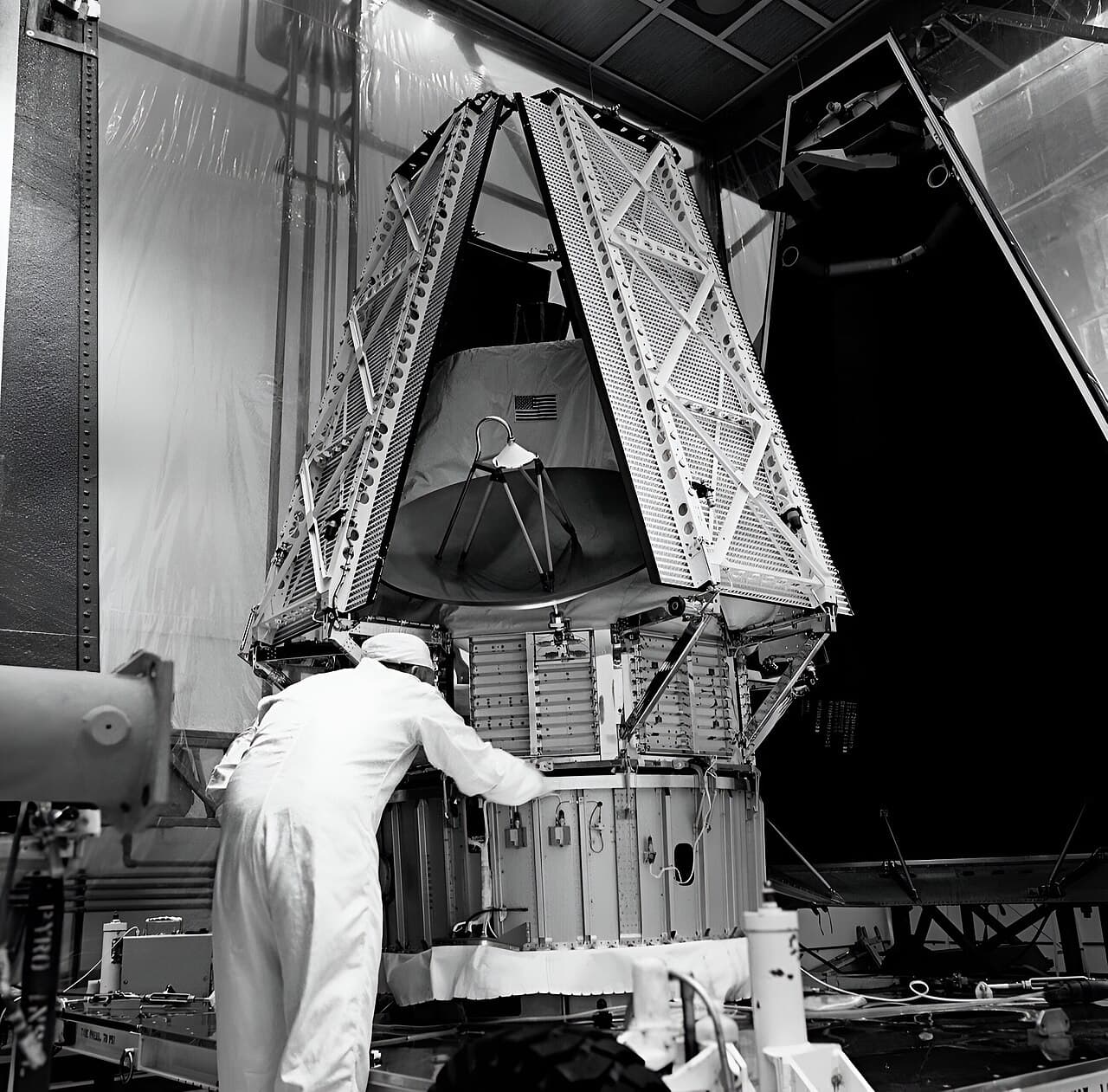
The Mariner Mars 1971 project was designed as a pair. Two identical orbiters, known before launch by letters rather than numbers, would split the work: Mariner H would fly Mission A and photograph about 70 percent of the surface at medium resolution, while Mariner I flew Mission B and watched selected places change over time. Mariner H left Cape Kennedy on 8 May 1971 local time (01:11 UTC on 9 May). The Centaur upper stage began oscillating after ignition, shut down early, and dropped the spacecraft into the Atlantic. Engineers traced the failure to a faulty diode on a circuit board. That left one spacecraft and 22 days to rebuild two missions into one. Mariner I lifted off on 30 May 1971 at 22:23:04 UTC on Atlas-Centaur AC-23 from Launch Complex 36B, six minutes into its window after a scrub the previous evening, and became Mariner 9 once it was safely away. It weighed 997.9 kg fully fuelled, of which 439.1 kg was propellant and pressurant, and carried 63.1 kg of instruments on a steerable scan platform: two television cameras, an infrared radiometer, an ultraviolet spectrometer and an infrared interferometer spectrometer, with the radio link doing double duty as an occultation and gravity experiment. A single midcourse correction on 5 June, a 5.1 second burn worth 6.7 m/s, was so accurate that the second correction, pencilled in for 26 October, was waived.
On 22 September 1971, with Mariner 9 still seven weeks out, ground-based astronomers watched a bright cloud spread across the Noachis region of Mars. Within three days it had covered a distance two thirds of the way around the planet, and by the first week of October most of Mars had vanished. The first pictures Mariner 9 sent back, on 8 November, showed a blank disk. One scientist joked that they must have gone to Venus by mistake, and the joke was not well received. Harold Masursky, who led the television team, said the storm shook everybody up because they could in effect see nothing. The elaborate mapping plan, which needed 20 days of orbital photography to build a control net before real work began, was simply dumped. The insertion burn went ahead regardless. The engine lit at 00:17:39 UTC on 14 November 1971, burned for 915.4 seconds, took 1,600.5 m/s off the spacecraft's speed and left it circling Mars every 12 hours and 34 minutes. Being in orbit rather than flying past is what saved the mission: an orbiter can wait out weather, and this one did, filling the time by photographing the moons. The Soviet Mars 2 and Mars 3 arrived on 27 November and 2 December and released landers that could not wait. The Mars 2 descent module entered too steeply and crashed. The Mars 3 lander reached the surface intact, the first soft landing on Mars, and fell silent about twenty seconds into its first picture. NASA's history of the period records that Soviet scientists blamed the storm; NPO Lavochkin's own anniversary account attributes the Mars 2 lander's loss to an entry angle far outside its limits.
Four dark spots showed through the murk, along with the south polar cap. Working from classical maps and Earth-based radar, the imaging team matched one of them to Nix Olympica, the Snows of Olympus, a bright patch telescopic observers had puzzled over for decades and which radar had already flagged as high ground. Computer enhancement of the 14 November frames found volcanic craters on the summits of all four mountains, and when they were rephotographed closer in, they strongly resembled terrestrial calderas. The other three were catalogued by position at first. North Spot, Middle Spot and South Spot became Ascraeus Mons, Pavonis Mons and Arsia Mons when the IAU approved Martian names in 1973, and Nix Olympica became Olympus Mons. On 17 November a bright streak appeared along the classical canal Coprates. As the dust settled through December and January it resolved into a rift system that NASA describes as more than 4,000 km long, up to 200 km wide and more than 7 km deep in places, with the USGS putting the deepest floors nearer 10 km below the plateau and merged troughs as much as 600 km across. It was named Valles Marineris in honour of the mission. Elsewhere the cameras found sinuous channels with tributaries, and Masursky told reporters that his team was hard put to find a mechanism other than water to cut them. Mars had been a dead cratered ball since Mariner 4 flew past in 1965. Mariner 9 replaced that planet with one that had volcanoes, fault zones, polar caps seen in detail for the first time and, most unsettling of all, dry riverbeds.
Mapping was patient, repetitive work. The orbit was tuned so that 35 revolutions equalled 17 Martian solar days, which meant the ground track repeated with the Sun in nearly the same place, and the second trim on 30 December 1971 raised periapsis to 1,650 km and set the period at 11 hours 59 minutes 28 seconds so periapsis would fall over Goldstone's 64 m antenna. Systematic mapping began on revolution 100, on 2 January 1972, at 32 pictures a revolution, with each longitude band taking 39 revolutions. The spacecraft aged as it worked. A travelling-wave-tube amplifier failed on revolution 48 and the backup took over. The wide-angle camera's filter wheel jammed on revolution 118 and stayed jammed, leaving only the 60 degree polarising filter, so the team substituted narrow-angle frames. A ground command error on revolution 31 drove the scan platform against its stops for about an hour while chasing Phobos. Mariner 9 nevertheless returned the first resolved pictures of both Martian moons, close enough to show that Phobos is a battered, irregular lump, and it refined their orbits enough for the cameras to find them reliably. NASA announced on 11 February 1972 that the mission had met all its objectives, and the standard 90-day mission closed the next day. The spacecraft then stood down from 2 April, while solar occultations shaded its panels and Goldstone was busy relaying Apollo 16, before beginning an extended mission on 4 June 1972.
The end came from the smallest tank aboard. Attitude control used cold nitrogen jets on the solar panel tips, and once that gas was gone the spacecraft could no longer hold its aim. On 27 October 1972 controllers at JPL sent the command that shut down the transmitters; last contact is logged at 22:32 UTC. Mariner 9 had spent 348 days in Mars orbit and returned 7,329 pictures and 54 billion bits of data. Those images became the first global map of Mars and the basis for choosing where Viking would land three years later. Its tracking data went into a time-delay test of general relativity by Irwin Shapiro and Robert Reasenberg, who could not yet separate Einstein's prediction from a scalar-tensor rival and quoted an uncertainty of about 10 percent on (1 + gamma)/2, the quantity the time delay measures. Its infrared spectrometer weighed the airborne dust and found it silicate rich, near 60 percent silica. Its ultraviolet and infrared instruments had meanwhile observed large parts of the planet alongside the cameras. The spacecraft itself was left in the orbit it had flown, and NSSDCA's entry says only that the orbit should not decay for at least 50 years. Predictions of a fiery arrival in 2020, and then 2022, have circulated for years, and nobody has announced that it happened. As of 24 September 2026 the honest answer is that the first spacecraft to orbit another planet is most likely still going round, unpowered and silent, with no published observation either way.
Mission facts
Launch
30 May 1971, 22:23:04 UTC (6:23 p.m. EDT), Atlas-Centaur AC-23 (Atlas SLV-3C s/n 5404, Centaur s/n 21D) from Launch Complex 36B, Cape Canaveral, on a flight azimuth of 92.742 deg. The first countdown, on 29 May, was scrubbed at 22:01 UTC over a suspect pitch-channel reading; the next day's launch went six minutes into the window.↗
Mass
997.9 kg at launch, of which 439.1 kg was expendables (propellant and pressurant), leaving 558.8 kg dry. Science instruments accounted for 63.1 kg. NSSDCA's summary box quotes the 558.8 kg dry figure, which is why two different masses circulate.↗
Spacecraft
Octagonal magnesium bus 45.7 cm deep and 138.4 cm across the diagonal, 2.28 m tall, with four solar panels of 215 x 90 cm spanning 6.89 m tip to tip. 14,742 solar cells produced 800 W at Earth and 500 W at Mars, backed by a 20 amp-hour nickel-cadmium battery.↗
Instruments
Wide-angle A and narrow-angle B television cameras, infrared radiometer (IRR), ultraviolet spectrometer (UVS) and infrared interferometer spectrometer (IRIS), all bore-sighted on a steerable scan platform, plus two experiments that needed no hardware of their own: S-band radio occultation and celestial mechanics.↗
Data handling
A 168 m, 8-track reel-to-reel tape recorder held 180 million bits, written at 132 kbit/s. Peak downlink was 16,200 bit/s to the 64 m Goldstone antenna and 2,025 bit/s elsewhere in the Deep Space Network.↗
Midcourse correction
One only. The sequence started 4 June 1971 and the engine burned at 00:22:00 UTC on 5 June 1971 for 5.1 s, changing velocity by 6.7 m/s with an error of 0.008 m/s. A second correction pencilled in for 26 October 1971 was waived as unnecessary. Sources that date the manoeuvre to 4 June are using Pacific time (JPL's own table puts it at 5:22 p.m. PDT on 4 June) or dating the start of the sequence; in UTC the engine burned the following day.↗
Mars orbit insertion
Engine ignition at 00:17:39 UTC on 14 November 1971 (16:17 Pacific time on 13 November), burning 915.4 s for a velocity change of 1,600.5 m/s, an error of 0.147 m/s against target. The project chronology logs the manoeuvre complete at 16:39 PST. Flight time from launch was 167 days.↗
Insertion orbit
Period 12 h 34 min 1 s, periapsis altitude 1,398 km, inclination 64.4 deg to the Martian equator and an apsidal rotation angle of 139.7 deg, per JPL's final report. NASA's mission page gives the apoapsis as about 17,916 km and NSSDCA's trajectory page 17,915 km, at an inclination NASA rounds to 64.3 deg. The planned orbit had been 12 h 25 min with a 1,350 km periapsis.↗
Orbit trims
OTM-1 ignited 02:37:53 UTC on 16 November 1971 (15 November Pacific time), 6.4 s and 15.25 m/s, aimed at the 11 h 58 min 48 s period needed to synchronise periapsis passes with Goldstone zenith; the mean period actually achieved was 11 h 58 min 14 s, a 34 s difference JPL logged and lived with. OTM-2 on 30 December 1971 burned 17.3 s for 41.8 m/s, raising periapsis to 1,650 km and setting the period at 11 h 59 min 28 s so that periapsis passages stayed synchronised with Goldstone.↗
Ground track
The 11.98 h period was chosen as 17/35 of a Martian solar day (24.660 h), so after 35 revolutions and 17 Martian days the ground track repeated under almost identical lighting. That repeatability is what made change detection possible.↗
The dust storm
Began 22 September 1971 in the Noachis region and spread two thirds of the way around Mars in three days. By the first week of October a zone some 12,000 km long had been obscured in 16 days. Craters and a bright streak along Coprates were showing through by 17 November, but the dust cleared slowly, and systematic mapping began only on 2 January 1972.↗
Mapping
Systematic mapping opened with the map 1 cycle on revolution 100, beginning 2 January 1972, at 32 pictures per revolution; each longitude band took 39 revolutions, a little under 20 days. The 90-day standard mission closed on 12 February 1972, the day JPL's chronology also logs as the start of the extended mission. After a stand-down that began with solar occultations on 2 April, operations resumed on 4 June 1972, the date NASA SP-4212 gives for the start of the extended mission.↗
Returns
7,329 pictures and 54 billion bits of science data, mapping 85 percent of the surface at 1 to 2 km resolution, including at least 80 frames of Phobos and Deimos. The 85 percent is NASA's mission page; NSSDCA and NASA SP-4212 instead describe the final coverage as the entire planet. JPL's own operations tally shows 6,848 pictures received in flight through revolution 262 on 23 March 1972, so most of the haul came in the first four months of mapping.↗
End of mission
The attitude-control nitrogen ran out and JPL sent the command that shut down the transmitters. Last contact is logged at 22:32 UTC on 27 October 1972, after 348 days in Mars orbit. The spacecraft was not lost; it was switched off.↗
Valles Marineris
NASA's summary gives more than 4,000 km long, up to 200 km wide and more than 7 km deep in places. The USGS puts individual troughs at 50 to 100 km wide, merged depressions at as much as 600 km, and the deepest floors at about 10 km, six to seven times the depth of the Grand Canyon. The name, approved by the IAU in 1973, honours the mission.↗
Cost
$129 million for the basic 90-day Mariner Mars '71 mission in 1971 dollars, excluding launch vehicles and data acquisition, per the pre-launch press kit. That figure is for the two-spacecraft project as quoted before Mariner 8 was lost, so it covers more than Mariner 9 alone. The $554 million figure that appears in some Mariner 9 summaries is NSSDCA's research, development, launch and support total for Mariners 1 through 10.↗
Mission timeline
- 9 May 197101:11:02 UTC (8 May, EDT): Mariner 8 is lost when the Centaur upper stage oscillates, shuts down early and drops the spacecraft into the Atlantic. The failure is traced to a faulty diode on a circuit board, and two missions must be merged into one in 22 days.
- 30 May 197122:23:04 UTC: Launch on Atlas-Centaur AC-23 from Launch Complex 36B, Cape Canaveral, six minutes into the window.
- 5 Jun 197100:22:00 UTC: The only midcourse correction, a 5.1 s burn worth 6.7 m/s. It is accurate enough that the second correction, planned for 26 October, is cancelled.
- 22 Sep 1971Ground-based astronomers see a bright cloud spread across the Noachis region. It grows into a planet-encircling storm that NASA's history of the period calls the greatest and most widespread yet recorded, and it is still raging when Mariner 9 arrives.
- 8 Nov 1971The first pictures come back. They are essentially camera calibration shots, and they show a featureless disk. One scientist jokes that the spacecraft has gone to Venus by mistake.
- 14 Nov 197100:17:39 UTC: The engine lights for 915.4 s and slows the spacecraft by 1,600.5 m/s, making Mariner 9 the first spacecraft to orbit another planet. Computer enhancement of the same day's frames finds volcanic craters on the summits of four mountains standing above the dust.
- 29 Nov 1971Revolution 31: a special sequence to photograph Phobos goes wrong when a ground command cannot be sent and the scan platform is driven against its stops for about an hour. Nothing is damaged, and Mariner 9 goes on to return the first properly resolved views of both Martian moons.
- 30 Dec 1971Orbit trim 2 raises periapsis to 1,650 km and sets the period at 11 h 59 min 28 s, locking periapsis passes to the Goldstone 64 m antenna.
- 2 Jan 1972Revolution 100: with the dust finally settling, systematic mapping begins at 32 pictures per revolution, covering 65 deg S to 20 deg S in the first band.
- 12 Feb 1972The 90-day standard mission ends. NASA had announced the day before that Mariner 9 had achieved all of its goals, and the spacecraft keeps working anyway.
- 4 Jun 1972The extended mission begins after a stand-down that started with solar occultations on 2 April, during which Goldstone was also needed for Apollo 16. The extension completes the global map and photographs candidate Viking landing sites.
- 27 Oct 197222:32 UTC: Last contact. With the attitude-control nitrogen exhausted, JPL commands the transmitters off after 348 days in orbit.
A filled dot marks something that physically happened. A hollow one marks an announcement, a naming or a target.
In pictures
Tap a photo to enlarge.
Sources
- NSSDCA Master Catalog: Mariner 9 (1971-051A), archived snapshot
- USGS Astrogeology: Valles Marineris, the Grand Canyon of Mars
- JPL Technical Report 32-1550 Vol. I: Mariner Mars 1971 Project Final Report, development through launch and trajectory correction (Apr 1973)
- JPL Technical Report 32-1550 Vol. III: Mission Operations System implementation and standard mission flight operations
- NASA/JPL Mariner Mars '71 press kit (1971)
- NASA Science: Mariner 9 mission page
- NASA History: 50 Years Ago, Mariner 9 Launches to Orbit Mars (John Uri, 2021)
- Ezell and Ezell, On Mars: Exploration of the Red Planet 1958-1978 (NASA SP-4212), archived PDF
- Shapiro and Reasenberg, Time-delay test of general relativity from Mariner 9 tracking data (NTRS)
- Hanel et al., Investigation of the Martian environment by infrared spectroscopy on Mariner 9, Icarus 17 (1972)
- Linda Hall Library, Scientist of the Day: Mariner 9 (William B. Ashworth Jr., 30 May 2025)
- NPO Lavochkin: Pervye na Marse, AMS Mars-2 i Mars-3 (Russian, 19 May 2021), archived snapshot
- NSSDCA Master Catalog: Mariner 9 trajectory details, archived snapshot
- USGS Gazetteer of Planetary Nomenclature: Valles Marineris
- Hanel et al., Investigation of the Martian environment by infrared spectroscopy on Mariner 9 (NTRS record of the Icarus paper)
Facts on this page were verified on 24 September 2026. Where sources disagree, the disagreement is stated rather than resolved silently.