Mariner 8
NASA · United States · Orbiter · 1971 · Reaching MarsFailure
Lost on 9 May 1971 when the Centaur upper stage lost pitch control about 4.7 minutes after liftoff. It fell into the Atlantic, and its mapping mission was folded into Mariner 9.
TL;DR· 10 min read
Mariner 8 was assigned to map roughly 70 percent of Mars from a steep twelve-hour orbit. Less than five minutes after liftoff on 9 May 1971 the Centaur upper stage lost pitch control, tumbled and starved, and the spacecraft fell into the Atlantic northwest of Puerto Rico. The cause was traced to a single uA709 integrated circuit in the Centaur's pitch rate gyro preamplifier. Its mapping work was folded into Mariner 9, which flew 22 days later into a compromise orbit and carried both missions at once.
Mariner 8 was the first half of a two-spacecraft plan to make Mars a place that could be watched rather than glimpsed. It was assigned the mapping mission: a steep, twelve-hour orbit from which it would photograph about 70 percent of the surface. Less than five minutes after liftoff the Centaur upper stage lost control in pitch, tumbled and shut down, and the spacecraft fell into the Atlantic northwest of Puerto Rico. The failure was eventually traced to one integrated circuit the size of a grain of rice.
- 28 sinto the Centaur burn before the stage began to tumble
- 70%of the Martian surface it was assigned to map
- 22 daysthe failure added before Mariner 9 could fly, against a planned 10
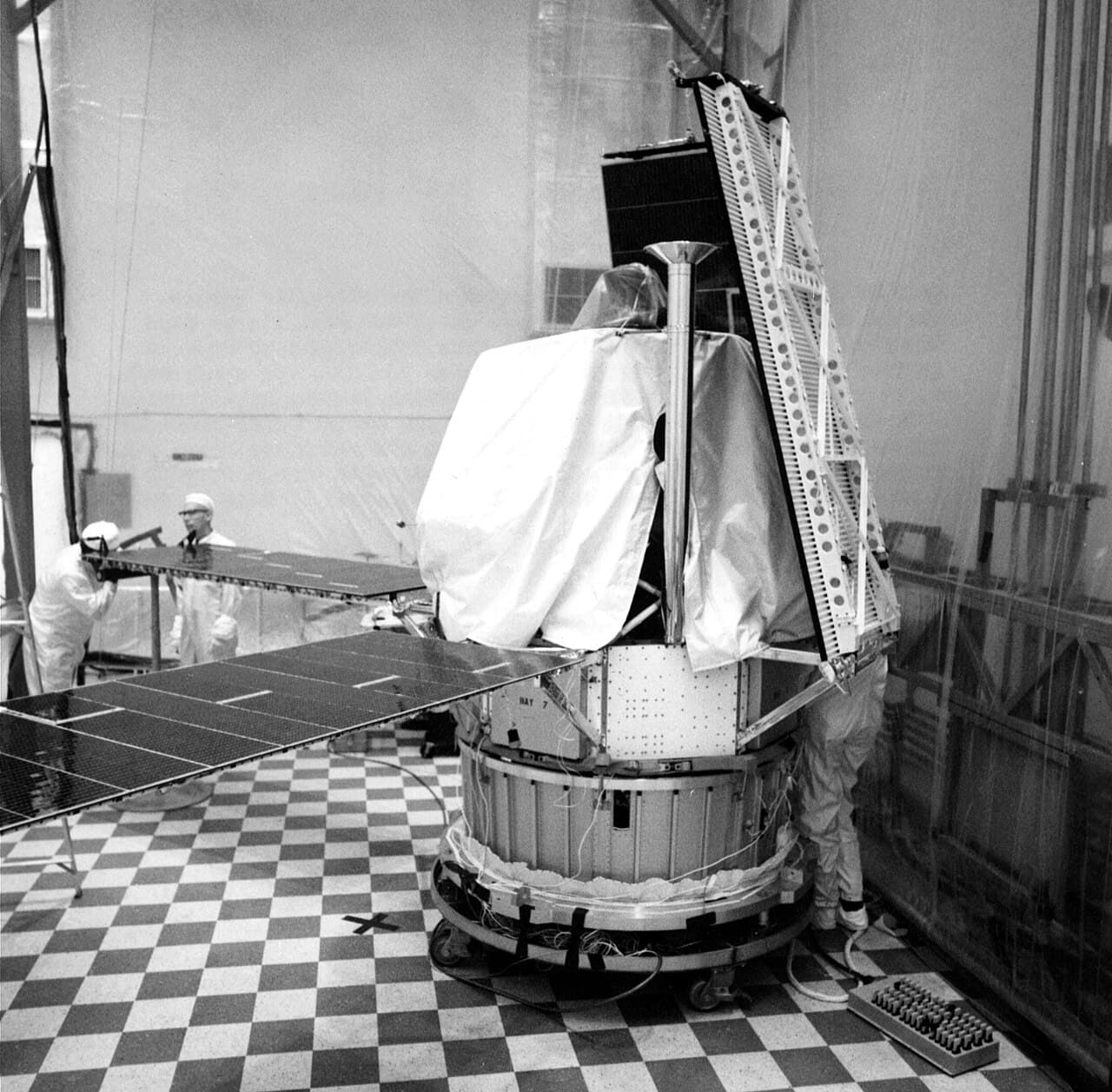
The Mariner Mars 1971 project was designed around two spacecraft doing two different jobs, because one orbit cannot do both. To map a planet you want a steep orbit that carries you over high latitudes as the planet turns beneath, so the ground track eventually covers everything; to watch a planet change you want a lower-inclination orbit whose period is tuned to the Martian day, so you come back to the same places under the same lighting again and again. Mariner-H, the spacecraft that became Mariner 8, was assigned the mapping job: 80 degrees inclination, a twelve-hour period and a closest approach of 750 miles, from which it would photograph roughly 70 percent of the surface over at least ninety days. Mariner-I, which became Mariner 9, drew the other job at 50 degrees, a 20.5 hour period and a 550 mile periapsis, revisiting six chosen areas to record seasonal and dust changes. The hardware was identical and either spacecraft could have flown either mission; only the flight plan separated them. Both were also new in a specific way. Every previous Mariner had flown past its target. These carried a restartable 1,340 newton engine and enough propellant for a 1,600 metre per second braking burn, an entirely redesigned propulsion system, because for the first time an American spacecraft was going to stop at Mars.
Mariner 8 lifted off from Launch Complex 36A at Cape Kennedy on 9 May 1971 at 01:11:02.294 GMT, which was ten past nine on the evening of 8 May in Florida. The Atlas performed. The trouble began at Centaur main engine start, and it began invisibly: the gain in the pitch rate channel, the loop that tells the engines how hard to push back against an unwanted rotation, came up at only 20 to 40 percent of what it should have been. A rate gyro measures how fast the vehicle is turning, and its signal is what damps a steering command so the rocket settles onto a new attitude instead of overshooting it. With that damping weak, the vehicle was stable only while it was being asked to do nothing. Four seconds after ignition, when the guidance system started steering, the pitch motion began to diverge. Twenty-four seconds after that the engines went to fixed positions and the stack started to tumble. Roll and yaw stayed normal the whole time, which is exactly the signature of a single failed channel. Eighty-six seconds after ignition the payload telemetry cut out as the spacecraft came off the stage, and two seconds later the tumbling had thrown the propellants away from the pump inlets and the engines starved. The wreckage hit the Atlantic about ten minutes after launch, 1,665 kilometres downrange and some 560 kilometres northwest of Puerto Rico.
The investigation was fast and unusually conclusive. A first-look review ran the night of the launch, with NASA Lewis, JPL, Kennedy, General Dynamics, Minneapolis-Honeywell and Pratt and Whitney in the room, and it put the fault in the pitch channel of the Centaur flight control system before morning. General Dynamics then built a computer simulation of that flight control system, worked through root-locus analysis and analogue simulation, and finally installed real hardware in the loop. A prototype gyro canister with a deliberately failed part reproduced the flight records. The single cause was a uA709 integrated circuit in the pitch rate gyro preamplifier. JPL's public statement on 26 May put it slightly differently, saying the integrated circuit failed apparently because a protective diode had malfunctioned, and both descriptions survive in later accounts, which is why some sources blame a diode and others a chip. The fix was a partial redesign of the rate gyro package plus much harsher acceptance testing: temperature cycling for dc offset, elevated temperature and vibration, deliberate attempts to provoke dc latch-up, and explicit checks of the amplifier input diodes. Engineers also looked hard at flying a replacement. The proof test model spacecraft could have been brought to flight standard, a Centaur and Atlas could have been found, and a nose fairing could have been modified in time. Everyone agreed it was possible and that it needed money. NASA said no.
What was left was one spacecraft and two missions, so JPL merged them. Mariner 9 flew on 30 May into a compromise orbit at 65 degrees inclination with an 11.98 hour period, a number chosen because it is 17/35 of a Martian solar day, so that after seventeen Martian days and thirty-five orbits the ground track repeats under nearly identical lighting. That single choice preserved the variable-features work, expanded from six target areas to seventeen, while the inclination kept enough polar reach for mapping. It worked better than the original plan deserved. Mariner 9 arrived on 14 November 1971 GMT to find Mars buried under a global dust storm, waited it out, and then returned a near-complete map of the planet plus the discovery of Olympus Mons and Valles Marineris, doing in one mission what two had been budgeted for. Mariner 8's own name is a small historical oddity: it flew as Mariner-H, never reached Earth orbit, and was still given the number 8, a point JPL's final report felt the need to footnote. NASA's history office describes it as the last American planetary spacecraft lost to a launch vehicle failure, a claim that holds if you count CONTOUR's 2002 destruction as a spacecraft failure rather than a launch vehicle one, since its Delta II had already delivered it to orbit.
Mission facts
Launch
9 May 1971 at 01:11:02.294 GMT, which was 21:11 EDT on 8 May, from Launch Complex 36A at Cape Kennedy Air Force Station, on a flight azimuth of 101.95 degrees at the opening of the day's window↗
Launch vehicle
Atlas-Centaur AC-24, comprising Atlas SLV-3C serial 5405 and Centaur D-1A serial 22D↗
Spacecraft names
Built and flown as Mariner-H, the first Mariner Mars 1971 flight article (MM71-1). JPL's own final report notes that it was still designated Mariner 8 even though the Centaur never injected it toward Mars↗
Mass
997.9 kg at launch, of which 439.1 kg were expendables, leaving a dry mass of 558.8 kg. The science instruments came to 63.1 kg↗
Instruments
Wide-angle and narrow-angle television cameras, an infrared radiometer, an ultraviolet spectrometer and an infrared interferometer spectrometer (IRIS), all mounted on a steerable scan platform, plus S-band occultation and celestial mechanics experiments using the radio link↗
Assigned mission
An orbit inclined 80 degrees with a 12 hour period and a periapsis of 750 miles (about 1,207 km), from which it would map roughly 70 percent of the Martian surface over at least 90 days↗
Twin's mission
Mariner-I, the second spacecraft, was assigned 50 degrees inclination, a 20.5 hour period and a 550 mile periapsis, to watch six areas for changes in the atmosphere and on the surface over time↗
Launch period
7 May to 4 June 1971, with daily windows of 30 to 90 minutes set by launch vehicle performance. The two spacecraft were to arrive at Mars on 14 and 21 November 1971↗
Failure sequence
At Centaur main engine start the pitch rate channel gain was only 20 to 40 percent of nominal. At MES plus 4 s, when guidance steering began, pitch motion turned divergent. At MES plus 28 s the engines went to fixed pitch positions and the vehicle began to tumble. The payload telemetry channel was lost at MES plus 86 s as the spacecraft separated, and 2 s later the Centaur shut down from propellant starvation. Roll and yaw were normal throughout↗
Impact
The Atlantic Ocean about 600 s after launch, 1,665 km (900 nautical miles) downrange and roughly 560 km (350 miles) northwest of Puerto Rico. NSSDCA gives about 1,500 km downrange and 560 km north; Siddiqi gives about 400 km north↗
Cause
Simulation using a prototype gyro canister reproduced the flight conditions and pinpointed the failure to the uA709 integrated circuit in the Centaur's pitch rate gyro preamplifier. JPL's release of 26 May 1971 put it as an integrated circuit failing apparently because a protective diode had malfunctioned↗
Corrective action
Partial redesign of the rate gyro package plus expanded acceptance testing (temperature cycling for dc offset, elevated temperature and vibration, high-rate and high-guidance-input latch-up tests, and checks of the amplifier input diodes) and countdown procedure changes. AC-23's rate package was tested to the new standard and then swapped for an even more extensively tested unit↗
A third launch
Engineers concluded a replacement flight was physically possible within the contingency launch period, using the proof test model spacecraft fitted with new solar panels, a modified nose fairing and a spare Centaur. NASA declined for lack of funds↗
Prelaunch trouble
The IRIS instrument on MM71-1 failed on 22 April 1971 because of a capacitor problem affecting all units. A repaired and retested IRIS arrived at the Cape on 3 May and was installed, and the spacecraft was mated to AC-24 on Pad 36A the same day↗
What replaced it
Mariner 9 launched on 30 May 1971 on AC-23 from Pad 36B, 22 days after Mariner 8 rather than the planned 10, into a compromise orbit of 65 degrees inclination, an 11.98 hour period and a periapsis of 1,200 to 1,500 km, carrying both missions at once↗
Programme cost
NSSDCA puts total research, development, launch and support costs for the whole Mariner series, Mariners 1 through 10, at about $554 million in then-year dollars↗
Mission timeline
- 22 Apr 1971The IRIS infrared spectrometer on Mariner 8 fails during prelaunch testing; a capacitor fault affects every unit and the launch schedule is now set by IRIS repair
- 3 May 1971A repaired IRIS is installed and the spacecraft is mated to AC-24 on Pad 36A
- 9 May 197101:11:02 GMT: launch from Complex 36A at the opening of the window, on a 21 C night with scattered cloud and two knots of surface wind
- 9 May 1971About 270 s in, radar shows the vehicle is off its predicted altitude track. Pitch control degrades from Centaur ignition, the stack tumbles, the engines starve and shut down, and the spacecraft hits the Atlantic about 600 s after launch
- 9 May 1971A first-look failure review is held the same night with NASA Lewis, JPL, Kennedy Space Center, General Dynamics, Minneapolis-Honeywell and Pratt and Whitney. The pitch channel of the Centaur flight control system is identified as the culprit
- 10 May 1971The USSR launches Kosmos 419, the orbiter meant to reach Mars ahead of the American pair. Its upper stage never restarts and it stays in Earth orbit
- 11 May 1971Mariner 9 is mated to AC-23 on Pad 36B for interface tests while the investigation continues
- 13 May 1971A special radio frequency interference test is run to see whether the spacecraft could have contributed to the AC-24 failure. The results show no effect on AC-23, and the investigation stays with the launch vehicle
- 26 May 1971A second Launch Readiness Review clears AC-23, and JPL announces the rewritten single-spacecraft mission: 65 degrees inclination, a 12 hour period and 17 target areas for variable features instead of six
- 30 May 1971Mariner 9 launches successfully, 22 days after its twin
- 14 Nov 1971Mariner 9 arrives at Mars on the date Mariner 8 had been targeting and becomes the first spacecraft to orbit another planet. NASA history pages date the insertion 13 November using US local time; JPL's project report gives the arrival as 14 November GMT
A filled dot marks something that physically happened. A hollow one marks an announcement, a naming or a target.
In pictures
Tap a photo to enlarge.
Sources
- JPL Technical Report 32-1550 Vol. I, Mariner Mars 1971 Project Final Report: Project Development Through Launch and Trajectory Correction Maneuver (April 1973), NTRS record
- JPL Technical Report 32-1550 Vol. I, full PDF
- NSSDCA Master Catalog: Mariner-H / Mariner 8 (archived Aug 2025)
- JPL news release, 26 May 1971: Mariner I Assigned New Mission
- NASA history: 50 Years Ago, Mariner 9 Launches to Orbit Mars
- NASA history: 50 Years Ago, Mariner 9 Enters Mars Orbit
- Asif A. Siddiqi, Beyond Earth: A Chronicle of Deep Space Exploration, NASA SP-2018-4041 (PDF)
- Jonathan McDowell, GCAT launch table
- NSSDCA Master Catalog: Cosmos 419 (archived Aug 2025)
Facts on this page were verified on 23 August 2026. Where sources disagree, the disagreement is stated rather than resolved silently.