Kosmos 419
USSR · Soviet Union · Orbiter · 1971 · Reaching MarsFailure
Reached Earth parking orbit on 10 May 1971, but its Blok D upper stage never restarted because the wrong ignition time had been loaded into the onboard computer. It reentered on 12 May 1971.
TL;DR· 10 min read
Kosmos 419 was a stripped-down Soviet orbiter with no lander, added to the 1971 Mars plan to reach Mars orbit before the Americans did. It launched on 10 May 1971 and reached its parking orbit perfectly, but the Blok D upper stage never restarted: an error in one digit of the ignition time set the engine to fire after roughly 150 hours instead of a few tens of minutes. It reentered on 12 May 1971, and the Soviet press announced it as one more Kosmos satellite.
Kosmos 419 was a Soviet orbiter added to the 1971 Mars plan for one reason: to get into orbit around Mars before the Americans did. It was a stripped-down spacecraft with no lander, launched a day after Mariner 8 failed, and it reached Earth orbit perfectly. Then the upper stage that was meant to push it toward Mars sat there and did nothing, because a single wrong digit in the ignition time told its computer to fire in about 150 hours instead of a few tens of minutes. Two days later it burned up over Earth, and the Soviet press called it another Kosmos satellite.
- 150 hthe ignition delay loaded into the computer, instead of a few tens of minutes
- 2 daysfrom launch to reentry
- 1 of 3Soviet Mars spacecraft launched in the 1971 window
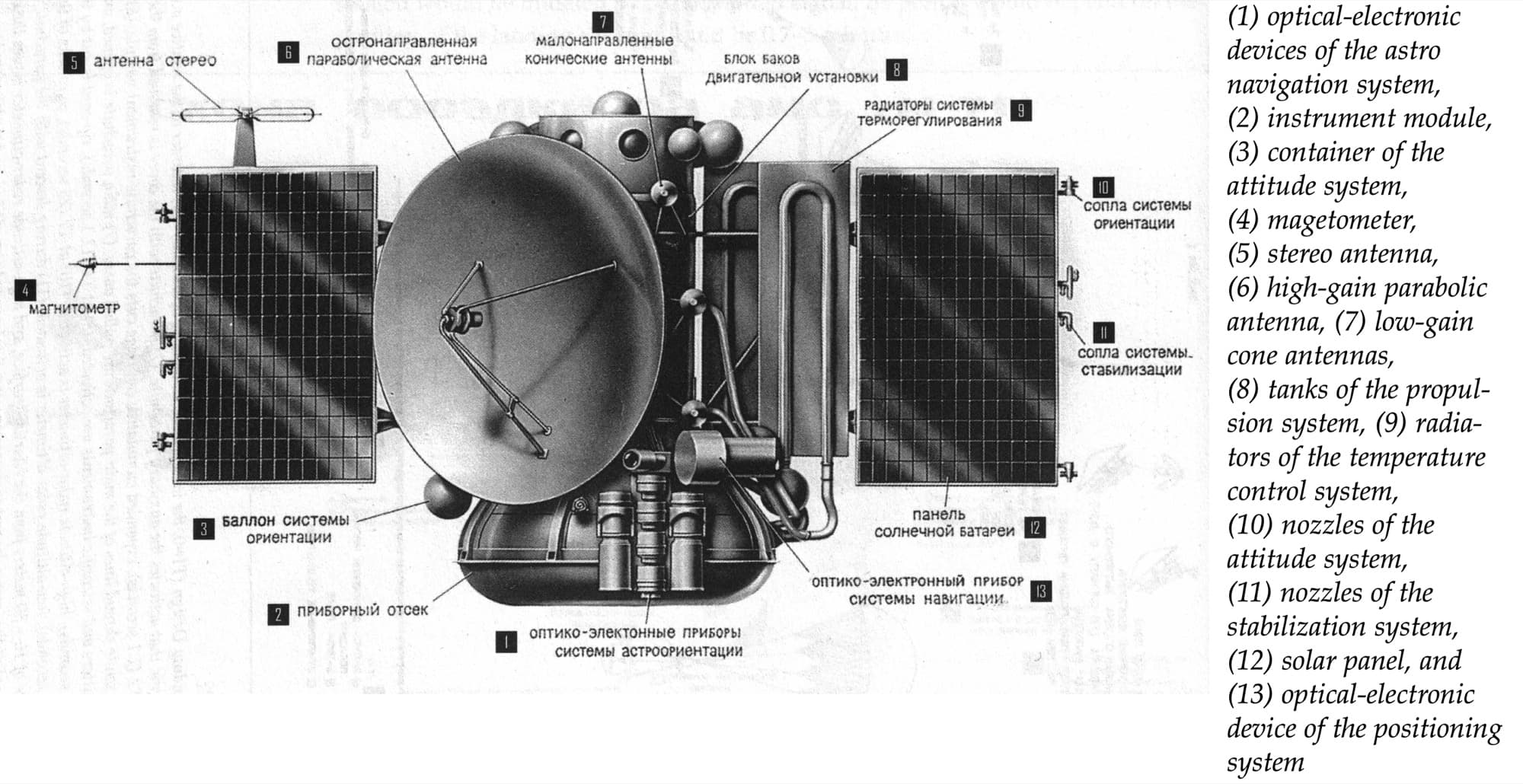
By 1971 the Soviet Mars programme had a plan and a problem. The plan was two spacecraft of the M-71 type, each an orbiter carrying a lander, launched into the most favourable Mars window in fifteen years. The problem was that NASA was sending two orbiters of its own into the same window, and whoever arrived first would own the phrase first spacecraft to orbit another planet. So Lavochkin added a third vehicle. The 3MS, also written M-71S, was a lightened version of the same design with the descent module removed, and its job was to get to Mars orbit ahead of the Mariners. It had a second, quieter job that mattered more to the engineers. Nobody knew exactly where Mars was, to the precision a lander needs. The distance and direction to the planet were known well enough for a flyby and not well enough to choose an atmospheric entry angle, and an entry angle that is a couple of degrees too steep will kill a lander. An orbiter arriving early would fix the planet's position by radio and act as a beacon for the two that followed. It was also the first Soviet interplanetary spacecraft to carry an onboard digital computer, which was supposed to compute those entry settings for the landers.
It launched on 10 May 1971 at 16:58:42 UTC from Pad 23 at Site 81, one day after Mariner 8 fell into the Atlantic. The Proton worked exactly as advertised and put the spacecraft and its Blok D upper stage into a low parking orbit of roughly 145 by 159 kilometres. That is not the end of the journey. A trans-Mars injection from parking orbit has to happen at a particular point on a particular orbit, which for this trajectory meant a burn about an hour after launch, over the Atlantic near the Gulf of Guinea, where the Soviet Union kept a tracking ship for exactly this purpose. The ship reported nothing. A few minutes later the stack came over the Yevpatoria control station in Crimea and the telemetry was unambiguous: the engine had not failed to light, it had never been told to. The command had not been issued. What was left was a four and a half tonne spacecraft in a 150 kilometre orbit, far too low to stay up, with a full upper stage attached and no way to use it. TASS announced Kosmos 419, one more entry in a numbered series that by then had absorbed a decade of failed Soviet planetary launches. It reentered on 12 May.
The cause was human and it was small. The ignition time for the Blok D had been loaded into the onboard computer with an error in one digit, so that instead of firing after a few tens of minutes, as the flight program called for, the engine was scheduled to fire after roughly 150 hours, by which time the spacecraft had long since burned up. Perminov, Lavochkin's lead designer for the Mars and Venus spacecraft, tells it slightly differently: an operator entered an eight-digit code command in the wrong order, and the result was that no start command was ever generated. The two versions describe the same kind of mistake and the same consequence, and the distinction between them has never been resolved in public. What is clear is what it was not. Nothing broke. The rocket flew, the stage was healthy, the spacecraft was alive. The most widely circulated version in English, that the timer was set for 1.5 years instead of 1.5 hours, appears in NASA's NSSDCA entry and in English Wikipedia, and Siddiqi notes it as a single report while giving 150 hours as the figure. The fix took days. Mars 2 flew on 19 May with a corrected program and Mars 3 on 28 May, and both got there.
The loss had a long tail. France had been promised that two copies of its Stereo-1 decametric radio astronomy instrument would go to Mars in 1971, and one of them was riding on Kosmos 419. Since the mission officially had nothing to do with Mars, the Soviet side could not say what had happened to it, and when only one working Stereo appeared aboard the pair that did leave for Mars, the French were allowed to conclude that the other instrument had simply failed. More seriously, Mars 2 and Mars 3 went to Mars without the ephemeris refinement and radio beacon their mission design had assumed, relying instead on an optical angle-measuring system approved as a backup in 1970. On 27 November 1971 the onboard computer aboard Mars 2 generated the wrong pre-separation settings through a software error, the lander entered too steeply for its parachute to help, and it was destroyed. Mars 3 landed on 2 December and transmitted for seconds. Mariner 9, the survivor of the American pair, had already entered Mars orbit on 14 November. The race Kosmos 419 was built to win was decided by a mistyped number in a computer at Baikonur.
Mission facts
Launch
10 May 1971 at 16:58:42 UTC (19:58:42 Moscow), Proton-K (8K82K no. 253-01) with a Blok D upper stage (11S824 no. 1101L), from Site 81 Pad 23 at Baikonur. The Russian-language accounts give the time as 20:24 Moscow, about 25 minutes later; the 16:58:42 UTC figure is used here because Siddiqi, McDowell's GCAT and the launch catalogues agree on it↗
Designations
3MS No. 170, also written M-71S. NSSDCA lists it as M-71S No. 170 and some catalogues call it Mars 1971C. The public name Kosmos 419 was a cover: Soviet practice was to give a Kosmos number to any planetary probe that ended up stuck in Earth orbit↗
Mass
4,549 kg according to Siddiqi and McDowell's catalogue, with a dry mass of 2,164 kg and about 17,909 kg for the whole stack including the Blok D. NSSDCA and Russian Wikipedia both give 4,650 kg, which is the figure Siddiqi assigns to Mars 2↗
Built by
NPO Lavochkin (GSMZ imeni Lavochkina), with the KTDU-425 main engine↗
Configuration
Orbiter only, with no descent module. A cylindrical propulsion tank block, a toroidal instrument compartment, deployable solar panels, thermal control radiators and antennas. It could also have relayed data from the landers carried by Mars 2 and Mars 3↗
Why it existed
The 1971 plan originally called for two orbiter and lander pairs. A third, lighter, orbiter-only spacecraft was added specifically to reach Mars orbit ahead of the American Mariner H and Mariner I, and to measure the planet's position precisely so the two landers could be aimed correctly↗
Onboard computer
The M-71 series carried the first onboard digital computer flown on a Soviet interplanetary spacecraft. Siddiqi names it the S-530 and describes it as a simplified Argon-11, the machine flown on the 7K-L1 Zond craft; the Russian account describes the relationship the other way round, calling the L-1 unit the simplified one. Its job included computing the lander entry settings↗
Instruments
Fluxgate magnetometer, infrared radiometer, infrared photometer, RIEP-2801 multi-channel plasma spectrometer, visible photometer, radiometer, ultraviolet photometer, cosmic ray detector, D-127 charged particle traps, an imaging system using the Vega and Zufar cameras, and the French Stereo-1 radio astronomy experiment↗
Parking orbit
145 by 159 km at 51.5 degrees inclination with an 87.4 minute period according to Siddiqi and the Russian technical account. Published figures vary widely: NSSDCA says 174 by 159 km at 51.4 degrees, McDowell's catalogue says 126 by 191 km at 51.46 degrees (the Russian Wikipedia infobox has 126 by 191 km at 51.4 degrees), English Wikipedia says 134 by 187 km↗
The failure
The Blok D never restarted for the trans-Mars burn. A wrong value for the ignition time had been entered into the onboard computer, and because of an error in one digit the engine was set to start after roughly 150 hours instead of the few tens of minutes the flight program called for↗
A competing account
Perminov, Lavochkin's lead designer for the Mars and Venus spacecraft, writes that the tracking ship in the Gulf of Guinea saw no ignition, that telemetry over the Yevpatoria station in Crimea showed no start command had been issued at all, and that an operator had entered an eight-digit code command in reverse order. He also dates the launch 5 May 1971, which is wrong, so his chronology should be treated with care↗
Reentry
12 May 1971, two days after launch. McDowell's catalogue gives the decay as roughly 20:10 UTC on 12 May↗
Catalogue identifiers
COSPAR designation 1971-042A, US satellite catalogue number 5221↗
The Stereo-1 problem
France had been promised that two copies of its Stereo-1 decametric radio experiment would fly to Mars in 1971. One was on Kosmos 419 and burned up, but the mission officially did not exist, so when the second Mars spacecraft appeared to have a non-working Stereo the Soviet side let the French believe it was an instrument fault↗
The fix
The cause was found quickly and the computer program was corrected. Mars 2 launched nine days later on 19 May 1971 and Mars 3 on 28 May 1971, and both reached Mars↗
What was lost
Without an early orbiter, the Soviet programme lost both the radio beacon and the improved measurement of Mars's position that Mars 2 and Mars 3 were to have used when aiming their landers, and had to fall back on an optical angle-measuring system designed as a backup in 1970↗
Mission timeline
- 9 May 1971Mariner 8 is destroyed by its Centaur upper stage, removing one of the two American orbiters that Kosmos 419 had been added to the plan to beat
- 10 May 197116:58:42 UTC: launch from Site 81 Pad 23. The Proton performs and the spacecraft reaches a 145 by 159 km parking orbit at 51.5 degrees
- 10 May 1971Roughly an hour later, over the Gulf of Guinea, the Soviet tracking ship sees no sign that the Blok D has ignited
- 10 May 1971Minutes afterwards the stack passes over the Yevpatoria control station in Crimea and telemetry shows that no engine start command was ever issued
- 12 May 1971The spacecraft and its dead upper stage reenter and burn up, two days after launch
- 19 May 1971Mars 2 launches with the corrected onboard computer program
- 28 May 1971Mars 3 launches, carrying the second Stereo-1 experiment
- 30 May 1971Mariner 9 launches, the surviving half of the American pair
- 14 Nov 1971Mariner 9 enters Mars orbit and becomes the first spacecraft to orbit another planet, the outcome Kosmos 419 was built to prevent
- 27 Nov 1971Mars 2 arrives. Its orbiter enters Mars orbit; its lander is sent in at too steep an angle by faulty settings from the onboard computer and is destroyed on impact
- 2 Dec 1971Mars 3 arrives and lands, transmitting for a matter of seconds from the surface
A filled dot marks something that physically happened. A hollow one marks an announcement, a naming or a target.
In pictures
Tap a photo to enlarge.
Sources
- NSSDCA Master Catalog: Cosmos 419, 1971-042A
- Asif A. Siddiqi, Beyond Earth: A Chronicle of Deep Space Exploration, NASA SP-2018-4041 (PDF)
- V. G. Perminov, The Difficult Road to Mars, NASA Monographs in Aerospace History 15 (PDF)
- Марсианское время: советские АМС серии М-71
- Russian Wikipedia: Космос-419
- Jonathan McDowell, GCAT launch table
- Jonathan McDowell, GCAT satellite catalogue
- RussianSpaceWeb: Soviet and Russian planetary spacecraft to Mars, mission index
- English Wikipedia: Kosmos 419
- JPL Technical Report 32-1550 Vol. I, Mariner Mars 1971 Project Final Report
Facts on this page were verified on 24 September 2026. Where sources disagree, the disagreement is stated rather than resolved silently.