PrOP-M
USSR · Soviet Union · Rover · 1970 · Reaching MarsFailure
Both lost without ever moving: two 4.5 kg ski-walking robots rode to Mars in 1971. The first was destroyed when Mars 2 hit the ground on 27 November; Mars 3 landed on 2 December and fell silent within two minutes.
TL;DR· 18 min read
PrOP-M was a pair of 4.5 kg ski-walking robots, tethered to their landers by a cable, that rode to Mars aboard Mars 2 and Mars 3 in 1971. Their job was to measure whether the ground would carry a vehicle, for a larger Soviet rover that was never built. Neither ever moved on Mars: the first was destroyed when the Mars 2 capsule hit the ground on 27 November 1971, and the second landed intact on 2 December 1971 but its lander fell silent within two minutes. The world outside the programme learned they existed in 1990.
PrOP-M was not built to explore Mars. Its name, Прибор оценки проходимости, Марс, means instrument for assessing trafficability, Mars, and its job was to find out whether the ground would carry a vehicle at all, so that the large Soviet rover planned for later could be designed against measurements instead of guesses. It weighed about as much as a full kettle, walked on two skis because nobody knew what the surface was made of, and stayed plugged into its lander by a cable because Mars is minutes of light away and no one on Earth could drive it. Two were sent in 1971. Neither ever moved on Mars, and for roughly two decades almost nobody outside the programme knew they had gone.
- 2PrOP-M rovers flown to Mars in 1971; neither ever returned a measurement
- 25 yr 7 mofrom the Mars 3 landing to Sojourner's first drive on Mars in July 1997
- 15 mtether in NSSDCA, Perminov and Siddiqi; VNIITransMash's space chief designer said 5 m in 2019
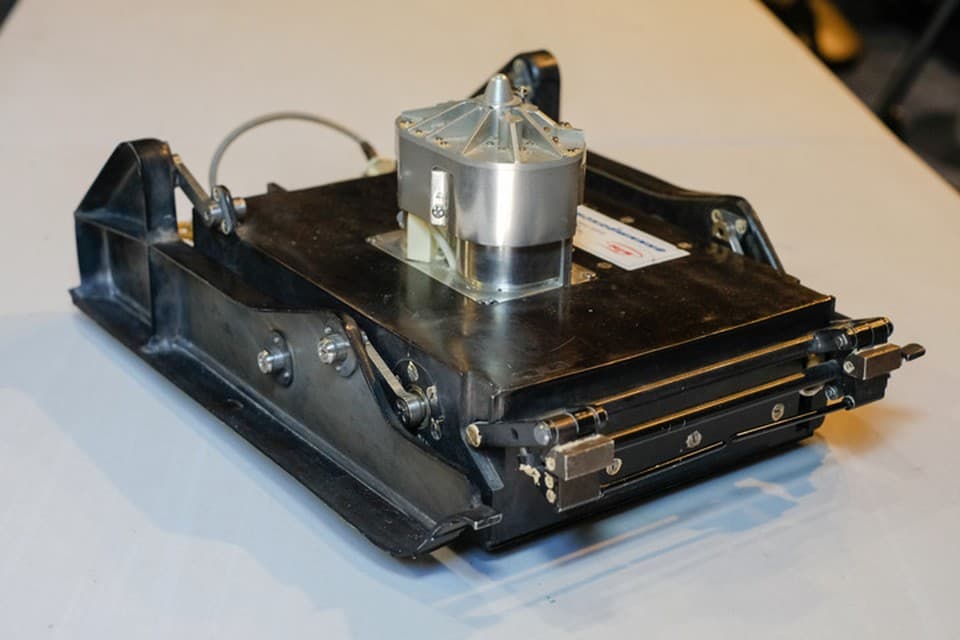
The name is the first thing to get right. ПрОП-М stands for Прибор оценки проходимости, Марс: instrument for assessing trafficability, Mars. It was carried and catalogued as an instrument, filed in Siddiqi's payload list for both landers alongside the barometer and the mass spectrometer, and its formal job was not exploration. It was to find out whether the Martian surface would carry the weight of a vehicle, so that the much larger rover the Soviet Union intended to send next could be designed against measurements rather than telescope guesses. Perminov, deputy chief designer on the project, says exactly that: the data would be used in future to develop the Martian rover. The people who built it were the people who had built Lunokhod. Alexander Kemurdzhian's department at VNIITransMash in Leningrad, the transport-machinery institute formerly numbered VNII-100, had produced the self-propelled lunar chassis that drove on Mare Imbrium in November 1970, and Kemurdzhian had been the institute's chief designer and deputy director since 1969. Sergei Fedoseev, who now holds the space-side chief designer's post there, says about 150 people worked on PrOP-M for five years. What they produced was a flat metal box roughly the size of a thick book, with a small turret on top holding the penetrometer, sitting on two wide skis that held it just clear of the ground. It weighed 4.5 kg by NASA's catalogue and by every Russian account we found, and 4 kg by Siddiqi's. Its dimensions are worse: four different sets are in print and English Wikipedia lists all of them rather than choose.
The skis are the part everyone remembers, and the reason for them is the most honest thing about the design. Nobody knew what Mars was made of. The best information available was blurred orbital photography and telescope work, so the machine had to be able to move on something that might be loose dust. Fedoseev's account of the trade is compact: wheels at that scale would have been toy-sized and would have sunk, tracks would have worked better but were more complicated and therefore less reliable, so the institute invented walking skis for this one job. The cycle went like this. The box settled onto its belly on the ground, threw the skis forward one after the other, and then dragged the body up after them. Turning was done by walking the two skis in opposite directions. NSSDCA describes the same motion from the other side of the Cold War in almost the same words. It was to stop every metre and a half to take its measurements, and the tracks the skis pressed into the soil were themselves part of the experiment, to be photographed by the lander's cameras and read for the properties of the material. How fast it went is contested by a factor of a hundred. Fedoseev and Russian Wikipedia say about 100 metres an hour. Siddiqi says 1 metre a minute, which is 60 metres an hour and broadly agrees. Several Russian popular accounts, and a reference work English Wikipedia cites, print 1 metre an hour instead.
The cable is the second thing everyone remembers, and it is also the number this entry cannot settle. PrOP-M had no batteries and no radio. Electricity came down the cable from the lander, commands came down the cable, and measurements went back up it, which means the instrument could not outlive its lander by a second and could not go further than the wire allowed. NSSDCA, Perminov, Siddiqi and Russian Wikipedia all say fifteen metres. Fedoseev, speaking in 2019 for the institute that built the thing, says five, and gives a reason that sounds like an engineer rather than a copyist: the point was only to get the instrument out of the disturbed patch of ground the landing rockets had churned up, and five metres was thought to be plenty. He adds a corroborating detail, that because of the short reach the prototype was not taken to the volcanic sands of Kamchatka where VNIITransMash normally tested running gear, but was tried out at the institute's own range in Leningrad. Either way, the tether explains the strangest feature of the machine, which is that it had to think. Mars is minutes away at light speed. The Planetary Report, breaking the story in 1990, said signals from Earth to Mars can take between 4 and 20 minutes, too long for a walking robot to wait for commands from Earth. On landing day the figure was near the bottom of that range: 7 minutes 52 seconds one way, about sixteen minutes for a question and an answer. So two thin rods on the front were to serve as feelers, and on striking something the machine was to back off, turn away from the obstacle and step forward again, without asking anyone. On Mars it never did any of it.
None of it happened. The Mars 2 descent module came in too steeply on 27 November 1971, its parachute sequence never ran, and it hit the ground hard enough that the first PrOP-M became part of the first wreckage humans ever left on Mars. NSSDCA calls Mars 2 the first human-made object to reach the surface of Mars; it was not the first to reach another planet, because Venera 3 had struck Venus in March 1966. Nobody has found that wreckage. NSSDCA and Siddiqi place the impact near 4 N, 47 W, while other published accounts give 45 S, 313 W. Five days later Mars 3 did what nothing had done before and arrived alive. NSSDCA has the four petal covers opening and the capsule beginning to transmit 90 seconds after touchdown. Roughly twenty seconds after that the signal fell apart, and it never came back. NSSDCA's sentence on both lander pages is the same: the failure of the mission resulted in the robot never being deployed. What makes this hard to write about with confidence is that no telemetry survives to show how far the Mars 3 station got through its own start-up before it died. The cyclogram Russian Wikipedia reads out of the M-71 draft project has PrOP-M beginning to move at the same instant the transmitters and cameras switched on. Whether the manipulator ever lifted it out of the capsule and set it on Mars is not a question anybody can currently answer. The closest thing to a picture of PrOP-M working is Perminov's account of the final ground test, in which the whole station ran its flight sequence on the test rig and, he writes, the PROP-M instrument made its short trip, still analyzing Earth's soil.
Then the record goes quiet for twenty years. The TASS communique published in Izvestia on 7 December 1971 announced the landing and the pennant with the Soviet coat of arms and named not a single instrument, let alone a robot. Kemurdzhian's own name was classified for much of his career; his papers were published under the covers Aleksandrov, Leonovich and Uglev, and Fedoseev's account has the designer's son finding out what his father built only after Mars 3 had left the pad. The world outside learned about it in the July and August 1990 issue of The Planetary Report, in an article by Charlene Anderson crediting Kemurdzhian, which stated that the presence of mobile vehicles on these missions had not been revealed for nearly 20 years. The descendants are easier to trace than the ancestor. The heavy Mars rover PrOP-M was supposed to inform, carried on Perminov's 4NM spacecraft and planned for a 1973 launch, was never built. Perminov records that the fabrication of the N-1 rocket had been stopped, but he writes that in his account of the later sample-return work rather than as the stated reason 4NM was dropped. VNIITransMash turned to Venus, where a PrOP-V penetrometer did fly and did work, and to Phobos, where the PrOP-F hopper reached Mars orbit aboard Phobos 2 in 1989 and was never released. Three PrOP-M units are reported to survive on Earth, one of them in a glass case in the Peter and Paul Fortress. The fourth, if the 2013 identification holds, is still with a dead lander in Ptolemaeus crater, twenty-five years and seven months ahead of the first wheels that actually turned on Mars.
Mission facts
What the name means
ПрОП-М, from Прибор оценки проходимости, Марс. Siddiqi's NASA chronicle renders it Device to Evaluate Mobility, Mars. It is a machine whose name calls it an instrument rather than a vehicle, and Soviet documentation treats it that way: Siddiqi's payload list for both landers files the penetrometer and the gamma-ray densitometer as lander instruments 8 and 9, with the note that they sit on PrOP-M.↗
Who built it
VNIITransMash in Leningrad, the transport-machinery research institute formerly numbered VNII-100, under Alexander Leonovich Kemurdzhian (1921 to 2003), who had led the design of the Lunokhod self-propelled chassis from 1963 and was chief designer and deputy director of the institute from 1969. Sergei Fedoseev, VNIITransMash's chief designer for space work, told Komsomolskaya Pravda in 2019 that roughly 150 people worked on PrOP-M for five years.↗
Mass
4.5 kg. That figure is given by NASA's NSSDCA on both the Mars 2 and Mars 3 lander pages, by Russian Wikipedia, by Fedoseev in the 2019 Komsomolskaya Pravda interview and by IEEE Spectrum. Siddiqi's NASA chronicle instead calls them 4 kilogram mini-rovers. We found no source that reconciles the two.↗
Dimensions
Genuinely unsettled. Four values are in print: 21.5 by 16 by 6 cm (NSSDCA, and Ulivi's Robotic Exploration of the Solar System), 25 by 22 by 4 cm (Russian Wikipedia and Harvey's Russian Planetary Exploration), 25 by 25 by 4 cm (Huntress and Marov, Soviet Robots in the Solar System) and 25 by 20 by 4 cm (Harvey's Russian Space Probes). English Wikipedia lists all four in a footnote rather than pick one. The two families differ in shape as well as size: one is a squat brick 6 cm thick, the other a flat slab 4 cm thick. Popular Russian accounts consistently describe it as the size of a thick book.↗
How it walked
Two wide flat skis, one down each side, holding the body slightly clear of the ground. NSSDCA: it could move by alternately moving the skis, and turn by walking the two skis in opposite directions. Fedoseev describes the same cycle from the builder's side: the box sat down on its belly, threw the skis forward in turn, then dragged the body after them. Skis were chosen because nothing was known about the surface. Wheels at that scale would have been toy-sized and would have bogged in sand, and tracks were judged more complex and therefore less reliable.↗
Speed
Contested by a factor of a hundred. Fedoseev and Russian Wikipedia give about 100 metres per hour, which Fedoseev glosses as forty times slower than an unhurried walking pace. Siddiqi gives 1 metre per minute, which is 60 metres per hour and consistent with that. Several Russian popular accounts and at least one reference work cited by English Wikipedia print 1 metre per hour instead. The 1 metre per hour figure looks like a units slip from 1 metre per minute, but we found no source that says so, and we do not treat our reading as verified.↗
The tether, and the number that does not agree
15 metres in NSSDCA, in Perminov (the M-71 deputy chief designer, who writes that the PROP-M instrument has a cable 15 meters in length), in Siddiqi, in Russian Wikipedia and in every English catalogue. But Fedoseev, speaking for the institute that built it, told Komsomolskaya Pravda in 2019 that the cable was five metres, and gave a reason: they only needed to get the instrument clear of the patch of ground the landing rockets had disturbed, and five metres was considered more than enough. The same interview says that because of that short reach the prototype was not taken to the volcanic sands of Kamchatka where VNIITransMash normally tested chassis, but was tested at the institute's own range in Leningrad. We report 15 m as the catalogued figure and flag the 5 m claim rather than discard it.↗
Why a cable at all
Three reasons, none of them optional. It carried power: the rover had no batteries and drew electricity from the lander. It carried data: the rover had no radio of its own and the lander was the only transmitter. And it bounded the working area, keeping the instrument inside the field of view of the lander's two panoramic cameras, which were the only way anyone would ever see it move.↗
Why it had to think for itself
Mars is minutes away at the speed of light, so a joystick on Earth was never an option. The Planetary Report, publishing the rovers' existence in 1990, put it plainly: signals from Earth to Mars can take between 4 and 20 minutes to reach their destination, too long for a walking robot to wait for commands from Earth. On the day Mars 3 landed the gap was near the bottom of that range: a JPL Horizons query for the landing instant, 2 December 1971 at 13:50:35 UT, returns a geocentric range of 0.95082 AU and a one-way light time of 7.9077 minutes, which is 7 minutes 54 seconds out and about 15 minutes 49 seconds for a question and an answer.↗
The obstacle bars
Two thin rods projecting from the front of the box, working as contact sensors. On hitting something the machine was to reverse, turn away from the side that had been struck, and step forward again. Where the logic lived is not agreed. Siddiqi describes the sensors signalling an automated control system on the lander, which then sent the back-up and turn commands. Fedoseev describes a brain hidden inside the rover's own small black body and calls PrOP-M the grandfather of self-navigating planetary rovers. Both accounts describe the same behaviour and disagree about which box it ran in.↗
Science payload
Two instruments. A dynamic penetrometer, housed in the small turret on top, which dropped and drove into the soil while the machine measured how deep it went and what force that took. And a gamma-ray densitometer for soil density. NSSDCA calls the second a radiation densitometer. English Wikipedia attributes the penetrometer to Transmash and the densitometer to the Institute of Geochemistry of the USSR Academy of Sciences, citing Ulivi and Perminov; we have not checked either page and pass the attribution on as second-hand. A third, cost-free measurement was designed in: the tracks the skis left in the soil were themselves to be photographed and read for material properties.↗
How it was to be put down
By a manipulator arm on the lander, described by English Wikipedia as having six joints, which was to lift the instrument out and set it on a patch of ground already inside the cameras' view. The same arm sequence was also to place the x-ray spectrometer on the soil. Perminov's walkthrough of the station has the petals opening, the antennas rising, the weather sensors swinging outward, and then the spectrometer and PrOP-M being placed on the Martian surface. Komsomolskaya Pravda describes the instrument travelling in a special metal paw.↗
Where it sat in the surface programme
The lander's surface work was built from cycles of 4 minutes 34 seconds, of which 4 minutes 22 seconds was panorama and the last 12 seconds everything else. Russian Wikipedia, reading the M-71 draft-project cyclogram held at the Russian State Archive of Scientific and Technical Documentation, has PrOP-M starting to move at the same instant as the transmitters and the cameras and moving for exactly half a cycle, 2 minutes 16 seconds, then stopping to work the soil and reporting in the last 12 seconds. Five such cycles were allotted to the first session and ten to each later one.↗
What happened to each unit
The first rode the Mars 2 descent module, which entered too steeply on 27 November 1971, never opened its parachute and struck the ground. The second rode Mars 3, which landed intact on 2 December 1971 at about 13:50:35 UT, began transmitting 90 seconds later and stopped roughly 20 seconds after that. NSSDCA's verdict on both pages is the same sentence: the failure of the mission resulted in the robot never being deployed. No telemetry survives that would show how far into the deployment sequence the Mars 3 station got.↗
Whether it flew again
Disputed. Russian Wikipedia states that PrOP-M units were also carried by the Mars 6 and Mars 7 stations of 1973, citing Asyushkin and others, Automatic Spacecraft for Fundamental and Applied Scientific Research (MAI-Print, 2010); Ball, Garry, Lorenz and Kerzhanovich say the same in Planetary Landers and Entry Probes (Cambridge, 2007). Against that: NSSDCA's instrument list for the Mars 6 descent module does not include it, the Russian Wikipedia article on Mars 6 does not mention it, and Fedoseev told Komsomolskaya Pravda flatly that PrOP-M was never launched to Mars again and that why is still not known. We could not settle this.↗
Where the survivors are
Three units are reported to remain on Earth: one at NPO Lavochkin, one at VNIITransMash, and one on public display in a glass case beside a Mars 1 model at the Museum of Space and Missile Technology in the Peter and Paul Fortress in St Petersburg. A Mars 3 lander model at the Memorial Museum of Cosmonautics in Moscow carries a PrOP-M on top. These placements come from Russian Wikipedia and the 2019 Komsomolskaya Pravda article and we have not confirmed them against the museums in 2026.↗
Mission timeline
- 17 Nov 1970Luna 17 sets Lunokhod 1 on Mare Imbrium and it drives, the first roving vehicle to move across a world other than Earth. Its running gear came from the same Leningrad institute and the same chief designer as the machines already being prepared for Mars.
- 19 May 1971Mars 2 leaves Baikonur at 16:22:49 UT with the first PrOP-M stowed inside its descent module. Nothing announced at the time says a mobile device is aboard.
- 28 May 1971Mars 3 follows at 15:26:30 UT with the second unit. Fedoseev's account has Kemurdzhian's own son learning only after this launch what his father had been working on.
- 27 Nov 1971The Mars 2 descent module enters the atmosphere far too steeply, the parachute sequence never runs, and the capsule strikes Mars. The first PrOP-M becomes part of the first human-made object to reach the surface of Mars. A human-made object had already reached another planet: Venera 3 struck Venus in March 1966. The site has never been found.
- 2 Dec 197113:50:35 UT: Mars 3 lands intact on the floor of Ptolemaeus crater, the first spacecraft to survive arrival at Mars. At 13:52:05 the station starts transmitting. About twenty seconds later the signal falls apart. The second PrOP-M is aboard, and nothing is ever heard from it.
- 7 Dec 1971The TASS communique on the landing, carried in Izvestia, describes the achievement and the pennant bearing the Soviet coat of arms. It names no scientific instrument and no mobile device of any kind.
- 1973 to 1974The heavy rover PrOP-M was meant to inform never happens. Perminov describes the 4NM spacecraft, planned for a 1973 launch to test spacecraft and lander systems and to explore Mars with a rover; it was never built. He separately records that the fabrication of the N-1 rocket had been stopped, in his account of the sample-return work of 1973 rather than as the stated reason 4NM was dropped, so the link between the two is the standard reading; he does not make it himself. After the 1973 flotilla of Mars 4 to 7, the Soviet Union turns away from Mars toward Venus.
- Jul to Aug 1990The Planetary Report publishes Charlene Anderson's article The First Rover on Mars, crediting Kemurdzhian, and states that the presence of mobile vehicles on these missions had not been revealed for nearly 20 years. This is the moment the rest of the world learns the machines existed.
- 24 Feb 2003Kemurdzhian dies in St Petersburg at 81. Asteroid 5933 was named for him in 1997, and the rover centre at VNIITransMash carries his name. For much of his working life his own name was classified and his papers appeared as Aleksandrov, Leonovich or Uglev.
- 11 Apr 2013NASA announces that HiRISE imagery contains a candidate parachute, heat shield, retrorocket and four-petalled lander at the Mars 3 site, found by a Russian volunteer search led by Vitaly Egorov. Alfred McEwen calls it a remarkable match while saying alternative explanations cannot be ruled out. The release does not mention PrOP-M, but if the identification holds, that is where the second one is.
- 23 May 2019Komsomolskaya Pravda publishes an interview with Sergei Fedoseev of VNIITransMash which contradicts the standard account on two points: it gives the cable as five metres rather than fifteen, and states that PrOP-M was never launched to Mars again after 1971.
A filled dot marks something that physically happened. A hollow one marks an announcement, a naming or a target.
In pictures
Tap a photo to enlarge.
Sources
- NSSDCA Master Catalog: Mars 3 Lander (1971-049F)
- NSSDCA Master Catalog: Mars 2 Lander (1971-045D)
- V. G. Perminov, The Difficult Road to Mars (NASA Monographs in Aerospace History No. 15, 1999)
- Asif A. Siddiqi, Beyond Earth: A Chronicle of Deep Space Exploration 1958-2016 (NASA SP-2018-4041)
- Russian Wikipedia: Прибор оценки проходимости, Марс
- Russian Wikipedia: Кемурджиан, Александр Леонович
- Komsomolskaya Pravda, 23 May 2019: Нашли спустя 42 года
- Charlene Anderson, The First Rover on Mars: The Soviets Did It in 1971, The Planetary Report, July/August 1990
- Evan Ackerman, Meet the Very First Rover to Land on Mars, IEEE Spectrum, 27 Aug 2012
- English Wikipedia: PrOP-M
- Russian Wikisource: TASS communique on the landing of the automatic station Mars-3, Izvestia, 7 December 1971
- NASA JPL, 11 Apr 2013: NASA Mars Orbiter Images May Show 1971 Soviet Lander
- JPL Horizons query for Mars from Earth's centre at the Mars 3 landing instant, 2 December 1971 13:50:35 UT
Facts on this page were verified on 27 August 2026. Where sources disagree, the disagreement is stated rather than resolved silently.
-158.0000 E, -45.0000 N · Ptolemaeus crater