Mars 1969A and 1969B
USSR · Soviet Union · Orbiter · 1969 · Reaching MarsFailure
Two identical Soviet Mars orbiters, both destroyed by their Proton rockets six days apart in spring 1969. Neither reached Earth orbit, and the USSR never acknowledged that they existed.
TL;DR· 10 min read
The Soviet Union tried twice in spring 1969 to put a spacecraft into orbit around Mars, and both attempts were destroyed by the Proton rockets under them six days apart. The first exploded after its third stage caught fire 438.66 seconds into flight, raining debris on the Altai mountains; the second lost an engine 0.02 seconds after liftoff and hit the ground about 3 km from its pad. Neither launch was ever announced, and the pair are still known publicly by the placeholder names NASA gave them.
In March and April 1969 the Soviet Union tried twice to put a spacecraft into orbit around Mars, two and a half years before anyone managed it. Both attempts were destroyed by the rocket underneath them: the first exploded high over Siberia and rained down on the Altai mountains, the second lost an engine two hundredths of a second after liftoff and hit the ground three kilometres from its pad. Neither launch was ever announced, and the two spacecraft are still known publicly by the placeholder names NASA gave them.
- 2 of 2spacecraft lost, six days apart
- 438.66 sinto flight when the first rocket's third stage shut down and exploded
- 0.02 safter liftoff when the second rocket lost an engine
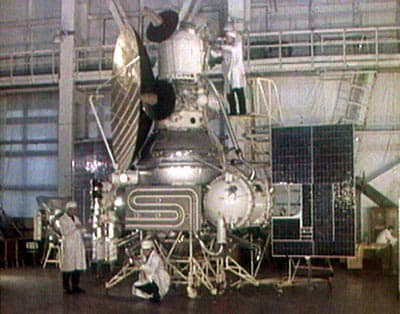
The M-69 project was an attempt to use the Soviet Union's new heavy rocket, the Proton, to do something nobody had done: put a spacecraft into orbit around another planet. Everything sent to Mars before 1969 had been a flyby, a single fast pass giving a few hours of useful observation before the planet fell behind. An orbiter could watch Mars for months. Chief designer Georgy Babakin approved a preliminary design at NPO Lavochkin in November 1967, built around hardware borrowed from the E-8 lunar lander programme, but the borrowed design would not hold. Endurance tests showed the elastic membranes that pushed propellant out of the tanks could leak on a six month cruise, the centre of gravity shifted unpredictably as propellant drained, and the thermal system could not keep the avionics cool. Babakin threw the architecture away and started again roughly thirteen months before the window opened. The replacement was built around a lenticular propellant tank with a metal membrane (NSSDCA's description of the flown vehicle instead calls the tank spherical), with two solar wings totalling seven square metres, a 2.8 metre dish and three pressurised compartments. A 260 kilogram entry capsule survived into the new design, to be released from Mars orbit rather than on approach, but the vehicle kept gaining weight and there was no time left to drop-test the capsule from a high-altitude balloon, so the landing was cut. The approved design carried thirteen instruments weighing 99.5 kilograms in total, 15 of those kilograms on the deleted lander, so what flew was an orbiter with roughly 85 kilograms of instruments, including a film camera that could store 160 pictures.
The first M-69 lifted off from Pad 23 at Site 81, Baikonur, on 27 March 1969 at 10:40:45 UTC, which was 13:40:45 by Moscow time. Loudspeakers at the site called the milestones: pitch, yaw and roll within limits, first stage separated, fairing separated, second stage separated. Then the announcements stopped, and after a pause came two words, no signal. The Proton's third stage had shut down 438.66 seconds into the flight after a fire in its turbopump, traced to an imbalance in the pump rotor, and then exploded. What was left came down in the Altai mountains of southern Siberia. Asif Siddiqi's NASA chronology puts the shutdown at T+438.46 seconds; the figure of 438.66 appears in both NASA's own NSSDCA catalogue and Anatoly Zak's Russian-sourced account, and that is the one used here. The timing was particularly hard to take. Later the same day, at 22:22:01 UTC, NASA launched Mariner 7 from Cape Kennedy, the second American Mars flyby of the season, and it worked; Mariner 6 had already left on 25 February. Had the Soviet craft flown, it would have entered a 1,700 by 34,000 kilometre orbit inclined 40 degrees on 11 September 1969, then lowered its closest approach to between 500 and 700 kilometres for roughly three months of photography.
The second spacecraft went up from Pad 24, a few hundred metres from where the first had left, on 2 April 1969 at 10:33:00 UTC. At T+0.02 seconds one of the six RD-253 engines in the Proton's first stage failed. The investigation found that a drain port in the oxidiser pump cover was missing its hydraulic lock plug, so oxidiser gas rushed into the cavity behind it and set the pump shaft alight. The control system compensated and the rocket climbed on its five surviving engines. Major General Vasily Shirshov, watching, described it rising about a hundred metres and then settling back with the engines still firing, as though trying to carry itself clear of the pad. Perminov, watching from the same site, remembered black smoke from an engine and then a dense, luminous mass of fire. The published accounts diverge on the numbers. NASA's catalogue and the Russian-language record say the vehicle held on for about twenty-five seconds and reached roughly a kilometre before tipping toward the horizontal, that the engines then shut down, and that it struck nose first at T+41 seconds about three kilometres from the pad. Zak has it down at about thirty seconds just outside the fence at the western corner of Site 81, narrowly missing Pad 23. Both agree on the fireball. The complex itself came through essentially undamaged; the nearest real casualty was the glass in the assembly and test building. It was the seventeenth Proton flight.
That ended the 1969 window and the M-69 project. Only two spacecraft had been built, so there was nothing left to launch, and the next chance to reach Mars was two years away. The loss mattered beyond the two vehicles. M-69 was meant to pin down two numbers the Soviet programme badly needed: a precise Martian ephemeris, so a lander could be aimed accurately, and the atmospheric pressure at the surface, so a parachute could be sized. Without them the 1971 missions carried those uncertainties with them. Vladimir Dolgopolov, one of the leading designers, later remembered the pair as, in his words, "examples of how not to make a spacecraft", and Siddiqi records the engineers' own view that even a clean launch would probably not have produced a working mission, given how fast the hardware had been assembled. What survived was the architecture. The lenticular tank, the pressurised instrument compartments and much of the instrument set went into the M-71 series, which flew in 1971 as Kosmos 419, Mars 2 and Mars 3. The first spacecraft actually to orbit Mars turned out to be American: Mariner 9, which arrived on 14 November 1971 UTC, two years and two months after the date M-69 No. 521 had been aiming for.
Mission facts
First launch
27 March 1969, 10:40:45 UTC (13:40:45 Moscow), Proton-K (8K82K no. 240-01) with a Blok D upper stage (11S824 no. 521L), from Site 81 Pad 23 at Tyuratam (Baikonur)↗
Second launch
2 April 1969, 10:33:00 UTC (13:33 Moscow), Proton-K (8K82K no. 233-01) with Blok D (11S824 no. 522L), from Site 81 Pad 24. RussianSpaceWeb gives the time as 13:30 Moscow, about three minutes earlier than the 10:33:00 UTC figure used here↗
Designations
2M (project M-69) No. 521 and No. 522. Mars 1969A and Mars 1969B are labels applied by NASA's NSSDCA; the launches were never announced by the USSR and the spacecraft were given no Soviet public names↗
Built by
NPO Lavochkin, under chief designer Georgy Babakin, with the science payload supplied by the Space Research Institute (IKI) in Moscow↗
Launch mass
About 4,850 kg each. Perminov's design history gives a proposed weight of 3,834 kg, but that figure is from the preliminary project and includes a 260 kg lander that was later deleted↗
Structure
Built around a single large propellant tank with an internal baffle, with two solar wings totalling 7 square metres, a 2.8 m parabolic high-gain dish, two conical low-gain antennas and three pressurised compartments for electronics, radio and navigation, and cameras. NSSDCA calls the tank spherical; RussianSpaceWeb, describing the 1968 redesign, calls it lenticular with a metal membrane↗
Propulsion and control
Turbopump-fed main engine burning nitrogen tetroxide and UDMH, eight attitude thrusters with their own tanks, and three-axis stabilisation using two Sun sensors, two Earth sensors, two Mars sensors, a Canopus sensor, gyros and cold nitrogen gas jets↗
Cameras
A film-based system with three cameras, three colour filters and two lenses, storing up to 160 images at 1,024 by 1,024 pixels for a best resolution of 200 to 500 m. NSSDCA describes the lenses as 50 mm (1,500 by 1,500 km field) and 350 mm (100 by 100 km); Perminov and RussianSpaceWeb instead list three telephotometers of 35, 50 and 250 mm focal length↗
Science payload
Perminov and RussianSpaceWeb list 13 instruments totalling 99.5 kg for the design as approved, of which 15 kg was carried on the lander that was later deleted. Siddiqi's per-flight instrument list names the RA69 radiometer, an IV1 water vapour detector, a USZ ultraviolet spectrometer, a UTV1 infrared Fourier spectrometer, a KM69 cosmic ray detector, a PL18M solar plasma spectrometer, a RIP-803 low-energy ion spectrometer, a GSZ gamma spectrometer, a UMR2M hydrogen and helium mass spectrometer, D-127 charged particle traps and the three-camera imaging system↗
Planned orbit
Capture into roughly 1,700 by 34,000 km at 40 degrees inclination with a 24 hour period, then a burn to lower periapsis to 500 to 700 km for about three months of imaging↗
Planned arrival
11 September 1969 for No. 521 and 15 September 1969 for No. 522, which would have made them the first spacecraft to orbit Mars↗
Lander
A 260 kg entry capsule was carried in the design and was to have been released from Mars orbit rather than on approach, but it was deleted before flight because the spacecraft had gained weight and there was no time left for high-altitude balloon drop tests↗
Cause of the first failure
The Proton's third stage shut down at T+438.66 s after its turbopump caught fire, traced by RussianSpaceWeb to an imbalance in the pump rotor and by NSSDCA and Siddiqi to a faulty rotor bearing, and then exploded. Siddiqi's NASA chronology gives T+438.46 s. Debris fell in the Altai mountains↗
Cause of the second failure
One of the six RD-253 (11D43) first-stage engines failed at T+0.02 s because a drain port in the oxidiser pump cover was missing its hydraulic lock plug, letting oxidiser gas into the cavity and igniting the pump shaft↗
Impact of the second vehicle
The rocket flew on five engines for about 25 s, reached roughly 1 km, tipped toward the horizontal, shut down and hit the ground nose first at T+41 s about 3 km from the pad, exploding on impact. The launch complex was essentially undamaged; windows were blown out in the nearby assembly and test building (MIK). NASA's NSSDCA, Siddiqi's NASA chronology and the Russian Wikipedia record of Proton failures all give this sequence independently↗
End of mission
Both vehicles were destroyed during launch. No Earth orbit was reached, no telemetry was returned from either spacecraft, and no further M-69 hardware existed to fly in the 1969 window↗
Mission timeline
- 31 Dec 1968IKI hands the science module and data processing system for the second spacecraft to Lavochkin at 11 p.m., less than three months before the launch window opens
- 21 Feb 1969The first N1 moon rocket explodes at Baikonur while the M-69 team is on site. The blast blows out the hotel windows and the heating freezes at minus 30 C
- 25 Feb 1969NASA launches Mariner 6 toward Mars, four days after the N1 accident
- 27 Mar 196910:40:45 UTC: the first M-69 lifts off from Site 81 Pad 23. The third stage catches fire at T+438.66 s and explodes; debris falls in the Altai mountains
- 27 Mar 196922:22:01 UTC: NASA launches Mariner 7 the same day, and it works
- 2 Apr 196910:33:00 UTC: the second M-69 lifts off from Pad 24. One first-stage engine fails at T+0.02 s and the rocket hits the ground at T+41 s about 3 km away
- 11 Sep 1969The date the first spacecraft was to have entered Mars orbit
- 15 Sep 1969The date the second spacecraft was to have entered Mars orbit
- 10 May 1971The M-69 design lineage returns as the M-71 series. The first of the three, Kosmos 419, is stranded in Earth orbit
- 19 May 1971Mars 2 launches successfully, carrying the instrument set and much of the architecture developed for M-69
- 28 May 1971Mars 3 launches, the second of the M-71 pair built on the M-69 design lineage
- 14 Nov 1971Mariner 9 enters Mars orbit, the first spacecraft to do so, two years and two months after M-69 No. 521 was to have arrived
A filled dot marks something that physically happened. A hollow one marks an announcement, a naming or a target.
In pictures
Tap a photo to enlarge.
Sources
- NSSDCA Master Catalog: Mars 1969A
- NSSDCA Master Catalog: Mars 1969B (archived Aug 2025)
- RussianSpaceWeb: Mars-69 (Anatoly Zak)
- Asif A. Siddiqi, Beyond Earth: A Chronicle of Deep Space Exploration, NASA SP-2018-4041 (PDF)
- V. G. Perminov, The Difficult Road to Mars, NASA Monographs in Aerospace History 15 (PDF)
- Jonathan McDowell, GCAT launch table
- Russian Wikipedia: Марс 1969В (Mars 1969B)
- Russian Wikipedia: Аварии ракет-носителей «Протон» (Proton launch failures)
- Encyclopedia Astronautica: Mars M-69
- English Wikipedia: Mars 2M No.522
Facts on this page were verified on 23 August 2026. Where sources disagree, the disagreement is stated rather than resolved silently.