Mars 96
Roscosmos · Russia · Orbiter · 1996 · The losing decadeFailure
Never left Earth orbit: the Blok D-2 missed its second burn and Mars 96 re-entered on 17 November 1996 over the eastern Pacific, Chile and Bolivia. Nothing was recovered, including about 270 g of plutonium-238.
TL;DR· 16 min read
Mars 96 was the most international planetary spacecraft Russia has launched, an orbiter with two small landing stations and two penetrators carrying instruments from 22 countries and ESA. It never left Earth orbit: the Blok D-2 upper stage missed its second burn, the spacecraft's own engine then fired in the wrong direction, and it re-entered within five hours along a track from the eastern Pacific across Chile and Bolivia. About 270 g of plutonium-238 came down with it, and nobody has ever gone to look.
Mars 96 was the most international planetary spacecraft Russia has ever launched: an orbiter carrying roughly twenty instruments, two small landing stations and two ground-piercing penetrators, with hardware from institutions in 22 countries and the European Space Agency. It never left Earth orbit. The Blok D-2 upper stage did not make its second burn, the spacecraft's own engine then fired in the wrong direction, and less than five hours after liftoff it came down somewhere along a line from the eastern Pacific across the Andes. Eighteen sealed capsules of plutonium-238 came down with it, and nobody has ever gone to look for them.
- 22countries, plus ESA, built instruments for it
- 270 gof plutonium-238 that reached the ground on Earth and was never found
- 3rdorbit of Earth was as far as it got, against a planned ten-month cruise to Mars
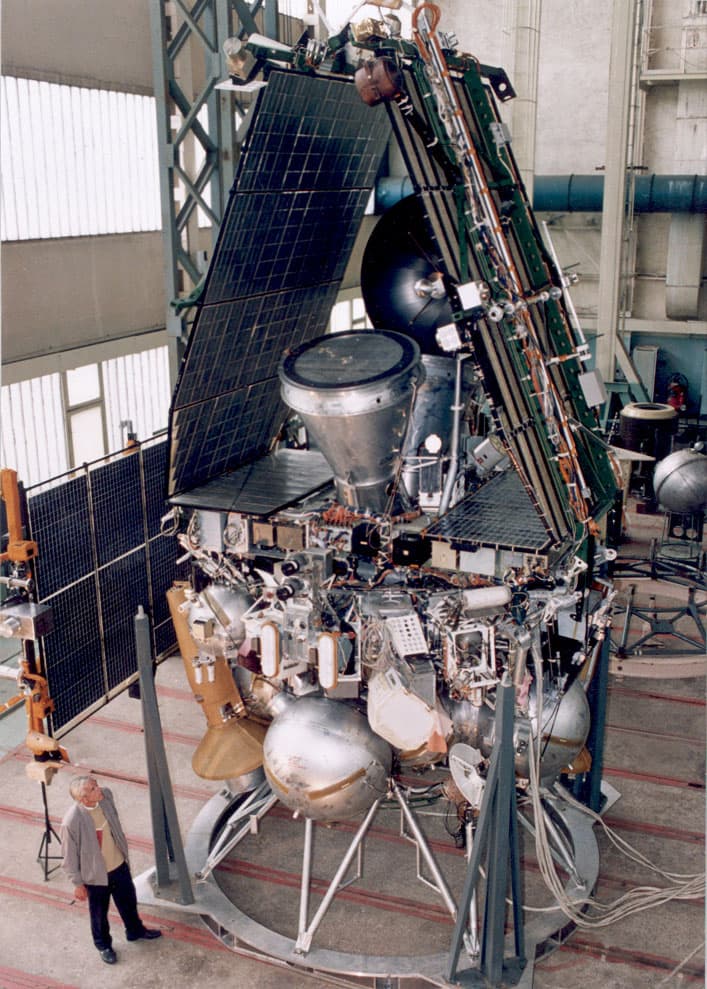
Mars 96 began as Mars 92. NPO Lavochkin's plan, drawn up in the late 1980s on the strength of the Phobos spacecraft bus, was for a pair of vehicles carrying a 240 kg rover, a giant French balloon that would drift over the planet by day and settle on the surface at night, and a probe that would bury itself in the ground. A Soviet decree of 30 December 1988, the last government document on the subject before the union dissolved, authorised a Mars orbiter with a lander. Everything after that was subtraction. The rover went, the balloon went, France withdrew, the second vehicle went, and the 1994 launch window went too, for lack of money. What lifted off in November 1996 was a single spacecraft with two small landing stations and two penetrators. What survived the cuts, remarkably, was the science: instruments built by institutions in 22 countries and the European Space Agency, about twenty of them on the orbiter alone. The people building it were being paid late or not at all. At the press conference after the failure, the head of NPO Lavochkin said his staff earned 160 to 180 dollars a month and had just received their August and September wages, in November. During final assembly at Baikonur the stack would not fit inside the fairing, because the small landers were bigger than their own specifications said, so engineers cut a 30 cm segment out of the structure that held the high-gain antenna until it closed.
The launch, at 20:48:53 UTC on 16 November 1996 from the left pad at Site 200, went perfectly. Three Proton stages and the first burn of the Blok D-2 upper stage put the stack into a parking orbit near 160 km, and mission control began celebrating. The second Blok D-2 burn, 528 seconds long, was due 68 minutes and 53 seconds after liftoff, over the South Atlantic and out of sight of every Russian ground station. The Soviet programme had always parked a tracking ship there for exactly this moment; by 1996 the ships had been sold for scrap or laid up, and this was the first Russian interplanetary attempt flown without one. So nobody watched the burn and no telemetry of it exists. What is known is that it did not happen, and that the stage came away with a velocity gain of two or three metres per second, too little to say whether its main engine had lit at all. The spacecraft then did what it was programmed to do. Its control system, shared with the upper stage and mounted on the truss between them, was meant to measure the delivered impulse and adapt: if the accelerometers read healthy and the shortfall was too big to make up, the spacecraft's own engine would fire only an 8.5 m/s separation nudge. Instead the full burn ran, minutes early, in the wrong attitude and at the wrong point in the orbit. Its radial component lifted apogee to roughly 1,500 km and drove perigee down to 75 or 80 km, into the atmosphere. Mars 96 had aimed itself at the ground.
Then came the part the world heard about. The small stations and penetrators carried radioisotope units to keep them alive through Martian nights. At the Moscow press conference on 18 November, Russian Space Agency deputy director Yuri Milov gave the inventory: about 270 g of plutonium in eighteen capsules, four on each small station and five on each penetrator, each rated at 280 curies, the plutonium dioxide pressed into ceramic pellets at 1,200 degrees and sealed in a double shell of platinum-rhodium alloy and tantalum-tungsten inside a carbon-graphite jacket. None of that was clear to the outside world the day before. US Space Command was tracking exactly one object from the launch, gave it the designation 1996-064A and catalogue number 24656, and NASA's Orbital Information Group bulletins called it Mars 96 all through Sunday 17 November. It was the upper stage, which carried no plutonium whatsoever, and its ground track crossed Australia. President Clinton telephoned Prime Minister John Howard to warn him that a plutonium-carrying spacecraft might come down on his country and to offer American help with any cleanup; the Australian army and civil defence went on alert and the north and east of the country were put on notice. The stage re-entered harmlessly over the southern Pacific near 50.9 S, 168.1 W at about 01:20 UTC on 18 November. By then the actual spacecraft, and its plutonium, had been on the ground for more than twenty-four hours.
Where it came down is still unsettled. Russian ballistics specialists, reconstructing the orbit backwards from the upper stage and the logic of the flight programme, put re-entry between 00:30 and 01:30 UTC on 17 November and assumed the Pacific, because that was where the modelled perigee lay. James Oberg pointed out that the same window brackets South America. The US Space Surveillance Network logged an object entering at 00:49. In northern Chile, on a clear Saturday night, thousands of people watched a slow fireball shedding sparks travel from southwest to northeast; further south, an electronics specialist at the European Southern Observatory near La Serena watched it from a campsite and knew at once that he was seeing space debris. Luis Barrera of the Universidad Catolica del Norte in Antofagasta went out and collected the statements, visited the sighting points and reconstructed a track running from near Tocopilla toward Oruro in Bolivia. About two weeks after the event US Space Command revised its assessment: surviving debris would have fallen along a 200 mile stretch taking in the Pacific, Chile and Bolivia, an ellipse NSSDCA renders as 320 km by 80 km centred some 32 km east of Iquique. No search was ever mounted. Writing in New Scientist in March 1999, Oberg reported that Chilean witnesses had been told they had seen nothing important, that no piece of either vehicle had been recovered, and that neither government intended to look. Nothing has been reported found since.
The bill was modest by American standards and ruinous by Russian ones. The agency put the whole system, spacecraft plus rocket plus launch and control, at about 122 million dollars; foreign partners had spent perhaps 180 million more on instruments, taking the programme to roughly 300 million. Vasily Moroz had put the cost of the Mars-94 project, in 1989 prices, at 500 million roubles, about 660 million dollars at the official rate, for two spacecraft. Nothing was insured, because Russian law of the day did not let the agency buy insurance out of anything but profit, and there was no profit. RussianSpaceWeb calls the loss the start of a long hiatus in Russian planetary exploration, and it was: the next Russian planetary launch, Phobos-Grunt in November 2011, also failed to leave Earth orbit. The science, though, did not die with the spacecraft. Five instrument names from the Mars 96 payload list, HRSC, OMEGA, PFS, SPICAM and ASPERA, reappear on ESA's Mars Express, whose own mission page says the spacecraft borrowed technology from Rosetta and from Mars 96. Mars Express reached Mars in December 2003, and ESA was still publishing fresh Mars Express imagery in August 2026. The high-resolution stereo camera that never photographed Mars from a Russian orbiter has spent two decades mapping the planet from a European one. Two details are worth keeping, because they say what the era felt like from inside. The Novosti Kosmonavtiki account records in an aside that the Proton's second stage came down in its Gorny Altai drop zone and killed a cow. The same account closes with a rhyme then going round the space firms: the rocket flew, the rocket fell into a bog, and the wages you are paid are the work you get, more or less. Nobody at the press conference argued with it.
Mission facts
Launch
16 November 1996, 20:48:53 UTC (23:48:52.795 Moscow decree time), Proton-K (8K82K, serial 392-02) with a Blok D-2 (11S824F) upper stage, from the left pad at Site 200, Baikonur. Novosti Kosmonavtiki logs it as the 244th launch of a Proton, on a flight azimuth of 61 deg 19 min 40 s. The launch window had opened on 12 November; 16 November was chosen because it gave the rocket its best performance toward Mars.↗
Spacecraft
Orbiter on NPO Lavochkin's 1F bus, the same platform flown as Phobos 1 and 2 in 1988, with the K52 capacitors and ground-control software that killed those two missions reworked. Factory index M1 No. 520. It carried two Small Autonomous Stations (MS) and two penetrators, an Argus pointing platform for the imaging instruments and a second platform, Pais, for three more.↗
Mass
6,827.5 kg at separation from the upper stage and 6,825 kg when its own engine lit, per the mass table published by Novosti Kosmonavtiki. IKI's project summary rounds the launch mass to 6,700 kg, of which 3,000 kg propellant and 550 kg science. NSSDCA gives 6,180 kg, which matches no Russian figure; we use the Russian numbers and flag the discrepancy.↗
Propellant load
1,909.65 kg of nitrogen tetroxide in four tanks and 923.07 kg of UDMH in four tanks for the Autonomous Propulsion Unit (ADU), plus 188.15 kg of hydrazine in two tanks for attitude control. The ADU was to be jettisoned in Mars orbit at 573 kg, leaving a 3,001 kg orbiter.↗
International payload
Instruments built in Austria, Belgium, Bulgaria, the Czech Republic, Finland, France, Germany, Greece, Hungary, Ireland, Italy, Norway, Poland, Romania, Russia, Slovakia, Spain, Sweden, Switzerland, Ukraine, the United Kingdom and the United States, plus the European Space Agency, per IKI's own project description. RussianSpaceWeb says 21 countries; the IKI list names 22 plus ESA, and we go with the project's own list.↗
Orbiter instruments
Twelve for the surface and atmosphere (including the HRSC stereo camera, WAOSS, the OMEGA imaging spectrometer, PFS, Termoskan, SPICAM, a long-wave radar and gamma and neutron spectrometers), seven for plasma and fields (including ASPERA-S and FONEMA), and three for astrophysics during the cruise, plus radio science, a navigation camera and a radiation dosimetry package.↗
Small stations
Two, aeroshell 100 cm across, landing by parachute and airbag in Arcadia at about 37 N 162 W and 33 N 169 W, designed for 360 days on the surface with a meteorology package, an alpha-proton-X-ray spectrometer, the OPTIMISM seismometer and magnetometer, a descent camera, a panoramic camera and the American MOx oxidant experiment. IKI's own pages give the station mass as both 75 kg and 86 kg on different pages.↗
Penetrators
Two titanium darts, entering the atmosphere at 5.6 km/s and striking the surface at 80 plus or minus 20 m/s, surviving 500 g and burying the forebody 5 to 6 m down while the tail stayed on the surface. Ten instruments, 4.5 kg of them, designed for a year of operation. IKI quotes 45 kg for the embedded probe and 100 kg for the whole unit; RussianSpaceWeb gives 120 kg. Drop tests were run inside a 60 m tower at the Moscow Aviation Institute.↗
Plutonium aboard
About 270 g of plutonium-238 in 18 capsules of 15 g each, per Russian Space Agency deputy director Yuri Milov at the 18 November 1996 press conference: four capsules on each small station (two powering an RTG, two heating instruments) and five on each penetrator (two power, three heating), each capsule rated 280 curies. NSSDCA and Oberg's New Scientist account both say about 200 g. The Russian breakdown is itemised and internally consistent, and Oberg's article independently counts 18 units, so we use 270 g.↗
Capsule design
Plutonium dioxide pressed into ceramic pellets at 1,200 degrees, sealed in a double shell of platinum-rhodium anticorrosion alloy and tantalum-tungsten and jacketed in carbon-graphite composite from NII Grafit. The developer, Aleksei Pustovalov, said the design followed the UN General Assembly principles on nuclear power sources in space adopted in December 1992 and was certified by the Russian Space Agency's certification centre. Yuri Milov said the capsules had been shot at hard targets from a cannon and qualified against fires up to 3,000 K.↗
Flight plan
Parking orbit 165 km circular at 51.6 deg inclination; a 3,150 m/s second burn by the Blok D-2 and a 575 m/s burn by the spacecraft's own ADU to make up the 3,725 m/s needed for escape; two cruise corrections totalling 35 m/s; Mars arrival 12 September 1997 after about ten months; a 1,020 m/s braking burn into a 43.09 hour orbit inclined 106.4 deg, with periapsis lowered to 300 km before the penetrators were released.↗
The failure
The Blok D-2's second burn, 528 s long, was scheduled for 21:57:46 UTC, 68 minutes and 53 seconds after liftoff, over the South Atlantic and out of range of every Russian ground station. It did not happen. Tracking put the stage's total velocity gain at only about 2 to 3 m/s, and that from separation, attitude control and possibly the ullage motors, leaving it in a 143.7 by 169.6 km orbit against a planned 150.8 by 165.7 km parking orbit; the ballistics chief, Nikolai Ivanov, said it was impossible to tell whether the main engine had lit at all. Lissov's preliminary English summary of 19 November instead gives 20 m/s in the wrong direction, a figure the observed orbit change does not support. No telemetry of the burn exists, and the failure review could not say whether the fault lay in the stage or in the spacecraft.↗
Why nobody was watching
The second burn happened over the South Atlantic, where the Soviet space programme had always stationed a tracking ship. By 1996 the fleet had been sold for scrap or laid up, and this was the first Russian interplanetary attempt flown without one. A ship on station could have received telemetry and sent backup commands.↗
Contact with the spacecraft
Yevpatoria in Crimea received a signal from 22:19:14 to 22:26:55 UTC on 16 November, with usable telemetry in a 91 second window: solar arrays, booms and science platforms deployed, tank temperatures and pressures normal, several minutes ahead of the nominal timeline. Ussuriysk heard it again from 22:35:00 to 22:38:10 UTC. Nothing was heard on the third orbit. Lissov's English summary gives the Ussuriysk pass as 22:55 to 22:57; his Russian original says 22:35 to 22:38, and we use the original.↗
Re-entry
Between 00:30 and 01:30 UTC on 17 November 1996, the estimate given by the Russian space surveillance system and quoted by Novosti Kosmonavtiki; NSSDCA's own timeline gives 00:45 to 01:30 and attributes a narrower 01:00 to 01:30 to Russian sources. The US Space Surveillance Network logged an entering object at 00:49 and Chilean witnesses reporting a breakup over the Atacama at about 00:50. NSSDCA describes a presumed debris ellipse 320 km by 80 km running southwest to northeast and centred about 32 km east of Iquique, Chile. RussianSpaceWeb reports a Russian version placing it between Easter Island and the Chilean coast at 01:32 UTC.↗
Cost
The Russian Space Agency put the system total, spacecraft plus launcher plus launch and control services, at about 122 million dollars (roughly 86 million for the spacecraft, 36 million for launch and operations). Foreign partners were estimated to have spent about 180 million on instruments, taking the programme to roughly 300 million. Nothing was insured: Milov said Russian law did not let the agency insure spacecraft, since insurance came out of profit and there was none.↗
Mission timeline
- 30 Dec 1988The Central Committee and Council of Ministers issue a decree on a Mars orbiter with a lander, the last Soviet-era government document on the subject. The project already carries the manufacturing index M1 and has been shrinking for years: the rover is gone, and the French balloon and the 1994 launch date will follow.
- 15 Oct 1996The spacecraft arrives at Baikonur. During integration the stack will not fit the fairing, because the small landers are larger than their own specifications say, and a 30 cm segment is cut out of the structure holding the high-gain antenna.
- 7 Nov 1996The small stations and penetrators, delivered on 1 November, are mated to the spacecraft. The Argus platform and the landers went straight to the cosmodrome, skipping the electrical tests of the fully assembled vehicle that should have happened at the factory. Flight software for the platforms and for the lander relay antenna is not finished, and the plan is to write it during the ten-month cruise.
- 16 Nov 199620:48:53 UTC: Liftoff from the left pad at Site 200. Three Proton stages and the first Blok D-2 burn work perfectly and put the stack into a parking orbit near 160 km. People at mission control start congratulating each other.
- 16 Nov 199621:57:46 UTC: The Blok D-2's second burn is due, over the South Atlantic, with no ground station and no tracking ship in view. It does not happen. Nobody on the ground knows yet.
- 16 Nov 199622:19:14 UTC: Yevpatoria, expecting to find the spacecraft on an escape trajectory, catches it almost by accident on the parking orbit. Telemetry shows arrays and booms deployed and the engine having fired. Simultaneously another station is tracking the upper stage on a low orbit, which proves the two have separated and that nothing is going to Mars.
- 17 Nov 199600:30 to 01:30 UTC: Mars 96 re-enters on its third orbit. US sensors log an entering object at 00:49; witnesses in northern Chile watch a slow fireball cross the sky from southwest to northeast at about 00:50.
- 17 Nov 1996US Space Command, tracking the one object it can see and believing it to be the spacecraft with the plutonium still attached, predicts a fall over Australia. President Clinton telephones Prime Minister John Howard to warn him and offer help with decontamination. Australian civil defence goes on alert. The object is the upper stage, which carries no plutonium, and the real spacecraft is already down.
- 18 Nov 199601:13 to 01:20 UTC: The Blok D-2 re-enters and falls into the open southern Pacific near 50.9 S, 168.1 W, roughly 1,800 km east-southeast of New Zealand. (Novosti Kosmonavtiki describes the point as near Auckland Island and NSSDCA as off the coast of Chile; neither matches those coordinates.) Hours later the Russian Space Agency holds its press conference in Moscow, confirms the separation, gives the plutonium inventory and admits it does not know where the spacecraft came down.
- Dec 1996About two weeks after the event, US Space Command revises its analysis using infrared tracking data: any surviving debris would have fallen along a 200 mile stretch taking in the Pacific Ocean, Chile and Bolivia. In Antofagasta, astronomer Luis Barrera of the Universidad Catolica del Norte begins collecting eyewitness statements and reconstructing the track toward Oruro in Bolivia.
- 6 Mar 1999James Oberg reports in New Scientist that no part of the spacecraft or the upper stage has been recovered, that Chilean witnesses were told they had seen nothing important, and that neither Moscow nor Washington intends to search. A US Space Command media officer had confirmed in March 1997 that a land impact was considered reasonable. Nothing has been reported found since.
A filled dot marks something that physically happened. A hollow one marks an announcement, a naming or a target.
In pictures
Tap a photo to enlarge.
Sources
- NSSDCA Master Catalog: Mars 96 Orbiter (1996-064A), archived snapshot
- NSSDCA: Mars 96 failure timeline from launch to re-entry, archived snapshot
- I. Lissov, "Zapusk i polet stantsii Mars-96", Novosti Kosmonavtiki NN 22-23, 1996 (Russian original, archived snapshot)
- Igor Lissov with James Oberg annotations, "What Really Happened With Mars-96?" (19 Nov 1996), archived snapshot
- James Oberg, "The probe that fell to Earth", New Scientist, 6 March 1999, archived snapshot
- IKI RAN: MARS-96 project description, introduction and cooperation (Russian), archived snapshot
- IKI RAN: MARS-96 mission scheme, ballistics and working orbit (Russian)
- IKI RAN: MARS-96 small autonomous stations (Russian), archived snapshot
- IKI RAN: MARS-96 penetrators (Russian), archived snapshot
- RussianSpaceWeb: The Mars-96 mission (Anatoly Zak)
- Solar System section, RAS Council on Space: Mars-96 (Russian)
- ESA Science and Technology: Mars Express fact sheet
Facts on this page were verified on 23 August 2026. Where sources disagree, the disagreement is stated rather than resolved silently.