Hera at Deimos
ESA · Europe · Flyby · 2024 · Multipolar MarsSuccess
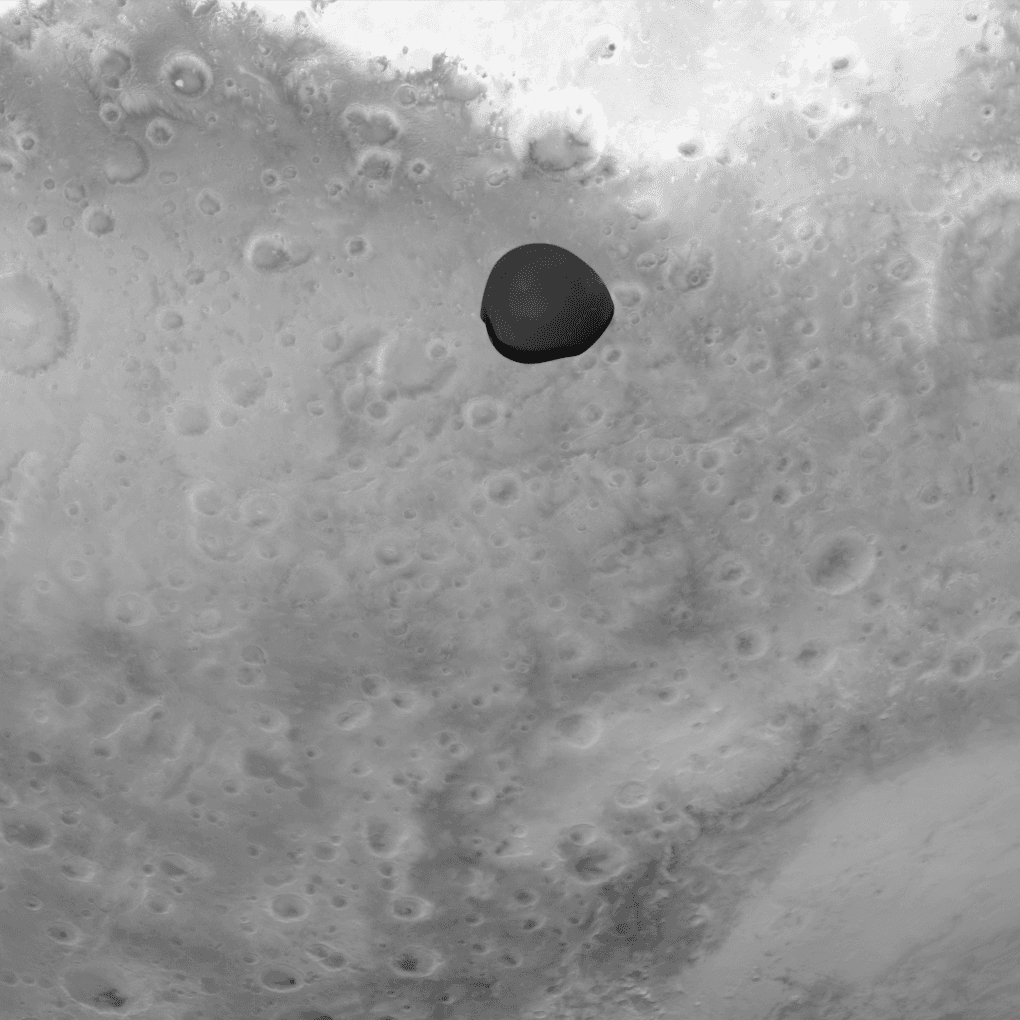
Success: Hera photographed the far side of Deimos from about 1,000 km on 12 March 2025 during a Mars gravity assist. In August 2026 those frames pinned a Nature Astronomy reconstruction to a 320 m impactor.
TL;DR· 15 min read
ESA's Hera photographed the far side of Deimos from about 1,000 km on 12 March 2025, during a Mars gravity assist on its way to the Didymos asteroids. Three instruments were used: the Asteroid Framing Camera, HyperScout-H and JAXA's Thermal Infrared Imager. In August 2026 those frames supplied the last constraint on a Nature Astronomy reconstruction that explains Deimos as a rubble-pile body reshaped by a single 320 metre impactor.
Hera was not sent to Mars. It is a planetary defence spacecraft on its way to Dimorphos, the asteroid moonlet NASA's DART hit in 2022, and Mars was simply in the right place in March 2025 to bend its trajectory and save it propellant. But ESA's flight dynamics team was asked to shape the swingby so that it also passed close to Deimos, the smaller and far less visited of the two Martian moons, and to point three instruments at the hemisphere that permanently faces away from Mars. Eighteen months later those pictures turned out to contain the piece of evidence a simulation campaign had been waiting for.
- 1,000 kmdistance from which Hera imaged the anti-Mars face of Deimos
- 3instruments used: Asteroid Framing Camera, HyperScout-H and the JAXA-supplied Thermal Infrared Imager
- 320 mdiameter of the impactor that the 2026 reconstruction says reshaped Deimos
Hera is a planetary defence spacecraft and Mars was never its destination. It launched on 7 October 2024 to survey Dimorphos, the 151 metre moonlet whose orbit around the 780 metre asteroid Didymos was measurably shifted when NASA's DART spacecraft hit it in September 2022, and its whole purpose is to turn that one grand experiment into a repeatable technique. Mars entered the story only as a piece of celestial luck. ESA's mission analysis team found that the planet would be in the right place in March 2025 to bend Hera's trajectory toward the asteroids, saving propellant that could then be spent arriving earlier. That much is ordinary. What was not ordinary was the decision to shape the swingby so that Hera also passed close to Deimos and pointed its science payload at it. Deimos is the outer and smaller of the two Martian moons, orbiting roughly 20,000 kilometres above the surface, which puts it far outside the orbits most Mars spacecraft occupy and makes close looks at it rare. ESA's project scientist Michael Kueppers had framed the encounter honestly before launch: it was not part of Hera's core mission, but several instruments would be switched on anyway, giving another chance to calibrate them and possibly to discover something. The spacecraft operations manager was blunter about the cost, thanking the flight dynamics team for extra work they had not asked for.
The encounter itself lasted minutes. ESA's real-time simulation of the flyby puts closest approach to Deimos at 12:10 GMT on 12 March 2025 and closest approach to Mars at 12:50 GMT, with Hera moving at nine kilometres per second relative to the planet. Beyond that, the published numbers need care, because ESA has printed several and they do not agree. The Mars distance appears as 6,000 kilometres in the April 2024 announcement, about 5,000 kilometres in the two flyby pages of 10 and 13 March 2025, and 5,700 kilometres in the technology release of 25 March 2025. No ESA page reconciles them. The Deimos distances look contradictory but are not: the trajectory brought Hera within 300 kilometres of the moon, while the instruments imaged it from a minimum of about 1,000 kilometres, and both figures sit on the same ESA graphic. The Nature Astronomy paper that later used the pictures describes them as acquired at about 1,000 kilometres, which settles which of the two is the imaging number. Three instruments were used: the monochrome Asteroid Framing Camera, the HyperScout-H hyperspectral imager working across 25 visible and near-infrared bands, and the JAXA-supplied Thermal Infrared Imager. The PALT laser altimeter, whose range tops out at 20 kilometres, stayed off.
Hera also used Mars as a test track for the thing that will decide whether the asteroid mission works. Its guidance system is meant to navigate autonomously around Dimorphos by watching surface features move between frames, and before launch that capability had only been exercised on a robotic testbed in Madrid. There had been no time to run it on the full avionics bench in Bremen. So for twenty minutes during the swingby, the flight team let it loose on Mars: a fresh Asteroid Framing Camera image every 48 seconds, the software acquiring up to a hundred craters and markings spread across four quadrants of a planet it had never seen and using the best six to compute its own position and heading. GNC engineer Jesus Gil Fernandez called it a technology experiment regarded in advance as slightly risky, since a locked-up flight computer would have cost the rest of the Mars science, and afterwards said that tracking unmapped markings this way was unprecedented. The system did not lose a single target. That result matters more to Hera's mission than any picture of Deimos does, because at the asteroids it will be operating far beyond real-time control, closing to within two kilometres of a body whose surface fills the whole field of view.
Then the pictures did more than the flyby had promised. Sabina Raducan of the University of Bern had been running impact simulations of Deimos since before the flyby, trying to reproduce the moon as it actually looks: a potato roughly 12 kilometres across, dominated by a ten-kilometre depression around its south pole, and unnervingly smooth compared with the cratered and grooved Phobos. Her group built a shape model out of millions of smoothed-particle-hydrodynamics particles, filled in the southern depression to restore the pre-impact body, and ran about a hundred simulations, each taking roughly a week, across a range of impactor masses and approach angles. The best fit was an oblique strike at about 45 degrees by a projectile only 320 metres across, big enough to excavate the polar basin and throw debris around the moon, small enough not to destroy it. Much of that debris fell back as a global blanket of loose regolith more than two hundred metres deep in places, which is what smooths the surface and softens the basin into a saddle rather than a sharp crater. Raducan says the last piece she needed was the buried craters visible on the face Hera imaged, and that she did not see them by eye: she first made them out in a stereo rendering of the Hera frames produced by Brian May, who sits on the Hera science team.
The inference from those buried craters is the part that reaches beyond Mars. If Deimos were a solid body, the shockwave from a 320 metre impact would have rung through it and erased or disrupted older features. That the pre-impact craters survived under the blanket implies an interior that is highly porous, fractured and dissipative, soaking up the energy before it could do catastrophic work. Kueppers put the conclusion in one line: the simulation implies Deimos is a rubble-pile body, akin to many asteroids. He was careful about what that does and does not mean. It does not prove Deimos is a captured asteroid rather than material blasted off Mars and reaccreted; it says only that whatever it is, it has ended up in the same physical state as the rubble piles that recent missions have visited. The paper makes testable predictions, and the test is already on the pad. JAXA announced on 20 August 2026 that its Martian Moons eXploration mission will launch on H3 flight 10 from Tanegashima at 04:41:03 Japan Standard Time on 20 October 2026, with a backup window running to 7 November. MMX will survey both moons, land on Phobos and bring a sample home. Hera, meanwhile, completed its second deep-space manoeuvre in early 2026, burning 123 kilograms of hydrazine for 367 metres per second, and begins its rendezvous burns in October for an arrival at Didymos in November 2026.
Mission facts
The encounter
12 March 2025. ESA's real-time flyby simulation puts closest approach to Deimos at 12:10 GMT and closest approach to Mars at 12:50 GMT, forty minutes apart. Secondary accounts put the Mars point a minute later, at 12:51, and we follow ESA. Hera was moving at 9 km/s relative to Mars, which is why the whole scientific encounter is measured in minutes rather than hours.↗
Two Deimos distances, both from ESA
300 km and 1,000 km are both correct and mean different things. ESA's flyby graphic of 10 March 2025 says the trajectory brought Hera within 300 km of Deimos; the same page says the three instruments imaged the moon from a minimum distance of 1,000 km. The post-flyby release of 13 March says Hera imaged Deimos from as close as 1,000 km. The Nature Astronomy paper describes the stereo pair as acquired at about 1,000 km. ESA's real-time flyby simulation page puts both in one sentence: Hera would image Deimos from a minimum 1000 km away while venturing as close as 300 km. The original announcement of April 2024 had said only that Hera would come within 1,000 km.↗
Three Mars distances, also all from ESA
The announcement of 25 April 2024 said Hera would venture as near as 6,000 km from the surface. The flyby pages of 10 and 13 March 2025 say about 5,000 km. The technology release of 25 March 2025 says Hera came within 5,700 km. ESA has not published a reconciliation and we do not pick between them.↗
Instruments
The Asteroid Framing Camera, a pair of redundant 1020 by 1020 pixel monochrome visible-light sensors used for both navigation and science; HyperScout-H, a hyperspectral imager working in 25 visible and near-infrared bands to characterise mineralogy; and the Thermal Infrared Imager, supplied by JAXA, which maps surface temperature and through it roughness, particle size distribution and porosity. Hera's PALT laser altimeter has a maximum range of 20 km and was useless here.↗
Which face
Deimos is tidally locked, so one hemisphere permanently faces Mars. Hera surveyed the other one, the anti-Mars side, which ESA describes as the less-seen face. Hera also imaged Mars itself and glimpsed Phobos on departure.↗
Somebody had to ask for this
The Deimos pass was not free. Hera's spacecraft operations manager Caglayan Guerbuez credited the Mission Analysis and Flight Dynamics team at ESOC for planning the gravity assist, adding that "they were asked to fine-tune the manoeuvre to take Hera close to Deimos" and that this created a good deal of extra work. Hera's project scientist Michael Kueppers had said before launch that the encounter was not part of the core mission but that instruments would be on anyway.↗
The self-driving test
For 20 minutes during the flyby, Hera ran its autonomous surface feature tracking system on Mars, taking a new Asteroid Framing Camera image every 48 seconds and locking onto craters and other markings it had never seen. The system acquires up to 100 features spread across four quadrants and uses the best six to compute its own position. GNC engineer Jesus Gil Fernandez: "Landmark tracking has been demonstrated before with previously charted features but tracking unmapped markings in this way is really unprecedented." The software was built by GMV in Spain and Romania.↗
Joint observations
ESA reports that Hera performed some joint observations of Deimos with Mars Express, which has been in Mars orbit since 2003. Before the flyby ESA had also described planned co-observation with the Emirates Mars Mission Hope probe and possible work with the ExoMars Trace Gas Orbiter.↗
Deimos, the object
ESA gives a diameter of 12.4 km; the Nature Astronomy paper calls Deimos a potato-shaped, 12 km body against a 22 km Phobos. Its surface is dark, carbonaceous and reminiscent of C-type asteroids, and strikingly smoother than its grooved and heavily cratered sibling because fine regolith has buried many older craters. Its topography is dominated by one feature, a roughly 10 km depression around the south pole that ESA describes as a saddle between mountains.↗
How far out Deimos orbits, three ways
ESA has published three numbers that look contradictory and are not. April 2024: orbiting 23,460 km from Mars, which is the orbital radius measured from the planet's centre. March 2025: orbiting 20,068 km away from the surface, which is that radius minus Mars's radius. August 2026: about 24,000 km from the surface, which appears to apply the centre-based figure to the surface. The first two are consistent; the third is not.↗
The 2026 result
Raducan, Agrusa, Asphaug, Ernst, Jutzi, Michel, Popescu and Sugita, "Deimos's shape and geology explained by a subcatastrophic impact", Nature Astronomy, published online 18 August 2026, doi 10.1038/s41550-026-02956-w. About a hundred smoothed-particle-hydrodynamics simulations on the University of Bern cluster, each taking around a week, converged on an oblique strike at roughly 45 degrees by a 320 metre projectile.↗
What the simulation says happened
The impact excavated the broad south-polar depression without shattering the moon, threw material across the surface, and let much of it fall back as a global regolith blanket more than two hundred metres deep in places. That blanket buries older craters and produces the smooth, muted face that has puzzled observers since Viking. The survival of those buried craters implies a highly porous, fractured, dissipative interior: Kueppers summarised it as "this simulation therefore implies that Deimos is a rubble-pile body, akin to many asteroids."↗
Where Hera's images came in
Raducan says the campaign began before the flyby in the hope that Hera would constrain it further, and that the face Hera imaged turned out to show additional buried craters. They were not obvious by eye. She credits the stereo rendering made from the Hera frames by Brian May, who sits on the Hera science team, for revealing them; ESA's own article calls these "spectroscopic depictions", while its image caption and the paper both describe a cross-eyed stereo view. The paper marks a circular depression about 3 km across in that stereo pair.↗
Not the closest look ever taken
ESA's August 2026 wording is careful: Hera's are "the most recent images" of Deimos rather than the closest. The Nature Astronomy paper lists the Viking Orbiters, Mars Reconnaissance Orbiter and Mars Express and, more recently, the Emirates Mars Mission Hope probe as earlier imagers, citing for Hope a 2023 Nature news report titled as the first up-close images of Deimos. Deimos's distance from Mars is what makes it hard to reach: most Mars orbiters simply never get near it.↗
Who checks the answer
JAXA's Martian Moons eXploration mission. On 20 August 2026 JAXA announced a launch on H3 flight 10 from the Tanegashima Space Center at 04:41:03 Japan Standard Time on 20 October 2026, which is 19 October 2026 at 19:41:03 UTC, with a backup window from 21 October to 7 November 2026. MMX will survey both moons, land on Phobos, collect a sample and return it to Earth about five years later.↗
Where Hera is now
As of ESA's release of 17 March 2026, Hera had completed the second of its two deep-space manoeuvres, split into three burns plus a small correction over about four weeks in February and March 2026, consuming 123 kg of hydrazine for a velocity change of 367 m/s. Rendezvous burns begin in October 2026 and the approach takes about three weeks. ESA said in October 2025 that a more aggressive braking plan had moved arrival at Didymos to November 2026, a month earlier than planned.↗
Mission timeline
- 25 Apr 2024ESA announces the side-trip at the Hera Science Community Workshop at ESTEC: a swingby as near as 6,000 km from the Martian surface, closer than either moon's orbit, with the trajectory tweaked to bring the instruments within 1,000 km of Deimos.
- 7 Oct 2024Hera launches at 14:52 UTC on a Falcon 9 from Cape Canaveral. Both 5 m solar arrays are deployed by 18:24 CEST and ESOC has the spacecraft.
- 23 Oct to 6 Nov 2024The first deep-space manoeuvre, split in two: a 100 minute burn on 23 October for about 146 m/s, then a 13 minute trim on 6 November for about another 20 m/s. Together they aim Hera at Mars.
- 10 Mar 2025ESA publishes the Deimos parameters two days out: the trajectory brings Hera to just 300 km from the moon, the three instruments will work from a minimum of 1,000 km, and the target is the tidally locked far side, the hemisphere that never faces Mars.
- 12 Mar 202512:10 GMT: closest approach to Deimos. 12:50 GMT: closest approach to Mars. The Asteroid Framing Camera, HyperScout-H and the Thermal Infrared Imager are used on a planetary body for the first time, and the autonomous feature tracker runs for 20 minutes on Martian craters it has never seen.
- 13 Mar 2025The images are premiered from ESOC in Darmstadt in a public webcast at 11:50 CET, with ESA astronaut Alexander Gerst and the novelist Andy Weir alongside the science team. It is the first scientific use of Hera's payload beyond the Earth-Moon system.
- 25 Mar 2025ESA publishes the autonomy result. The tracker held every target across the planet, and the flyby distance is now given as 5,700 km rather than 5,000. Mission manager Ian Carnelli calls the technique applicable to lunar and planetary landings.
- 7 Oct 2025One year after launch, ESA reports Hera roughly halfway to Didymos and announces that a more aggressive braking plan will bring arrival forward to November 2026. The spacecraft is behind the Sun until about 24 October.
- Feb to Mar 2026The second deep-space manoeuvre, three burns and a correction across about four weeks, burns 123 kg of hydrazine for 367 m/s and aligns Hera's orbital inclination with the Didymos system. ESA confirms success on 17 March 2026.
- 18 Aug 2026Nature Astronomy publishes Raducan and colleagues on Deimos. The Hera stereo images of the anti-Mars face, rendered by Brian May, supply the buried craters that pin the reconstruction: a 320 m impactor at about 45 degrees, a regolith blanket over 200 m thick, a porous rubble-pile interior.
- 20 Oct 2026JAXA's scheduled launch of MMX at 04:41:03 Japan Standard Time (19 October, 19:41:03 UTC) on H3 flight 10, announced on 20 August 2026, with a backup window to 7 November. MMX is the mission that will test the Deimos reconstruction in person.
- Oct to Nov 2026Scheduled, not yet flown as of 24 August 2026: ESA's plan has Hera beginning a series of precisely timed rendezvous burns, opening a three-week approach to Didymos and Dimorphos. The crash-site survey of Dimorphos is what Hera was actually built for; Deimos was the warm-up.
A filled dot marks something that physically happened. A hollow one marks an announcement, a naming or a target.
In pictures
Tap a photo to enlarge.
Sources
- ESA (13 Mar 2025): Hera asteroid mission spies Mars's Deimos moon
- ESA (25 Apr 2024): Hera asteroid mission's side-trip to Mars
- ESA image release (10 Mar 2025): Hera: Target Deimos
- ESA (8 Nov 2024): Hera burns towards Mars
- ESA video (12 Mar 2025): Real-time simulation of Hera's Mars flyby
- ESA (25 Mar 2025): Hera asteroid mission tested self-driving technique at Mars
- ESA (18 Aug 2026): Hera's Mars flyby guided impact study of Deimos moon
- S. D. Raducan et al., Deimos's shape and geology explained by a subcatastrophic impact, Nature Astronomy, 18 Aug 2026, doi 10.1038/s41550-026-02956-w
- ESA (17 Mar 2026): Hera on course for asteroid rendezvous
- ESA (7 Oct 2025): ESA's Hera targets early arrival at Didymos asteroids
- JAXA ISAS MMX news (20 Aug 2026, in Japanese): H3ロケット10号機による火星衛星探査機(MMX)の打上げ
- ESA (10 Oct 2024): Hera takes flight, Didymos here we come
Facts on this page were verified on 24 August 2026. Where sources disagree, the disagreement is stated rather than resolved silently.