The Three Forks sample depot
NASA · United States · Sample depot · 2023 · Multipolar MarsOperating
Intact and uncollected: ten sealed titanium tubes Perseverance laid on the floor of Jezero Crater between 21 December 2022 and 28 January 2023. As of 3 September 2026 no mission is scheduled to retrieve them.
TL;DR· 13 min read
Between 21 December 2022 and 28 January 2023 Perseverance laid ten sealed titanium tubes on the floor of Jezero Crater at a spot called Three Forks, a duplicate set kept as insurance in case the rover could not deliver its own samples. Seven are rock cores, one is regolith, one holds Martian air and one is a witness tube. Mars Sample Return, the campaign built to collect them, was defunded on 23 January 2026, and as of 23 August 2026 nothing is scheduled to go and get them.
In six weeks over the turn of 2022 and 2023, NASA's Perseverance rover built what NASA calls the first sample depot on another world. It put samples down instead of picking them up: ten sealed titanium tubes, one from each duplicate pair the rover had drilled, plus an atmospheric tube and a contamination witness tube, dropped onto flat ground in an area of Jezero Crater the team calls Three Forks. They were a hedge, insurance in case Perseverance itself could not hand its samples to a future lander. Three and a half years later the rover is fine, the depot is intact, and the mission that was supposed to come and get the tubes has been cancelled.
- 10sealed tubes lying on the ground in Jezero Crater
- 42 solsto build and document the depot, per NASA's robotic operations chief engineer
- 0missions scheduled to collect them as of September 2026
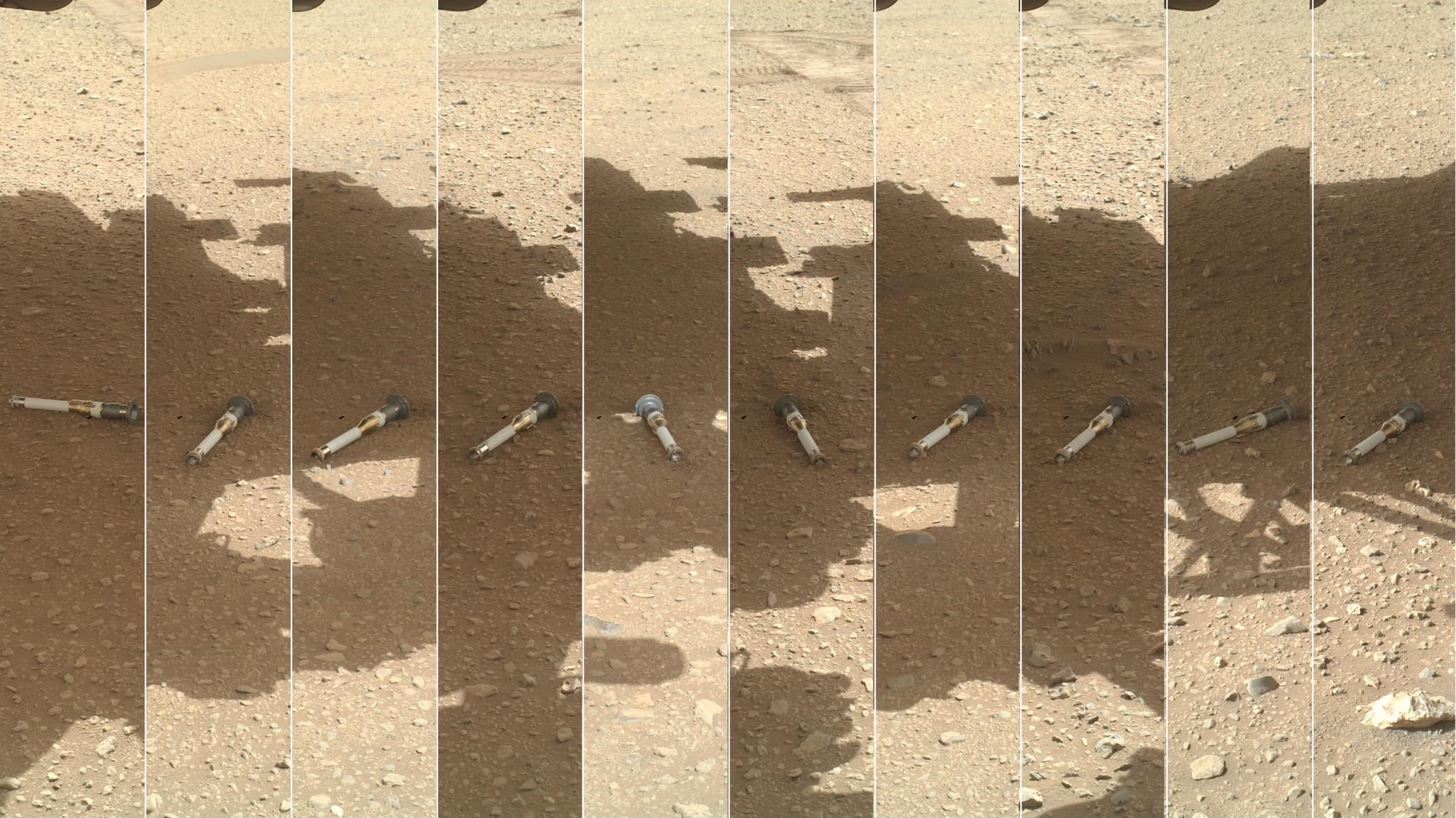
Perseverance spent six weeks over the turn of 2022 and 2023 doing the opposite of what a sampling rover normally does. Between 21 December 2022, sol 653, and 28 January 2023, sol 690, it put ten sealed titanium tubes down on flat ground near the base of Jezero Crater's fan-shaped delta, in an area the team calls Three Forks. Each drop was a small choreography. The Adaptive Caching Assembly inside the rover's belly retrieved a tube, photographed it one last time with the internal CacheCam, and released it from about 89 centimetres up. Then the WATSON camera on the end of the two-metre robotic arm was driven under the rover to check that the tube had not rolled towards a wheel and was not standing on its end. Earth testing had shown a tube lands upright less than 5 percent of the time, and the team had written commands to knock one over with part of the turret on the end of the robotic arm if it happened. It never happened. Between drops the rover reversed, photographed the tube from a distance, and drove 8 to 22 metres to the next spot. Vandi Verma, JPL's chief engineer for robotic operations, later put the whole job at 42 sols, 207.93 metres of driving, ten tubes and 4,000 images. NASA calls the result the first sample depot on another world.
The depot's shape was designed around aircraft that never flew. Under the 2022 Mars Sample Return architecture, Perseverance would drive to a Sample Retrieval Lander and hand over its tubes directly. If it could not, two Sample Recovery Helicopters carried by that lander would fly to the depot, land, roll up to a tube, grip it, fly back and drop it for the lander's arm. That backup plan set every constraint. A circle 5.5 metres in radius around each drop had to be clear of hazards, and a rock 2 centimetres across counted as a hazard for a 2.3 kilogram rotorcraft with small wheels. Each tube had to come to rest within 70 to 95 centimetres of that circle's centre, so that the helicopter had both a doughnut-shaped landing zone and a drive-grab-and-go zone. The whole depot had to sit between 200 and 700 metres of flight from a plausible lander site. On top of that, nothing could block Perseverance's high-gain antenna while it was parked for a drop, the next drop zone had to be visible for hazard imaging, and the rover had to keep a route back through the field in case a tube needed re-imaging or toppling. The zigzag that satisfied all of this left three prongs of rover tracks across the site, which suited the name Three Forks.
What is actually in the depot is more varied than the phrase ten samples suggests. Seven are rock cores: Montdenier, Coulettes, Malay and Atsah are igneous, from the crater floor; Skyland, Bearwallow and Mageik are sedimentary, from the delta front. One, Crosswind Lake, is loose regolith. One, Roubion, is the mission's atmospheric sample, and it has a story: on sol 164, 6 August 2021, Perseverance's first ever coring attempt drilled to its full commanded 7 centimetres, transferred the tube and sealed it perfectly, and then reported the volume as zero. The rock had crumbled to powder. The sealed tube holds Martian air instead. The tenth is a witness tube, preloaded with materials that trap molecular and particulate contaminants and opened on the surface to record what the rover itself brought from Earth; it is the only one of Perseverance's three sealed witness tubes at the depot, and it was the last thing dropped. Every rock and regolith tube at Three Forks is the twin of one still riding in the rover. That was the point. The depot was never the collection. It was the copy you keep somewhere else in case the house burns down.
The house did not burn down. The programme did. NASA's fiscal 2026 budget request proposed cancelling Mars Sample Return outright after cost estimates rose to about $11 billion and the return date slipped towards 2040. Congress, which rejected most of the administration's other NASA cuts, agreed on this one. The conference report on the January 2026 appropriations minibus says flatly that the agreement does not support the existing Mars Sample Return program, and puts $110 million into a Mars Future Missions account to keep radar, spectroscopy and entry, descent and landing technology alive instead. The House passed the bill 397 to 28 on 8 January, the Senate 82 to 15 on 15 January, and the President signed it on 23 January 2026. In March, ESA's Daniel Neuenschwander confirmed that member states had asked for the cancellation of the Earth Return Orbiter, the 491 million euro Airbus spacecraft that was to catch the samples in Mars orbit. In April, four senators asked appropriators for at least $400 million in 2027 to stop the capability rotting, and Lockheed Martin repeated that it could do the job for under $3 billion. None of that is a mission. As of 3 September 2026, nothing is scheduled to go and get the tubes.
So they lie there. Ten titanium cylinders, each about 18 centimetres long and 2 centimetres across, scattered in a zigzag across roughly 48 by 50 metres of Jezero, 2.4 kilometres from where Perseverance landed and about 9.9 kilometres from where the rover was on sol 1965, its odometer at 45.11 kilometres. Nothing in orbit can see them: HiRISE resolves objects around 90 centimetres across, so a tube is not a faint dot, it is nothing at all. The only images of the depot are the ones Perseverance took, which is exactly why the team spent so much of those 42 sols mapping each position, so that the tubes could be found again under dust by a machine that has not been built. Legally they remain American property: Article VIII of the Outer Space Treaty keeps a launching state's jurisdiction over its objects wherever they are, and there is no such thing as abandonment in space law. Practically, they are the best-documented objects on Mars that nobody is coming for. Perseverance, meanwhile, is still working, still drilling, and still carrying the other half of every pair.
Mission facts
What it is
A backup cache of ten sealed sample tubes lying loose on the Martian surface at a spot called Three Forks, on flat ground near the base of Jezero Crater's fan-shaped ancient river delta. NASA describes it as the first sample depot built on another world.↗
Why it exists
Through its first seven rock sampling sites and one regolith site, Perseverance drilled twin cores. One of each pair stayed in the rover, which was to be the primary way of handing samples to a Mars Sample Return lander. The other went to the depot, to be collected by two Sample Recovery Helicopters if the rover could not make the rendezvous.↗
First tube down
21 December 2022, sol 653. An igneous core informally named Malay, drilled on 31 January 2022 at South Séítah. The Sampling and Caching System took almost an hour to fetch it from the rover's belly, viewed it one last time with the internal CacheCam, and dropped it about 89 cm (3 feet) onto a chosen patch of ground.↗
Last tube down
28 January 2023, sol 690. It was the witness tube sealed at the Amalik sampling site, the only one of Perseverance's witness tubes placed in the depot. JPL's release says confirmation reached mission controllers around 5 p.m. PST (8 p.m. EST) on Sunday 29 January, one day after the drop.↗
The ten tubes
Named, in the order NASA lists them by distance from the rover in its February 2023 depot panorama: Amalik (witness), Atsah and Skyland, then Bearwallow, Coulettes, Montdenier, Crosswind Lake and Roubion, then Mageik and Malay.↗
What is inside them
Seven rock cores (Montdenier, Coulettes, Malay and Atsah are igneous; Skyland, Bearwallow and Mageik are sedimentary), one regolith sample (Crosswind Lake), one atmospheric sample (Roubion) and one witness tube (Amalik). NASA's own summary of the set is one sample from each pair taken so far, plus one atmospheric sample and one witness tube.↗
The odd one out
Roubion, catalogued as tube 1 and as the mission's atmospheric sample, is the tube from the failed first coring attempt on sol 164 (6 August 2021). The corer reached its full commanded 7 cm depth, the tube was transferred and sealed correctly, and then the volume measurement came back empty: the rock had crumbled and no core survived. The sealed tube holds Martian air.↗
Tube dimensions
Each tube is about 18 cm (7 inches) long and about 2 cm across, and they are titanium. NASA's depot map page gives the tube and glove (adapter) combination as 18.6 cm, and says the team mapped each one precisely so the samples could be found even if covered with dust.↗
Layout
An intricate zigzag, with the tubes 5 to 15 metres (15 to 50 feet) apart so that each could be reached safely, a spacing given in JPL's depot-completion release. The rover drove roughly 8 to 22 metres between drop zones. NASA's chief engineer for robotic operations, Vandi Verma, put the whole job at 42 sols, 207.93 metres of driving, ten dropped tubes and 4,000 images.↗
Why that shape
Helicopter access drove the geometry. A circle of radius 5.5 metres around each drop had to be free of hazards for a Sample Recovery Helicopter, the tube had to land within 70 to 95 cm of that circle's centre, and rocks about 2 cm across counted as hazards for a 2.3 kg rotorcraft with small wheels and a gripper. The whole depot had to sit 200 to 700 metres flight distance from a plausible lander site. Nothing could block Perseverance's high-gain antenna during a drop, and the rover had to keep a return route through the depot in case a tube needed re-imaging or toppling.↗
Invisible from orbit
An 18 cm tube is far below what any camera at Mars can resolve. HiRISE, the sharpest, shot Jezero at about 29 cm per pixel, map-projected to 25 cm, and its own caption for the Perseverance landing frame states that objects about 88 cm across are resolved. Every published picture of the depot was taken by Perseverance itself, which is why NASA's depot map records each tube's position: the tubes have to be findable even under dust.↗
Share of the collection
NASA's sample catalogue, last updated 20 June 2026 and read on 3 September 2026, lists 30 of Perseverance's 38 sample tubes and 3 of its 5 witness tubes as used, which is 33 of the 43 tubes it carried. Ten of those 33 are at Three Forks. At an AGU briefing in December 2025, reported by SpaceNews, the project said six empty tubes remained and two filled tubes were deliberately left unsealed so their contents could be swapped.↗
Mars Sample Return defunded
The conference report on the fiscal 2026 appropriations minibus, released 5 January 2026, states: "As proposed in the budget, the agreement does not support the existing Mars Sample Return (MSR) program." It instead directs $110 million to a Mars Future Missions account to preserve radar, spectroscopy, entry, descent and landing and related technologies. The House passed the bill 397 to 28 on 8 January and the Senate 82 to 15 on 15 January. (SpaceNews's report of the Senate vote says 16 January, but that report was published on the evening of 15 January, so the date appears to be a slip; The Planetary Society gives 15 January.) President Trump signed it into law on 23 January 2026, a date for which The Planetary Society is our only source.↗
The European half
ESA's contribution was the Earth Return Orbiter, awarded to Airbus Defence and Space under a 491 million euro contract in October 2020. After the US vote, ESA's Director of Human and Robotic Exploration Daniel Neuenschwander said Mars Sample Return was "currently not planned to be continued", and following the 345th ESA Council meeting he said member states had "asked for the cancellation of the Earth Return Orbiter mission", with talks under way with Airbus about reusing hardware such as the electric propulsion system.↗
Who owns the tubes now
Legally, the United States does. Article VIII of the 1967 Outer Space Treaty gives a launching state continuing jurisdiction and control over objects it launches, wherever they end up, and space law has no concept of abandonment. Another state could physically collect the tubes but that would not transfer ownership; whether the obligation to return a recovered space object extends to the material inside it is not settled.↗
Is the rover still working
Yes. NASA published a HiRISE image on 24 June 2026 showing Perseverance as a green speck west of Jezero on 13 June 2026, the day before it passed a marathon of driving (42.195 km) on sol 1890, five years and four months in; Opportunity took eleven years and two months to cover the same distance. Perseverance's own waypoint file, read on 3 September 2026, records 700 waypoints, sol 1965 and 45.11 km (it gave sol 1955 and 44.98 km on 23 August 2026, and 694 waypoints, sol 1947 and 44.97 km on 16 August 2026). The depot lies about 9.9 km behind the rover in a straight line, and about 2.4 km from the landing site. Nothing in NASA's published plans has it going back.↗
Mission timeline
- 6 Aug 2021Sol 164: Perseverance's first coring attempt, at a target called Roubion, drills to full depth but the tube comes back empty. Sealed anyway, it becomes the mission's atmospheric sample and eventually the depot's oddest occupant.
- 21 Dec 2022Sol 653: the igneous core Malay is dropped about 89 cm onto the surface at Three Forks, the first tube of what NASA calls the first sample depot built on another world.
- 28 Jan 2023Sol 690: the tenth and last tube, the Amalik witness tube, goes down. WATSON photographs it on the ground.
- 29 Jan 2023Confirmation that the depot is complete reaches controllers at JPL around 5 p.m. PST, according to JPL's release, which is itself datelined 28 January. NASA's pages do not resolve the one-day gap.
- 31 Jan 2023Sol 693: Perseverance takes a 368-image Mastcam-Z panorama of the finished depot, with the nearest tube 3 metres away and the farthest about 60 metres off, then drives away up the delta.
- 31 Mar 2023Vandi Verma, chief engineer for robotic operations at JPL, publishes the reasoning behind the depot's shape: helicopter landing circles, antenna sight lines and a rover route back through the field.
- Jan 2025After cost and schedule overruns, NASA announces it will study two alternative Mars Sample Return architectures through mid-2026.
- 17 Dec 2025At an American Geophysical Union briefing, deputy project manager Steve Lee says Perseverance is "really in excellent shape" and capable of many more years, while conceding there are few public updates on how or whether the samples will ever be returned.
- 5 Jan 2026The fiscal 2026 appropriations minibus is released. Its report states that the agreement does not support the existing Mars Sample Return program, and moves $110 million into a Mars Future Missions account instead.
- 23 Jan 2026The bill is signed into law after passing the House 397 to 28 on 8 January and the Senate 82 to 15. The campaign that the Three Forks depot was built for no longer has a budget line.
- 28 Mar 2026ESA confirms that member states have asked for the cancellation of the Earth Return Orbiter, the European spacecraft that was to catch the samples in Mars orbit and carry them home.
- Apr 2026Four US senators ask appropriators for at least $400 million for Mars Future Missions in fiscal 2027, warning of "severe and irreversible harm" to the ability to land on Mars. Lockheed Martin says it still stands behind a plan to return the samples for under $3 billion.
A filled dot marks something that physically happened. A hollow one marks an announcement, a naming or a target.
In pictures
Tap a photo to enlarge.
Sources
- NASA JPL: NASA's Perseverance Rover Completes Mars Sample Depot (28 to 30 January 2023)
- NASA JPL: NASA's Perseverance Rover Deposits First Sample on Mars Surface (21 December 2022)
- NASA Science: Perseverance's 'Three Forks' Sample Depot Map
- NASA Science: WATSON Documents Final Tube Dropped at 'Three Forks' Sample Depot
- NASA Science: Perseverance's Portrait of the Sample Depot (14 February 2023)
- Vandi Verma (NASA JPL): The Role of a Rover, a Lander, and Helicopters in the Unique Shape of the First Sample Depot on Mars (31 March 2023)
- NASA Science: Mars Rock Samples catalogue, last updated 20 June 2026
- NASA Science: Assessing Perseverance's First Sample Attempt (11 August 2021)
- NASA MMGIS: M20_waypoints.json
- SpaceNews (5 January 2026): Minibus provides $24.4 billion for NASA for fiscal year 2026
- The Planetary Society (30 January 2026): NASA is funded. Now what?
- European Spaceflight (28 March 2026): ESA Member States Call for Cancellation of Earth Return Orbiter
- SpaceNews (15 January 2026): Congress passes minibus spending bill that rejects proposed NASA cuts
- SpaceNews (26 December 2025): Perseverance continues science mission amid uncertainty about Mars Sample Return
- SpaceNews (15 April 2026): Senators seek increased funding for NASA Mars missions
- Michelle Hanlon, Payload (13 January 2026): Mars Sample Return may be canceled, but the legal questions it leaves behind continue
- NASA Science (image added 24 June 2026): NASA's HiRISE Captures Perseverance Marking a Milestone on Mars
- HiRISE ESP_068294_1985: Perseverance Hardware One Day after Landing
Facts on this page were verified on 3 September 2026. Where sources disagree, the disagreement is stated rather than resolved silently.
77.4082 E, 18.4529 N · Three Forks