LightShip, SpotLight and MARCONI
ESA · Europe · Program · 2023 · AnnouncedIn development
Not approved: a Phase A/B1 design study running to mid-2027. ESA's exploration programme was undersubscribed at the November 2025 ministerial, and LightShip was not among the missions confirmed there.
TL;DR· 14 min read
LightShip is ESA's proposal to build the infrastructure first: an electric propulsion tug that would carry one large passenger spacecraft or up to twelve small ones to Mars, then settle into a 5,720 km orbit at 20 degrees inclination as a permanent node of a communications and navigation network called MARCONI. Its first passenger, SpotLight, would image landing sites at 25 cm per pixel. It is a Phase A/B1 study running to mid-2027, and ESA's exploration programme was undersubscribed at the November 2025 ministerial, which did not confirm it.
Every orbiter Europe and the United States have sent to Mars this century has been a science mission wearing a relay antenna as a second job, and when the science mission dies the relay dies with it. LightShip is ESA's answer: build the infrastructure first. As designed, a tug with electric propulsion would carry one large passenger spacecraft or up to twelve small ones to Mars, drop them off, then climb into a service orbit and stay there as a communications and navigation node. Fly several and a network would accumulate. The first mission would carry a high-resolution imaging orbiter called SpotLight. None of this is funded to build. It is a study, and in November 2025 the money that would have started it did not arrive.
- 5,720 kmaltitude of the MARCONI service orbit, at 20 degrees inclination
- 25 cm/pixelthe imaging resolution ESA has specified for SpotLight, the first passenger
- EUR 445.3mMars share of ESA's exploration subscriptions at the 2025 ministerial, against 704m for low Earth orbit
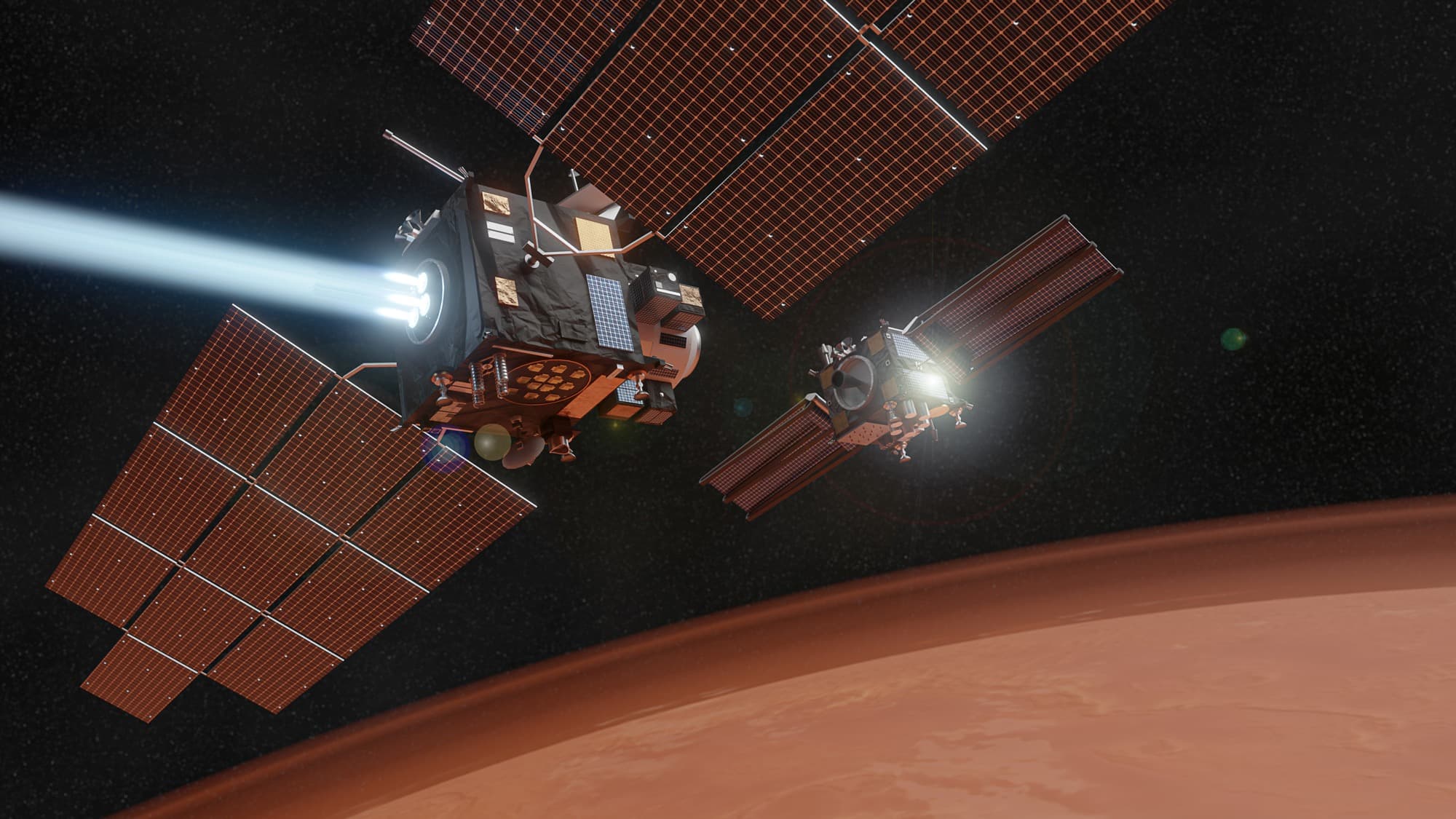
The problem LightShip is designed to solve is structural rather than technical. A spacecraft that wants to send a lot of data home from Mars needs a big antenna, a lot of power and a lot of mass, and most of that mass exists only to talk to Earth. Since 2000 the way round this has been to let science orbiters carry relay radios as a sideline, so that a rover can get away with a small antenna. It works, and it is fragile, because the relay retires when the science mission does, and science orbiters are expensive and slow to build. ESA's proposal is to separate the two functions. A LightShip, on paper, is an electric propulsion tug. It would carry one large passenger spacecraft, or as many as twelve small ones, from Earth to Mars, release them, and then move itself into a near-equatorial orbit 5,720 km above the surface, inclined 20 degrees, where it would stop being a transport vehicle and become a permanent node providing communications and positioning. Launch several and the coverage, the bandwidth and the redundancy would accumulate. The service has a name of its own, MARCONI, for Mars Communication and Navigation Infrastructure, after the wireless pioneer whose equipment carried the first radio distress call from the East Goodwin lightship in 1899. The tug is named for the vessel, and the service for the man.
Because the tug would sit high above Mars looking down at the whole disc, it would make a good weather satellite, and ESA's study allocates it about 30 kilograms of science capacity to be one. An instrument definition team reporting in December 2024 proposed a thermal infrared mapper, a sub-millimetre sounder, a multiband imaging suite, a near-infrared spectral imager and radio occultation both between spacecraft and to Earth, aimed at winds, temperatures, dust, cloud, water vapour and surface pressure, with the stated goal of real-time Mars weather monitoring and forecasting. That is not a decorative objective. If you intend to land heavy things precisely, you need to know what the atmosphere is doing on the day. The first passenger reflects the same logic. SpotLight would be a low-altitude polar orbiter whose assigned job is choosing and certifying landing sites: a multispectral imager at 25 centimetres per pixel across a swath of at least 7 kilometres, a context camera at 2.5 metres per pixel across at least 22 kilometres, stereo pairs yielding one-metre terrain models, and, if the mass budget allows, an imaging spectrometer and a Doppler LiDAR that would make the first direct orbital measurements of Martian winds. The definition team wrote plainly why this matters to Europe: it would reduce dependence on HiRISE, which certified the landing site for ESA's own Rosalind Franklin rover and is nearing the end of its life.
What LightShip is not, in August 2026, is a mission. It is in industrial Phase A/B1, the competitive feasibility and preliminary design stage, which ESA's own presentation to MEPAG dates from the fourth quarter of 2024 to the second quarter of 2027. Around it sit real but preparatory activities: four consortia led by Argotec, Deimos Space, Politecnico di Milano with SITAEL, and Redwire studying what a small low-cost European Mars platform would have to look like to ride as a passenger; announcements of opportunity issued in March 2025 for payloads on both LightShip and SpotLight, with proposals closing that June. Implementation is a separate decision, and in ESA that decision belongs to member states at a Council at ministerial level, held every three years. The relevant one was CM25, in Bremen on 26 and 27 November 2025. ESA arrived asking for a step change in exploration. It did not get one. The agency's overall subscription was a record, but the Human and Robotic Exploration directorate came up short, and when its director Daniel Neuenschwander listed what had been confirmed he named the low Earth orbit cargo return service, the Argonaut lunar lander and the Rosalind Franklin rover. He did not name LightShip.
The size of that shortfall is reported three different ways, and the difference is worth pinning down because it changes how bad the picture looks. European Spaceflight put exploration at just over 2.9 billion euros against a projected 3.7 billion, calling it a shortfall of more than 20 per cent. SpaceNews, reporting from Bremen, gave 2.98 billion against an ask of 3.77 billion and described that as roughly 70 per cent and a 30 per cent gap, although those numbers divide to 79 per cent. SpaceNews again in December gave about 80 per cent and a shortfall of nearly 800 million euros, which is the arithmetic the other figures imply. Within exploration, Mars received 445.3 million euros against 704 million for low Earth orbit and 620 million for the Moon. One Mars item did come out of Bremen with backing: ZefERO, the repurposing of the Earth Return Orbiter that ESA had been building for Mars Sample Return into a standalone European mission for 2032 studying Martian winds and geology and acting as a relay, which may take over the relay role LightShip was meant to introduce. Neuenschwander said in December that his directorate would report in February on how it would absorb the gap, and that ZefERO was itself a candidate for cuts. We have not found that report.
Mission facts
What LightShip is
ESA's own description: "LightShip is an electric propulsive tug that will deliver one or more passenger spacecraft to Mars and offer communications and navigation services around the planet, as well as several seats for a range of scientific payloads." The plan is a series of them, launched at a regular cadence, each staying at Mars after delivering its passengers so that coverage, bandwidth and redundancy build up over successive missions.↗
The name
A lightship is a vessel anchored where a lighthouse cannot be built, carrying its own lantern as a navigation beacon. ESA cites the East Goodwin lightship, whose captain sent the first radio distress signal using Guglielmo Marconi's wireless equipment in 1899. The communications and navigation service is therefore called MARCONI, for Mars Communication and Navigation Infrastructure.↗
The service orbit
The LightShip Instrument Definition Team's final report specifies near-equatorial orbits at 20 degrees inclination and 5,720 km altitude, chosen to optimise the communications and navigation functions, with successive LightShips distributed around the equator to give constant coverage for low-latitude surface stations.↗
LightShip's own science
Each tug can carry about 30 kg of scientific payload, and ESA specified atmospheric monitoring as the theme for a high-altitude platform. The definition team's strawman payload is a thermal infrared mapper, a sub-millimetre sounder, a multiband imaging suite, a near-infrared spectral imager and radio occultation both spacecraft-to-spacecraft and spacecraft-to-Earth, aimed at winds, temperatures, dust and cloud abundance, water vapour and surface pressure. The stated goal is real-time weather monitoring and forecasting at Mars.↗
SpotLight
The passenger on LightShip-1: a low-altitude polar orbiter whose assigned job is landing-site selection and characterisation. ESA has specified high-resolution imaging at 25 cm per pixel over a swath of at least 7 km with at least four colour filters, plus a colour context imager at 2.5 m per pixel over at least 22 km in at least six bands, and, if mass allows, an imaging spectrometer and a Doppler LiDAR for direct orbital wind measurements. Stereo imaging is to yield 1 m per pixel terrain models. The measurement definition team says the orbit altitude should not exceed 400 km.↗
Why the imaging matters to Europe
The SpotLight report is unusually direct about the strategic point. The high-resolution imager "will empower Europe to independently shape its Mars exploration program, reducing dependence on NASA's MRO/HiRISE, which is nearing the end of its operational life". HiRISE has covered about 3 per cent of Mars, mostly in panchromatic, and certified landing sites including that of ESA's own Rosalind Franklin rover.↗
How the first mission would fly
On the mission profile in ESA's study, LightShip-1 and SpotLight would launch together. SpotLight would separate during the interplanetary cruise and enter Mars orbit under its own propulsion, then lower itself to its operational orbit, while LightShip-1 would arrive with essentially zero excess velocity, insert into the MARCONI service plane and spiral down to the service orbit. Later LightShips could instead deliver passengers door to door, and could carry up to twelve small satellites. None of this has been built or flown.↗
What phase it is in
Industrial Phase A/B1, running from the fourth quarter of 2024 to the second quarter of 2027 according to ESA's own MEPAG presentation of 1 May 2025. In ESA practice this means competing industrial consortia carry a feasibility and preliminary design study in parallel before one is chosen, and implementation is a separate decision requiring member states to fund it.↗
The platform studies
On 21 January 2025 ESA selected four consortia, led by Argotec, Deimos Space, Politecnico di Milano with SITAEL, and Redwire, to define small low-cost Mars satellite platforms suitable as LightShip passengers. The studies are funded through the Preparation element of ESA's Basic Activities and, unusually, look at the platform alone with no payload. Claire Parfitt, ESA's Mars Exploration Study Team Lead, said the aim was to understand "what the small and low-cost platform capabilities are in Europe and how they need to be modified for the Mars environment".↗
Payloads of opportunity
ESA's Directorate of Human and Robotic Exploration released announcements of opportunity for preliminary selection of payloads of opportunity on LightShip and SpotLight on 7 March 2025, with mandatory letters of intent due 13 May 2025 and full proposals by 30 June 2025 at 13:00 CEST. Slots on LightShip missions could be awarded to any ESA member or associated state.↗
The 2025 ministerial
At ESA's Council at ministerial level in Bremen on 26 and 27 November 2025, member states subscribed a record total, but the Human and Robotic Exploration directorate was undersubscribed. Daniel Neuenschwander, its director, named the confirmed items: "We confirmed the Cargo Return Service for LEO, Argonaut for the moon, and Rosalind Franklin for Mars." LightShip was not among them.↗
How large the shortfall was
Published figures disagree, and it is worth being precise about what each measures. European Spaceflight reported a total of EUR 22.1 billion agreed against an opening proposal of EUR 22.25 billion, with exploration committed at just over EUR 2.9 billion against a projected EUR 3.7 billion, "a shortfall of more than 20%". SpaceNews reported EUR 2.98 billion against an ask of EUR 3.77 billion, calling it "roughly 70%" and a "30% budget gap", although 2.98 divided by 3.77 is 79 per cent. SpaceNews later reported about 80 per cent and a shortfall of nearly EUR 800 million, which matches the arithmetic, and noted that ESA issued a revised total of EUR 22.3 billion on 2 December 2025.↗
What Mars actually got
Of the exploration subscriptions made at the ministerial, ESA budget documents show EUR 704 million going to low Earth orbit activities and EUR 620 million to lunar activities, against EUR 445.3 million for Mars. The remainder went to exploration science, other programmes, or was unallocated within exploration.↗
ZefERO
With Mars Sample Return cancelled on the American side, ESA proposed to member states on the second day of the ministerial that it repurpose the Earth Return Orbiter it had been building for that mission as a "dedicated European exploration mission, with scientific and communication relay dimensions". The proposed mission, ZefERO, would launch in 2032 to study Martian winds and conduct geological investigations as well as serve as a communications relay. European Spaceflight reported that ZefERO could affect the scope of LightShip: implementing it is unlikely to displace the tug's payload delivery role, but it may replace the tug's data relay function.↗
What ESA said about ZefERO
Reporting from Bremen at the close of the ministerial, SpaceNews wrote that Neuenschwander confirmed the Earth Return Orbiter would be reoriented into ZefERO, a standalone European mission focused on Mars geology planned for 2032. "I'm very happy that the member states supported us in the concept of reorienting ERO towards ZefERO," he said. That is support for a concept rather than an approved mission, and the same article records that what remained unclear was which parts of the exploration portfolio would be reassessed to cover the gap.↗
The February review
At a briefing on 18 December 2025 Neuenschwander said the directorate was assessing how to absorb the shortfall and would have more to say in February, after reviews by programme boards, and that ZefERO itself was one potential target for cuts. As of 24 August 2026 we found no published outcome of that review, and no ESA statement confirming or cancelling LightShip. Any status claim about LightShip made after February 2026 should be treated as unverified until ESA publishes one.↗
M-MATISSE, the other European Mars candidate
Separate from LightShip and run by ESA's science programme rather than its exploration directorate, M-MATISSE (Mars Magnetosphere ATmosphere Ionosphere and Space-weather SciencE) is one of three finalists for the M7 medium mission, alongside Plasma Observatory and Theseus. It would fly two orbiters with identical payloads, a fathership called Henri and a daughtership called Marguerite, both at 60 degrees inclination with periapsis below 270 km and apoapsis of 3,000 and 10,000 km respectively, for a nominal mission of one Martian year with a launch identified for July 2037. ESA said in November 2023 that one candidate was expected to be chosen by mid-2026. ESA's own call page carries no update after 8 November 2023, and as of 24 August 2026 we found no announcement of a selection.↗
Mission timeline
- 8 Nov 2023ESA's Science Programme Committee narrows the shortlist for its next medium science mission to three: M-Matisse, Plasma Observatory and Theseus. M-Matisse would put two identically instrumented orbiters around Mars. ESA says one of the three is expected to be chosen by mid-2026. This is a different European Mars line from LightShip, run by the science programme rather than the exploration directorate.
- 17 Sep 2024ESA publishes a public explainer of the concept: a tug with electric propulsion, a data relay named MARCONI after the wireless pioneer whose equipment sent the first distress call from the East Goodwin lightship in 1899, and a passenger called SpotLight bound for a roughly 300 km mapping orbit. The concept is entering competitive Phase A/B1 and its future depends on the ministerial in November 2025.
- 5 Dec 2024The LightShip Instrument Definition Team delivers its final report: 20 degrees inclination, 5,720 km altitude, about 30 kg of payload, and a strawman suite of a thermal infrared mapper, sub-millimetre sounder, multiband imaging suite, near-infrared spectral imager and radio occultation, aimed at Mars weather monitoring and forecasting.
- 12 Dec 2024The SpotLight Measurement Definition Team delivers its final report, specifying 25 cm per pixel multispectral imaging and a 2.5 m per pixel context imager, and arguing explicitly that this is how Europe stops depending on HiRISE.
- 21 Jan 2025ESA selects four consortia, led by Argotec, Deimos Space, Politecnico di Milano with SITAEL, and Redwire, to define low-cost Mars satellite platforms that could ride as LightShip passengers. The studies deliberately exclude payloads.
- 7 Mar 2025Announcements of opportunity for payloads of opportunity on LightShip and SpotLight are released, with letters of intent due 13 May and full proposals by 30 June 2025.
- 1 May 2025Claire Parfitt presents LightShip to MEPAG, dating the industrial Phase A/B1 study to the fourth quarter of 2024 through the second quarter of 2027 and setting the concept alongside MEDaL, ESA's pre-Phase A work on heavy and precise Mars entry, descent and landing.
- 26 Nov 2025On the second day of the ministerial in Bremen, ESA proposes repurposing the Earth Return Orbiter as ZefERO, a standalone European Mars mission for 2032 with science and relay roles, and notes it could replace LightShip's data relay function.
- 27 Nov 2025The ministerial closes with a record overall subscription but with Human and Robotic Exploration undersubscribed by roughly 20 to 30 per cent depending on whose figures you read. Neuenschwander names the cargo return service, Argonaut and Rosalind Franklin as confirmed. LightShip is not named.
- 2 Dec 2025ESA issues revised final figures for the ministerial, raising the headline total to EUR 22.3 billion.
- 18 Dec 2025Neuenschwander says the directorate is assessing how to absorb the shortfall with its member states and will say more in February, and that ZefERO is one candidate for cuts. Budget documents show EUR 445.3 million subscribed for Mars against EUR 704 million for low Earth orbit and EUR 620 million for the Moon.
- 24 Aug 2026We found no published outcome of that February review, no ESA statement on LightShip's status since the ministerial, and no announcement of the M7 selection that ESA expected by the middle of this year.
A filled dot marks something that physically happened. A hollow one marks an announcement, a naming or a target.
In pictures
Tap a photo to enlarge.
Sources
- ESA blog, To Mars and back (17 Sep 2024): Seven things you didn't know about Europe's tug to Mars
- ESA (21 Jan 2025): Towards low-cost missions to Mars
- LightShip Instrument Definition Team, Final Report v1.0, ESA-E3P-LS1-RP-002, 5 December 2024 (PDF)
- LightShip-1 Passenger S/C SpotLight, Measurement Definition Team Final Report v1.1, ESA-E3P-LS1-RP-001.1, 12 December 2024 (PDF)
- Claire E. Parfitt (ESA ESTEC), ESA's LightShip in the European exploration strategy, MEPAG hybrid meeting, 1 May 2025 (PDF)
- ESA SciSpacE (7 Mar 2025): Announcement of Opportunity for LightShip and SpotLight Science Payloads of Opportunity Released
- European Spaceflight (26 Nov 2025), Andrew Parsonson: ESA to Repurpose European Service Module and Earth Return Orbiter
- European Spaceflight (27 Nov 2025), Andrew Parsonson: Exploration and the UK Emerge as the Biggest Losers of CM25
- SpaceNews (Nov 2025), Emma Gatti: Europe's human and robotic exploration hit by budget shortfall
- SpaceNews (Dec 2025), Jeff Foust: ESA weighing options to address exploration funding shortfall
- ESA (8 Nov 2023): Final three for ESA's next medium science mission
- M-MATISSE Workshop, The Mission
Facts on this page were verified on 24 August 2026. Where sources disagree, the disagreement is stated rather than resolved silently.