Rosalind Franklin rover
ESA, with NASA · Multinational · Rover · 2028 · AnnouncedIn development
Funded and building hardware as of September 2026: NASA approved its supporting project on 16 April 2026 and selected a Falcon Heavy. ESA still says launch in 2028 and landing in 2030, with no exact dates published.
TL;DR· 13 min read
The Rosalind Franklin rover is built around a drill that reaches two metres down, the depth at which preserved biosignatures could still survive. Russia's invasion of Ukraine ended the partnership that was to launch and land it in 2022, leaving a nearly complete European rover with no ride and no landing gear. It is funded again: ESA confirmed the money in November 2025, NASA approved its supporting project on 16 April 2026 and selected a Falcon Heavy, and ESA still says launch in 2028 and landing at Oxia Planum in 2030.
The Rosalind Franklin rover is built around a drill that reaches two metres below the surface, the depth at which radiation and soil chemistry have not yet finished destroying organic molecules and preserved biosignatures could still survive. It has been finished, or nearly finished, since 2022, when Russia's invasion of Ukraine ended the partnership that was to launch it and land it and left a complete European rover with no ride and no landing gear. Four years on it has a new landing platform being built in Britain, a NASA-provided rocket, engines and heaters, and a stated launch in 2028 with a landing in 2030. What it does not have is a date.
- 2 mthe depth the rover's drill is designed to reach below the surface
- 310 kgrover mass, carrying about 26 kg of instruments
- 2030ESA's stated landing year, eight years after the lost 2022 launch slot
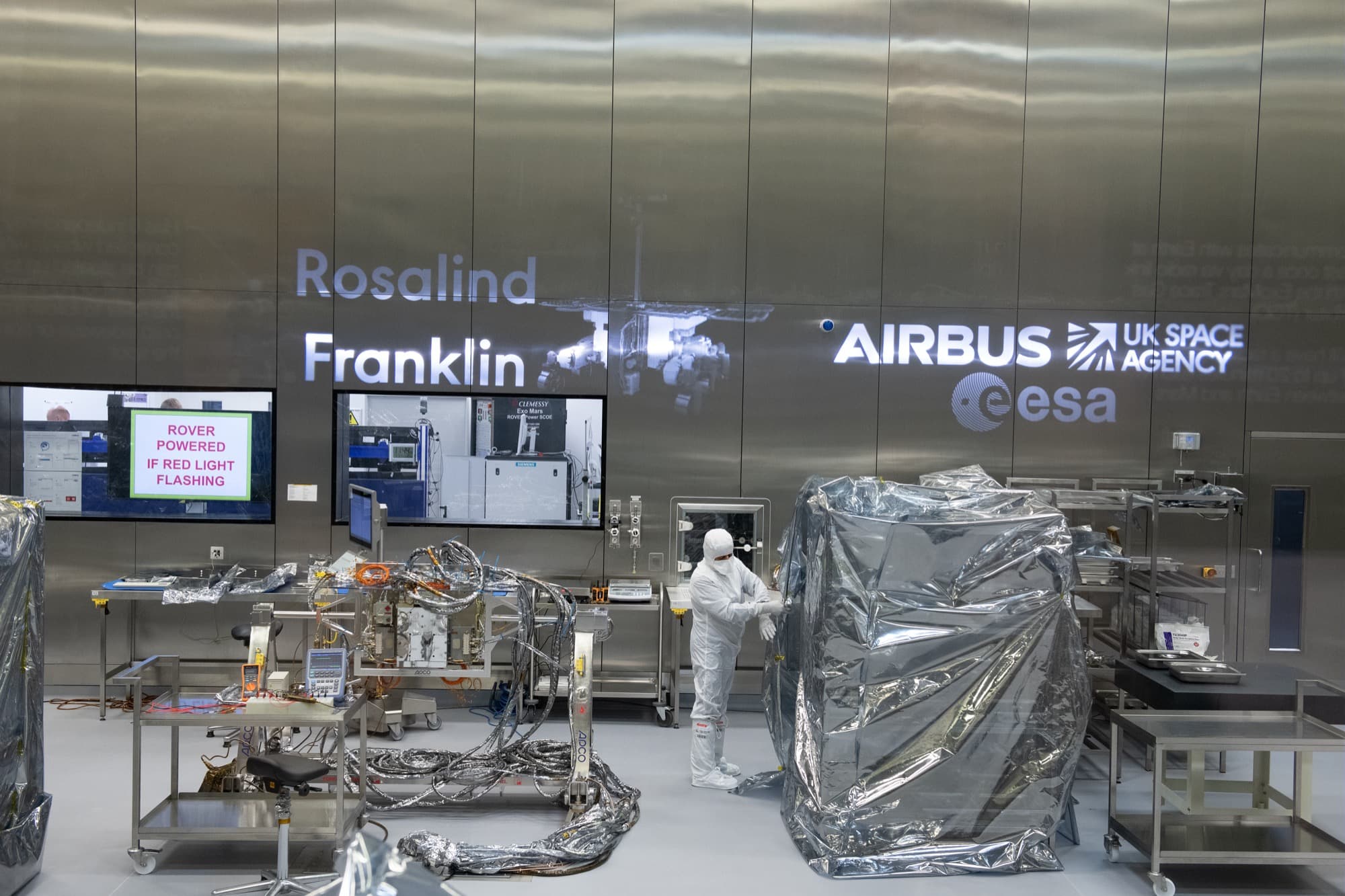
Everything about the Rosalind Franklin rover follows from one number: two metres. Mars surface missions so far have sampled at most the top few tens of centimetres, where cosmic rays and soil chemistry have had billions of years to take apart anything organic. Two metres down, that destruction has not finished the job, and molecules made by life, if there ever was any, could still be readable. So the rover is built around a drill that reaches two metres and feeds what it brings up to an analytical laboratory inside the body: MicrOmega, an infrared microscope for crushed samples; a Raman spectrometer; and MOMA, the Mars Organic Molecule Analyser, a high-sensitivity search for organic molecules built by the Max Planck Institute with NASA-supplied electronics and mass spectrometer. Around them sit PanCam for terrain, CLUPI for close-up rock texture, WISDOM ground-penetrating radar to see the layering the drill will enter, a neutron spectrometer looking for subsurface water, and Ma_MISS, a spectrometer that rides inside the drill itself and reads the borehole wall as it descends. The rover masses about 310 kg with roughly 26 kg of that being instruments, runs on solar power, and is specified for at least seven months on the surface. The landing site, chosen years ago, is Oxia Planum, a clay-rich plain that ESA described in June 2026 as a deposit spanning some 600 km, possibly the floor of an ancient ocean.
The rover was ready before its ride was. Under the original ExoMars arrangement, Roscosmos supplied the Proton launcher and the Kazachok landing platform, and the mission was to launch in September 2022. On 17 March 2022, after Russia's invasion of Ukraine, ESA suspended the mission, and the partnership was terminated. In one stroke Europe lost the rocket, the landing platform, the descent engines and two Russian-supplied instruments, and was left holding a nearly complete rover. What followed is the least glamorous and most consequential part of this story: rebuilding the missing half. ESA contracted Thales Alenia Space in 2024 to lead the reconstruction, at a value reported as 522 million euros, awarded 9 April 2024, by European Spaceflight and as $567 million by English Wikipedia, two figures that convert into each other at the exchange rates of the time and are very likely the same award. Airbus took the landing platform, built at Stevenage in the UK. Sener in Spain designed the four landing legs. Astronika in Poland built the three-metre ramps the rover will drive down. ArianeGroup is building the heat shields. And on 16 May 2024, NASA agreed to supply the launch, throttleable braking engines and radioisotope heater units, with ESA's Daniel Neuenschwander saying the agreement ensured the rover would set its wheels on Mars in 2030.
Then the American commitment wobbled. Proposed deep cuts to NASA's science budget through 2025 made it genuinely unclear whether the agency could deliver a launch, engines and nuclear heat sources for a European rover. That uncertainty ran into ESA's ministerial council itself, where on the morning of 26 November 2025 Director General Josef Aschbacher said he had received very good news from NASA the previous day confirming its contribution, and member states then confirmed the European funding to continue. The confirmations since have been concrete rather than rhetorical. On 16 April 2026 NASA approved its supporting project, ROSA, to begin implementation after passing its preliminary design review, and named a SpaceX Falcon Heavy from Launch Complex 39A, no earlier than late 2028. By 17 June 2026, four braking engines had physically arrived at Airbus in the UK, with a fifth flight spare outstanding. The heaters remain the loose end: Neuenschwander said in June that they still need to progress until launch and that decisions remain to be taken, while adding that it looks good so far, and Europe is separately developing its own radioisotope heat source under the ENDURE programme, with a demonstrator unit from Perpetual Atomics in the UK expected to fly on the platform alongside the NASA units.
So the honest status in September 2026 is that this mission is funded, staffed and cutting metal, and still has no date. Hardware milestones arrive steadily: parachutes recertified by balloon drop in July 2025 and sterilised in a bake lasting over 79 hours by May 2026, full-scale landing platform drop tests at Turin in January 2026, ramps through thermal vacuum at minus 70 Celsius in July 2026, legs snapping open in two pairs in under a second on 6 August 2026, and a full-scale landing platform separating from its backshell in footage ESA published on 3 September 2026. What nobody has published is a launch date or a landing date more precise than a year. ESA says 2028 and 2030, and has repeated 2030 in every 2026 item on the mission. NASA says no earlier than late 2028. English Wikipedia offers October 2028 and November 2030, but we could not trace either figure to an ESA or NASA statement, and the gap between them is longer than a normal Mars transfer, so we do not repeat them here as fact. What can be said with confidence is that the rover which lost its ride in 2022 now has a rocket, a landing platform being built in Britain, engines delivered from America, and a plain in Oxia waiting.
One thing worth keeping in view: this is a mission that was fully built, then had half of itself removed for political reasons, and is being rebuilt piece by piece. It is a rare test of whether a completed spacecraft can survive the loss of its partner, and the work is now spread across the continent in a way that makes it both hard to kill and hard to hurry. Prime contractor in Turin. Landing platform at Stevenage. Legs from Spain, ramps from Poland, heat shields from ArianeGroup, thermal vacuum testing at Criotec in Italy, drop tests at ALTEC, braking engines shipped in from the United States, and a British-built radioisotope demonstrator waiting in reserve in case the American heaters do not arrive. Every one of those interfaces is somewhere a schedule can slip, and this schedule has already slipped from September 2022 to no earlier than late 2028. If Rosalind Franklin lands in 2030 it will reach a site chosen in the 2010s, carrying instruments designed even earlier, eight years behind its original slot. It will also still be carrying the two-metre drill that is the whole reason it was worth saving.
Mission facts
Status on 23 August 2026
In development and funded, not merely announced. ESA member states confirmed the funding needed to continue the ExoMars programme at the ministerial council in Bremen in November 2025, and on 16 April 2026 NASA approved its supporting project, ROSA, to begin implementation after passing its preliminary design review. Hardware for the landing platform was in environmental testing across Europe through the first half of 2026.↗
Launch
A SpaceX Falcon Heavy from Launch Complex 39A at Kennedy Space Center, no earlier than late 2028, announced by NASA on 16 April 2026. The contract value was not disclosed. The launch is NASA's contribution to the mission, so ESA is not paying for it.↗
Landing
2030, at Oxia Planum. ESA has repeated the 2030 landing year through 2026, in its 21 January, 21 July and 6 August 2026 items on the landing platform. Neither ESA nor NASA has published a launch date or a landing date more precise than the year. English Wikipedia's infobox gives October 2028 and November 2030; we could not trace either figure to an ESA or NASA statement.↗
The landing site
Oxia Planum, a clay-rich plain in an open basin, given as about 18.20 N, 335.45 E by English Wikipedia. In a story published 4 June 2026, ESA described the clay deposit as extending roughly 600 km across and over 1 km in elevation, possibly laid down by an ancient ocean several kilometres deep about four billion years ago. ExoMars project scientist Jorge Vago is quoted there: "Because the area is so large, we are not talking about a localised occurrence, but rather a regional or global process that would have required immense amounts of water".↗
The rover
About 310 kg, carrying roughly 26 kg of instruments, solar powered at about 1,200 watt-hours per day with a 1,142 watt-hour lithium-ion battery, and specified for a surface mission of at least seven months. ESA describes it as able to drive about 70 m per sol.↗
The drill
Two metres, feeding samples to an onboard analytical laboratory. ESA describes it as "a drill able to reach two metres below the martian surface". Depth is the entire scientific argument: cosmic radiation and oxidants break down organic molecules in the top of the Martian soil, so the case for finding preserved biosignatures rests on getting beneath that layer.↗
Instruments
The Pasteur payload: PanCam for terrain and morphology, ENFYS, a UK-built infrared spectrometer from Aberystwyth that took the place of the Russian-supplied ISEM, CLUPI for close-up imaging, WISDOM ground-penetrating radar, ADRON-RM neutron spectrometer, Ma_MISS inside the drill, MicrOmega infrared microscope, RLS Raman spectrometer and MOMA, the Mars Organic Molecule Analyser, from the Max Planck Institute with NASA-supplied electronics and mass spectrometer.↗
What NASA provides
Under the memorandum of understanding announced on 16 May 2024: the launch service, throttleable braking engines for the landing platform, radioisotope heater units, supplied in partnership with the US Department of Energy, to keep the rover's insides warm, and, per NASA's April 2026 statement, specialised electronics plus the mass spectrometer for the MOMA instrument.↗
Braking engines delivered
Braking engines had been delivered to Airbus Defence and Space in the UK by 17 June 2026, when ESA's Director of Human and Robotic Exploration, Daniel Neuenschwander, told a press briefing following ESA's 347th Council meeting that the first engines had arrived. The figure of four came separately, from ESA to European Spaceflight, and did not appear in Neuenschwander's remarks. A fifth flight spare was still to come.↗
The open item
Radioisotope heater units. Neuenschwander said on 17 June 2026 that the heaters are "still something which needs to progress until launch, and we will have to take a number of decisions but I can underline that also here it looks good so far". Europe is separately developing its own radioisotope heat source under the ENDURE programme, with UK-based Perpetual Atomics producing a demonstrator unit that is expected to fly on the landing platform alongside the mission-critical NASA-supplied units, rather than in place of them.↗
The new landing platform
A European entry, descent and landing module replaces the Russian Kazachok lander. Thales Alenia Space is prime contractor; Airbus builds the landing platform at Stevenage in the UK; Sener in Spain designed and built the four landing legs; Astronika in Poland built the three-metre aluminium egress ramps; ArianeGroup is building the front and rear heat shields.↗
How the legs work
The four legs are deployed in two pairs in under a second, using non-explosive actuators, immediately after the front heat shield is jettisoned. They carry shock absorbers and touchdown sensors. ESA team leader Benjamin Rasse, quoted in January 2026 on the drop-test campaign, put the target as reducing engine switch-off after touchdown "to the blink of an eye, to no more than 200 milliseconds".↗
Programme cost figures
Reported values for the 2024 contract that put Thales Alenia Space in charge of replacing the Russian contribution disagree: European Spaceflight gives 522 million euros awarded in April 2024, while English Wikipedia's ExoMars article says a $567 million contract in June 2024. European Spaceflight dates its figure to 9 April 2024. The two are very likely the same award in different currencies: 522 million euros converts to roughly 567 million dollars at April 2024 exchange rates. We could not confirm that from a primary ESA document.↗
How the partnership ended
ESA suspended the mission on 17 March 2022 over Russia's invasion of Ukraine, and the cooperation with Roscosmos was terminated. That removed the Proton launcher, the Kazachok landing platform and two Russian-supplied instruments in a single stroke, and cost the rover its September 2022 launch slot.↗
The 2025 funding scare
Deep proposed cuts to NASA's science budget in 2025 raised real doubt over whether NASA could deliver what it had promised. Speaking at ESA's ministerial council on the morning of 26 November 2025, Director General Josef Aschbacher said that "just yesterday" he had received "very good news from NASA to confirm their contribution to the Rosalind Franklin mission". The news therefore reached him on 25 November; he said it publicly on the 26th. NASA's April 2026 project approval and June 2026 hardware deliveries followed.↗
Parachutes
The descent parachutes, built years ago and stored, were recertified with a stratospheric balloon drop test in July 2025, then dry-heat sterilised for planetary protection in a process lasting over 79 hours, completed by 1 May 2026.↗
Mission timeline
- 17 Mar 2022ESA suspends the mission over Russia's invasion of Ukraine, ending cooperation with Roscosmos and stripping out the launcher, the Kazachok landing platform and two Russian instruments. The September 2022 launch slot is lost.
- Apr 2024ESA contracts Thales Alenia Space to rebuild the missing half of the mission and complete assembly, integration and testing of a European landing platform. Reported as 522 million euros awarded on 9 April 2024 (European Spaceflight) and as a $567 million contract in June 2024 (English Wikipedia); the two are close to equivalent at the exchange rates of the time.
- 16 May 2024ESA and NASA announce a memorandum of understanding: NASA will supply the launch, throttleable braking engines and radioisotope heater units. Daniel Neuenschwander says the agreement "ensures that the Rosalind Franklin rover will set its wheels on martian soil in 2030".
- Mar 2025Airbus is selected to build the landing platform at Stevenage, and Sener is contracted for critical descent module systems including the landing legs.
- Jul 2025The stored descent parachutes are recertified with a drop test from a stratospheric balloon.
- 25 to 26 Nov 2025At ESA's ministerial council in Bremen, Director General Josef Aschbacher reports that NASA has confirmed its contribution, after a year of doubt driven by proposed US science budget cuts. Member states confirm the funding needed to continue ExoMars.
- 21 Jan 2026Full-scale drop tests of the landing platform at ALTEC in Turin, dropping onto hard and soft Mars-like surfaces at a range of speeds and heights, with Sener-built legs.
- 16 Apr 2026NASA approves its Rosalind Franklin Support and Augmentation project to begin implementation after a successful preliminary design review, and names a SpaceX Falcon Heavy from Kennedy Space Center Launch Complex 39A, no earlier than late 2028.
- 1 May 2026ESA completes dry-heat sterilisation of the descent parachute, a process running over 79 hours, for planetary protection compliance.
- 17 Jun 2026ESA's Daniel Neuenschwander tells an ESA Council briefing that the first four NASA braking engines have been delivered to Airbus in the UK. A fifth flight spare is still to come, and the radioisotope heater units remain the open question.
- 21 Jul 2026The three-metre aluminium egress ramps built by Astronika in Poland pass thermal-vacuum testing at Criotec in Italy at about minus 70 Celsius, after vibration testing at Airbus in Germany.
- 6 Aug 2026ESA publishes footage of the landing platform's legs deploying in two pairs in under a second on a full-scale model at Thales Alenia Space in Turin. On 3 September 2026 ESA published slow-motion footage from the same Turin facility of a full-scale landing platform separating from its backshell, the most recent ExoMars hardware milestone as of that date.
A filled dot marks something that physically happened. A hollow one marks an announcement, a naming or a target.
In pictures
Tap a photo to enlarge.
Sources
- NASA blog, 16 Apr 2026: NASA Begins Implementation for ESA's Rosalind Franklin Mission to Mars
- NASA ROSA project blog index
- ESA press release, 16 May 2024: ESA and NASA join forces to land Europe's rover on Mars
- ESA ExoMars programme hub
- ESA, 4 Jun 2026: ExoMars rover targets vast bed of clay in search for life
- ESA, 21 Jan 2026: Legs made for a Mars landing
- ESA, 21 Jul 2026: ExoMars ramps put up with cold, shaking and vacuum
- ESA, 6 Aug 2026: ExoMars stretches out its legs
- European Spaceflight, 17 Apr 2026: ESA's Mars Rover to Launch Aboard SpaceX Falcon Heavy in 2028
- European Spaceflight, 26 Jun 2026: NASA Delivers Braking Engines for ESA Rosalind Franklin Mars Mission
- European Spaceflight, 1 May 2026: ESA Completes Sterilisation of ExoMars Parachute
- SpacePolicyOnline, 26 Nov 2025: ESA DG Says NASA Confirms Commitment to ExoMars Rover
Facts on this page were verified on 3 September 2026. Where sources disagree, the disagreement is stated rather than resolved silently.