What we left behind: parachutes, backshells and heat shields
various · Multinational · Descent hardware · 2026 · Multipolar MarsSuccess
Twelve landing sites carry entry hardware identified from orbit, almost all by HiRISE: heat shields, backshells, parachutes, descent stages and Curiosity's tungsten ballast. At the oldest the pieces are only likely.
TL;DR· 15 min read
Every Mars landing throws hardware away: a heat shield, a backshell, a parachute, and for Curiosity and Perseverance a descent stage as well. Curiosity also jettisoned tungsten ballast. Since 2006 the HiRISE camera on Mars Reconnaissance Orbiter has been finding those pieces from orbit, and twelve landing sites now have identified hardware in the published record, though at the oldest the pieces are called only likely or candidate. The most-quoted total for human-made mass on Mars, 7,119 kg, was published in September 2022 and is out of date.
Landing on Mars is a process of shedding. A spacecraft arrives inside an aeroshell, drops the heat shield once the air has done its braking, cuts away the backshell and parachute, and in the case of Curiosity and Perseverance flies the rocket stage off to crash somewhere safe. Everything discarded stays where it falls. Since 2006 the HiRISE camera on Mars Reconnaissance Orbiter has been finding those pieces from around 270 kilometres up: a parachute from 1976 still bright enough to spot, a heat shield lying dark side down and glinting, four fresh craters punched into the plain by jettisoned ballast and cruise stage debris. Taken together they are the archaeological record of human arrival on Mars, and they are slowly disappearing under dust.
- 12landing sites with published orbital IDs of entry hardware, some only 'likely'
- 7,119 kgof human-made debris on Mars in the most-cited estimate, published September 2022
- 21.5 macross: Perseverance's parachute, by JPL's account the biggest ever opened over Mars
A Mars landing is a controlled act of littering. The spacecraft arrives inside an aeroshell, a blunt heat shield in front and a conical backshell behind. The heat shield takes the worst of the entry heating and is then dropped so the radar can see the ground. The parachute slows the vehicle to a few hundred kilometres per hour and is then cut away with the backshell still attached, because a canopy dragging behind a rocket-powered descent is lethal. What happens next depends on the era. Viking, Phoenix and InSight fired throttled engines and landed on legs, leaving three objects behind. Pathfinder and the two Mars Exploration Rovers bounced in on airbags and left a lander base as well. Curiosity and Perseverance were lowered on cables from a slowly descending rocket stage that then flew off and crashed deliberately, at a distance chosen so that its remaining hydrazine could not contaminate the site. Curiosity also jettisoned tungsten ballast, blocks whose only job was to shift the vehicle's centre of mass so that it could steer during entry, and which then fell separately to the ground at high speed. Nothing is recovered. Nothing decays. Mars has no biology to consume it, no rain to corrode it and, at these latitudes, no ice to swallow it. The hardware simply sits where it stopped, and gets dustier.
The systematic census began in 2006. Mars Global Surveyor's camera had picked out Opportunity's landing site back in 2004, but that November, within 36 hours, the new HiRISE camera on Mars Reconnaissance Orbiter photographed the Viking 2 site on 21 November and the Spirit and Viking 1 sites on 22 November, and in each frame the team could pick out not just the lander but likely positions for the heat shield, the backshell and the parachute. At Viking 1 the identification was checked by overlaying topographic contours the lander itself had produced in 1976 onto the orbital image, and the match was excellent. A month later Pathfinder's site produced a small piece of historical revisionism: a bright glint that the 1997 team had provisionally called the backshell turned out, in the light of the orbital view, to be more likely a piece of insulating material from the inside of the heat shield, since the real backshell and parachute were hidden behind a ridge. The census has kept growing since. Spirit's parachute shows folds in the fabric. Opportunity's lander sits as a dark centre in reddish airbag remains at the bottom of Eagle Crater, its crumpled parachute still tied to a bluish backshell. Phoenix's three pieces disappear under 30 centimetres of carbon dioxide frost every polar winter. InSight's heat shield glints because it seems to have landed dark side down. Twelve landing sites now carry identified entry hardware in the published record, though for the oldest of them HiRISE describes the pieces as likely or candidate rather than confirmed, and ESA's own wording for Beagle 2's rear cover is "what is thought to be".
The strangest debris field belongs to Curiosity, and it was not planned as a debris field at all. Ten minutes before hitting the atmosphere, the entry vehicle let go of the cruise stage; two minutes later it threw off two 75-kilogram tungsten blocks to move its centre of gravity for the guided entry. The Context Camera was pointed at the predicted impact area, roughly 80 kilometres west of Gale Crater, and found four large fresh impacts rather than the expected two. HiRISE then resolved craters 3 to 5 metres across in a strewn field at least 8 kilometres long, along with a scatter of smaller ones. The interpretation is that the two central, similar craters are the tungsten blocks, which are far too dense to have broken up, and the two with lopsided ejecta are pieces of the cruise stage, which was not. Six more 25-kilogram tungsten blocks were released later and lower by the descent stage, and their marks were imaged too. HiRISE's team pointed out what makes this valuable: hundreds of fresh impacts have been photographed on Mars, but this is the rare case where the mass, density, velocity and angle of the impactor are all known in advance. Human rubbish became a calibrated cratering experiment.
Some of it does not stay put. HiRISE has watched Curiosity's parachute flapping in the wind next to its backshell, and Opportunity's parachute has shuffled around enough to leave an arc of disturbed ground, while the rover tracks nearby were erased entirely. Fragments travel further than that. Between April and July 2022 Perseverance photographed roughly half a dozen pieces of its own entry hardware in Hogwallow Flats, about two kilometres from where the descent stage and backshell came down: shiny multi-layer insulation whose dot pattern matched the spacecraft's thermal blankets, Dacron netting, and shredded string, one piece snagged on a rock and visibly moving in the breeze. The tidiest close-up of any of this came from the air. On 19 April 2022 the Ingenuity helicopter flew eight metres above the ground and took ten colour images of Perseverance's backshell and parachute for the Mars Sample Return engineers, showing an upright backshell that had struck at about 126 kilometres per hour with its coating intact, and a canopy with no visible inflation damage. The blast zones, meanwhile, have refused to behave: two and a half years of monitoring at Gale showed the dark landing scars fading more slowly than models predicted, and perhaps darkening.
How much is up there is harder to say than the round numbers suggest. The figure that circulates, 15,694 pounds or 7,119 kilograms, comes from a September 2022 article by the robotics researcher Cagri Kilic: about 9,979 kilograms of spacecraft sent to Mars, minus 2,860 kilograms then still operating. It is a reasonable back-of-envelope, but it counts spacecraft rather than the aeroshells and parachutes that delivered them, and Curiosity's heat shield and back shell alone were 4.5 metres across. It is also out of date, because InSight, Zhurong and Ingenuity have all since stopped working, which on the same accounting shifts their mass into the debris column. None of it is legally abandoned. Article VIII of the Outer Space Treaty keeps a launching state's jurisdiction and control over the objects it launches, wherever they end up, and space law has no concept of abandonment, so every heat shield on Mars still belongs to whoever sent it. Whether any of it is protected as heritage is a different and unanswered question. What is certain is that the record is fading: NASA's own caption on the Perseverance frame says the pieces will become dustier and slowly fade into the background over years.
Mission facts
Viking 1 (1976)
HiRISE imaged the Chryse Planitia site on 22 November 2006. The 3-metre lander was precisely located and likely positions were found for the heat shield, the backshell and the parachute attached to it. The lander fix was confirmed by overlaying topographic contours derived from the lander's own pictures onto the orbital image, which HiRISE reports as an excellent match. Note the hedge: everything other than the lander is described as likely or candidate. None of it is confirmed.↗
Viking 2 (1976)
HiRISE imaged the Utopia Planitia site on 21 November 2006. The lander was precisely located and likely positions were found for the heat shield and backshell. That image was accidentally smeared in places when the high-gain antenna restarted tracking during the very short exposure, which HiRISE says was the first such unintentional smear after hundreds of pictures.↗
Mars Pathfinder (1997)
Imaged 21 December 2006. The lander is visible with its ramps, science deck and airbag remnants; the backshell and parachute lie to the south; and four features were identified as possible pieces of the heat shield. HiRISE's own caption revises the Pathfinder-era interpretation: a bright glint that the 1997 team took for the backshell is now thought more likely to be insulating material from the inside of the heat shield, because the backshell and parachute were actually hidden behind a ridge from the lander's viewpoint.↗
Spirit (2004)
Imaged 22 November 2006 at Gusev Crater. The parachute shows as a bright irregular patch with wrinkles and folds in the fabric clearly visible; the cone-shaped backshell nearby "appears relatively undamaged by its impact with the martian surface", in the words of the HiRISE caption written by Steve Squyres; the heat shield remnant is a separate, damaged object; and the lander sits near the small crater the team named Sleepy Hollow. A 2012 follow-up frame, ESP_028070_1655, was released under the title Spirit Lander Backshell Heatshield and Parachute.↗
Opportunity (2004)
The first colour HiRISE view of the site, taken 10 April 2017, shows the lander as a dark centre amid reddish airbags at the bottom of Eagle Crater, the crumpled parachute still attached to the bluish backshell, and the heat shield crash site. The parachute has visibly blown around in the wind, leaving an arc of darker ground. Opportunity's rover tracks, by contrast, had been erased by wind within a decade.↗
Phoenix (2008)
The backshell with its parachute, the heat shield and the lander were all identified in Vastitas Borealis, but at 68 degrees north they vanish every winter. About 30 cm of carbon dioxide frost freezes onto the surface during the polar night, and in a January 2010 frame the hardware could not be picked out at all: the frost camouflaged it, and HiRISE noted that even after the frost sublimates, winter dust may keep the pieces hidden.↗
Curiosity (2012)
Four objects on the ground: the rover, the crashed descent stage, the heat shield, and the backshell with its parachute. A frame taken 17 August 2012, twelve days after landing, resolved seven bright spots around the descent stage crash that may be pieces of hardware, dark streaks radiating from the impact, and bright fragments scattered downrange of the backshell. The rover's own mast shadow is visible in the same image.↗
Curiosity's tungsten ballast
Ten minutes before reaching the atmosphere the entry vehicle separated from the cruise stage, and two minutes later it jettisoned two 75 kg tungsten blocks called cruise balance mass devices. A Context Camera image of the predicted impact area, about 80 km west of the landing site, found four large fresh impacts rather than two. HiRISE resolved craters 3 to 5 metres across in a strewn field at least 8 km long. The reading is that two impacts are the tungsten blocks and two are pieces of the cruise stage, which was far likelier to break up. The descent stage later released six more 25 kg tungsten blocks from low altitude, whose marks were imaged by the Context Camera.↗
InSight (2018)
Imaged 11 December 2018 in Elysium Planitia. The heat shield reads as a saturated bright spot, which HiRISE interpreted as a specular reflection from its dark outer face landing upward. The lander sits in a darkened patch where its thrusters disturbed the dust, with two bluish extensions that are the solar arrays. The backshell and attached parachute lie to the southwest; a dark streak running south past the parachute is probably a pre-existing dust devil track rather than anything InSight did.↗
Perseverance (2021)
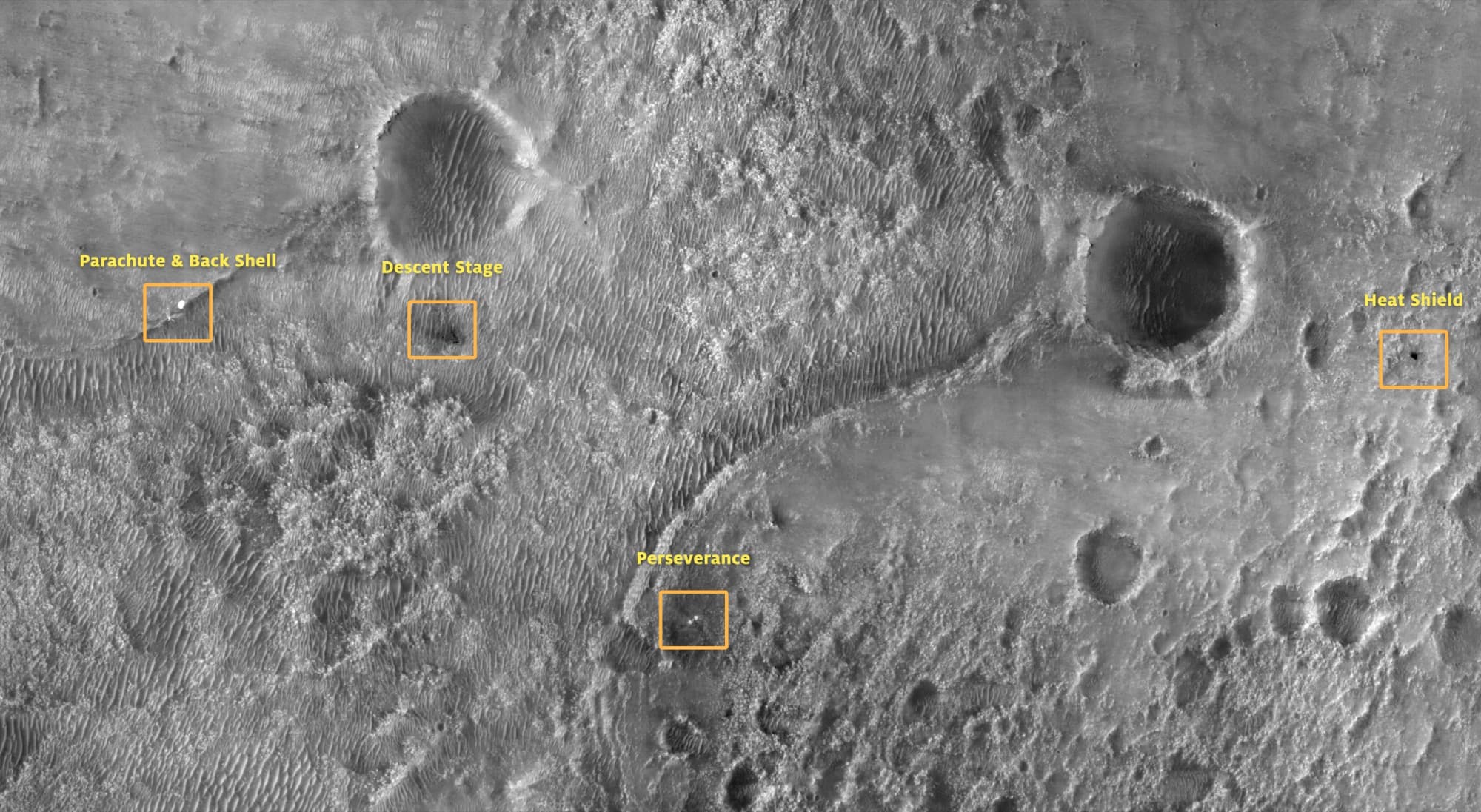
HiRISE imaged the site on 19 February 2021, one day after landing, and caught four things in one frame: the rover in the blast pattern left by the descent stage, the descent stage's own V-shaped crash debris pointing back at the rover, the heat shield, and the parachute with the backshell. NASA's caption notes that the objects are highly visible now but will get dustier and slowly fade into the background over years.↗
How big the parachutes are, and a published disagreement
NASA's 2009 page on Curiosity's parachute describes a disk-gap-band canopy with 80 suspension lines, more than 50 metres long, opening to a diameter of nearly 16 metres (51 feet), and calls it the largest ever built to fly on an extraterrestrial mission. NASA's Mars 2020 landing page gives Perseverance's parachute as 70.5 feet (21.5 metres) in diameter, deploying about 240 seconds after entry at an altitude of about 11 km and a speed of about 1,512 km/h, and JPL's 2022 article on Ingenuity's survey of the wreck calls it the biggest ever deployed on Mars and counts 80 suspension lines on it. We found no NASA page that reconciles the two diameters or that states the two canopies differ in size.↗
The backshell, up close
On 19 April 2022, Ingenuity's 26th flight took ten aerial colour images of Perseverance's backshell and parachute at the request of the Mars Sample Return team. The backshell had hit the ground at about 126 km/h (78 mph) and stood upright with its protective coating apparently intact; many of the 80 suspension lines were visible and undamaged; about a third of the dust-covered orange and white canopy could be seen, with no sign of supersonic inflation damage. The flight lasted 159 seconds and covered 360 metres at 8 metres above the ground.↗
The pieces that move
Perseverance's parachute and backshell lie about 1 km northwest of its landing site, but fragments have travelled much further. By sol 508 (24 July 2022) the operations team had catalogued roughly half a dozen suspected pieces of entry hardware in Hogwallow Flats, about 2 km from the crash zones: shiny multi-layer insulation whose dot pattern matched the spacecraft's thermal blankets, Dacron netting, and shredded string. One blanket fragment was snagged on a rock and seen flapping in the breeze. NASA's assessment is that the wind carried them there over days or weeks.↗
Tianwen-1 and Zhurong (2021)
HiRISE imaged China's landing site in southern Utopia Planitia on 6 June 2021, three weeks after the 14 May landing. The frame shows the lander in its blast pattern, the Zhurong rover a little to the south after driving off, and both the parachute with its backshell and the heat shield lying separately on a smooth, largely boulder-free plain.↗
Schiaparelli (2016)
Schiaparelli's crash on 19 October 2016 left three things in Meridiani Planum: the lander module, which NASA reports hit at more than 300 km/h (more than 180 mph), the parachute with its back shell, released prematurely, and the heat shield, which had separated as planned. HiRISE's first colour view of the site was taken on 1 November 2016.↗
Beagle 2 (2003, found 2015)
Beagle 2, lost on Christmas Day 2003, was found in HiRISE imagery in a finding ESA announced on 16 January 2015. ESA's statement places the lander beside "the main parachute and what is thought to be the rear cover with its pilot/drogue parachute still attached close by". The hedge is ESA's own: the rear cover identification is not confirmed, which is the weakest link in the count of twelve sites.↗
The debris as an instrument
Landings blow bright dust away and leave dark blast zones, and HiRISE has monitored how those zones fade. Scientists expected the fading to follow a model that would predict when the marks vanish. A frame taken 28 February 2015, two and a half years after Curiosity landed, showed the opposite: the blast zones were not fading as fast as predicted and might even be darkening. In the same series the parachute can be seen flapping around in the wind near the backshell. HiRISE's own conclusion was that the processes moving dust around on Mars are not yet understood.↗
How much is there
The most-cited figure comes from Cagri Kilic of West Virginia University, writing in The Conversation on 20 September 2022: adding up the mass of all spacecraft ever sent to Mars gives about 9,979 kg, subtracting the 2,860 kg then still operating leaves 15,694 pounds (7,119 kg) of debris. He also cites the UN Office for Outer Space Affairs for 18 human-made objects delivered over 14 missions. Treat both numbers with care. They count spacecraft and leave out the aeroshells and parachutes that carried them: Curiosity's heat shield and back shell alone were 4.5 metres across. And the figure is stale, because InSight, Zhurong and Ingenuity have all stopped working since it was published, which on the same accounting moves their mass from the operating column to the debris column.↗
Mission timeline
- 21 to 22 Nov 2006In 36 hours HiRISE images the Viking 2, Spirit and Viking 1 sites, locating the landers and finding likely heat shields, backshells and parachutes at all three. It is the first time 1976-era entry hardware is picked out from orbit.
- 7 Aug 2012HiRISE images the Gale Crater landing site 24 hours after Curiosity's arrival. The sky crane's impact scar shows dark streaks with small white dots in and beyond them, read as possible pieces of the crashed stage.
- 17 Aug 2012A less oblique frame at 27 cm per pixel resolves all four pieces of Curiosity hardware, seven bright spots at the descent stage crash, and debris downrange of the backshell.
- 22 Oct 2012HiRISE covers the impact field of Curiosity's two 75 kg tungsten cruise balance masses about 80 km west of the landing site, and finds four large craters, 3 to 5 metres across, in a strewn field at least 8 km long.
- 10 Mar 2013Following a Russian crowdsourced search led by Vitali Erogov (the spelling used on the HiRISE page; usually written Vitaly Egorov), HiRISE re-images candidate Mars 3 hardware in Ptolemaeus Crater: a bright 7.5-metre patch consistent with an 11-metre parachute, plus candidate heat shield, retrorocket and lander. The identification has never been confirmed. The same caption notes that Viking 1's parachute, on the ground since 1976, can still be seen from orbit as a bright area, which is part of why a 1971 parachute was thought plausible.
- 28 Feb 2015Two and a half years of monitoring show that the dark blast zones at Curiosity's landing site are not fading as models predicted and may be getting darker, and that the parachute is flapping in the wind.
- 1 Nov 2016HiRISE obtains the first colour view of the Schiaparelli crash site, showing the lander module, the prematurely released parachute and back shell, and the heat shield in three separate places.
- 11 Dec 2018HiRISE images InSight in Elysium Planitia with its heat shield glinting to the northeast and its backshell and parachute to the southwest.
- 19 Feb 2021One day after Perseverance lands, HiRISE captures the rover, the crashed descent stage, the heat shield and the parachute and backshell in a single frame in Jezero Crater.
- 6 Jun 2021HiRISE images China's Tianwen-1 lander, the Zhurong rover, and the mission's parachute, backshell and heat shield in southern Utopia Planitia.
- 19 Apr 2022Ingenuity's 26th flight photographs Perseverance's backshell and parachute from 8 metres above the ground, at the request of the Mars Sample Return team, and returns ten colour images.
- 24 Jun 2026NASA publishes a HiRISE frame taken on 13 June 2026 showing Perseverance as a green speck west of Jezero with its tracks behind it, the day before the rover passed a marathon of driving. Twenty years after it first catalogued Viking's parachutes, the same camera is still watching the hardware humans leave on Mars.
A filled dot marks something that physically happened. A hollow one marks an announcement, a naming or a target.
In pictures
Tap a photo to enlarge.
Sources
- HiRISE PSP_001521_2025: Viking Lander 1 (Thomas Mutch Memorial Station), imaged 22 November 2006
- HiRISE PSP_001501_2280: Viking Lander 2 (Gerald Soffen Memorial Station), imaged 21 November 2006
- HiRISE PSP_001890_1995: HiRISE Images Mars Pathfinder Site, imaged 21 December 2006
- HiRISE PSP_001513_1655: Mars Exploration Rover Spirit Landing Site at Gusev Crater, caption by Steve Squyres
- HiRISE ESP_050177_1780: What Opportunity Left Behind, imaged 10 April 2017
- HiRISE ESP_016160_2485: Phoenix Lander in Springtime
- HiRISE ESP_028401_1755: Views of MSL Hardware 12 Days after Landing
- HiRISE ESP_029245_1755: Impacts from MSL Tungsten Blocks and Cruise Stage
- HiRISE ESP_058005_1845: InSight Lander on Mars, imaged 11 December 2018
- HiRISE ESP_068294_1985: Perseverance Hardware One Day after Landing, imaged 19 February 2021
- HiRISE ESP_069665_2055: Tianwen-1 Lander and Zhurong Rover in Southern Utopia Planitia
- Cagri Kilic, The Conversation (20 September 2022): Mars is littered with 15,694 pounds of human trash from 50 years of robotic exploration
- HiRISE ESP_028269_1755: Bits and Pieces
- HiRISE ESP_031036_1345: Could This Be the Soviet Mars 3 Lander?, imaged 10 March 2013
- HiRISE ESP_040269_1755: Curiosity Landing Site Over Time
- NASA Science (3 November 2016): Schiaparelli Impact Site on Mars, in Color
- ESA (16 January 2015): Beagle-2 lander found on Mars
- NASA Science (2009): Mars Parachute Testing in World's Largest Wind Tunnel
- NASA Mars 2020, Entry, Descent, and Landing (archived 2 January 2022)
- NASA JPL (27 April 2022, archived): NASA's Mars Helicopter Spots Gear That Helped Perseverance Rover Land
- Justin Maki, NASA (2 August 2022): Images of EDL debris
- NASA Science (image added 24 June 2026): NASA's HiRISE Captures Perseverance Marking a Milestone on Mars
Facts on this page were verified on 23 August 2026. Where sources disagree, the disagreement is stated rather than resolved silently.
77.4300 E, 18.4650 N · Jezero crater