The derelict fleet in Mars orbit
various · Multinational · Orbiter · 2026 · Multipolar MarsDebris
Twenty-three objects were in orbit at Mars on 26 August 2026: six working spacecraft, ten dead ones and seven pieces of hardware. Nothing there is tracked, and JPL models only five of the wrecks.
TL;DR· 18 min read
Ten dead spacecraft and seven pieces of hardware are still in orbit around Mars, roughly 14 tonnes in all, and none of it is tracked. No radar or telescope on Earth can see that far, so every Martian orbit came from radio tracking of a spacecraft while it was alive, and JPL propagates old solutions for only five of the ten wrecks. The four Soviet ones are not among them. Ephemeris sharing between live operators is the whole safety system.
Mars has a debris population and no way of watching it. Ten dead spacecraft and seven pieces of hardware are still going round the planet, the earliest of them shut down in 1972 and the most recent, MAVEN, given up on in June 2026. There is no equivalent of the Space Surveillance Network out there: as the JPL team that runs collision assessment in deep space puts it, ephemeris sharing between operators is the only thing keeping these orbits safe. Where an operator has stopped sharing because the spacecraft is dead, the best anyone can do is propagate a decades-old solution forward and hope the phasing is roughly right.
- 23objects the deep-space register lists in orbit at Mars on 26 August 2026
- 5of the ten dead spacecraft that JPL still models; none of them Soviet
- 0objects at Mars tracked by any surveillance network, active or dead
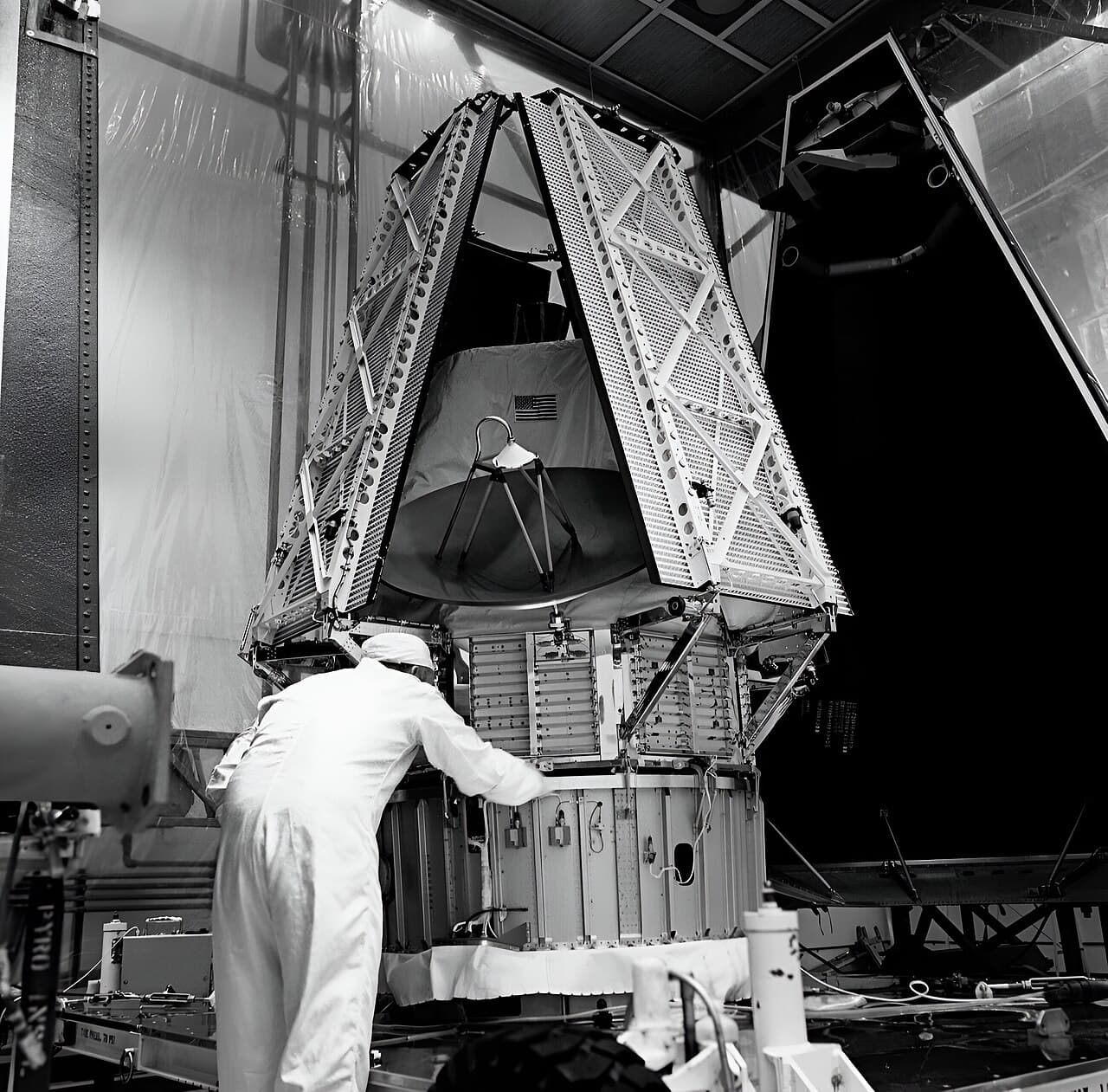
Most published counts of what is at Mars stop at the working spacecraft, so the full inventory comes first. Filter Jonathan McDowell's Lunar and Planetary Register for objects whose current phase is orbiting Mars, at the 26 August 2026 data update, and you get 23. Six are alive: Mars Odyssey, Mars Express, Mars Reconnaissance Orbiter, ExoMars Trace Gas Orbiter, Hope and the Tianwen-1 orbiter, and five of the six carry an operator statement dated 2026: NASA for Odyssey and MRO, ESA for Mars Express, the UAE Space Agency, which announced a three-year extension of Hope to 2028 on 17 February 2026, and CNSA, which said on 20 May 2026 that the Tianwen-1 orbiter is "running stably and in good condition". ExoMars TGO is the one we could not match to a 2026 operator statement. Ten are dead spacecraft, spread across five and a half decades and three space programmes: Mariner 9, Mars 2, Mars 3, Mars 5, both Viking orbiters, Phobos 2, Mars Global Surveyor, India's Mars Orbiter Mission and, since June 2026, MAVEN. The remaining seven are hardware, and they are the part nobody counts. Two Viking bioshield bases, 74 kg discs 3.6 m across, the bottom halves of the sterile containers the landers rode inside. The Phobos 2 propulsion module, 3,800 kg fuelled and 570 kg empty. The break-off cap from a MAVEN instrument. A 1 kg Chinese object released from Tianwen-1 in December 2021 that the register glosses as a "separate measurement sensor" and that we could not find a CNSA description of. And bolted to the corpse of Phobos 2, never released, the DAS station and the PrOP-F hopper that were supposed to land on the moon.
None of it was ever meant to be disposed of, because the rules that apply are about biology rather than debris. COSPAR's planetary protection policy puts Mars orbiters in Category III, and a Category III spacecraft has to meet one of two conditions: keep its probability of hitting Mars below one percent for the first twenty years after launch and below five percent for years twenty to fifty, or fly with no more than 500,000 bacterial spores on board. That is a rule designed to stop a dirty spacecraft falling on ground a future mission might sample for life. It says nothing about what happens in year fifty-one, and nothing at all about leaving hardware in a useful orbit. Only one end-of-life manoeuvre appears anywhere in the records we could consult: on 7 August 1980, with Viking Orbiter 1 running out of attitude control gas, its periapsis and apoapsis were pushed out to 320 by 56,000 km, in NASA's own words "to prevent impact with Mars and possible contamination until the year 2019." Viking Orbiter 2, whose propulsion system had already leaked away its attitude control gas, was simply switched off two years earlier in a 302 by 33,176 km orbit with no estimate published for how long it would stay there. Mariner 9 was left in an orbit NASA said should not decay for at least fifty years. Both of those deadlines have now passed.
The second problem is that nobody can see any of it. There is no Space Surveillance Network at Mars and no prospect of one: the JPL group that runs deep-space conjunction assessment states plainly that passive ground-based tracking of objects at lunar distances and beyond is not currently possible, and that ephemeris sharing between operators is the only mechanism available. Every Martian orbit in existence is a navigation solution derived from tracking that spacecraft's own radio through the Deep Space Network or ESTRACK. When a spacecraft dies, the data stops, permanently. What JPL does instead, through a system called MADCAP that has run at Mars since 2011, is have orbit determination specialists propagate the last known state forward with the best dynamic models they have. Its 2024 status paper lists exactly five inactive spacecraft handled that way: Mariner 9, Viking 1, Viking 2, Mars Global Surveyor and the Mars Orbiter Mission. The paper is candid that the orbit phasing information degrades quickly, so these objects are never assigned a collision risk at all. Only the shape and orientation of their orbits is considered usable. Mars 2, Mars 3, Mars 5 and Phobos 2 do not appear on the list, and neither do the bioshields, the ADU, the instrument cap or the Chinese sensor.
What makes this more than a curiosity is that Mars orbits are not randomly distributed. Missions that want to map the surface or relay for landers converge on the same places: low, near-polar, near-circular, sun-synchronous if possible. Mars Global Surveyor is dead in exactly such an orbit, 378 km and sun-synchronous, the orbit that its living successors want. The clearest demonstration of the risk is not even a debris event. On 28 February 2017 MAVEN had to raise its speed by 0.4 metres per second to avoid Phobos, because without the burn the spacecraft and the moon would have reached their orbit crossing point six days later within about seven seconds of each other. Phobos is a natural satellite whose orbit is known far better than any derelict's, and it still required a manoeuvre. A dead Soviet orbiter whose last tracking pass was in 1974 offers nothing like that certainty. And the consequence of getting it wrong is asymmetric: as the MADCAP papers keep saying, there are no known debris fields at Mars or the Moon today, and creating one would be catastrophic precisely because it could not be catalogued afterwards. There would be no way to know where the fragments went.
The population is still growing, and it grows by losing spacecraft rather than by launching them. Mangalyaan died after a long eclipse in April 2022 and was moved onto the inactive list in early 2023. MAVEN lost signal on 6 December 2025 as it passed behind the planet and never came back; NASA declared the mission over on 3 June 2026 after more than eleven years, and its 809 kg of dry mass joined the pile. Mars Odyssey, which has been up there since October 2001 and has passed 100,000 orbits, is the obvious next candidate, whenever its hydrazine finally runs out. The one genuinely encouraging development is procedural rather than physical: when JPL learned in 2018 and 2019 that China was building a Mars orbiter, it went through NASA's international relations office and set up an ephemeris exchange, receiving the first CNSA file on 21 June 2021 and now trading trajectories weekly. That is the whole safety system at Mars, and it only covers spacecraft that are still alive. For the other seventeen objects the answer is that somebody has a decades-old estimate, or nobody has anything at all, and there is no instrument anywhere that could tell you which.
Mission facts
What the register actually says
Jonathan McDowell's General Catalog of Artificial Space Objects includes a Lunar and Planetary Register listing objects inside the sphere of influence of another world. Filtering it for objects whose latest phase is in orbit around Mars, at the 26 August 2026 data update, gives 23: 21 free-flying and two still bolted to a dead spacecraft. Six of the 21 are working (Mars Odyssey, Mars Express, Mars Reconnaissance Orbiter, ExoMars Trace Gas Orbiter, Hope and the Tianwen-1 orbiter), ten are dead spacecraft, and five are pieces of hardware thrown away deliberately.↗
The ten dead spacecraft
In order of arrival: Mariner 9 (US, in orbit 14 November 1971, commanded off 27 October 1972), Mars 2 and Mars 3 (USSR, November and December 1971), Mars 5 (USSR, 12 February 1974), Viking Orbiter 1 (US, off 17 August 1980) and Viking Orbiter 2 (US, off 25 July 1978), Phobos 2 (USSR, lost 27 March 1989), Mars Global Surveyor (US, last contact 2 November 2006), India's Mars Orbiter Mission (widely reported lost after a long eclipse in April 2022; the register carries no cause, and JPL's conjunction assessment paper records only that it was moved to the inactive list in early 2023) and MAVEN (US, last signal 6 December 2025, mission declared over 3 June 2026). Seven of the ten were dead before the end of the Cold War, and four of those seven are Soviet.↗
The hardware nobody talks about
Five discarded pieces are catalogued as separate objects in Mars orbit. Two are the Viking bioshield bases, 74 kg discs 3.6 m across, the bottom halves of the sterile containers the landers travelled in: one released on 21 July 1976, the day after Viking 1 landed, the other on 3 March 1978. NASA's own Viking 2 orbiter record says the bioshield stayed attached after separation problems, which does not sit easily with the register's 1978 release date. The third is the Phobos 2 propulsion module. The fourth is the break-off cap from MAVEN's neutral gas and ion mass spectrometer, popped on 10 October 2014 into a 166 by 6,416 km orbit. The fifth is a 1 kg Chinese object, 0.2 m on its longest side, that the register names Fenli celiang chuanganqi and glosses as a "separate measurement sensor", released from Tianwen-1 around December 2021.↗
The heaviest discarded piece
The Phobos 2 autonomous propulsion module, jettisoned on 18 February 1989 after it had finished shaping the spacecraft's orbit. The register gives it a launch mass of 3,800 kg and a dry mass of 570 kg, which makes the empty stage heavier than every other piece of discarded hardware at Mars put together, several times over. It was left in a near-circular orbit about 6,144 by 6,396 km above the surface, close to Phobos' own altitude, because that is the orbit a Phobos rendezvous needs.↗
Two landers that never landed
Phobos 2 was still carrying both of its surface payloads when it went silent: the DAS long-lived autonomous station and the PrOP-F hopper, 67 kg and 43 kg in the register, which were to be released as the spacecraft closed to within about 50 metres of the moon. The register lists them as attached in orbit, with orbital elements dated 27 March 1989, the day the mission ended. NASA attributes the loss to a malfunction of the onboard computer. Both are still up there, bolted to a dead spacecraft, in an orbit nobody has updated in thirty-seven years.↗
How much mass is up there
Adding the register's dry masses for the ten dead spacecraft gives about 13.4 tonnes. The range runs from India's Mars Orbiter Mission at 500 kg up to Phobos 2 at 2,420 kg, with the two Mars M-71 orbiters just behind it at 2,350 kg each and Mariner 9 near the bottom at 555 kg. Adding the discarded hardware and the two Phobos 2 landers brings the total to roughly 14.3 tonnes. Treat that as an order of magnitude rather than a measurement: dry masses exclude residual propellant, some of these spacecraft died with tanks that were not empty, and the register's mass fields mix launch and dry figures depending on what was published at the time.↗
Mariner 9's fifty years are up
NASA's catalogue entry for Mariner 9 states that after its attitude control gas ran out and it was switched off on 27 October 1972, it "was left in an orbit which should not decay for at least 50 years, after which the spacecraft will enter the martian atmosphere." Fifty years from that date was October 2022. As of 24 August 2026 we found no published statement that Mariner 9 has come down, and the register still carries it as in orbit, so the honest position is that its fate is now an open question rather than a settled one.↗
The one deliberate disposal manoeuvre in the record
On 7 August 1980, with attitude control gas running low, Viking Orbiter 1's orbit was raised from 357 by 33,943 km to 320 by 56,000 km, in NASA's words "to prevent impact with Mars and possible contamination until the year 2019." Operations were terminated ten days later after 1,485 orbits. That deadline passed seven years ago. The register still lists Viking Orbiter 1 in orbit and JPL still models it, but the guarantee bought in 1980 has expired. We found no other end-of-life disposal manoeuvre at Mars in the sources consulted for this entry.↗
Viking Orbiter 2 got no such treatment
Its propulsion system developed a leak that vented the attitude control gas, and it was placed in a 302 by 33,176 km orbit and turned off on 25 July 1978 after 706 orbits and almost 16,000 images. A 302 km periapsis is low enough to feel the top of the atmosphere, and no orbit-raising burn was possible. NASA's record gives no lifetime estimate for it at all.↗
The rule that is supposed to govern this
COSPAR's planetary protection policy, approved by the COSPAR Bureau on 3 June 2021, puts Mars orbiters in Category III. Such a spacecraft has to meet one of two conditions. Either the probability that any part of it impacts Mars is no more than 1 in 100 for the first 20 years after launch and no more than 5 in 100 for the period from 20 to 50 years after launch, under "nominal and non-nominal flight conditions," with the spacecraft assembled and maintained in ISO class 8 conditions or better. Or its total bioburden, surface, mated and encapsulated, is no more than 500,000 bacterial spores. A separate rule caps the launch vehicle's own impact probability at 1 in 10,000 over 50 years. The requirement is written about biology rather than about debris, and it stops at fifty years.↗
What NASA requires of its own missions
NPR 8715.24, effective 24 September 2021 and running to 2032, requires every NASA robotic planetary mission to document its planetary protection implementation in a Post-Launch report, an Extended Mission report if it lives past its planned end, and an End of Mission report. The numbers themselves are not in the NPR: it points to the agreed set of accepted standards, of which the COSPAR policy is the reference document. There is no NASA requirement anywhere in it to dispose of a Mars orbiter at end of life.↗
Nothing at Mars is tracked
The JPL team responsible states it flatly: "Since there is no space surveillance network for deep space environments, ephemeris sharing is the only way in which spacecraft operators can ensure the safety of their spacecraft from collision in these orbit regimes." And: "Passive ground-based tracking of objects at lunar distances and beyond is not currently possible." Every orbit at Mars comes from a navigation team's own radiometric solution, using Deep Space Network or ESTRACK tracking of that spacecraft's own radio. A dead spacecraft has no radio, so it produces no new data ever again.↗
What is modelled, and what is not
JPL's Multi-mission Automated Deep-space Conjunction Assessment Process has run at Mars since 2011. Its 2024 status paper records that it "currently analyses five inactive spacecraft in the Martian environment: Mariner 9, Viking 1, Viking 2, Mars Global Surveyor (MGS), and MOM." Their trajectories are produced by orbit determination specialists from the last known state and the best dynamic models available, and the paper is blunt about the limits: "Although the orbit phasing information quickly degrades, the orbit geometry knowledge can make the orbit crossing data produced by MADCAP useful." Inactive spacecraft are excluded from risk categorisation entirely. Mars 2, Mars 3, Mars 5, Phobos 2 and all the discarded hardware are on nobody's list.↗
The manoeuvre everyone cites
On 28 February 2017 MAVEN fired its engine for a velocity change of 0.4 metres per second, less than 1 mph, to avoid Phobos. Without it the spacecraft and the moon would have reached their orbit crossing point on 6 March within about seven seconds of each other, which JPL described as a high probability of colliding. The burn turned that into a miss of about two and a half minutes. It is the clearest illustration of the problem: the hazard was a natural satellite whose orbit is known precisely, and it still needed a manoeuvre.↗
The part that works internationally
When JPL learned in 2018 and 2019 that China was building a Mars orbiter, it worked through NASA's Office of International and Interagency Relations to set up an ephemeris exchange. The first ephemeris from CNSA arrived on 21 June 2021. JPL now receives Tianwen-1 ephemerides weekly and sends CNSA the ephemerides for Odyssey, MRO and MAVEN, plus the daily conjunction summary reports, through a shared server. The same 2024 paper proposes an international working group for shared deep-space environments, on the grounds that most of the missions coming are not NASA's.↗
Who is still flying there
NASA's own Mars pages state that the agency has four active missions at the Red Planet as of 2026: the orbiters Mars Odyssey and Mars Reconnaissance Orbiter, and the rovers Curiosity and Perseverance. Odyssey reached orbit on 24 October 2001. NASA's own Odyssey mission page, updated 22 June 2026, credits it with more than 100,000 orbits and says it "holds the record for the longest continually active mission in orbit around a planet other than Earth"; the four-active-missions count comes from the Mars portal page, updated 19 August 2026. ESA's own mission page lists Mars Express as in operation, with news items published through August 2026. The register adds ExoMars TGO, Hope and the Tianwen-1 orbiter to the working fleet, for six live orbiters against ten dead ones. Two of those three are confirmed by their own operators in 2026: the UAE Space Agency extended Hope by three years to 2028 on 17 February 2026, and CNSA stated on 20 May 2026 that the Tianwen-1 orbiter is running stably and in good condition. For ExoMars TGO we found no 2026 operator statement, so its place in the live column rests on the register.↗
Mission timeline
- 27 Nov 1971 to 12 Feb 1974The three Soviet orbiters arrive and die within thirty months. Mars 2 enters orbit on 27 November 1971 and Mars 3 on 2 December, and the joint programme is wound up in August 1972. Mars 5 is the last of them, entering a 1,755 by 32,555 km orbit inclined 35.3 degrees on 12 February 1974 and collecting data for 22 orbits before a loss of pressurisation in its transmitter housing ends the mission. No fresh orbit determination has been published for any of the three since.
- 27 Oct 1972Mariner 9 is switched off and, in NASA's phrase, "left in an orbit which should not decay for at least 50 years, after which the spacecraft will enter the martian atmosphere." That fifty-year window closed in October 2022 with no published follow-up.
- 21 Jul 1976The day after Viking 1 lands, the base of its bioshield, the sterile container the lander flew inside, becomes a separate 74 kg object in a 1,513 by 32,625 km orbit. The Viking 2 bioshield base follows on 3 March 1978 according to the register, although NASA's own account says that one stayed attached to the orbiter after a separation problem.
- 25 Jul 1978Viking Orbiter 2 is turned off in a 302 by 33,176 km orbit after a propulsion leak vents its attitude control gas. It had flown 706 orbits and returned almost 16,000 images. No lifetime estimate for it has ever been published.
- 7 to 17 Aug 1980Viking Orbiter 1's orbit is raised from 357 by 33,943 km to 320 by 56,000 km "to prevent impact with Mars and possible contamination until the year 2019." Operations end ten days later after 1,485 orbits. It is the only end-of-life disposal burn we found anywhere in the Martian record, and the protection it bought expired seven years ago.
- 18 Feb to 27 Mar 1989Phobos 2 drops its 3,800 kg propulsion module into a near-circular orbit close to Phobos' altitude, then falls silent on approach to the moon. NASA attributes the loss to a malfunction of the onboard computer. The DAS station and the PrOP-F hopper, 110 kg between them, are still attached to it.
- 2 Nov 2006 to 28 Jan 2007Mars Global Surveyor loses contact. NASA announced the mission over on 21 November 2006 and, according to the Operations Review Board report of 13 April 2007, formal recovery operations ended on 28 January 2007. It stays in the 118 minute, roughly 378 km circular sun-synchronous mapping orbit it had held since February 1999, the kind of low, near-circular, sun-synchronous orbit that later mappers and relay spacecraft also want.
- 2011JPL begins running automated conjunction assessment at Mars. The team's own reasoning: at Mars and the Moon, "due to the growing number of orbiter missions and the current inability to track orbital debris in these environments, the creation of a hazardous debris field must be avoided because a debris field would greatly complicate both existing and future operations." Inactive spacecraft are included from the start but never assigned a collision risk, because their predicted position along the orbit degrades too fast to mean anything.
- 10 Oct 2014MAVEN pops the break-off cap of its neutral gas and ion mass spectrometer, which becomes a separately catalogued object in a 166 by 6,416 km orbit. Small, light and untrackable, it is the kind of thing that never appears in a count of what is at Mars.
- 28 Feb 2017MAVEN raises its speed by 0.4 metres per second to avoid Phobos. Without the burn the two would have arrived at their orbit crossing point on 6 March within about seven seconds of each other. The manoeuvre turns that into a two and a half minute miss.
- 21 Jun 2021 to Dec 2021JPL receives its first Tianwen-1 ephemeris from CNSA, negotiated through NASA's Office of International and Interagency Relations, and begins a weekly exchange. Around December that year Tianwen-1 releases a 1 kg object, glossed in the register as a "separate measurement sensor", into a 263 by 10,735 km orbit, essentially its own. We found no CNSA description of it, and no Chinese-language source is cited on this page for it.
- Apr 2022 to 3 Jun 2026Two more spacecraft join the derelicts. India's Mars Orbiter Mission is lost after a long eclipse in April 2022 and moved to the inactive list in early 2023. MAVEN loses signal on 6 December 2025 while passing behind the planet, and NASA declares the mission over on 3 June 2026 after eleven years in orbit. Its 809 kg dry mass is now part of the population.
A filled dot marks something that physically happened. A hollow one marks an announcement, a naming or a target.
In pictures
Tap a photo to enlarge.
Sources
- Jonathan McDowell, General Catalog of Artificial Space Objects: lprcat, the Lunar and Planetary Register
- GCAT object catalogs documentation
- ESA: Mars Express mission page
- Z. B. Tarzi, D. S. Berry, Z. Kaufman, J. Ma and L. K. Newman, Deep-space Conjunction Assessment: Recent Developments and Future Evolution, 29th International Symposium on Space Flight Dynamics, ESOC, April 2024
- Automated Spacecraft Conjunction Assessment at Mars and the Moon: A Five Year Update, JPL
- COSPAR Policy on Planetary Protection, approved by the COSPAR Bureau on 3 June 2021
- NPR 8715.24, Planetary Protection Provisions for Robotic Extraterrestrial Missions, effective 24 September 2021
- JPL news release, 2 March 2017: NASA Orbiter Steers Clear of Mars Moon Phobos
- NSSDCA Master Catalog: Viking 1 Orbiter (1975-075A), archived July 2025
- NSSDCA Master Catalog: Viking 2 Orbiter (1975-083A), archived July 2025
- NSSDCA Master Catalog: Mariner 9 (1971-051A), archived July 2025
- NASA Science: MAVEN mission page
- NASA Science: Mars Odyssey mission page, updated 22 June 2026
- CNSA, 20 May 2026: 天问一号环绕器运行稳定、状态良好 (the Tianwen-1 orbiter is operating stably and in good condition)
- Phys.org, 17 February 2026: the UAE Space Agency extends the Hope Mars mission by three years to 2028
- Mars Global Surveyor Operations Review Board, 'Mars Global Surveyor (MGS) Spacecraft Loss of Contact', 13 April 2007
Facts on this page were verified on 24 August 2026. Where sources disagree, the disagreement is stated rather than resolved silently.