Space Reactor-1 Freedom
NASA · United States · Flyby · 2026 · AnnouncedIn development
Announced on 24 March 2026 for a December 2028 launch: it would be the first spacecraft to propel itself beyond Earth orbit on a fission reactor. By August 2026 it had a requirements-level review and no rocket.
TL;DR· 14 min read
SR-1 Freedom would be the first spacecraft to use a nuclear fission reactor to propel itself beyond Earth orbit, starting a reactor of more than 20 kilowatts electric within 48 hours of a December 2028 launch and carrying the SkyFall helicopters to Mars. NASA announced it on 24 March 2026 and can attempt the schedule only because pausing the Gateway freed an almost-finished Power and Propulsion Element. By August 2026 it had a preliminary cost estimate of 2.1 billion dollars, no launch vehicle and only a requirements-level review behind it.
Space Reactor-1 Freedom would be the first spacecraft to use a nuclear fission reactor to propel itself beyond Earth orbit. The United States has flown exactly one fission reactor in space, SNAP-10A in 1965, and it never left Earth orbit; NASA's own fact sheet puts more than 20 billion dollars and six decades of programmes behind that single flight. SR-1 is the attempt to break the pattern by attaching the reactor to a real destination and a real deadline: the December 2028 Mars window. It exists because NASA, on the day it announced SR-1, said it intends to pause the Gateway in its current form, freeing an almost-finished spacecraft bus.
- Dec 2028target launch, set by the Mars window and a reactor due in spring 2028
- $2.1bnNASA's preliminary cost estimate, disclosed after it declined to give one in June
- 1US fission reactors flown in space in 60 years and more than $20bn of programmes
The pitch for SR-1 Freedom is a historical argument as much as an engineering one. NASA's own fact sheet, published the day the mission was announced, states that the United States spent more than 20 billion dollars across dozens of space nuclear programmes over six decades and flew exactly one reactor, SNAP-10A in 1965, which never left Earth orbit. Steve Sinacore, presenting at the Ignition event on 24 March 2026, put it as a diagnosis rather than a complaint: "The lack of an operational space nuclear reactor is not a technology problem. It's an execution problem." He listed four failure modes, which SpaceNews noted mirror an assessment published by Idaho National Laboratory: no sustained mission pulling the technology forward, projects that were too ambitious, unrealistic timelines and fragmented leadership. SR-1 is designed as the inverse of each. It has a destination, a reactor deliberately kept small at around 20 kilowatts electric, a hard date fixed by the December 2028 Mars window, and a single accountable prime, which for once is NASA itself rather than industry. The agency had previously tried to buy a lunar reactor outright through its Fission Surface Power programme, and that stalled after two draft requests for proposals. Sinacore's summary of the lesson was blunt: "We realized that when we went out and said, 'Industry, you do it all,' that was a big ask." So NASA took it in-house, leaning on the Department of Energy for the reactor and promising to give the design away afterwards.
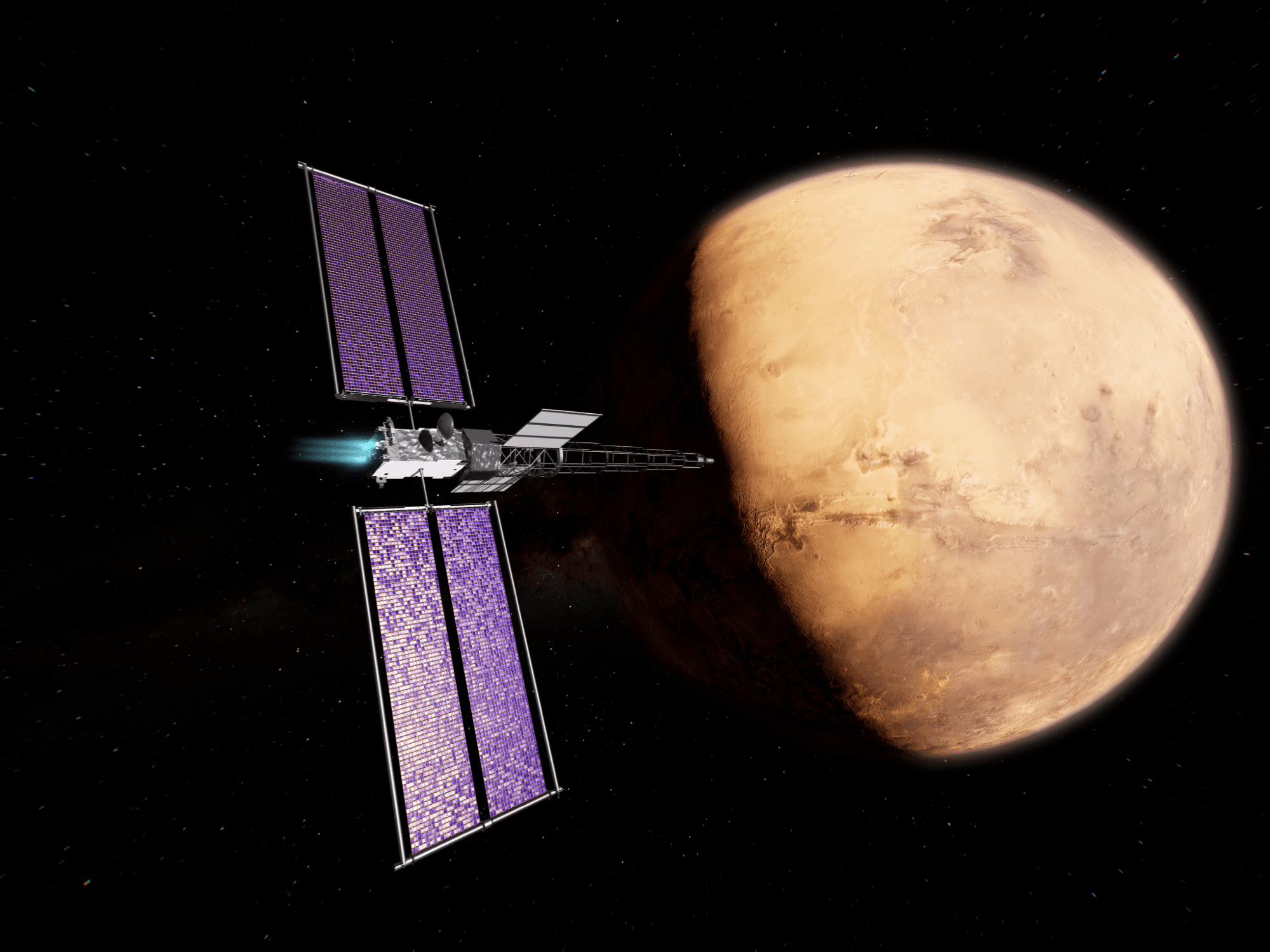
None of it would be attemptable on this timescale without a change of plan at the Moon. At the same March 2026 event, NASA said it intends to pause the lunar Gateway in its current form, redirecting the money and the hardware to a lunar base. That released the Power and Propulsion Element, a high-power solar-electric bus already deep into build. Lori Glaze described it plainly: "It's very far along in its development. Yes, it will require some modifications, but we're not starting from zero. We have a spacecraft." So SR-1 becomes a truss with the PPE at one end, the reactor at the other to keep its radiation away from the electronics, radiators between them, and solar arrays to run the vehicle until the reactor lights. Total mass is about 12,000 kg. NASA's own page lists a 12-kilowatt Hall thruster from the Advanced Electric Propulsion System and a PPE generating 48 kilowatts; third-party catalogues instead list the full Gateway thruster set of four 6-kilowatt Busek units and three 12-kilowatt AEPS units, which is what the PPE was built with. NASA has not published a definitive manifest, so both descriptions are in circulation. The reactor itself is derived from VALKRE, a lightweight kilowatt-class reactor experiment at Idaho National Laboratory, burning high-assay low-enriched uranium supplied by the Department of Energy from an allocation announced on 23 July 2026.
The schedule is the whole story, and it is tighter than the launch date suggests. The reactor has to be finished by spring 2028, months before the December launch, and Justin Coleman of Idaho National Laboratory called that "a very aggressive schedule" while arguing it was achievable given what commercial small-reactor firms have demonstrated recently. The binding constraint he and his DOE colleague Sebastian Corbisiero both named is not physics but parts: the same specialist components are being chased by a wave of commercial microreactor companies. HALEU is the other pinch point: NASA's Jeremy Kenny told a symposium in August 2026 that the agency had to be mindful of its availability and of the supply chain behind it, and White House officials at the same event named the absence of a production line for ceramic HALEU. Against that, progress is real but early. As of the second week of August 2026 the mission had completed what Sinacore called a design sync review, roughly equivalent to a mission concept or systems requirements review, had procurements going out for major components, and had a concept rather than a design for the structure joining the PPE, the payload and the reactor. NASA had said in June that a review analogous to a preliminary design review was planned for the autumn. That is a long way from a flight article with two years and four months to go.
Money and politics are the second constraint, and NASA has been unusually visible about both. The mission was left out of the fiscal 2027 budget request published a week and a half after it was announced. At a National Academies meeting on 2 June 2026, NASA officials declined to give a cost estimate at all, saying only that the mission would draw on the 2027 request and on the 2.6 billion dollars the previous year's reconciliation bill had provided for Gateway, and that "right now it all fits." Board members were openly sceptical, one observing that a two-year development timeline is more consistent with a cubesat than with a nuclear spacecraft. By 11 August 2026 the agency had produced a preliminary estimate of 2.1 billion dollars. The sharpest criticism on the record is not about the schedule but about what happens afterwards. Bhavya Lal, formerly NASA's associate administrator for technology, policy and strategy, told a symposium on 13 August that current support "is positional, not structural. It is attached to people and not to paper," and pointed out that nothing actually requires SR-1: its helicopter payload could fly on something else, the lunar reactor programme does not depend on it, and "the only thing that truly needs SR-1 is SR-2, SR-3 and SR-4, and those don't exist." Her worry is a repeat of 1965.
What SR-1 would actually do at Mars is, remarkably, still open. NASA's mission page lists the mission type as a Martian flyby and science payload deployment, with launch in 2028 and arrival in 2029, and describes multiple Mars flybys in the concept trajectory. The SkyFall page fills in the shape: after cruise and an initial Mars flyby in 2029, the helicopters land following a second Mars approach in autumn 2030. So the payload reaches the ground roughly two years after launch. Whether the mothership then enters Mars orbit, or keeps going somewhere else to wring more out of the propulsion demonstration, has not been decided; Sinacore said in March 2026 that NASA wanted "to push the bounds with this demonstrator." No launch vehicle has been announced either. Gunter's Space Page notes that a Falcon Heavy originally ordered for the Gateway PPE and HALO launch could potentially be reassigned, and flags the entry as a notional concept, which is a cataloguer's inference rather than a NASA statement. Two things about this mission are worth holding in mind together. It is the most concrete space fission propulsion effort the United States has mounted in sixty years, with a reactor engineering unit that senior NASA officials have physically inspected. And its design maturity in August 2026 was a completed requirements-level review, its funding line was unresolved, and its purpose after the payload separates was undetermined.
Mission facts
The announcement
24 March 2026, at NASA's "Ignition" event in Washington. Administrator Jared Isaacman: "After decades of study and millions spent on concepts that have never left Earth, America will finally get underway on nuclear power in space." At the same event NASA said it intends to pause the lunar Gateway in its current form, redirecting its funding and hardware to a lunar base.↗
What it would do first
NASA's Ignition fact sheet describes the opening sequence: after launch the spacecraft escapes Earth's gravity and "within 48 hours starts a nuclear fission reactor and powers electric thrusters. Three milestones, accomplished in two days." The reactor would not be started in Earth orbit.↗
The reactor
Sources differ on the power. NASA's Ignition fact sheet and Gunter's Space Page both say more than 20 kilowatts of electrical power; NASA's own SR-1 mission page and SpaceNews in March 2026 say 20 kilowatts flat. The conversion system is a closed Brayton cycle, fuelled by high-assay low-enriched uranium (HALEU). SpaceNews reported on 11 August 2026 that the design is based on VALKRE, the Versatile Autonomous Lightweight Kilowatt-class Reactor Experiment developed at Idaho National Laboratory. The Department of Energy announced on 23 July 2026 that it was providing an unspecified quantity of HALEU to NASA for the mission.↗
The spacecraft
About 12,000 kg (26,455 lb). A long truss puts the reactor at one end and the Power and Propulsion Element at the other, to keep radiation away from the electronics, with radiator panels between them and solar arrays for power before the reactor is running. Communications are X-band through the Deep Space Network.↗
Propulsion
NASA's own page lists "Advanced Electric Propulsion System, 12-kilowatt Hall thruster" and a Power and Propulsion Element generating 48 kilowatts of electrical power. Third-party catalogues instead list the PPE's full complement as built for Gateway: four 6 kW Busek Hall-effect thrusters plus three 12 kW Advanced Electric Propulsion System thrusters from NASA and Aerojet Rocketdyne. Both descriptions are in circulation and NASA has not published a full thruster manifest.↗
Why the schedule is possible at all
Existing hardware. Lori Glaze, then NASA acting associate administrator for exploration systems development, on the Gateway PPE: "It's very far along in its development. Yes, it will require some modifications, but we're not starting from zero. We have a spacecraft." NASA is preparing a contract modification to Intuitive Machines, which absorbed PPE builder Lanteris Space Systems, to perform those modifications.↗
The launch vehicle
Not announced. Gunter's Space Page notes that a Falcon Heavy originally ordered for the Gateway PPE and HALO launch "could potentially be reassigned" for SR-1, and labels the whole entry a notional concept. That is a cataloguer's inference; NASA has stated no such thing, and no launch contract has been made public.↗
The payload
SkyFall: an entry capsule carrying three Ingenuity-class Mars helicopters, housed between the truss and the Power and Propulsion Element. SR-1 would release it; the capsule would enter the Martian atmosphere and the aircraft would fly themselves down. None of this hardware exists yet.↗
Where the mission ends
Undecided, and NASA says so. Steve Sinacore, in March 2026: "We have not decided where the mission will end," with options including entering Mars orbit or flying past to another destination to further test the propulsion. NASA's mission page lists the mission type as "Martian flyby and science payload deployment" with launch and arrival given as 2028 and 2029, and describes multiple Mars flybys.↗
The two-flyby profile
NASA's SkyFall page gives the sequence: after the cruise phase and an initial Mars flyby in 2029, the helicopters land after a second Mars approach in autumn 2030. So the payload reaches the surface roughly two years after launch rather than one.↗
Cost
NASA declined to give a cost estimate at a National Academies meeting on 2 June 2026, where Glaze said only that the mission would draw on the fiscal 2027 request and on the 2.6 billion dollars provided for Gateway in the previous year's reconciliation bill, and that "right now it all fits." SpaceNews reported on 11 August 2026 that the agency subsequently gave a preliminary estimate of 2.1 billion dollars.↗
Appropriations
SR-1 Freedom was not included in NASA's fiscal year 2027 budget request, released about a week and a half after Ignition. English Wikipedia, reading the House Appropriations Committee's fiscal 2027 Commerce, Justice, Science report of 13 May 2026, records a recommendation of 50 million dollars for nuclear electric propulsion development with 10 million dollars named as advancing SR-1 Freedom. We have not read the committee report itself.↗
How far it has actually got
As of the second week of August 2026: a completed "design sync review" that SR-1 program director Steve Sinacore described as analogous to a mission concept or systems requirements review; procurements going out for major components; only a concept, with no design yet, for the structure linking the PPE, the payload and the reactor; and an engineering design unit of the VALKRE reactor at Idaho National Laboratory. Separately, SpaceNews reported on 4 June 2026 that a review analogous to a preliminary design review was planned for the autumn, tailored to the streamlined management approach.↗
The named risks: components and schedule
Component procurement is "the biggest challenge," according to Sebastian Corbisiero, national technical director for the DOE Space Reactor Program, because commercial microreactor startups need some of the same parts. The reactor has to be finished by spring 2028 to hold a December 2028 launch, which Justin Coleman of Idaho National Laboratory called "a very aggressive schedule." Both spoke to SpaceNews around the Idaho National Laboratory tour of 7 August 2026.↗
The named risks: fuel
HALEU supply is a possible bottleneck. Jeremy Kenny, manager of NASA's advanced nuclear technology office, at the Space Nuclear Industry Symposium on 13 August 2026: "We have a good problem in that we need to be mindful of the availability of HALEU and supply chain aspects of it." At the same event Aaron Miles of the White House Office of Science and Technology Policy named the lack of a production line for ceramic HALEU as one of several open issues.↗
The structural criticism
Bhavya Lal, former NASA associate administrator for technology, policy and strategy, at the Space Nuclear Industry Symposium on 13 August 2026: support for space nuclear "is positional, not structural. It is attached to people and not to paper." She noted SR-1 has no clear customer, that its SkyFall payload could fly on a different mission, and that the lunar reactor programme does not depend on it: "The only thing that truly needs SR-1 is SR-2, SR-3 and SR-4, and those don't exist."↗
What it is a pathfinder for
Lunar Reactor-1, a fission surface power system intended to keep a lunar base running through the lunar night and in places solar power cannot reach, which NASA's fact sheet says lands on the Moon in 2030. NASA's argument is that flying a reactor without the added complexity of a lunar landing retires nuclear flight risk, qualifies a supply chain and builds a workforce.↗
Mission timeline
- 1965SNAP-10A becomes the only fission reactor the United States has flown in space. It never leaves Earth orbit. NASA's 2026 fact sheet uses it as the indictment: more than 20 billion dollars across dozens of space nuclear programmes in six decades, and one flight.
- 24 Mar 2026At its Ignition event NASA announces SR-1 Freedom, and in the same session says it intends to pause the lunar Gateway in its current form. The Gateway's Power and Propulsion Element, well advanced in build, becomes available as the propulsion half of a nuclear spacecraft.
- 24 Mar 2026NASA publishes the Ignition fact sheet: launch in December 2028, reactor start and thruster ignition within 48 hours of launch, and a Mars payload of three Ingenuity-class helicopters called Skyfall.
- Apr 2026NASA's fiscal year 2027 budget request, released about a week and a half after Ignition, does not include SR-1 Freedom.
- 13 May 2026The House Appropriations Committee's fiscal 2027 Commerce, Justice, Science report recommends 50 million dollars for nuclear electric propulsion development and names 10 million dollars as advancing SR-1 Freedom, as read by English Wikipedia. We have not seen the report itself.
- 2 Jun 2026At a National Academies meeting NASA says it is streamlining project management to hold the schedule but gives few technical details and declines to offer a cost estimate. Board members are sceptical, one noting that a two-year development timeline is more consistent with a cubesat. Glaze, of the project and its schedule: "It is ambitious. It's a challenge," and "It doesn't mean we're going to be successful, but I can tell you we're doing everything we can to meet the challenge."
- 23 Jul 2026The Department of Energy announces it is providing high-assay low-enriched uranium to NASA for the SR-1 mission, in the same round of allocations that sends fuel to commercial reactor companies.
- 7 Aug 2026Isaacman and associate administrator Amit Kshatriya tour Idaho National Laboratory to review the reactor. Isaacman tells reporters the visit "absolutely" increased his confidence in a 2028 launch and compares the mission to the first nuclear submarine: "This is our Nautilus, and where we go from here must lead to the nuclear NASA of the future."
- 11 Aug 2026SpaceNews reports the preliminary cost estimate of 2.1 billion dollars, the completed design sync review, the VALKRE-derived reactor design, and a contract modification being prepared for Intuitive Machines to modify the PPE. Media on the INL tour were not allowed to photograph the room containing VALKRE hardware.
- 13 Aug 2026At the Space Nuclear Industry Symposium officials name HALEU production and component procurement as the near-term risks, and Bhavya Lal argues that political support for space nuclear is attached to people rather than to paper, and that SR-1 has no clear customer.
- Spring 2028The reactor must be complete by this point for the December 2028 launch to hold, according to Justin Coleman of Idaho National Laboratory, who calls the schedule very aggressive but achievable on the strength of recent commercial small-reactor work.
- Dec 2028Target launch, with a Mars encounter in 2029 and, on NASA's SkyFall page, a helicopter landing after a second Mars approach in autumn 2030. Where SR-1 itself finishes has not been decided.
A filled dot marks something that physically happened. A hollow one marks an announcement, a naming or a target.
In pictures
Tap a photo to enlarge.
Sources
- NASA mission page: Space Reactor-1 Freedom (last updated 19 Aug 2026)
- NASA release (24 Mar 2026): Ignition initiatives, primary source for the Gateway pause wording
- NASA Ignition fact sheet (24 Mar 2026): America Underway in Space on Nuclear Power
- SpaceNews, Jeff Foust (26 Mar 2026): NASA to test nuclear electric propulsion with 2028 mission to Mars
- SpaceNews, Jeff Foust (4 Jun 2026): NASA working to streamline development of nuclear electric propulsion demo mission
- SpaceNews, Jeff Foust (11 Aug 2026): National lab visit boosts NASA's confidence in space nuclear propulsion mission
- SpaceNews, Jeff Foust (18 Aug 2026): Space nuclear programs face near- and long-term challenges
- NASA Science: SkyFall mission page
- Gunter's Space Page: SR-1 Freedom (notional concept), last updated 7 Aug 2026
- English Wikipedia: Space Reactor-1 Freedom
Facts on this page were verified on 24 August 2026. Where sources disagree, the disagreement is stated rather than resolved silently.