SkyFall
NASA and AeroVironment · United States · Helicopter · 2021 · AnnouncedIn development
Adopted by NASA on 24 March 2026, cut from AeroVironment's six-helicopter concept to three: released in mid-air with no lander involved. Launch is December 2028 aboard SR-1 Freedom, landing in autumn 2030.
TL;DR· 11 min read
SkyFall would release three Ingenuity-derived helicopters in mid-air during descent and let them fly themselves to the surface, which NASA says eliminates the need and cost for a lander. AeroVironment revealed the concept with six aircraft on 24 July 2025, and NASA adopted it with three on 24 March 2026 under JPL management. Each 5 kg aircraft carries a ground-penetrating radar designed to read the top 3 metres of crust. Launch is December 2028 aboard SR-1 Freedom, with landing in autumn 2030.
SkyFall's whole idea is in its name. Instead of landing a platform and unfolding an aircraft from it, the descent stage would slow under a parachute and braking rockets and then simply let three helicopters go, in the air, to fly down and land themselves. That removes the lander, which is the most expensive and most dangerous part of any Mars surface mission. AeroVironment revealed the concept with six aircraft in July 2025; NASA adopted it with three in March 2026 and put it aboard a nuclear spacecraft that does not yet exist.
- 3helicopters, cut from the six in AeroVironment's original 2025 concept
- 0landers required, which is the point of the mid-air release
- 3.0 mdepth of Martian crust the ground-penetrating radar is designed to read
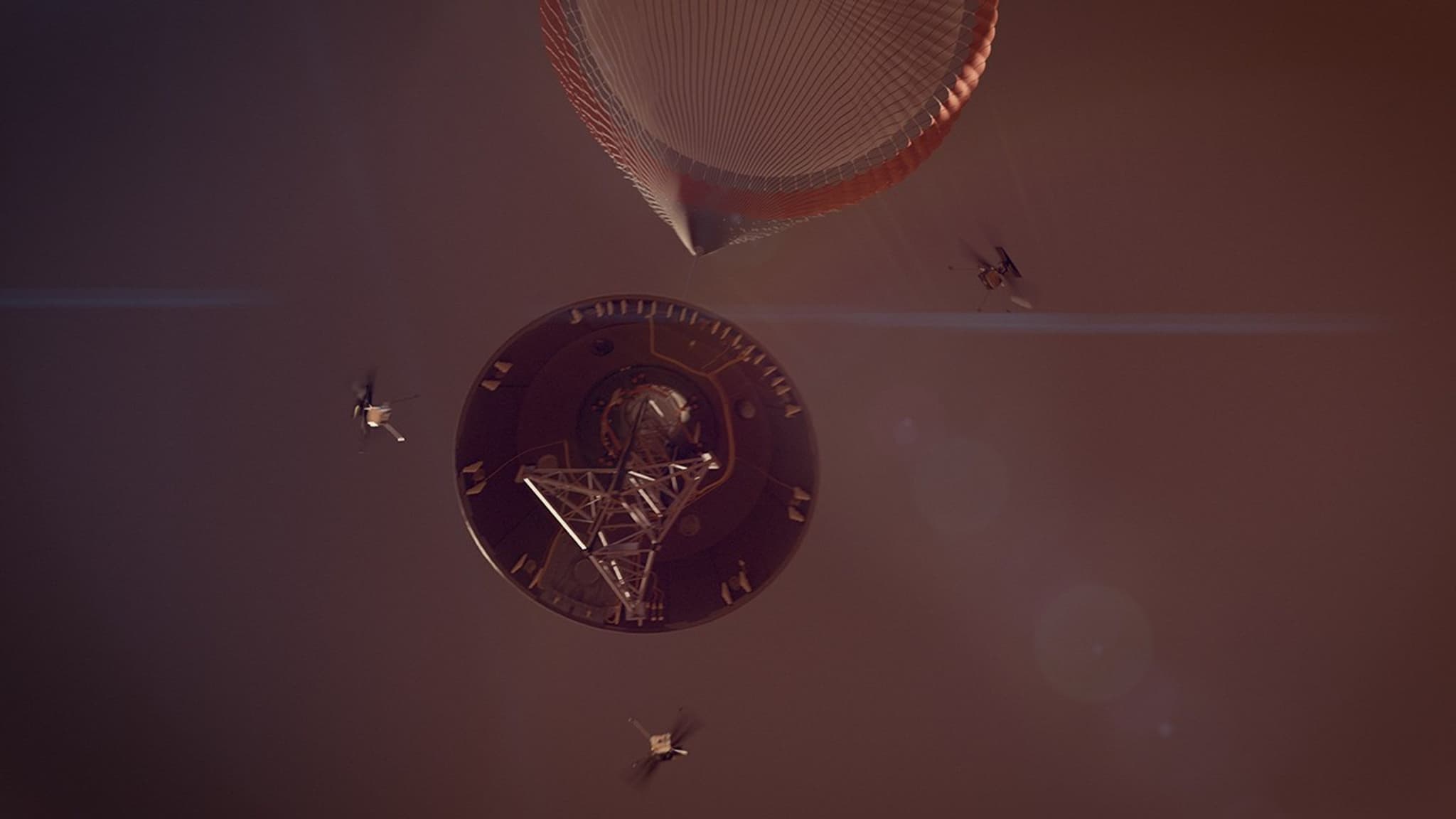
Every Mars surface mission so far has had to solve the same problem twice: get through the atmosphere, and then put something down gently. SkyFall proposes to solve it once. A parachute and braking rockets would slow a descent stage, and then, still in the air, three helicopters would let go and fly themselves down. NASA's own wording is that this "eliminates the need and cost for a lander," and the aircraft are named for the manoeuvre rather than the other way round. The idea came out of AeroVironment and JPL, the same pairing that built Ingenuity, and was revealed publicly on 24 July 2025 as a concept with six helicopters aimed at the 2028 window. Eight months later, on 24 March 2026, NASA adopted it as a real mission with three, managed by JPL, and gave it a ride: the Space Reactor-1 Freedom nuclear-electric spacecraft, itself announced the same day. The mission's job is scouting rather than deep science. Nicky Fox, NASA's associate administrator for science, set expectations without hedging: "They're going to be very, very similar in capabilities to Ingenuity. They're going to have cameras on them to be able to take images, but they're not going to be full-up heavy science birds." What they are meant to produce is a survey of a candidate human landing region, in three dimensions and from a few metres up.
The aircraft are considerably more capable than Ingenuity even so. Each is 52 centimetres tall and 5 kilograms, with two counter-rotating rotor blades given as 1.35 metres in diameter in the mission page's key facts, 1.4 metres tip-to-tip further down that same page, and 1.4 metres again on NASA's SR-1 page, which is a small reminder to check numbers even inside one agency's website. Each carries five things: a compact ground-penetrating radar, 13-megapixel colour cameras for overlapping views that build centimetre-scale terrain models, near-infrared cameras for regolith composition, temperature and wind sensors that exploit the ability to hover at chosen altitudes, and an off-the-shelf micro dosimeter with flight heritage on the Lunar Reconnaissance Orbiter to log the surface radiation dose a future crew would take. The single most important difference from Ingenuity is not an instrument at all. Ingenuity had to talk through Perseverance; the SkyFall helicopters are to transmit directly to orbiters, through an ultra low-mass direct-to-orbit radio. That is what would let three aircraft spread out from a common drop zone instead of orbiting a rover. A flight is expected to last about two and a half minutes and cover one to two kilometres. NASA has published no operating lifetime for them.
The radar is where the mission's stated purpose lives, and it is also the piece with visible hardware progress. Finding shallow water ice is the difference between a landing site that can support a crew and one that cannot, and orbital radar cannot resolve the layering at the scale that matters. So each helicopter carries a miniaturised Vivaldi antenna working between 500 and 2,500 MHz, weighing about 150 grams, built from metallised fabric on a polyester base with Vectran outer layers, the same material that wrapped the Spirit and Opportunity airbags, sprung on flexible fibreglass tape and mounted on magnesium. It has to hang below a landing aircraft, bend when the aircraft touches down, and spring back straight enough to keep taking data. In July 2026 JPL cycled it thermally through swings of up to 94 C, flexed it the equivalent of 200 Mars landings and checked its electromagnetic performance six times through the campaign, and reported no degradation. Adrian Tang, the radar lead, described what it buys: "By flying low and slow, a SkyFall helicopter could capture radar images that resolve the fine layering where dry soil gives way to ice." The design target is to read the upper three metres of crust, and deeper in good conditions.
What SkyFall does not yet have is a landing site, a launch that exists, or a certain ride. The landing site selection process is still to be run, through community workshops, with the search aimed at flat, low, obstacle-free ground with something worth looking under. A hardware contract surfaced on 7 July 2026, when Firefly Aerospace disclosed a 13 million dollar subcontract from JPL to build the aeroshell, backshell and heatshield, in carbon composite drawn from its Blue Ghost lunar landers and its launch vehicles, with development in its Gloworks lab and qualification at its Rocket Ranch in Texas. The schedule reads December 2028 for launch on the JPL caption published on 5 August 2026, then an initial Mars flyby in 2029, then entry and landing after a second Mars approach in autumn 2030. All of that hangs on SR-1 Freedom, a nuclear spacecraft that in August 2026 had completed a requirements-level review and had no flight article. That dependency has already been named in public: at a symposium on 13 August 2026, Bhavya Lal, arguing that SR-1 lacks a clear customer, observed that the SkyFall helicopters could fly on a different mission. No alternative ride has been announced, and no date earlier than 2028 appears in any NASA, JPL or AeroVironment source we consulted.
Mission facts
Origin
AeroVironment revealed Skyfall on 24 July 2025 as "a potential future mission concept for next-generation Mars Helicopters developed with NASA's Jet Propulsion Laboratory," with six scout helicopters and a target launch of 2028. William Pomerantz, head of space ventures at AV: "Skyfall offers a revolutionary new approach to Mars exploration that is faster and more affordable than anything that's come before it."↗
Adoption
NASA announced SkyFall as a mission on 24 March 2026 at the Ignition event, with three helicopters rather than six, as the science payload of Space Reactor-1 Freedom. JPL leads the work on the NASA side and holds the aeroshell subcontract with Firefly; NASA's page says AeroVironment of Arlington, Virginia "will co-design and co-manufacture the SkyFall helicopters with NASA's Jet Propulsion Laboratory," the pairing that built Ingenuity. NASA's page does not name a managing centre in those words.↗
The manoeuvre
NASA: "The Mars Entry, Descent, and Landing sequence (EDL) gets redefined with the SkyFall maneuver, in which rotorcraft are released midair during descent, enabling them to fly themselves safely to the Martian surface for the very first time." NASA's description continues in the future tense: "A parachute and then braking rockets will slow the SkyFall descent stage, and the three aircraft will fly off and land individually." NASA states this "eliminates the need and cost for a lander."↗
The aircraft
Height 52 cm (20.5 in); mass 5 kg (11 lb); fuselage 24.5 by 22 by 21.5 cm; two counter-rotating rotor blades. All three are identical.↗
Rotor size, three NASA figures
NASA's SkyFall page gives two different numbers for the same hardware. Its key facts say "two counter-rotating blades, each 4.4 feet (1.35 meters) in diameter"; further down the same page it says "The SkyFall rotor blades are even larger, spanning 4.6 feet (1.4 meters) tip-to-tip." NASA's SR-1 Freedom page gives a third form, "two 4-foot-wide (1.4 meter) rotor blades." We quote 1.35 m from the key facts and flag the disagreement.↗
Instruments
Five items per aircraft in NASA's listing: a compact ground-penetrating radar for subsurface structure and ice between 0.5 and 3.0 m depth; 13-megapixel colour cameras for overlapping mid-flight views and centimetre-scale 3D terrain maps; near-infrared cameras for regolith composition; sensors for air temperature, wind speed and direction, exploiting the ability to hover at different altitudes; and a commercial off-the-shelf micro dosimeter with flight heritage on the Lunar Reconnaissance Orbiter, to record total surface ionising radiation dose.↗
The radar antenna
A miniaturised Vivaldi antenna operating from 500 to 2,500 MHz, weighing about 150 grams (5 ounces), made of metallised flexible fabric on a polyester base with Vectran outer layers, the same material used in the Spirit and Opportunity landing airbags, on flexible fibreglass tape springs and a magnesium mount. It hangs below the aircraft and has to bend on landing and spring back.↗
Antenna testing
JPL ran environmental testing in July 2026: thermal cycling with swings up to 94 C (170 F), repeated flexing, and electromagnetic performance checks at six intervals. JPL states the antenna withstood the equivalent of 200 Mars landings with no performance degradation. Adrian Tang, ground-penetrating radar lead: "By flying low and slow, a SkyFall helicopter could capture radar images that resolve the fine layering where dry soil gives way to ice."↗
No rover required
Ingenuity relayed everything through the Perseverance rover. NASA says the SkyFall helicopters "will independently transmit their findings to spacecraft orbiting Mars," using an ultra low-mass direct-to-orbit radio developed separately, which is what would free them from having to stay near a partner vehicle.↗
Flight profile
About 2.5 minutes per flight, covering roughly 1 to 2 km (0.6 to 1.2 miles) of ground, which NASA gives as an expectation rather than a measured figure. NASA's mission page publishes no operating lifetime for the aircraft and does not state their power source; English Wikipedia's infobox gives solar-array-charged lithium-ion batteries.↗
The aeroshell
Firefly Aerospace announced a 13 million dollar subcontract from JPL on 7 July 2026 to manufacture, test and deliver the backshell and heatshield, using carbon composite techniques from its Blue Ghost lunar landers, Elytra orbiters and Alpha and Eclipse launch vehicles. Development runs in Firefly's Gloworks innovation lab; qualification and flight acceptance testing happen at its Rocket Ranch in Briggs, Texas.↗
Landing site
Not selected. NASA plans a landing site selection process with community workshops, targeting flat, low-elevation ground free of obstacles, ideally with interesting subsurface features inside or near the landing ellipse.↗
Schedule
Launch late 2028; the JPL caption on the August 2026 artist's concept says December 2028 specifically. NASA's key facts give landing "after cruise phase and initial Mars flyby in 2029, will land after second Mars approach in Fall 2030."↗
What the science leadership said about the aircraft
Nicky Fox, NASA associate administrator for science, in March 2026: "They're going to be very, very similar in capabilities to Ingenuity. They're going to have cameras on them to be able to take images, but they're not going to be full-up heavy science birds."↗
The dependency
SkyFall's only announced ride is SR-1 Freedom, a nuclear-electric spacecraft that had completed a requirements-level review and no flight hardware by August 2026. Bhavya Lal, formerly of NASA, noted on 13 August 2026 that SkyFall "could fly on a different mission," which is offered as a criticism of SR-1's rationale but is also a statement about SkyFall's options. The description of NASA's 4 September 2026 video still pairs the two, with the Department of Energy named as the partner on the reactor.↗
Mission timeline
- 19 Apr 2021Ingenuity becomes the first aircraft to fly on another planet. NASA's SkyFall material treats it as the direct ancestor: same JPL and AeroVironment pairing, evolved design.
- 24 Jul 2025AeroVironment reveals Skyfall from Arlington, Virginia: six scout helicopters developed with JPL, deployed by a mid-air release from the entry capsule that removes the need for a landing platform, targeting a 2028 launch. It is presented as a mission concept, with no funding behind it.
- 24 Mar 2026NASA announces SkyFall as a real mission at the Ignition event, with three helicopters instead of six, riding to Mars aboard SR-1 Freedom.
- 26 Mar 2026SpaceNews reports Nicky Fox setting expectations: capabilities very similar to Ingenuity, cameras aboard, but not heavy science instruments. Steve Sinacore says the aircraft will study a potential future human landing site and look for subsurface water ice.
- 7 Jul 2026Firefly Aerospace announces a 13 million dollar JPL subcontract to build the SkyFall aeroshell, the backshell and heatshield that protect the descent stage. It is the earliest hardware contract for the mission that we can find announced publicly.
- Jul 2026JPL environmentally tests the fabric ground-penetrating radar antenna in its laboratories: thermal cycling to 94 C, repeated flexing equivalent to 200 Mars landings, and electromagnetic checks at six points through the campaign.
- 5 Aug 2026JPL publishes an artist's concept of the three helicopters at work, whose caption states that the project will carry them to Mars in December 2028 and confirms AeroVironment's co-design and co-manufacturing role.
- 6 Aug 2026JPL publishes the antenna story, with the design details and quotes from radar lead Adrian Tang and mechanical lead Christine Gebara on how the antenna has to bend on landing and spring back to collect data.
- 13 Aug 2026At the Space Nuclear Industry Symposium, Bhavya Lal argues that SR-1 Freedom has no clear customer and observes that its SkyFall payload could fly on a different mission. No alternative ride has been announced.
- 4 Sep 2026NASA publishes a promotional video, What It Takes, whose description restates the plan: SR-1 Freedom launching in 2028 to demonstrate nuclear electric propulsion and deliver the SkyFall helicopters to Mars, in collaboration with the Department of Energy. It is NASA's first public statement on the pairing since Lal's remark, and the video itself names neither spacecraft.
- Dec 2028Planned launch aboard SR-1 Freedom. NASA's public pages say late 2028; the JPL image caption of 5 August 2026 says December 2028.
- 2029 to autumn 2030Planned arrival sequence: an initial Mars flyby in 2029, then release, entry and landing after a second Mars approach in autumn 2030. The landing site has not been chosen.
A filled dot marks something that physically happened. A hollow one marks an announcement, a naming or a target.
In pictures
Tap a photo to enlarge.
Sources
- NASA Science: SkyFall mission page
- NASA mission page: Space Reactor-1 Freedom
- NASA JPL (6 Aug 2026): NASA Tests Featherweight Radar Antenna for SkyFall Mars Helicopters
- NASA JPL image PIA26760 (5 Aug 2026): NASA's SkyFall Helicopters at Work
- AeroVironment (24 Jul 2025): AV Reveals Skyfall
- Firefly Aerospace (7 Jul 2026): Firefly Aerospace Receives $13 Million NASA JPL Subcontract to Build Aeroshell for SkyFall Mars Mission
- SpaceNews, Jeff Foust (26 Mar 2026): NASA to test nuclear electric propulsion with 2028 mission to Mars
- SpaceNews, Jeff Foust (18 Aug 2026): Space nuclear programs face near- and long-term challenges
- NASA (4 Sep 2026): What It Takes, video description
- English Wikipedia: SkyFall (helicopter)
Facts on this page were verified on 5 September 2026. Where sources disagree, the disagreement is stated rather than resolved silently.