Ingenuity
NASA · United States · Helicopter · 2021 · Multipolar MarsEnded
Grounded at Valinor Hills since 18 January 2024, when all four rotor blades broke on landing. NASA declared the mission complete on 25 January 2024 and left it recording with no way to send anything home.
TL;DR· 12 min read
Ingenuity was a 1.8 kg technology demonstration funded for up to five flights in 30 Martian days. It flew 72 times over nearly three years, scouting terrain for Perseverance and setting marks of 24 m altitude and 10 m/s, until on 18 January 2024 it came down on steep, featureless sand ripples its navigation system could not track and snapped all four rotor blades. NASA declared the mission complete on 25 January 2024 and left it at Valinor Hills, recording daily with no way to send anything home.
Ingenuity weighed 1.8 kg, carried no science instruments and cost about $85 million to build, carry to Mars and fly. It existed to answer one question: can a rotorcraft get off the ground in air less than one percent as dense as Earth's? The plan was up to five flights in up to 30 Martian days. It flew 72 times over nearly three years, became the rover team's scout, set an altitude record of 24 m and a groundspeed record of 10 m/s that nobody had designed for, and then, on 18 January 2024, came down onto a field of steep, featureless sand ripples that its navigation system could not read. It arrived moving sideways, hit the slope of a ripple, and all four carbon-fibre blades snapped about a third of the way in from their tips. NASA worked out what happened the way you would investigate any aircraft accident, except with no black box, no wreckage in hand, and the aircraft 100 million miles away.
- 72flights, against the five in 30 Martian days the technology demonstration was funded and designed for
- 1stpowered, controlled flight by an aircraft on another planet, 19 April 2021, 39.1 seconds at 3 m
- 4 of 4rotor blades snapped on the final landing, about a third of the way in from the tips
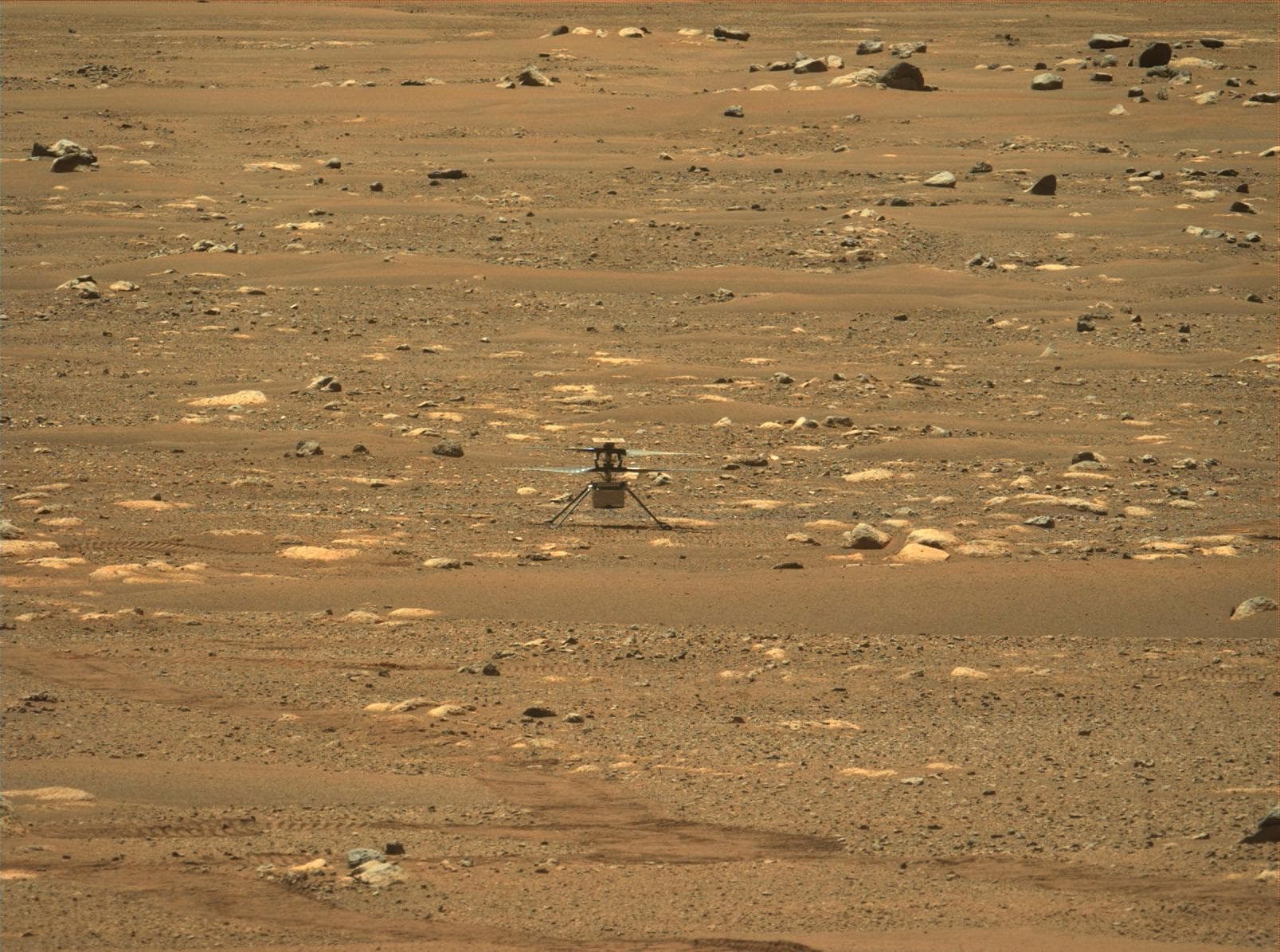
Ingenuity was built to be almost nothing. The aerodynamic problem it faced is closer to hovering at 30 km above Earth than to any flight anyone had actually performed, so the answer was mass discipline taken to an extreme: 1.8 kg all in, a fuselage the size of a tissue box, four carbon-fibre blades arranged as two counter-rotating rotors 1.2 m tip to tip turning at about 2,400 rpm, four spindly legs, a solar panel on the mast and six lithium-ion cells. Flight drew roughly 350 watts and the battery paid for one flight of up to 90 seconds a day, with the rest of the charge going to heaters so the electronics would survive Martian nights the press kit puts as cold as minus 90 degrees Celsius. It carried no science instruments, only a navigation camera and a colour terrain camera. To keep the computing affordable, JPL flew commercial off-the-shelf mobile-phone processors rather than the radiation-hardened parts a spacecraft normally carries. It could not talk to Earth: everything went through a base station on Perseverance over a 900 MHz link good for about a kilometre. NASA invested about $85 million to build it, accommodate it on the rover and operate it. The plan was up to five flights in up to 30 Martian days.
The first flight came on 19 April 2021, sol 58: 39.1 seconds in the air, a climb to 3 m, a hover, and a landing back on the same patch of ground, which the team named Wright Brothers Field. That single hop answered the question the whole project existed to ask. Four more flights finished the programme by 7 May, and NASA converted Ingenuity into an operations demonstration, scouting terrain and routes for the rover. It kept going for two and a half more years. Flight 6, on 22 May 2021, nearly ended it: a glitch in the navigation camera pipeline lost a single image and left every later image with a wrong timestamp, so the guidance algorithm corrected against a past that had never happened. The helicopter swung through roll and pitch excursions of more than 20 degrees, drew power spikes, and still put itself down within about 5 m of its target, saved by design margin and by a rule that stops trusting the camera during the last part of the descent. It went on to set marks nobody had designed for: 24 m altitude on Flight 61, 10 m/s on Flight 62, and ground tracks past 700 m in December 2023. By then it was flying over terrain nothing like the pebbly, well-textured flats it was built around.
Flight 71, on 6 January 2024, ended early. Flight 72, twelve days later, was meant to be a short vertical hop to check the aircraft over: up to 12 m, a brief hover, a few pictures, straight back down. Nineteen seconds in it started descending. By about 32 seconds it was on the ground and the radio went quiet. Contact came back on 20 January, and the helicopter was upright and power-positive, but an image showed the shadow of a rotor blade with a piece missing. NASA declared the mission complete on 25 January 2024. On 4 February Perseverance photographed it from about 450 m with Mastcam-Z at a place the team named Valinor Hills; on 27 February a navcam frame showed a blade gone entirely. The reconstruction, published on 11 December 2024, is unambiguous about the mechanism. The helicopter was over steep, relatively featureless sand ripples, and its vision navigation system had too little surface texture to track. It arrived with high horizontal velocity, hit the slope of a ripple, pitched and rolled, and the loads on the spinning blades went past their design limits. All four snapped about a third of the way in from the tips. The vibration that followed tore away more blade and demanded power the vehicle could not supply, and the link died.
As Håvard Grip, Ingenuity's first pilot, put it: 'When running an accident investigation from 100 million miles away, you don't have any black boxes or eyewitnesses.' What the team had instead was telemetry, a handful of images, and a helicopter that was still answering. Before their final downlink shift on 16 April 2024 they uploaded software telling Ingenuity to wake every day, run its flight computers, test the solar panel, batteries and electronics, take a picture of the ground and log temperatures, with room to keep doing that for roughly twenty years. Team lead Josh Anderson said that after more than a thousand Martian days, 72 flights and one rough landing, 'she still has something to give.' None of it can reach Earth. The rover is the only relay, its base station reaches about a kilometre, and on 23 August 2026 the two published position files put Perseverance roughly 6.2 km from Valinor Hills. NASA's own pages called it 'the now-retired Ingenuity Mars Helicopter' in February 2026. Ingenuity is not dead in the sense of being switched off. It is a working instrument with no way to speak, filling a memory nobody can read until somebody goes there.
The legacy is easier to point at than most. Ingenuity's flights let the rover team plan routes and pick science targets from above, which is the argument for aerial scouts in one sentence. Its rotors gave the SuperCam microphone a controlled tone at 84.43 Hz, which is how the Mars soundscape paper measured the low-frequency speed of sound on another planet. Its base station is still working: the computer aboard Perseverance that talked to the helicopter now runs Mars Global Localization, the algorithm that on 2 February 2026 let the rover match a navcam panorama to orbital imagery and fix its own position to within about 25 cm in roughly two minutes, with no help from Earth. And NASA is building the sequel. SkyFall would deliver three next-generation helicopters carrying four instruments each, flying low and slow to hunt for shallow ice with ground-penetrating radar, and NASA expects it to launch in late 2028. The five flights in 30 days that Ingenuity was funded for turned into 72 flights, an accident investigation on another world, and an argument that the next thing to explore Mars should have rotors.
Mission facts
How it got there
Folded flat under Perseverance's belly inside the Mars Helicopter Delivery System, launched 30 July 2020, landed with the rover on 18 February 2021, and set on the Martian surface on 3 April 2021. It survived its first night alone, on its own heaters, on 4 April.↗
Mass and size
About 1.8 kg on Earth and 0.68 kg on Mars, 0.49 m tall, with a fuselage of 13.6 by 19.5 by 16.3 cm, about the size of a tissue box. Four carbon-fibre blades in two counter-rotating rotors 1.2 m tip to tip, spinning at roughly 2,400 rpm. Four carbon composite legs 0.384 m long gave about 13 cm of ground clearance.↗
Power
A solar array on top of the rotor mast charging six lithium-ion cells. Flight drew about 350 watts, and the energy budget allowed one flight of up to 90 seconds per Martian day. The rest of the stored charge went to heaters to survive the night.↗
Radio
A 900 MHz UHF link to the Mars Helicopter Base Station aboard Perseverance, capable of up to 250 kilobytes per second over distances of up to 1,000 m. Ingenuity never talked to Earth directly; everything went through the rover.↗
Cameras
Two: a 0.5 megapixel black-and-white downward-facing navigation camera on the underside, and a 13 megapixel colour horizon-facing terrain camera on a bottom edge. No science instruments at all.↗
Cost
The press kit's wording is exact: NASA invested about $85 million to build the Ingenuity Mars Helicopter, accommodate it on Perseverance, and operate the helicopter on Mars.↗
Planned versus flown
A flight test programme spanning no more than 30 sols, with up to five flights. Ingenuity flew 72 times between sol 58 and sol 1036, a span of about 33 Earth months, and NASA moved it through an operations demonstration phase and then an engineering demonstration phase along the way.↗
Totals, measured two ways
NASA's published flight log gives roughly 128.8 flying minutes and about 17.0 km (10.5 miles). NASA's helicopter flight data file gives 18,138.776 m and 7,735.448 seconds (128.92 minutes), and summing the 72 ground tracks in the separate flight-path file reproduces 18,138.776 m exactly. The log records each flight's horizontal displacement between airfields and lists zero for pure vertical hops; the data file sums the reconstructed ground track. Both are NASA's, and they measure different things.↗
Records
Highest: 24.0 m on Flight 61 (5 October 2023). Fastest: 10 m/s on Flight 62 (12 October 2023), later matched on Flights 68 and 69. Longest airborne: 169.5 seconds on Flight 12 (16 August 2021).↗
The distance record is ambiguous
NASA's own mission timeline credits Flight 25 (8 April 2022) with setting the distance record, and its flight log lists that flight at 704 m. But the same log lists Flight 69 (20 December 2023) at 705 m, and the flight-path data file makes Flight 68 the longest at 724.793 m with Flight 69 at 722.16 m and Flight 25 at 715.348 m. The published record depends on which file you read.↗
Flight 6, the near-miss
On 22 May 2021 a glitch in the navigation camera pipeline lost a single image and left every later image with an inaccurate timestamp. The helicopter oscillated through roll and pitch excursions of more than 20 degrees with large control inputs and power spikes, then landed within about 5 m of its target, saved by design margin and by a rule that stops using camera corrections during the last stretch of descent.↗
The final flight
Flight 72, 18 January 2024, a short vertical hop to check the aircraft over. It climbed to 12 m (40 feet), hovered and took pictures, began descending at 19 seconds, was back on the surface by 32 seconds, and then stopped communicating. NASA's flight log dates it to sol 1035 using Pacific time; the flight-path file records sol 1036.↗
What went wrong
By Flight 72 Ingenuity was operating over a part of Jezero crater filled with steep, relatively featureless sand ripples, rather than the well-textured pebbly flats it had been designed around. The vision navigation system had too little surface texture to track, which left high horizontal velocities at touchdown. The hard impact on a ripple slope pitched and rolled the helicopter, loads on the fast-spinning blades exceeded design limits, and all four snapped roughly one third in from the tips. The resulting vibration tore away more blade material and demanded power the vehicle could not supply, ending communications.↗
How the damage was seen
Ingenuity's own navigation camera returned an image showing the shadow of a damaged blade, released 25 January 2024. On 4 February 2024 Perseverance photographed the helicopter with Mastcam-Z from about 450 m at the spot the team named Valinor Hills, after Tolkien. On 27 February a navcam frame showed a blade missing entirely.↗
What it does now
Before the team's final downlink shift on 16 April 2024 they uploaded software telling Ingenuity to wake daily, run its flight computers, test the solar panel, batteries and electronics, take a surface photograph and log temperatures, with roughly twenty years of daily storage. None of it can be sent: the rover is its only relay and, from the two published position files read on 23 August 2026, Perseverance now sits about 6.2 km away, more than six times the 1 km link range. NASA said as much when it signed off: the rotorcraft would remain at Valinor Hills 'while the Perseverance rover drives out of communications range as it continues to explore the western limb of Jezero Crater.'↗
What it left behind
The processor Perseverance used to communicate with Ingenuity now runs Mars Global Localization, the terrain-matching algorithm that on 2 February 2026 let the rover fix its own position on Mars to within about 25 cm in roughly two minutes without help from Earth. NASA is also building three next-generation SkyFall helicopters, four instruments each, to hunt shallow ice with ground-penetrating radar, expected to launch in late 2028.↗
Mission timeline
- 3 to 4 Apr 2021Ingenuity is lowered from the rover's belly onto the surface at what becomes Wright Brothers Field, and survives its first Martian night on its own power.
- 19 Apr 2021Flight 1, sol 58: 39.1 seconds, a climb to 3 m, a hover and a landing on the same spot. The first powered, controlled flight by an aircraft on another planet.
- 7 May 2021Flight 5 completes the funded technology demonstration and is the first one-way trip, from Wright Brothers Field to Airfield B. NASA converts Ingenuity into an operations demonstration scouting for the rover.
- 22 May 2021Flight 6 nearly ends the mission. A lost navigation image mistimes everything that follows, the helicopter oscillates through more than 20 degrees of roll and pitch, and it still lands within about 5 m of its target.
- 8 Apr 2022Flight 25, sol 403: NASA's timeline calls this the distance record. The flight log lists 704 m; the reconstructed flight-path file gives 715.348 m, and two flights in December 2023 later went further on both measures.
- 13 Apr 2023Flight 50, more than ten times the mission it was funded for, on ground the aerodynamicists had never modelled.
- 5 to 12 Oct 2023Flight 61 reaches 24.0 m, the highest it ever flew. A week later Flight 62 hits 10 m/s, the fastest.
- 16 to 20 Dec 2023Flights 68 and 69, the two longest ground tracks of the mission at 724.793 m and 722.16 m, over the sand-ripple terrain that would later defeat the navigation system.
- 18 Jan 2024Flight 72. A vertical hop to 12 m, a hover, descent from 19 seconds, on the surface by 32 seconds, and then silence.
- 20 to 25 Jan 2024Contact is re-established on 20 January: the helicopter is upright and power-positive. Then an image shows the shadow of a rotor blade with a piece missing, and on 25 January NASA declares the mission complete.
- 4 to 27 Feb 2024Perseverance photographs Ingenuity at Valinor Hills from about 450 m on 4 February. Three weeks later the helicopter's own navigation camera shows one blade gone entirely.
- 16 Apr to 11 Dec 2024The team works its last downlink shift and leaves Ingenuity with software to keep recording weather and avionics data for about twenty years. On 11 December NASA publishes its reconstruction of the accident, the first aircraft accident investigation carried out on another world.
A filled dot marks something that physically happened. A hollow one marks an announcement, a naming or a target.
Where Ingenuity flew
- 72flights, the first to the last
- 16.97 kmflown in all, from the flight logs
- 24 mhighest it ever hovered
Path: NASA/JPL-Caltech. NASA MMGIS Mars 2020 helicopter flight path and waypoint layers
Ended, last position 18 January 2024. Every flight is on the globe, drawn where it was flown, with the sol it happened on. Distances here are NASA flight-log figures. The MMGIS ground track sums to 18.1 km because it follows every hover, while NASA gives about 17.0 km over 72 flights and about 128.8 minutes aloft. Flight 53 is dated sol 860, 22 July 2023, following JPL.
Replay the flightson the globe →In pictures
Tap a photo to enlarge.
Sources
- NASA MMGIS: m20_heli_waypoints.json
- NASA MMGIS: m20_heli_flight_path.json
- NASA Science: Ingenuity Flight Log Details, June 2024 (PDF)
- NASA Science: Ingenuity Mars Helicopter mission page
- JPL: NASA Performs First Aircraft Accident Investigation on Another World, 11 December 2024
- JPL: After Three Years on Mars, NASA's Ingenuity Helicopter Mission Ends, 25 January 2024
- NASA Science: Perseverance Spots Ingenuity at Its Final Airfield, 6 February 2024
- NASA Science blog: Ingenuity Reestablishes Communications, 22 January 2024
- JPL: NASA's Ingenuity Mars Helicopter Team Says Goodbye ... for Now, 16 April 2024
- NASA Science blog: Surviving an In-Flight Anomaly, What Happened on Ingenuity's Sixth Flight (Håvard Grip), 27 May 2021
- JPL: Ingenuity Mars Helicopter Landing press kit, January 2021 (archived PDF)
- NASA Science blog: NASA Tests Featherweight Radar Antenna for SkyFall Mars Helicopters, 6 August 2026
Facts on this page were verified on 23 August 2026. Where sources disagree, the disagreement is stated rather than resolved silently.
77.3225 E, 18.4973 N · Valinor Hills