Mars Life Explorer
NASA · United States · Lander · 2021 · AnnouncedPlanned
Still a concept as of 24 August 2026, with no new start, funding line or launch date. The 2022 decadal survey made this ice-drilling lander NASA's top medium-class Mars mission, to follow sample return's peak spending.
TL;DR· 13 min read
Mars Life Explorer is a studied concept for a fixed lander that would drill 2 metres into mid-latitude ground ice and look for life alive on Mars today. The 2022 decadal survey ranked it the highest-priority medium-class mission for the Mars Exploration Program, on condition that it follow the peak spending phase of Mars sample return. Sample return was not funded in the fiscal 2026 appropriation, and as of 24 August 2026 MLE has no new start, no funding line and no launch date.
Since Viking's biology experiments in 1976, every spacecraft NASA has sent to look for life on Mars has looked for life that used to be there. Mars Life Explorer is the concept built to ask the other question. It would land in the mid-latitudes where ground ice sits within a metre or so of the surface, drill 2 metres into it, and analyse the ice and the ice-cemented soil for organic molecules, non-equilibrium gases and isotopes at a sensitivity meant to support a biosignature claim, while measuring whether that ice is habitable now. The 2022 decadal survey made it the top medium-class Mars priority. Four years on, no project exists.
- 2 mdepth its drill would reach into mid-latitude ground ice
- May 2035launch date assumed in the decadal survey's own independent cost and technical evaluation
- 10 yearsgap in competed US Mars mission opportunities that MEPAG warned of in July 2026
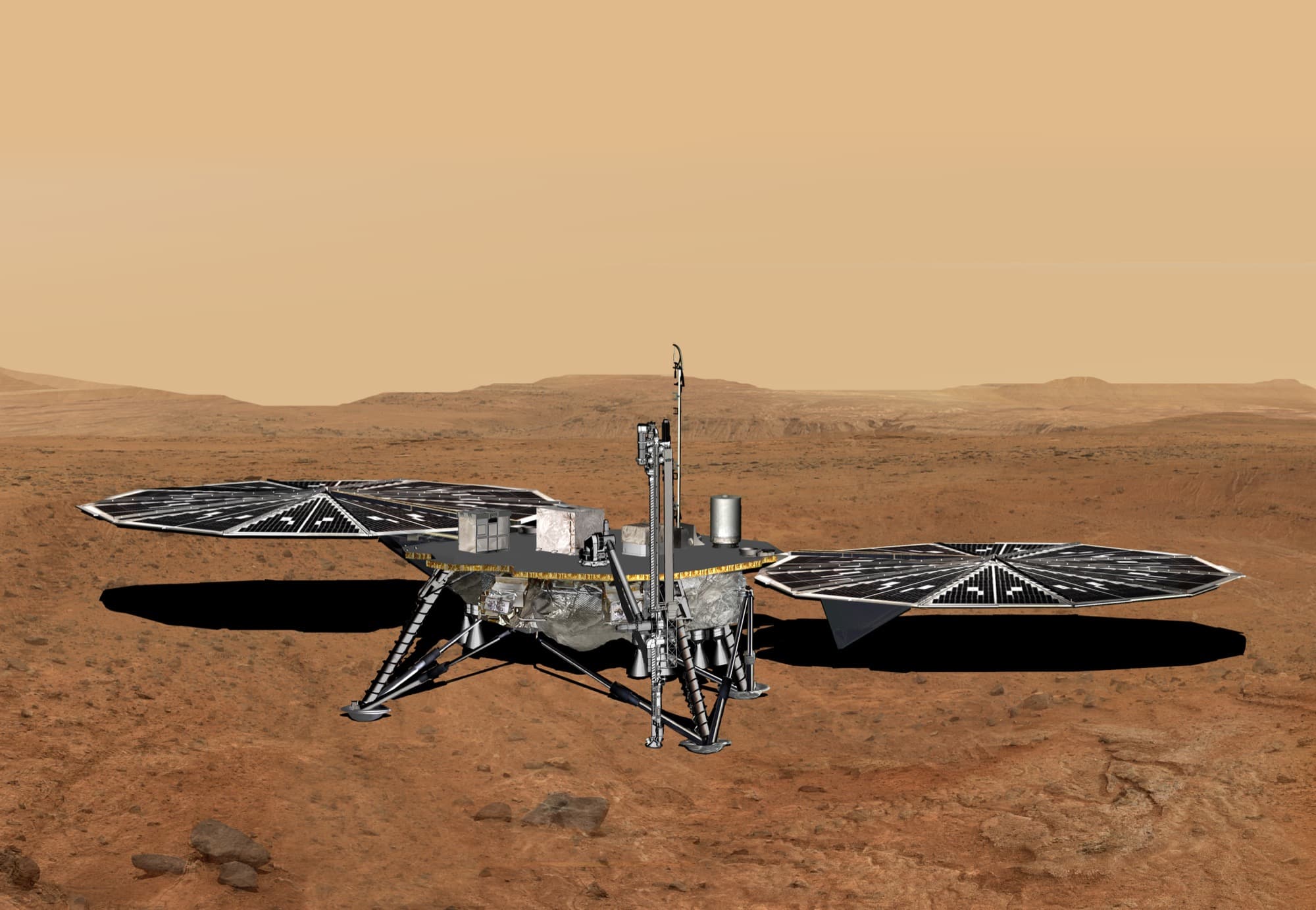
Mars Life Explorer exists because the search for life on Mars has quietly split in two. One branch looks backwards. Curiosity established that ancient Mars had habitable environments, Perseverance is caching rocks from a river delta that are roughly three and a half billion years old, and Mars sample return, whenever it happens, is aimed at that ancient record. The other branch asks whether anything is alive there now, and until recently it had almost nothing to work with. What changed is the recognition that Mars has substantial ground ice at surprisingly low latitudes, exposed by fresh impacts and mapped from orbit, and that a few millimetres of cover is enough to block the ultraviolet that sterilises the surface while a couple of metres blocks much of the harder radiation. If the ice episodically melts during high-obliquity periods, and Mars's obliquity does swing widely, then liquid water has been available in the geologically recent past at depths a robot can reach. MLE is the mission designed to go and look. It would land, drill 2 metres, and analyse both the ice and the ice-cemented regolith for organics, for gases out of chemical equilibrium and for isotopic patterns, while separately measuring whether the site has the elements, energy sources and freedom from toxins that microbial life would need today.
The decadal survey process gave it a formal standing that few concepts get. Origins, Worlds, and Life, the National Academies' planetary science and astrobiology decadal survey for 2023 to 2032, considered four medium-class Mars missions, put two of them through an independent technical, risk and cost evaluation, and ranked Mars Life Explorer the highest-priority medium-class mission for the Mars Exploration Program. Its recommendation is one sentence long and carries one large condition: subsequent to the peak-spending phase of Mars sample return, the next priority medium-class mission for the Mars Exploration Program should be Mars Life Explorer. The evaluation itself describes a fairly conservative lander. Two Ultraflex solar arrays, an 80 amp-hour battery, hydrazine propulsion, a 3.65 metre aeroshell, a single-segment 2 metre drill on a boom, a biobarrier, and a 34-month life of which 21 months is nothing but weather observation, because determining whether these ice deposits are currently gaining or losing material requires watching a full Martian year. The risk rating was medium-low. The named challenges were mundane and real: land accurately enough that a machine which cannot drive still reaches ice, and do not let the lander get heavier than the entry system can handle.
Now the arithmetic. The decadal made MLE conditional on sample return getting past its peak spending, and sample return has not started spending at all in the way the survey imagined. Congress declined to fund Mars sample return in the fiscal 2026 appropriations bill that finally passed in January 2026. NASA's planetary science division received 2.54 billion dollars for the year, comfortably above the 1.89 billion the administration had requested but roughly 200 million below what the division had in fiscal 2025, and its director, Louise Prockter, told the community at the Lunar and Planetary Science Conference on 16 March 2026 that not everything could continue forward, or continue forward in the same way. On sample return she said only that the division was standing by for future budget guidance. Meanwhile the Mars Exploration Program acquired a new obligation. A budget reconciliation bill had provided 700 million dollars for a dedicated Mars telecommunications orbiter, and on 24 March 2026 NASA announced Space Reactor-1 Freedom, a nuclear electric propulsion demonstration aiming to launch before the end of 2028 and to deliver a payload of Ingenuity-class helicopters, called Skyfall, to scout for subsurface water ice.
The Mars science community's reaction is the clearest statement available of where MLE stands. On 17 June 2026 the leadership of the Mars Exploration Program Analysis Group circulated a memo saying that the programme had been directed to absorb and manage Skyfall within its own budget, largely under the Mars Future Missions line, and that this would effectively eliminate any new developments or missions until after Space Reactor-1 launches. The line in question holds about 110 million dollars, which the memo expects Skyfall to exceed. On 1 July 2026 MEPAG released a set of findings and statements of concern which say that the current set of planned Mars activities does not reflect the Mars Future Plan or decadal survey priorities and does not lay out a clear long-term strategy, and that because of these changes the United States faces a ten-year gap in competed science mission and payload opportunities at Mars. That is not a statement about MLE by name. It does not need to be. A mission whose entire status is a decadal recommendation to start after something that is not happening, inside a programme that has been told it cannot start anything, has no path in the current plan.
None of that means the concept is dead, and it is worth being precise about what it is instead. Mars Life Explorer is a studied concept with a JPL design report behind it, an independent cost and risk evaluation, a named priority in the standing decadal survey, and an active community arguing about how to improve it. In July 2025 a white paper prepared for MEPAG's Search for Life Science Analysis Group workshop argued that MLE's science traceability matrix as written leans towards habitability assessment and organic chemistry rather than direct life detection, and pressed for instrumentation capable of agnostic biosignature detection, on the argument that crewed missions could reach Mars by around 2040 and the window for uncontaminated robotic sampling is closing. That is the argument of people who expect a mission to exist. Meanwhile a competing concept, Icebreaker, would drill to the same depth in the same ice and has already survived two Discovery competitions on merit without being chosen. If a US mission does go looking for life in Martian ground ice, MLE is the most likely name on it. As of 24 August 2026 there is no project, no budget line and no launch date, and the next competed opportunity of any kind at Mars is years away.
Mission facts
What it is for
In the decadal survey's words, the focus of Mars Life Explorer is to seek extant life and assess modern habitability. That is a different target from Perseverance and sample return, which look at the ancient rock record. In the survey's words the notional mission concept examines Mars's lowest-latitude ice deposits, which preserve a record of recent climate change and may provide a recent habitat. Nothing has been built.↗
Its formal priority
The 2023-2032 decadal survey, Origins, Worlds, and Life, considered four medium-class Mars missions and put two through independent evaluation. It states that the committee ranked MLE as the highest priority medium-class mission for the MEP, and recommends that subsequent to the peak-spending phase of MSR, the next priority medium-class mission for MEP should be Mars Life Explorer. The conditional clause matters: MLE was recommended to follow sample return, never to replace it.↗
Where the design comes from
A mission concept study report written by JPL in 2021 for the decadal survey, cited by the survey as NASA 2021h and hosted alongside the other decadal concept studies in a shared drive folder. The decadal's own summary of it is the most accessible public description of the design.↗
What it would measure
Four objectives as studied: search for organic molecules, non-equilibrium gases and isotopes associated with ice and regolith and evaluate their possible biological origin; assess the habitability of the near-subsurface for required elements, microbial energy sources and compounds toxic to microbes; quantify the down-borehole thermophysical properties of the ice and ice-cemented regolith and any role for liquid water; and determine what preserves, modifies or destroys these ice deposits in the modern climate.↗
The payload as studied
A biosignature detection suite built around DRaMS with evolved gas analysis and a miniature tunable laser spectrometer; a chemistry, mineralogy and conductivity suite combining CheMinX, MECA and evolved gas analysis; a wind, water and radiative flux suite with an anemometer, a tunable laser spectrometer and MEDA-derived temperature, pressure and thermal infrared sensors; a downhole sensor and imager; and a context camera.↗
The vehicle as studied
A lander that stays where it touches down. A single-segment 2 metre drill on a three-degree-of-freedom boom with its own avionics box, a biobarrier, a gas sample transfer system, two 5.8 square metre Ultraflex solar arrays, an 80 amp-hour lithium-ion battery, hydrazine propulsion, redundant avionics, UHF and X-band radio, a 3.65 metre aeroshell and a cruise stage with a 5 square metre fixed array. The study assumed launch on a recoverable Falcon Heavy.↗
How long it would work
A 34-month mission life: 10 months of cruise, 3 months of sampling and analysis, then 21 months of meteorology only. The long tail is deliberate. Watching one full Martian year is what tells you whether the ice deposit is currently stable or currently vanishing.↗
Where it would land
The decadal's technical evaluation gives the destination as the Martian surface at 40 to 50 degrees north latitude. The Planetary Society, reporting in August 2022 on the concept, named Arcadia Planitia as one proposed landing zone. Site choice is a genuine engineering tension: ice sits closer to the surface further north, and further north costs power and heat.↗
Cost, contested
The Planetary Society reported in August 2022 that MLE is slated to cost 1.1 billion dollars. The decadal survey's own independent cost figure for MLE is presented in a graphic in Appendix C and is not in the readable text of the report, so we cannot quote it. The decadal notes generally that its independent estimates run higher than the numbers mission advocates supply, so 1.1 billion should be read as a study-team figure rather than an independent one.↗
Launch and arrival dates, contested
Two dates circulate for the same concept and they do not measure the same thing. The Planetary Society reported in 2022 that MLE was "a fixed landing platform launching in the early-to-late 2030s" and "could land on Mars in 2033"; in that piece 2033 is when MLE would arrive. It is not the year it would launch. The decadal survey's independent technical and cost evaluation separately assumed a nominal launch of May 2035. Neither is a schedule. There is no project to schedule.↗
Technical risk rating
The decadal's evaluation rated MLE medium-low: moderate new development, adequate margins and moderate risk to major objectives. Its named challenges were landing accurately enough to reach accessible ice with a drill that cannot drive anywhere, lander mass growth beyond the entry and descent system's limits, design churn from payload uncertainty, and power sizing driven by that same uncertainty.↗
The rival that already exists on paper
Icebreaker, the NASA Ames ice-drilling lander proposed to Discovery in 2015 and 2019, would drill to the same 2 metres in the same mid-latitude ice. Its team states that Icebreaker could address most of the science goals of the decadal-prioritised MLE concept. The two are separate proposals with overlapping targets, and only one of them has ever been through a competitive review.↗
The precondition has not happened
MLE was recommended to follow the peak spending phase of Mars sample return. Congress declined to fund sample return in the fiscal 2026 appropriations bill. At the LPSC town hall on 16 March 2026, NASA planetary science division director Louise Prockter said of MSR that at this time we are standing by for future budget guidance and direction from the agency as to how we might proceed.↗
The money in 2026
NASA's planetary science division received 2.54 billion dollars for fiscal 2026, above the 1.89 billion the administration requested but below the 2.72 billion it received in each of fiscal 2024 and 2025. Prockter told the community that the division could not continue everything and that hard strategic choices were coming. She also said the next New Frontiers call is expected in 2027 and Discovery will not solicit before 2028.↗
What the Mars community said in 2026
In a memo circulated on 17 June 2026, MEPAG leadership wrote that the Mars Exploration Program had been directed to absorb the Skyfall payload on the Space Reactor-1 demonstration mission within its own budget, largely under the Mars Future Missions line, effectively eliminating any new developments or missions until after that launch, and that the line holds about 110 million dollars. In statements released for community review on 1 July 2026 MEPAG wrote that the current set of planned Mars activities does not reflect the Mars Future Plan or Decadal Survey priorities, and that the United States faces a ten-year gap in competed science mission and payload opportunities at Mars.↗
What NASA is flying to Mars instead
On 24 March 2026, in a set of announcements called Ignition, NASA said it would build out a Mars telecom network and start a new mission, Space Reactor-1 Freedom, aiming to launch before the end of 2028 using nuclear electric propulsion and to deploy a payload of Ingenuity-class helicopters to scout landing sites and search for subsurface water ice. So the vehicles currently headed for Martian ice are those helicopters, and MLE is not among them.↗
Mission timeline
- 2021JPL completes the Mars Life Explorer mission concept study report for the 2023-2032 decadal survey, one of a set of concept studies commissioned to give the survey something concrete to evaluate.
- 19 Apr 2022The decadal survey Origins, Worlds, and Life is released. It ranks MLE the highest-priority medium-class mission for the Mars Exploration Program and recommends it as the next such mission after the peak spending phase of sample return.
- 18 Aug 2022The Planetary Society publishes the first detailed public account of the concept, reporting a cost of 1.1 billion dollars, a launch in the early-to-late 2030s and a possible arrival at Mars as early as 2033, and quoting Amy Williams and Bethany Ehlmann on why modern habitability is now a tractable target.
- Dec 2024With sample return in trouble, the Mars community and NASA publish a plan for a sustainable science programme at Mars covering the next twenty years, the document later referred to as the Mars Future Plan.
- 6 Mar 2025TRIDENT, the Honeybee Robotics rotary-percussive drill baselined by the competing Icebreaker concept, reaches the Moon. The lunar unit NASA describes is 1 metre long; the Mars version Icebreaker baselines is 2 metre capable on Intuitive Machines' IM-2. The lander tips over and the mission lasts about ten hours, but the drill runs.
- 22 Jul 2025A white paper prepared for the MEPAG Search for Life Science Analysis Group workshop argues that MLE's own science traceability matrix emphasises habitability and organic chemistry over direct life detection, and proposes instrument upgrades for agnostic life detection before crewed missions contaminate the ground.
- Jan 2026The fiscal 2026 appropriations bill covering NASA finally passes. Planetary science gets 2.54 billion dollars, far above the administration's 1.89 billion request but below the 2.72 billion of the two previous years. Mars sample return, MLE's stated precondition, is not funded.
- 16 Mar 2026At the LPSC planetary science town hall, division director Louise Prockter says not everything can continue, that a fiscal 2026 operating plan will name what changes, and that the next Discovery call will not come before 2028.
- 24 Mar 2026NASA's Ignition announcements set the near-term Mars agenda: a Mars telecom network, and Space Reactor-1 Freedom, a nuclear electric propulsion mission aiming to launch before the end of 2028 carrying Ingenuity-class helicopters to look for subsurface ice.
- 17 Jun 2026A MEPAG memo tells the Mars community that the Mars Exploration Program has been directed to absorb Skyfall within its own budget, largely under a Mars Future Missions line holding about 110 million dollars, effectively eliminating new mission starts until after that launch.
- 1 Jul 2026MEPAG releases findings and statements of concern for community review, saying the planned Mars activities do not reflect the Mars Future Plan or decadal priorities and that the United States faces a ten-year gap in competed science mission and payload opportunities at Mars.
A filled dot marks something that physically happened. A hollow one marks an announcement, a naming or a target.
In pictures
Tap a photo to enlarge.
Sources
- Origins, Worlds, and Life: A Decadal Strategy for Planetary Science and Astrobiology 2023-2032 (National Academies, 2023)
- Origins, Worlds, and Life, Appendix C: Technical Risk and Cost Evaluation of Priority Missions
- The Planetary Society (18 August 2022): NASA's InSight mission is dying. Next could come the Mars Life Explorer
- arXiv:2507.16866 (22 July 2025): Enhancing Mars Life Explorer with true agnostic life detection capabilities
- SpaceNews (18 March 2026): NASA grappling with planetary science funding shortfall
- MEPAG memo on the NASA Mars Exploration Program budget, 17 June 2026, republished by Astrobiology Web
- MEPAG Acknowledgements, Findings, and Statements of Support/Concern, released for community review 1 July 2026, republished by Astrobiology Web
- The Planetary Society (24 March 2026): Ignition, a new series of NASA initiatives
- Science News (16 June 2026): NASA seems to be backing away from hunting for life on Mars
- Glass, Heldmann, McKay, Stoker and Davila, The Icebreaker Mars Mission (Mars Polar Conference 2024)
- NASA (29 April 2025): NASA's lunar drill technology passes tests on the Moon
Facts on this page were verified on 24 August 2026. Where sources disagree, the disagreement is stated rather than resolved silently.