Messages to Mars
USSR, NASA, ESA and CNSA · Multinational · Artefact · 2021 · Multipolar MarsSuccess
The deliberate messages are still there, from a Soviet pennant that arrived as wreckage on 27 November 1971 to flags, memorial plaques, four sundials, a 1909 penny and a parachute encoding DARE MIGHTY THINGS. One plaque meant for Mars is still in a museum in Washington.
TL;DR· 15 min read
Almost every spacecraft that has reached the Martian surface carried something that does no science at all. A Soviet pennant arrived by crash on 27 November 1971 and a second landed intact five days later, and Mars has since taken flags, memorial plaques, four sundials, a 1909 penny, World Trade Center aluminium and a parachute spelling DARE MIGHTY THINGS in binary. Most hide on calibration targets, which the cameras are certain to photograph. The Mutch memorial plaque is still in Washington.
Almost every spacecraft that has reached the surface of Mars has carried something that does no science at all. The Soviet Union called them pennants; NASA calls the practice festooning. The objects range from a metal pennant bearing a state emblem to a square of muslin cut from the wing of the Wright brothers' aeroplane, and most of them are hidden in plain sight on calibration targets, because a target the cameras photograph often is the one place a message is certain to be seen. This entry is about those objects: what they are, who put them there, what they say, and where each one is now.
- 27 Nov 1971the first deliberate message delivered, a pennant with the Soviet coat of arms, arriving as wreckage
- 4sundials landed on Mars, each carrying a motto: Spirit, Opportunity, Curiosity and Perseverance
- about 4,000imprints of the character zhong stamped into Utopia Planitia by Zhurong's rear wheels
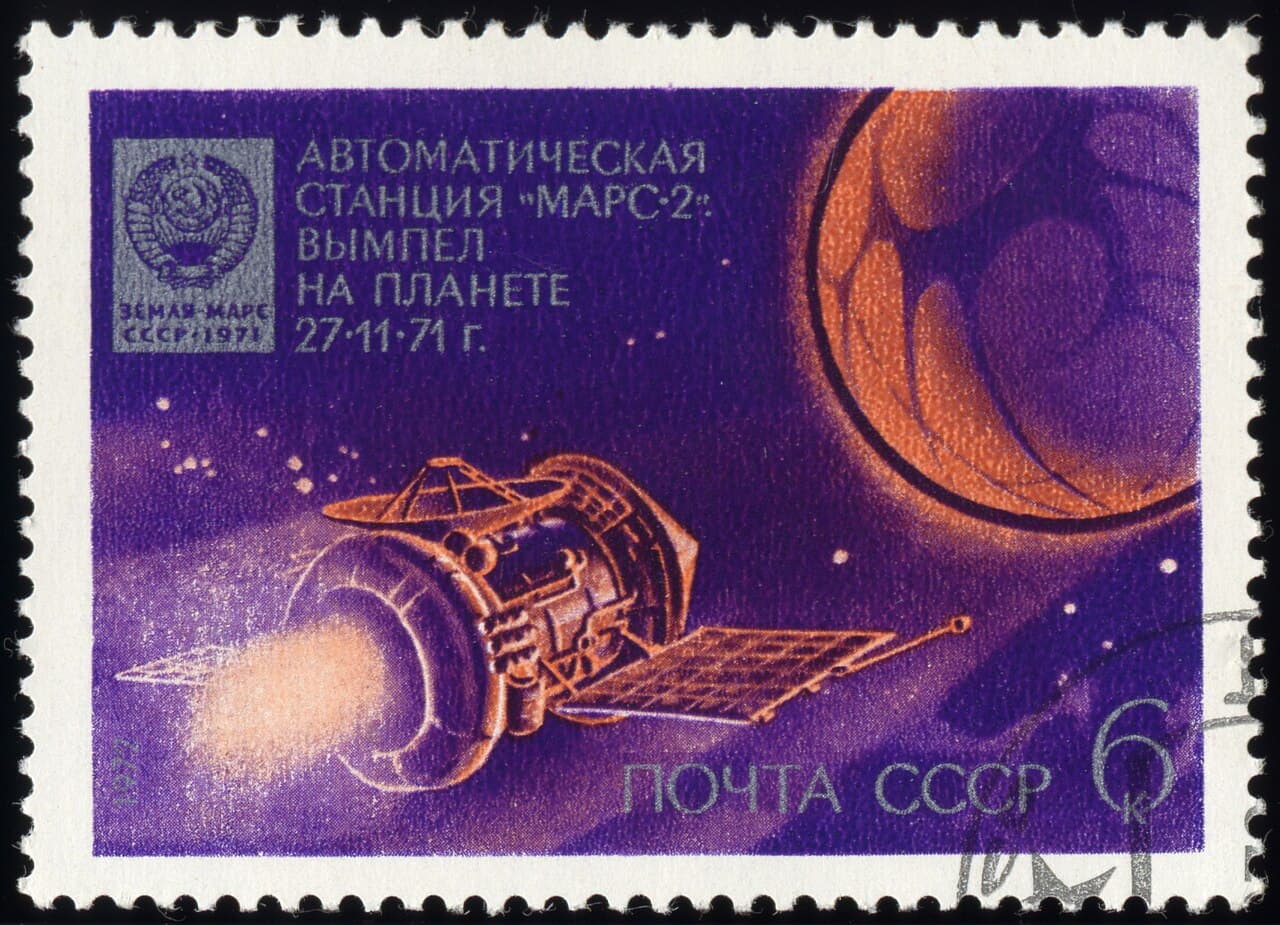
The habit is older than the landings. Soviet interplanetary probes of the early 1960s carried commemorative pennants intended for delivery by impact, and the surviving paperwork is unusually blunt about it: a letter from the chairman of the Military Industrial Commission to the Central Committee, two days before Zond 2 left the pad in November 1964, lists testing the spacecraft, doing interplanetary science, and hitting Mars with pennants. None of those attempts arrived. The first one that did arrived badly. On 27 November 1971 the Mars 2 descent module entered the atmosphere far too steeply, its parachute sequence never ran, and it struck the ground. NASA's catalogue records that among its cameras and its mass spectrometer and its soil instruments, the capsule also contained a pennant with the Soviet coat of arms. So the first object humans deliberately placed on the surface of another planet is simultaneously the first piece of human wreckage there, and it has never been found. Five days later Mars 3 came down intact with the same emblem aboard, which makes that one the first message on Mars delivered by a landing that worked, for the fourteen to twenty seconds the station stayed alive. Russian sources describe the pennants only as bearing the State Emblem of the USSR. Their size, their shape and the metal they were made from do not appear in anything we could find, which is a strange gap for the most symbolic object in the entire Soviet Mars programme.
American practice went in a different direction, towards memorials for the dead and towards things that were also tools. Viking 1 landed in 1976 wearing a United States flag and a Bicentennial logo, and, by the account of Jon Lomberg, a dot of microfilm carrying the names of several thousand people who had built it. Five years later NASA renamed that landing site the Thomas A. Mutch Memorial Station and had a stainless steel plaque made, inscribed to a geologist who had vanished on a Himalayan mountain. There was no way to deliver it. On 18 May 1984 the Administrator handed the plaque to the National Air and Space Museum, told the museum to hold it until astronauts could attach it to the lander, and in the same letter transferred ownership of Viking 1, sitting on Mars, to the museum. Forty-two years later the plaque is still in Washington. That gap between the memorial and the place it belongs is a recurring feature. Pathfinder became the Carl Sagan Memorial Station in July 1997 with nothing carried for it, and Spirit's and Opportunity's landing sites became Columbia Memorial Station and Challenger Memorial Station in January 2004 the same way. The Columbia memorial that is a physical object, a six-inch aluminium plaque designed by two JPL engineers and bolted to the back of Spirit's antenna dish in March 2003, travelled with the rover rather than staying at the station named after the crew.
The most reliable way to put a message on Mars turned out to be to make it part of something the cameras have to photograph. Calibration targets get imaged constantly, so anything on a calibration target will be seen. The MarsDial came out of a 1998 conversation between the camera scientist Jim Bell and Bill Nye about the shadow-casting post on the Mars Exploration Rover target, and by the time it flew it was an 8 cm square weighing 65 g with a 2 cm ball for a nodus, the motto "Two Worlds, One Sun" across it, the year 2004, the name of Mars in a ring of languages, and a short message with children's drawings around its four sides. How many languages depends on who you ask: Woody Sullivan and Jim Bell wrote 17, while English Wikipedia says 22. Curiosity flew a spare from that batch of seven, re-engraved "To Mars To Explore", with four side panels that end on a sentence that has since become a family motto: to those taking the next steps, we wish a safe journey and the joy of discovery. Perseverance's Mastcam-Z target reads "Two Worlds, One Beginning", carries line drawings of cyanobacteria, a fern, a dinosaur and two humans, and hides a longer inscription on its outer edge that opens with the question the rover was sent to work on: are we alone.
The rest is stranger and better. Curiosity's arm camera stares at a 1909 Lincoln penny for scale, which is a real geological convention and also a hundredth-birthday present to a coin. The same rover's name chips carry a micro-reproduction of Leonardo da Vinci's Codex on the Flight of Birds, written about 1505, and his self-portrait. Its wheels are punched with a pattern that spells JPL in Morse code, adopted because the laboratory was not allowed to write its initials on the wheels in letters, so the rover has been printing them into Gale crater ever since. Zhurong's designers did the same trick with intent: two of its six wheels carry the character zhong, meaning centre, and Xinhua reported in January 2023 that the rover had stamped nearly 4,000 of them into southern Utopia Planitia across more than 1,900 metres. Perseverance's parachute was woven so that its red and white gores encode DARE MIGHTY THINGS in binary with JPL's coordinates around the rim, and the public solved it from the descent video within days. On the SHERLOC calibration target there is a slice of a Martian meteorite that came back to Mars, swatches of spacesuit fabric being weathered on purpose, and a coin cut from helmet visor material stamped with Sherlock Holmes's address, placed there as a geocache with a real log. Bolted under Ingenuity's solar panel is a 1.3 cm square of muslin from the wing of the Wright Flyer.
Almost all of it is still there, and most of it will outlast everything around it. The machines are dead or dying: Spirit stopped talking in March 2010, Opportunity in June 2018, Zhurong in May 2022, Ingenuity flew its last flight in January 2024. The objects they carry do not need power. JPL's own estimate for the World Trade Center shields, in the cold and dry of Mars, is that they could stay in good condition for millions of years, and the same is broadly true of a metal pennant, an anodised plaque, a woven parachute or a stamped character in dust. What varies enormously is legibility. A pennant with a coat of arms on it and a plaque with signatures on it can be read by eye. A sundial can be read by anyone who understands shadows, which is close to a universal literacy. A Morse code wheel print or a binary parachute needs a key. The Leonardo codex on Curiosity's chip needs a microscope, and the names beside it need one too. It is worth noticing what the mottos have in common across twenty years and three rovers, because it is not national and it is not triumphal: two worlds and one sun, two worlds and one beginning, a safe journey and the joy of discovery. And the one object explicitly addressed to a future human reader, the Mutch plaque, is the one that never left Earth.
Mission facts
The first object with nothing to do
NASA's catalogue entry for the Mars 2 descent module lists its cameras, mass spectrometer, weather and soil instruments, and then adds that it also contained a pennant with the Soviet coat of arms. That capsule hit Mars on 27 November 1971 after its parachute sequence never ran, which makes the pennant the first thing humans deliberately placed on the planet and also a piece of debris.↗
The second pennant
Russian Wikipedia's Mars 3 article states plainly that a pennant bearing the State Emblem of the USSR was fixed to the descent module, in the same sentence group that records the capsule's pre-flight sterilisation. Mars 3 landed intact on 2 December 1971, so this pennant is the first message delivered to Mars by a working landing. No source we consulted gives its size, shape or material.↗
Pennants that never arrived
The practice predates the landing. A letter from Leonid Smirnov, chairman of the Military Industrial Commission, to the Central Committee on 28 November 1964, two days before the launch of Zond 2, states that the flight was to test 3MV hardware, do interplanetary science and, if everything worked, impact Mars and deliver commemorative pennants. Nothing in the 1962 or 1964 series reached the planet.↗
Not on the 1973 landers
Russian Wikipedia's article on Mars 6, which reached the atmosphere and lost contact during descent on 12 March 1974, describes the descent module's instruments in detail and mentions no pennant or commemorative object at all. We found no source recording pennants on the Mars 4 to Mars 7 series.↗
Viking, 1976
The Smithsonian's National Air and Space Museum, writing for the fiftieth anniversary in July 2026, records that the Viking 1 lander that touched down on 20 July 1976 carried the United States flag and the nation's Bicentennial logo. Viking was the United States' Bicentennial mission to Mars, launched in the year the country turned two hundred. The museum's account does not say where on the lander the two markings were fixed.↗
The Viking microdot
Jon Lomberg, writing for The Planetary Society, states that each Viking lander carried a tiny dot of microfilm recording the names of several thousand people who had worked on the mission. English Wikipedia repeats his sentence. We have not found a NASA document that describes this microdot, so treat it as an assertion by a well-placed participant rather than a confirmed inventory item.↗
The plaque still on Earth
In January 1981 NASA renamed the Viking 1 landing site the Thomas A. Mutch Memorial Station, for the planetary geologist who had led the lander imaging team and who disappeared climbing in the Himalaya. A stainless steel plaque was made, inscribed "Dedicated to the memory of Tim Mutch, whose imagination, verve, and resolve contributed greatly to the exploration of the Solar System." On 18 May 1984 NASA Administrator James M. Beggs handed it to the National Air and Space Museum, which was to retain, secure and protect it until astronauts could affix it to the lander on Mars. The museum still has it.↗
A memorial that is only a name
On 5 July 1997, at Planetfest in Pasadena, NASA Administrator Daniel S. Goldin named the Mars Pathfinder lander the Carl Sagan Memorial Station, six months after Sagan's death. The release describes a renaming and no object: nothing was carried to Mars for it. Several Martian memorials work this way, including Columbia Memorial Station and Challenger Memorial Station.↗
Columbia and Challenger
An aluminium plaque about six inches across, designed by JPL rover engineers Chris Voorhees and Peter Illsley, was fitted to the back of Spirit's high-gain antenna on 28 March 2003 at the Kennedy Space Center, honouring the STS-107 crew lost on 1 February 2003. NASA Administrator Sean O'Keefe named Spirit's landing site Columbia Memorial Station on 6 January 2004, and named Opportunity's landing site Challenger Memorial Station on 28 January 2004. The plaque rode with the rover, so it lies wherever Spirit stopped. The station that bears the name is a different place.↗
Signatures
Curiosity carries an anodised aluminium plaque 100 mm tall by 82 mm wide, bolted to the front left of the rover deck, bearing the signatures of United States officials including President Obama and Vice President Biden. The rover photographed it with MAHLI on sol 44, 19 September 2012. NASA's caption notes that similar signature plaques, including those of the sitting president and vice-president of the day, are on the lander platforms of Spirit and Opportunity, and points to PIA05034 as an image of Spirit's.↗
The sundials
The MarsDial began as a conversation between Jim Bell and Bill Nye in 1998 about the shadow-casting post on a camera calibration target. The Spirit and Opportunity version is 8 cm square, weighs 65 g, has a 2 cm sphere as its nodus, carries the motto "Two Worlds, One Sun" and the year 2004, and has the name of Mars written around it. Sullivan and Bell say 17 languages; English Wikipedia says 22. We found no NASA caption we could cite for either figure. Four sides carry a short message and drawings inspired by schoolchildren's suggestions.↗
What the later sundials say
Curiosity's dial, assembled at the University of Washington and about three inches square, reads "To Mars To Explore". The University of Washington account traces the year plates rather than giving Curiosity's: the seven dials made in 1999 read "Mars 2002" for a lander that was then cancelled, and were slip-covered to 2004 for the Mars Exploration Rovers. Its four sides carry a compressed history of how humans have seen Mars, ending: "Through it all, we have wondered: Has there been life on Mars? To those taking the next steps to find out, we wish a safe journey and the joy of discovery." Perseverance's Mastcam-Z target reads "Two Worlds, One Beginning", and around its outer edge: "Are we alone? We came here to look for signs of life, and to collect samples of Mars for study on Earth. To those who follow, we wish a safe journey and the joy of discovery." The phrase Joy of Discovery is repeated around it in several languages.↗
Things smuggled onto calibration targets
Curiosity's MAHLI calibration target carries a 1909 VDB Lincoln penny, both as a scale reference of the kind geologists use and as a nod to the coin's centenary. Perseverance's SHERLOC target carries a slice of the Martian meteorite Sayh al Uhaymir 008, five swatches of spacesuit material being watched for degradation, and a coin cut from helmet visor material inscribed with the address of Sherlock Holmes, placed there as a geocache. NASA's captions render the meteorite name as both SaU 008 and SaH 008.↗
Writing on the ground
Curiosity's wheel treads carry a hole pattern that spells JPL in Morse code, adopted after NASA declined to let the laboratory's initials be written on the wheels as text; the pattern is used to measure slip. Zhurong's two rear wheels carry the character zhong, so the rover stamped it into southern Utopia Planitia as it drove. Xinhua reported on 16 January 2023 that it had left nearly 4,000 of them over more than 1,900 metres. Deputy chief designer Jia Yang has described the spacing of the characters as a slip diagnostic as well as a commemoration.↗
The parachute
Perseverance's supersonic parachute was woven in a pattern that encodes, in binary, the words DARE MIGHTY THINGS across its inner rings and the coordinates of the Jet Propulsion Laboratory around its outer band. It was designed by Mars 2020 systems engineer Ian Clark, and members of the public decoded it from descent imagery within days of the landing on 18 February 2021. The parachute and backshell were cut away during descent and are still lying on the surface of Jezero crater, separately from the rover.↗
A piece of the first aeroplane
A 1.3 cm square of unbleached Pride of the West muslin, cut from the covering of the Wright brothers' Flyer of 1903 and supplied by Carillon Historical Park in Dayton, Ohio, was sealed in polyamide film and attached to a cable under the solar panel of the Ingenuity helicopter. It is now at Valinor Hills, where Ingenuity made its final landing.↗
Mission timeline
- 28 Nov 1964Two days before Zond 2 launches, a letter from the chairman of the Military Industrial Commission sets out the mission's real objectives, which include impacting Mars and delivering commemorative pennants. The spacecraft dies on the way.
- 27 Nov 1971The Mars 2 descent module strikes Mars with its parachute sequence unrun. The pennant bearing the Soviet coat of arms bolted to it becomes the first object humans deliberately placed on the surface of another planet, and has never been located.
- 2 Dec 1971Mars 3 lands intact carrying the same emblem, delivering the first Martian message by a working landing. It transmits for seconds and stops.
- 20 Jul 1976Viking 1 lands in Chryse Planitia carrying a United States flag and the Bicentennial logo of a country celebrating its two hundredth year, along with, by Jon Lomberg's account, a microfilm dot of the names of people who built it.
- Jan 1981NASA renames the Viking 1 landing site the Thomas A. Mutch Memorial Station and has a stainless steel plaque made for it. The plaque cannot be delivered, because nothing is going there.
- 18 May 1984NASA Administrator James M. Beggs gives the Mutch plaque to the National Air and Space Museum, with instructions to hold it until astronauts can fix it to the lander, and transfers ownership of Viking 1 on Mars to the museum in the same letter.
- 5 Jul 1997NASA Administrator Daniel S. Goldin names the Pathfinder lander the Carl Sagan Memorial Station. Nothing physical is involved: the memorial is the name.
- 25 Dec 2003Beagle 2 lands in Isidis Planitia carrying a Damien Hirst spot painting as its instrument calibration chart and a call sign composed by members of Blur. Neither is ever seen or heard from the surface.
- 4 to 25 Jan 2004Spirit and Opportunity land carrying MarsDials inscribed "Two Worlds, One Sun", signature chips, signature plaques on their lander platforms, Columbia memorial plaques on their high-gain antennas and rock abrasion tool shields machined from World Trade Center aluminium. NASA names the two landing sites Columbia Memorial Station on 6 January and Challenger Memorial Station on 28 January.
- 6 Aug 2012Curiosity lands in Gale crater with a 1909 penny on its arm camera target, a sundial reading "To Mars To Explore", a signed plaque on its deck, Morse code in its wheels and a micro-reproduction of Leonardo da Vinci's Codex on the Flight of Birds fastened to a names chip.
- 18 Feb 2021Perseverance lands in Jezero crater. Within days the public has decoded DARE MIGHTY THINGS from the parachute in the descent imagery, and NASA publishes an annotated key.
- 14 May 2021 to 16 Jan 2023Zhurong lands in southern Utopia Planitia and drives 1,921 m before hibernating. Xinhua reports in January 2023 that its rear wheels have stamped nearly 4,000 copies of the character zhong into the ground on the way.
A filled dot marks something that physically happened. A hollow one marks an announcement, a naming or a target.
In pictures
Tap a photo to enlarge.
Sources
- NSSDCA Master Catalog: Mars 2 Lander (1971-045D), archived 15 Aug 2025
- Russian Wikipedia: Mars-3 (Марс-3)
- National Air and Space Museum (20 Jul 2026): Viking and the National Air and Space Museum
- NASA Photojournal PIA08709: Mutch Crater
- JPL (5 Jul 1997): NASA Renames Mars Lander in Honor of Late Carl Sagan
- JPL (6 Jan 2004): Space Shuttle Columbia Crew Memorialized on Mars
- NASA Photojournal PIA15883: President's Signature Onboard Curiosity
- Woodruff Sullivan and Jim Bell, The MarsDial: A Sundial for the Red Planet, The Planetary Report, January/February 2004
- University of Washington News (29 Aug 2012): From UW to Mars, sundial has an important role
- JPL (8 Dec 2020): 5 Hidden Gems Are Riding Aboard NASA's Perseverance Rover
- Xinhua (16 Jan 2023): 祝融号已在火星留下近4000个「中」字
- Science Museum blog (Roger Highfield, 20 Dec 2018): Britain's great Martian adventure
Facts on this page were verified on 24 August 2026. Where sources disagree, the disagreement is stated rather than resolved silently.
77.4509 E, 18.4446 N · Octavia E. Butler Landing