Perseverance (Mars 2020)
NASA · United States · Rover · 2021 · Multipolar MarsOperating
Operating as of 9 October 2026: NASA's raw-image feed carries pictures taken through sol 2001, the latest at 12:47 UTC on 6 October 2026, and its traverse file, last modified 15 September 2026, still ends with an end-of-drive localisation on sol 1980 at 45,126.078 m, about 34 m short of the 28.06 miles (45.16 kilometres) NASA credits to Opportunity as the off-Earth driving record. As of 9 October 2026 no agency had announced that record passed.
TL;DR· 15 min read
Perseverance landed in Jezero crater on 18 February 2021 to collect rock cores that a later spacecraft could fetch, using Range Trigger and Terrain-Relative Navigation to shrink the landing ellipse to a tenth of Curiosity's. By 21 September 2026 it had driven 45.13 km, filled 30 of its 38 sample tubes, made 122 grams of oxygen with MOXIE and cored a rock NASA calls a potential biosignature. The mission that would bring those tubes home has no confirmed architecture, so the samples wait on Mars.
Perseverance was sent to Jezero crater to do something no Mars mission had attempted: not just look for signs of ancient life, but pick up rock, seal it in a tube and leave it where a later spacecraft could fetch it. Landing near a river delta that was worth sampling meant landing more precisely than anyone had managed, so the Mars 2020 project flew two new pieces of software, Range Trigger and Terrain-Relative Navigation, which between them shrank the target area to a tenth of Curiosity's. It worked on 18 February 2021. In the five and a half years since, the rover has filled at least 30 of its 38 sample tubes, made oxygen out of Martian air, recorded the first measurements of what Mars sounds like, driven further than Curiosity has in fourteen years, and cored a rock that produced what NASA calls a potential biosignature. The one thing it cannot do is bring any of it home.
- 45.13 kmdriven by sol 1980, read straight from NASA's Mars 2020 traverse file on 9 October 2026 (last modified 15 September), further than Curiosity has managed in fourteen years
- 30 of 38sample tubes filled in NASA's published sample table as it stood on 3 September 2026, ten of them left on the ground at the Three Forks depot in January 2023
- 122 gof oxygen MOXIE made from Martian carbon dioxide across 16 runs before NASA retired it in 2023
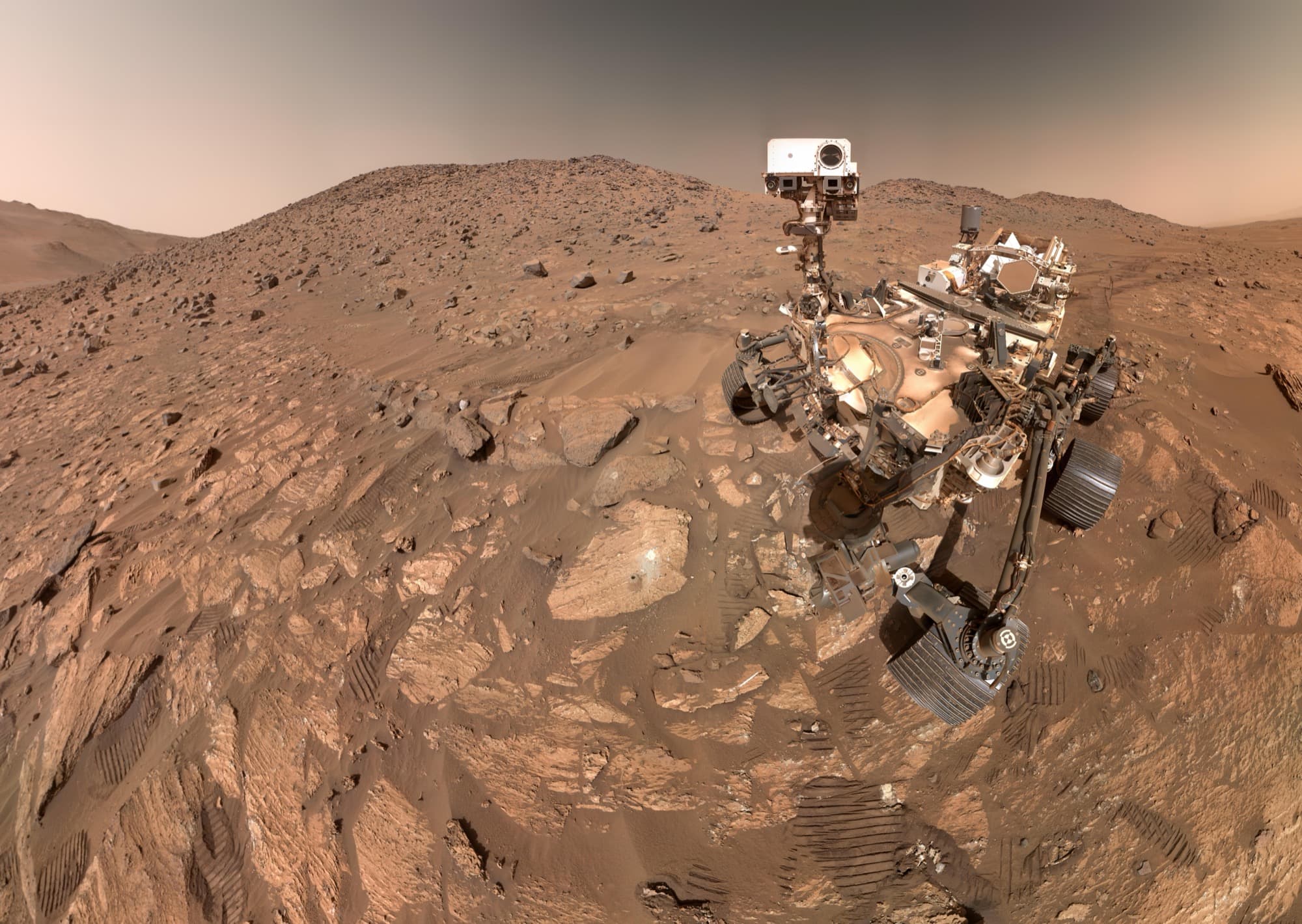
Perseverance is a 1,025 kg rover built to pick up rocks and leave them somewhere a later spacecraft could collect them. To reach a target worth sampling it had to land more precisely than anything before it. Jezero crater holds a fan of sediment where a river once emptied into a lake, and that fan sits among boulder fields and cliffs that would have destroyed a rover on touchdown. Two new pieces of software made the site reachable. Range Trigger fired the 21.5 m parachute based on the spacecraft's distance to its target rather than its speed, shrinking the landing ellipse to a tenth the area of Curiosity's and almost 300 times smaller than Sojourner's. Terrain-Relative Navigation, running on a downward-looking camera and a dedicated Vision Compute Element, photographed the ground rushing up between roughly 4.2 and 2.2 km altitude, matched it against a map carried onboard, fixed the spacecraft's position to about 40 m in under ten seconds, and let the descent stage move the touchdown point by up to 600 m. All of it ran alone: on 18 February 2021 Earth was 11 minutes and 22 seconds away by radio, so the seven minutes from atmospheric entry to touchdown had already happened by the time anyone heard it start. NASA named the spot Octavia E. Butler Landing, announcing it on 5 March 2021, the day after the rover's first drive of 6.5 m.
The rover carried 43 titanium tubes: 38 for samples and five sealed witness tubes that record what the sampling hardware itself was carrying from Earth. The first core, attempted on 6 August 2021, came back empty, because the rock had crumbled to powder. The tube was sealed anyway, and it stands in NASA's public table as sample 1, Roubion, an atmospheric sample, which is an accurate description of what is actually inside it. The first rock core, Montdenier, followed a month later. Over less than six weeks ending on 28 January 2023 the rover laid ten tubes on the ground about 5 to 15 m apart at a flat spot called Three Forks, a backup depot in case Perseverance could not hand its collection over itself. On 3 September 2026 NASA's published sample table showed 30 of 38 tubes filled and three of five witness tubes sealed, the newest entry a core called Gallants, from a target the rover photographed on sol 1551, 1 July 2025. Nothing later had been added to that table, so 30 is a floor rather than a count, and this page says so rather than guessing. What has not happened is the return. NASA's Mars Sample Return page, last updated 17 September 2026, now describes the campaign in the past tense, as a proposed multi-mission campaign by NASA and ESA, while still carrying a Future Mission label; the most recent milestone it cites is a January 2025 announcement that the agency was weighing two landing options. The tubes are sealed and waiting, most of them still aboard the rover.
Two of the seven instruments were not really about Mars's past. MOXIE, roughly the size of a car battery, drew in Martian carbon dioxide, heated it to about 800 degrees Celsius and split it into oxygen and carbon monoxide. Its first run, on sol 60, made about 5.4 grams. By the time NASA retired it after a final run on 7 August 2023 it had run sixteen times and produced 122 grams at up to 12 grams an hour and 98 percent purity or better. That is a trivial quantity beside the tens of tonnes of liquid oxygen a crew would need to launch off Mars, and it was never meant to be more than proof that the chemistry works in place. The two microphones cost far less and arguably returned more. One is an off-the-shelf part bolted to the rover's flank to record the landing; the other rides on SuperCam and listens to the instrument's own laser sparks, sampling from 20 Hz to 12.5 kHz. From those recordings an international team led by Sylvestre Maurice published the first characterisation of the Martian acoustic environment in Nature on 1 April 2022, drawn from 4 hours 40 minutes of sound gathered over the mission's first 216 sols. The result is genuinely odd. Mars has two speeds of sound: about 237.7 metres per second below 240 Hz, measured from Ingenuity's 84.43 Hz blade tone, and 246 to 257 metres per second above it. A voice on Mars would arrive out of order.
NASA publishes the traverse as a data file, and it is the most honest record of the mission there is. Read on 24 September 2026, it holds 703 waypoints from sol 13 to sol 1980, a final cumulative odometry of 45,126.078 m, and exactly one panorama attached to every waypoint, which is a quiet statement about how this rover works: it does not move without looking around first. Perseverance has now driven further than Curiosity, whose equivalent file stands at 38,383.67 m after 5,021 sols. Lining the two files up date by date, Perseverance's odometer passed Curiosity's around 20 June 2025 at roughly 35.6 km, having arrived on Mars eight and a half years later. The elevation column tells the other half of the story. The rover landed at -2,569.91 m on the areoid, dropped to -2,585.87 m on sol 153, then climbed to -1,786.00 m on sol 1354, around 10 December 2024. That gain of 799.87 m matches the 800 m rim-to-crest ascent NASA quotes for the climb out of Jezero, which is a satisfying case of the raw file and the press release agreeing to within a metre. On sol 1890, 14 June 2026, the odometer passed a marathon; the Mars Reconnaissance Orbiter photographed the rover the day before. Read again on 9 October 2026, the file still ended at that sol 1980 drive, about 34 m short of the 45.16 km NASA credits to Opportunity as the off-Earth driving record.
On 21 July 2024, sol 1215, Perseverance cored a rock called Cheyava Falls in the Bright Angel formation and sealed the sample as Sapphire Canyon. The rock is marked with pale, dark-rimmed spots that the team nicknamed leopard spots. PIXL found vivianite, a hydrated iron phosphate, and greigite, an iron sulfide, arranged in a way consistent with electron-transfer reactions between sediment and organic matter, which on Earth is a thing microbes do. Fourteen months later, on 10 September 2025, a paper led by Joel Hurowitz of Stony Brook University appeared in Nature, and NASA called the result a potential biosignature: in the agency's own definition, a substance or structure that might have a biological origin but requires more data before a conclusion can be reached. Non-biological chemistry can produce the same minerals. Settling it very probably requires the tube in a laboratory on Earth, which is the return that has no confirmed architecture. Meanwhile the rover works. It is west of Jezero now, outside the crater it landed in, and its status was checked twice on 24 September 2026: NASA's raw-image feed carried pictures taken on sol 1988, and the traverse file logged a drive on sol 1980. Since February 2026 it has been locating itself on Mars without asking Earth, running a terrain-matching algorithm on the processor it once used to talk to a helicopter that no longer flies.
Mission facts
Launch and landing
Launched 30 July 2020 at 11:50 UTC (7:50 a.m. EDT) on a United Launch Alliance Atlas V 541 from Space Launch Complex 41, Cape Canaveral Air Force Station, Florida, for a 471 million km crossing. Touchdown was 18 February 2021 at 20:55 UTC (3:55 p.m. EST), 3:53 p.m. local mean solar time at the landing site. One-way light time that day was 11 minutes 22 seconds, so the entire descent was autonomous.↗
The off-Earth distance record
Opportunity's final odometry is given by NASA as 28.06 miles (45.16 km) when that mission was declared complete on 13 February 2019, and NASA's resource page Driving Distances on Mars and the Moon (last updated 3 November 2024) says Opportunity holds the off-Earth roving distance record. Read on 9 October 2026, Perseverance's traverse file, last modified 15 September 2026, still ended with its sol 1980 drive at 45,126.078 m, about 34 m short of 45.16 km; because NASA rounds that figure to the nearest 10 m, the real gap is between about 29 and 39 m. No agency had announced the record passed as of 9 October 2026. Every Perseverance raw image released for sols 1981 to 2001 carries the same rover motion counter in its file name as the sol 1980 drive (site 91, drive 970), which by azmth's reading of NASA's naming convention means the rover had not driven since; NASA does not state this. Any statement about the record needs a date attached.↗
Masses and size
About 1,025 kg on Earth and 393 kg on Mars, including a 45 kg turret on a 2.1 m robotic arm. The body is roughly 3 m long, 2.7 m wide and 2.2 m tall, not counting the arm.↗
Power
One Multi-Mission Radioisotope Thermoelectric Generator supplied by the US Department of Energy, producing about 110 watts from the decay of plutonium-238, with two rechargeable lithium-ion batteries for peak demand.↗
Science payload
59 kg (130 pounds) in seven instruments: Mastcam-Z, the Mars Environmental Dynamics Analyzer (MEDA), the Mars Oxygen In-Situ Resource Utilization Experiment (MOXIE), the Planetary Instrument for X-ray Lithochemistry (PIXL), the Radar Imager for Mars' Subsurface Experiment (RIMFAX), SHERLOC and SuperCam.↗
Cameras and microphones
The press kit counts 25 cameras flown to Mars on the mission, 23 on the spacecraft and 2 on Ingenuity, and calls that the most ever flown on a deep-space mission. Nineteen are on the rover itself. There are two microphones: a commercial off-the-shelf part on a port-side panel for entry, descent and landing, and one built into SuperCam.↗
Cost
NASA states approximately $2.4 billion to build and launch the Mars 2020 Perseverance mission, plus approximately $300 million to land the rover and operate it through the prime mission.↗
Prime mission versus actual
The prime mission was one Mars year, about 687 Earth days, which ran out in early January 2023, per the Mars 2020 landing press kit. NASA's Mars 2020 raw-image feed, queried on 9 October 2026, shows the rover had reached sol 2001 on 6 October 2026, almost three Mars years and more than five and a half Earth years after landing.↗
Traverse, as measured today
NASA's M20_waypoints.json, read again on 9 October 2026 (last modified 15 September 2026), holds 703 waypoints and ends at sol 1980 with a cumulative odometry of 45,126.078 m (45.13 km). Downloaded on 3 September 2026 it held 700 waypoints running from sol 13 to sol 1965, with a final cumulative odometry of 45,105.717 m (45.11 km). Every one of the 700 waypoints carries exactly one attached panorama. The same file read on 23 August 2026 ended at 697 waypoints, sol 1955 and 44,976.465 m, and a week before that at 694 waypoints, sol 1947 and 44,967.045 m; those rows are all still in the file, and every reading is correct for its date.↗
Out-driving Curiosity
The equivalent Curiosity file, read on 24 September 2026, ends at 38,383.67 m after 1,384 waypoints and 5,021 sols. Lining the two files up date by date, using the standard sol-to-UTC conversion from each landing, Perseverance's odometer passed Curiosity's around 20 June 2025 at roughly 35.6 km, having landed eight and a half years later. That comparison is azmth's own computation from the two published files. NASA does not state it.↗
Elevation, and the climb out of Jezero
The traverse file puts the landing site at -2,569.91 m on the areoid, the lowest point of the whole traverse at -2,585.87 m on sol 153, and the highest at -1,786.00 m on sol 1354, which falls around 10 December 2024. That climb of 799.87 m matches the 800 m rim-to-crest ascent NASA quotes for the summit of the crater rim in December 2024. The last waypoint in the file on 3 September 2026, sol 1965, sits at -1,927.69 m.↗
Sample tubes
The rover carried 43 tubes: 38 for samples and 5 witness tubes preloaded to record what the sampling hardware itself brought from Earth. On 3 September 2026 NASA's public sample table showed 30 of 38 filled and 3 of 5 witness tubes sealed, the newest entry being a core called Gallants from Salmon Point, listed with its sealing sol as TBD; the table's photograph of the Gallants target was taken on sol 1551 (1 July 2025). No later sample had been published, so 30 is a floor: the real total may be higher.↗
The Three Forks depot
Ten tubes were laid on the ground about 5 to 15 m apart at a flat spot called Three Forks: igneous cores, sedimentary cores, one atmospheric sample and one witness tube. JPL reports confirmation that the tenth and last tube was down arriving about 5 p.m. PST on Sunday 29 January 2023 (01:00 UTC on 30 January), less than six weeks after construction began. The depot is a backup, in case Perseverance itself cannot hand its collection over.↗
MOXIE
Sixteen runs, 122 grams of oxygen in total, at up to 12 grams an hour and 98 percent purity or better. The first run, on sol 60 (20 April 2021), made about 5.4 grams after a two-hour warm-up, working at roughly 800 degrees Celsius. The final run was on 7 August 2023 and NASA announced the retirement on 6 September 2023.↗
The microphones, and two speeds of sound
SuperCam's microphone records pressure fluctuations from 20 Hz to 12.5 kHz at a 25 kHz sampling rate, and up to 50 kHz in a 100 kHz mode. The Nature study covering sols 1 to 216 reports 4 hours 40 minutes of Martian sound recorded, 46 percent of it atmospheric turbulence. Maurice et al. found that the speed of sound at the surface differs by about 10 m/s either side of 240 Hz, a consequence of carbon dioxide vibrational relaxation at low pressure: 237.7 plus or minus 3 m/s below the threshold, derived from Ingenuity's 84.43 Hz blade-passage tone, and 246 to 257 m/s above it from laser-induced sparks. Popular accounts round these to 240 and 250 m/s.↗
The potential biosignature
Perseverance cored the rock Cheyava Falls in the Bright Angel formation on sol 1215 (21 July 2024) and sealed the core as Sapphire Canyon, sample 25. PIXL found vivianite (a hydrated iron phosphate) and greigite (an iron sulfide) in leopard-spot patterns. A paper led by Joel Hurowitz of Stony Brook University appeared in Nature on 10 September 2025; NASA calls the result a potential biosignature, defined by the agency as a substance or structure that might have a biological origin but requires more data before any conclusion about life can be reached.↗
Mission timeline
- 30 Jul 2020Launch at 11:50 UTC on an Atlas V 541 from Complex 41, Cape Canaveral, with the Ingenuity helicopter folded flat against the rover's belly.
- 18 Feb 2021Landing at 20:55 UTC in Jezero crater. Range Trigger opened the 21.5 m parachute at about 11 km on distance-to-target rather than speed; the Lander Vision System matched camera images to an onboard map between roughly 4.2 and 2.2 km altitude, fixing position to about 40 m in under ten seconds, and the descent stage was free to move the touchdown point by up to 600 m.
- 4 to 5 Mar 2021First drive, 6.5 m in 33 minutes on sol 13. NASA names the touchdown spot Octavia E. Butler Landing, for the Pasadena science-fiction writer who was the first of her field to win a MacArthur Fellowship.
- 19 to 20 Apr 2021Two firsts on consecutive days. Ingenuity flies on sol 58, and on sol 60 MOXIE pulls about 5.4 grams of oxygen out of the Martian atmosphere.
- 6 Aug to 6 Sep 2021The first coring attempt returns an empty tube: the rock crumbled to powder. The tube is sealed anyway and appears in NASA's sample table as sample 1, Roubion, classified atmospheric. The first rock core, Montdenier, is sealed on sol 194.
- 1 Apr 2022Nature publishes the first characterisation of the Martian acoustic environment, built from SuperCam and EDL microphone recordings, reporting two speeds of sound about 10 m/s apart across a 240 Hz threshold.
- Dec 2022 to 29 Jan 2023Perseverance builds the first sample depot on another world at Three Forks, setting ten tubes on the ground about 5 to 15 m apart so a future lander could collect them without the rover. JPL confirms the tenth tube is down at about 5 p.m. PST on Sunday 29 January, less than six weeks after construction began.
- 7 Aug to 6 Sep 2023MOXIE's sixteenth and last run. NASA announces the instrument's retirement with a career total of 122 grams of oxygen and a best rate of 12 grams an hour, which is the figure NASA calls twice its original goal for the instrument.
- 21 Jul 2024Sol 1215: the rover cores Cheyava Falls in the Bright Angel formation and seals the sample as Sapphire Canyon.
- Aug to Dec 2024The crater rim campaign. Perseverance climbs out of Jezero, a rim-to-crest ascent of about 800 m, summiting in December 2024. The traverse file's highest waypoint, -1,786.00 m, falls on sol 1354, around 10 December.
- 10 Sep 2025Nature publishes Hurowitz et al. on the vivianite and greigite in Cheyava Falls. NASA describes the finding as a potential biosignature and points at its Confidence of Life Detection scale rather than claiming a detection.
- 2 Feb to 23 Sep 2026On sol 1762 the rover fixes its own position on Mars for the first time without human help, matching a navcam panorama to onboard orbital imagery at a featureless spot called Mala Mala, using the processor it once used to talk to Ingenuity. On sol 1890 (14 June 2026) the odometer passes a marathon, 42.195 km, five years and four months after landing; Opportunity took eleven years and two months to cover the same ground. The last drive in the published file is sol 1980 (15 September 2026), and raw images arrive from sol 1988 on 23 September 2026.
A filled dot marks something that physically happened. A hollow one marks an announcement, a naming or a target.
Where Perseverance drove
- 45.22 kmdriven, the figure the mission reports
- 1,996sols from the first drive to the last
- 706stops in the published path
Path: NASA/JPL-Caltech. NASA MMGIS Mars 2020 traverse and waypoint layers
Still driving, as of 14 October 2026. Every waypoint is on the globe, drawn where it was driven, with the sol it happened on.
Replay the driveon the globe →In pictures
Tap a photo to enlarge.
Sources
- NASA MMGIS: M20_waypoints.json
- NASA MMGIS: MSL_waypoints.json
- NASA Science: Mars Exploration Rover Opportunity
- NASA Mars 2020 raw-image feed, queried 23 August, 24 September and 9 October 2026
- JPL: Mars 2020 Perseverance Landing press kit, January 2021 (PDF)
- NASA Science: Mars Rock Samples
- JPL: NASA's Oxygen-Generating Experiment MOXIE Completes Mars Mission, 6 September 2023
- Maurice et al. (2022): In situ recording of Mars soundscape, Nature 605, 653 to 658
- JPL: NASA Says Mars Rover Discovered Potential Biosignature Last Year, 10 September 2025
- JPL: NASA's Perseverance Rover Completes Mars Sample Depot, 29 January 2023
- NASA Science: NASA's HiRISE Captures Perseverance Marking a Milestone on Mars, 24 June 2026
- NASA Science: Mars Global Localization Pinpoints Perseverance's Location, February 2026
- Hurowitz et al., Redox-driven mineral and organic associations in Jezero Crater, Mars, Nature 645:332-340 (10 Sep 2025), doi 10.1038/s41586-025-09413-0
- NASA Science: Mars Sample Return (page last updated 17 September 2026)
- NASA Science blog: Assessing Perseverance's First Sample Attempt, 11 August 2021
- JPL: NASA's Ingenuity Mars Helicopter Succeeds in Historic First Flight, 19 April 2021
Facts on this page were verified on 24 September 2026. Where sources disagree, the disagreement is stated rather than resolved silently.
77.4509 E, 18.4446 N · Octavia E. Butler Landing