Hope (Emirates Mars Mission)
MBRSC and UAE Space Agency (United Arab Emirates) · United Arab Emirates · Orbiter · 2021 · Multipolar MarsOperating
In Mars orbit since 9 February 2021 and still flying as of 23 August 2026: the UAE announced a three-year extension to 2028 on 17 February 2026, and JPL held tracking data for it through 28 May 2026.
TL;DR· 12 min read
Hope was the first interplanetary spacecraft built by an Arab nation, and it has been in Mars orbit since 9 February 2021. Its high 20,000 by 43,000 km, 55-hour orbit sees most of the disc at once and drifts through every local hour, building a global weather record across a full Martian year. The UAE announced a three-year extension to 2028 in February 2026, and JPL Horizons fits its orbit to tracking data through 28 May 2026.
Hope was the first interplanetary spacecraft built by an Arab nation, and it was designed around one idea: instead of flying low and looking down hard, fly high and watch the whole planet breathe. Its 55-hour, 20,000 by 43,000 km orbit lets three instruments see most of the Martian disc at once and drift slowly through every local hour, producing something no low orbiter can produce: a global weather record of Mars covering all times of day across a full Martian year.
- 1stinterplanetary mission built and flown by an Arab nation
- 55 horbit period, chosen so one spacecraft sees the whole disc at every local hour
- 2028extended mission end approved in February 2026
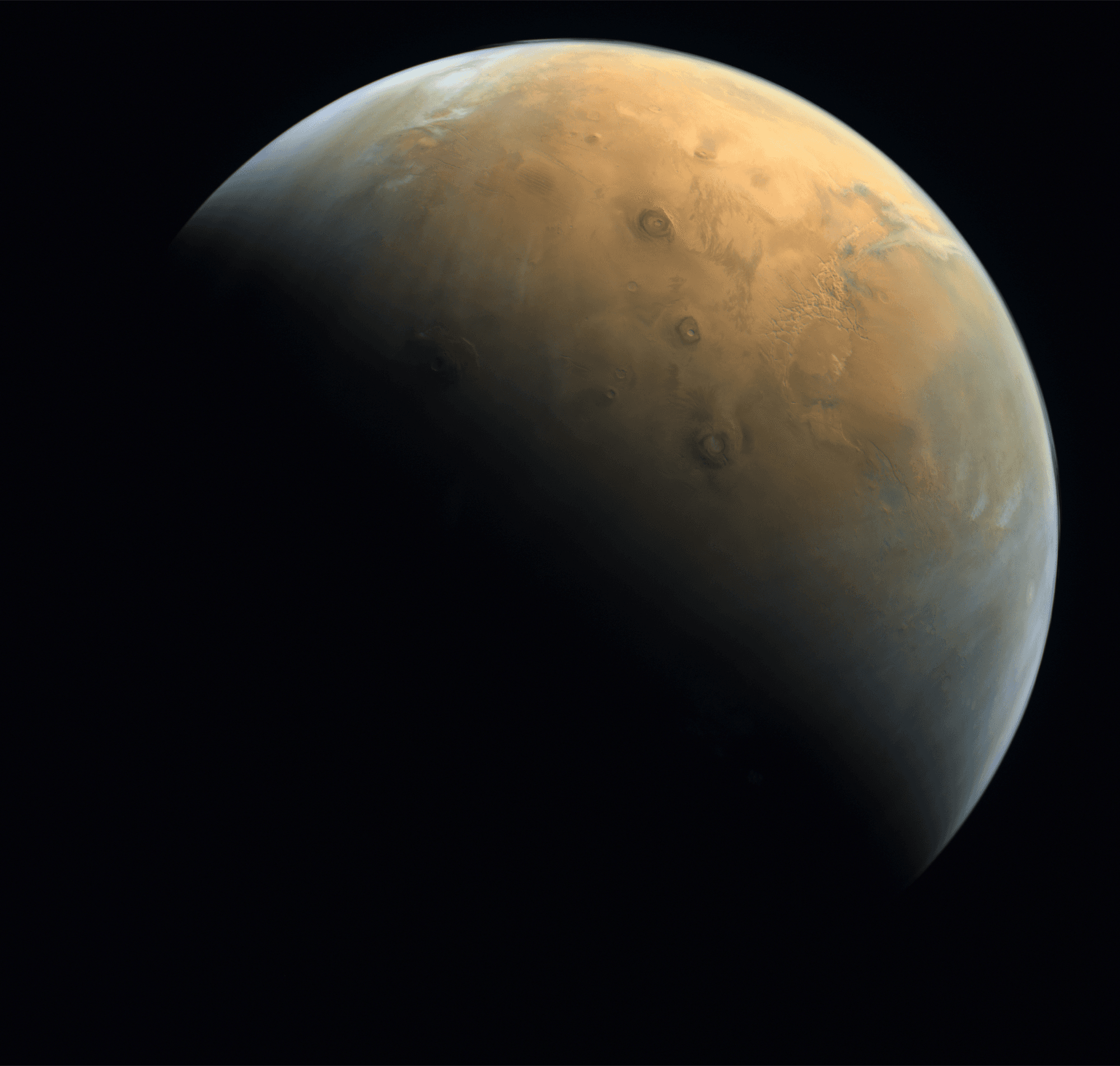
The Emirates Mars Mission started as a deadline. The United Arab Emirates decided in 2014 to have a spacecraft at Mars for the fiftieth anniversary of the federation, which gave the team six years to build an interplanetary probe in a country that had never built one. The work was led by the Mohammed bin Rashid Space Centre in Dubai, with three American partners: the Laboratory for Atmospheric and Space Physics at the University of Colorado Boulder, Arizona State University, and the Space Sciences Laboratory at the University of California, Berkeley. Arabic Wikipedia puts the team at roughly 200 Emirati engineers working alongside roughly 200 people at the partner institutions, with Omran Sharaf as project manager and Sarah Al Amiri as science lead. The launch happened at 21:58:14 UT on 19 July 2020 from Tanegashima in Japan, which was already the small hours of 20 July in the UAE and breakfast time on 20 July in Japan. Two hundred days later, on 9 February 2021, a 27-minute burn spent about 400 of the 800 kilograms of hydrazine on board and dropped Hope into orbit. The UAE became the fifth entity to put a spacecraft around Mars, after the United States, the Soviet Union, the European Space Agency and India. China's Tianwen-1 arrived the next day and NASA's Perseverance landed nine days later, making February 2021 the busiest month Mars has ever had.
The orbit is the mission, and it is the thing most summaries skip. Almost every Mars orbiter flies low and close to polar: a few hundred kilometres up, sweeping north to south, which resolves boulders but revisits each patch of ground at nearly the same local hour every time. Hope does the opposite. It sits in a 20,000 by 43,000 kilometre ellipse inclined 25 degrees, taking about 55 hours to go round, which is a little over two Martian days. From that height the whole disc fits in the field of view, so its three instruments observe the lower and upper atmosphere as one connected system rather than as a strip of ground. Because periapsis local time drifts as Mars moves around the Sun, the mission builds a full picture of the Martian day in roughly nine to ten days, then repeats it through the seasons. NASA's own catalogue rounds the numbers to about 22,000 by 44,000 kilometres, which is the same orbit described more loosely. The instruments are EXI, a visible and ultraviolet camera; EMIRS, an infrared spectrometer that maps dust, ice cloud, water vapour and temperature; and EMUS, an ultraviolet spectrograph watching hydrogen and oxygen leak into space. The design question they were built to answer is how weather in the lower atmosphere changes what escapes from the top.
The results have justified the geometry. Hope reported forms of Martian aurora nobody had catalogued, including what the team named sinuous discrete aurora, worm-like ultraviolet structures stretching thousands of kilometres from the dayside into the nightside, and patchy proton aurora. It produced daily dust and ice maps across a full Martian year. In its extended mission it went after Deimos, coming within about 100 kilometres, which the UAE Space Agency describes as the closest approach since Viking in 1977; the observations included the first extreme and far-ultraviolet measurements of the moon and the first hyperspectral thermal infrared data, and the team argued they favour Deimos forming from Mars over the older idea of a captured asteroid. All of it is meant to be public. The mission's Science Data Center releases data on a six-month cadence, free to anyone with an account. How much has come back depends on who you ask and in what unit. A July 2026 roundup says more than 10 terabytes across 16 released batches, more than 35 peer-reviewed papers and more than 200 institutions using the data. AFP, reporting the February 2026 announcement, quoted a target of one terabit and an outcome of ten terabits. Arabic Wikipedia gives 5.4 terabytes by April 2025. These are not reconcilable as written, and we have not found a source that reconciles them.
As of 23 August 2026 the mission is alive on the operator's word, which is the strongest evidence available and worth stating plainly rather than dressing up. On 17 February 2026, at a press conference in Dubai, Ahmad Belhoul Al Falasi, the UAE Minister of Sport and chairman of the UAE Space Agency board, announced a three-year extension to 2028; Aviation Week covered it again on 1 May 2026, and the UAE Space Agency's own mission page carries a Mission Extension section. A six-year roundup on 19 July 2026 described the spacecraft as still delivering and revealed that Hope had also pointed EXI and EMUS at interstellar comet 3I/ATLAS. JPL Horizons serves Mars-centred vectors for Hope, target -62, from an orbit solution that Horizons says is fit to tracking data through 28 May 2026 and predicted after that. Today's numbers are a prediction rather than a fix, but the fit date is itself evidence: JPL was still tracking the spacecraft in late May 2026. Against that, one thing does not fit the picture of a fully current mission: the Science Data Center's public news page, checked today, has announced nothing since 10 September 2025, when Release 16 made observations up to 28 February 2025 available. On a six-month cadence, two further releases would be due by now. That may simply be a website nobody has updated. We flag it because the alternative reading matters, and we could not test it without creating an account.
Hope's real legacy may be institutional rather than scientific. A country with no interplanetary heritage went from decision to Mars orbit in under seven years, and it did so by buying expertise rather than hardware: the partner laboratories in Colorado, Arizona and California trained and worked alongside Emirati engineers who did the building, rather than delivering a finished spacecraft to be flown. The data policy followed the same logic. Everything goes to a public archive that any researcher can register for, and the mission counts more than 200 institutions using it and more than 35 peer-reviewed papers written from it, which is a far larger scientific footprint than a single 550 kg orbiter would normally generate. The next Emirati deep-space mission, to the asteroid belt, is scheduled for 2028, the same year the Hope extension runs out, and the July 2026 six-year roundup frames the extra three years partly as a way to keep the operations team current for it. Whether the spacecraft physically lasts that long is a separate question from whether it is funded to. Its orbit is high enough that atmospheric drag is irrelevant on any human timescale, so the real limits are hydrazine for attitude control, solar panel and battery degradation, and the continued attention of a team that will soon have a second interplanetary spacecraft to fly. On today's evidence none of those has run out.
Mission facts
Launch
19 July 2020 at 21:58:14 UT on a Mitsubishi H-IIA from Tanegashima Space Center, Japan. NASA's catalogue gives the local equivalents as 20 July, 01:58 a.m. in the UAE and 06:58 a.m. in Japan, which is why almost every account, English Wikipedia included, dates the launch 20 July. Two further sources agree on 19 July: the mission's own overview paper in Space Science Reviews gives 19 July 2020 (UTC), and JPL Horizons' EMM trajectory file, EMM_20200719-20261126_od03-195, begins at 2020-Jul-19 23:07 UT.↗
Mars orbit insertion
9 February 2021. NASA's catalogue times the start of the 27-minute burn at about 15:41 UT Earth-received time, with completion at about 16:08 UT ERT and a one-way light time of 10 min 40 s, which puts the burn start at roughly 15:30 UT on the spacecraft's own clock. English Wikipedia prints 15:30 UTC. The two figures describe the same event measured at different ends of the link.↗
Insertion cost in propellant
About 400 kg of hydrazine, half the 800 kg the spacecraft carried at launch.↗
Science orbit
About 20,000 by 43,000 km, period about 55 hours (roughly 2.25 Martian sols), inclination 25 degrees. NASA's catalogue rounds it to roughly 22,000 by 44,000 km. Periapsis sits near the equator and its local time precesses at about the same rate Mars moves around the Sun.↗
Why that orbit
The mission's own overview paper describes it as giving global views of the lower and upper atmosphere at all local times over a nine to ten day cycle. A low, near-polar orbit of the kind most Mars orbiters use resolves fine detail but revisits each place at nearly the same hour; Hope traded resolution for coverage.↗
Spacecraft
1,350 kg at launch including 800 kg of hydrazine, 550 kg dry, per NASA's catalogue; the mission's overview paper gives about 1,343 kg wet and 543 kg dry. A hexagonal prism 2.37 m across and 2.90 m tall, with solar wings spanning 7.9 m.↗
Power
NASA's catalogue gives 600 W at Mars against a spacecraft requirement of 477 W. English Wikipedia's infobox instead prints 1,800 W from the two panels, which is a panel rating rather than the delivered power at Mars distance.↗
Instruments
Three: the Emirates eXploration Imager (EXI), a visible and ultraviolet camera; the Emirates Mars Infrared Spectrometer (EMIRS), which maps dust, water vapour, ice and temperature in the lower and middle atmosphere; and the Emirates Mars Ultraviolet Spectrometer (EMUS), which watches hydrogen and oxygen escaping from the upper atmosphere.↗
US partners
The mission was developed with the Laboratory for Atmospheric and Space Physics at the University of Colorado Boulder, Arizona State University, and the Space Sciences Laboratory at the University of California, Berkeley. English Wikipedia assigns EXI and EMUS to LASP and EMIRS to Arizona State with Northern Arizona University.↗
Team
Arabic Wikipedia gives about 200 Emirati engineers alongside about 200 scientists and engineers at the US partner institutions, with Omran Sharaf as project manager and Sarah Al Amiri as deputy project manager and science lead.↗
Nominal mission
One Martian year of science from 23 May 2021, with a two-year extension foreseen from the outset. NASA's catalogue records the plan as two years of science with the possibility of extending into 2025.↗
Extension to 2028
Announced on Tuesday 17 February 2026 by Ahmad Belhoul Al Falasi, UAE Minister of Sport and chairman of the UAE Space Agency board, at a press conference in Dubai: three further years, to 2028.↗
Data releases
The Emirates Mars Mission Science Data Center publishes on a six-month cadence. Its public news page, checked on 23 August 2026, still shows Release 16 dated 10 September 2025, covering instrument observations up to 28 February 2025, as the most recent announcement. Downloading data requires a free account, which we did not create.↗
How much data
Figures differ and so do the units. A July 2026 six-year roundup says more than 10 terabytes shared openly, in 16 released batches. AFP's report of the February 2026 announcement says the mission planned to collect one terabit and ultimately collected ten. Arabic Wikipedia gives about 12 data packages totalling 5.4 terabytes by April 2025.↗
Scientific output
More than 35 peer-reviewed papers and more than 250 conference presentations, with data used by more than 200 institutions worldwide, per the July 2026 roundup.↗
Tracking
JPL Horizons lists target -62 as Emirates Mars Mission (EMM, HOPE Probe) and returns Mars-centred state vectors for 3 September 2026 from orbit solution EMM_20200719-20261126_od03-195. Horizons states that this solution is fit to tracking data through 2026-05-28, with a predicted trajectory thereafter running to 2026-11-26. Today's vectors are therefore predicted; none of them is a measurement. What the file does establish is that JPL held real tracking data for Hope as recently as late May 2026.↗
Mission timeline
- 2014The UAE commits to a Mars orbiter and gives itself six years. The mission's overview paper describes development starting in 2014 under aggressive schedule and cost constraints.
- 19 Jul 202021:58:14 UT: launch on a Mitsubishi H-IIA from Tanegashima. Locally it is already 20 July in both Japan and the UAE, which is the date most accounts print.
- 9 Feb 2021A 27-minute burn consuming about 400 kg of hydrazine puts Hope into Mars orbit. The UAE becomes the fifth entity to place a spacecraft in orbit around Mars, after the United States, the Soviet Union, ESA and India, and the first Arab nation to do so.
- 23 May 2021Science operations formally begin, after transfer into the 20,000 by 43,000 km, 55-hour observing orbit.
- 10 Mar 2023The first close-up global images of Deimos are released. The UAE Space Agency puts the closest approach at about 100 km and calls it the nearest a spacecraft has come to the moon since Viking in 1977.
- 2023At a special session of a geosciences congress in Vienna, the science team presents the full Deimos dataset and argues the moon more likely formed from Mars than as a captured asteroid.
- 10 Sep 2025Science Data Center Release 16 makes instrument observations up to 28 February 2025 public. As of 23 August 2026 this is still the newest release announced on the centre's public news page.
- 2025Hope turns EXI and EMUS on interstellar comet 3I/ATLAS, the third interstellar object identified in the Solar System, adding a Mars-orbit vantage point to observations made from Earth.
- 9 Feb 2026Five years in Mars orbit, against a nominal mission of one Martian year.
- 17 Feb 2026Ahmad Belhoul Al Falasi announces in Dubai that the mission is extended by three years to 2028. He tells reporters the mission had aimed to collect one terabit of atmospheric data and collected ten.
- 1 May 2026Aviation Week reports the extension, noting the agency's statement that the probe has exceeded its initial data goals by more than ten times.
- 19 Jul 2026A six-year roundup describes Hope as still delivering, lists more than 10 terabytes of shared data and more than 35 peer-reviewed papers, and frames the extension as preparation for the Emirates Mission to the Asteroid Belt, scheduled for launch in 2028.
A filled dot marks something that physically happened. A hollow one marks an announcement, a naming or a target.
In pictures
Tap a photo to enlarge.
Sources
- NSSDCA Master Catalog: Emirates Mars Mission (Hope), 2020-047A, archived 14 Jun 2025
- Amiri, Brain, Sharaf et al., The Emirates Mars Mission, Space Science Reviews 218:4 (2022)
- UAE Space Agency: Emirates Mars Mission
- EMM Science Data Center: release notices and data policy
- Phys.org carrying AFP (17 Feb 2026): UAE extends Mars probe mission until 2028
- Aviation Week (1 May 2026): UAE Extends Hope Mars Mission By Three Years
- SatellitePro ME (19 Jul 2026): UAE's Hope Probe marks six years with mission extension
- LASP, University of Colorado Boulder: Emirates Mars Mission partnership page
- Arabic Wikipedia: مسبار الأمل
- English Wikipedia: Emirates Mars Mission
- JPL Horizons system, used on 23 Aug 2026
Facts on this page were verified on 3 September 2026. Where sources disagree, the disagreement is stated rather than resolved silently.