Tianwen-1's deployable cameras
CNSA · China · Artefact · 2020 · Multipolar MarsSuccess
Success: three throwaway cameras, one ejected on the cruise in 2020, one reported released in Mars orbit at the end of 2021, and the one Zhurong dropped on 1 June 2021 for the portrait, still lying in Utopia Planitia.
TL;DR· 15 min read
Three small throwaway cameras flew with Tianwen-1, China's first independent Mars mission. One was ejected on the cruise and photographed Tianwen-1 in deep space, one is reported to have been released in Mars orbit at the end of 2021, though the CNSA release that carried the images does not say so, and one was dropped on the ground by the Zhurong rover on 1 June 2021. That last camera took the ground-level portrait of the lander and rover that CNSA used ten days later to declare the mission a complete success, and it is still lying in Utopia Planitia.
The best-known photograph from China's first independent Mars mission was taken by a camera lying on the ground, by itself, with nobody holding it. On 1 June 2021 the Zhurong rover drove about ten metres south of its landing platform, released a small camera mounted under its belly, reversed back towards the platform and posed. The camera sent the pictures back to the rover over a wireless link, the rover passed them to the orbiter, and the orbiter relayed them to Earth. It was a deliberate piece of engineering theatre, and it produced a ground-level view of a working spacecraft on Mars that no camera carried by the rover itself could have taken. The camera is still there, its job finished in a single day.
- 10 mhow far south of the landing platform Zhurong drove before releasing the camera
- 1 Jun 2021the day the portrait was taken; CNSA published it ten days later
- about 1 kgcatalogued mass of the camera left on the surface, the only mass figure we could find
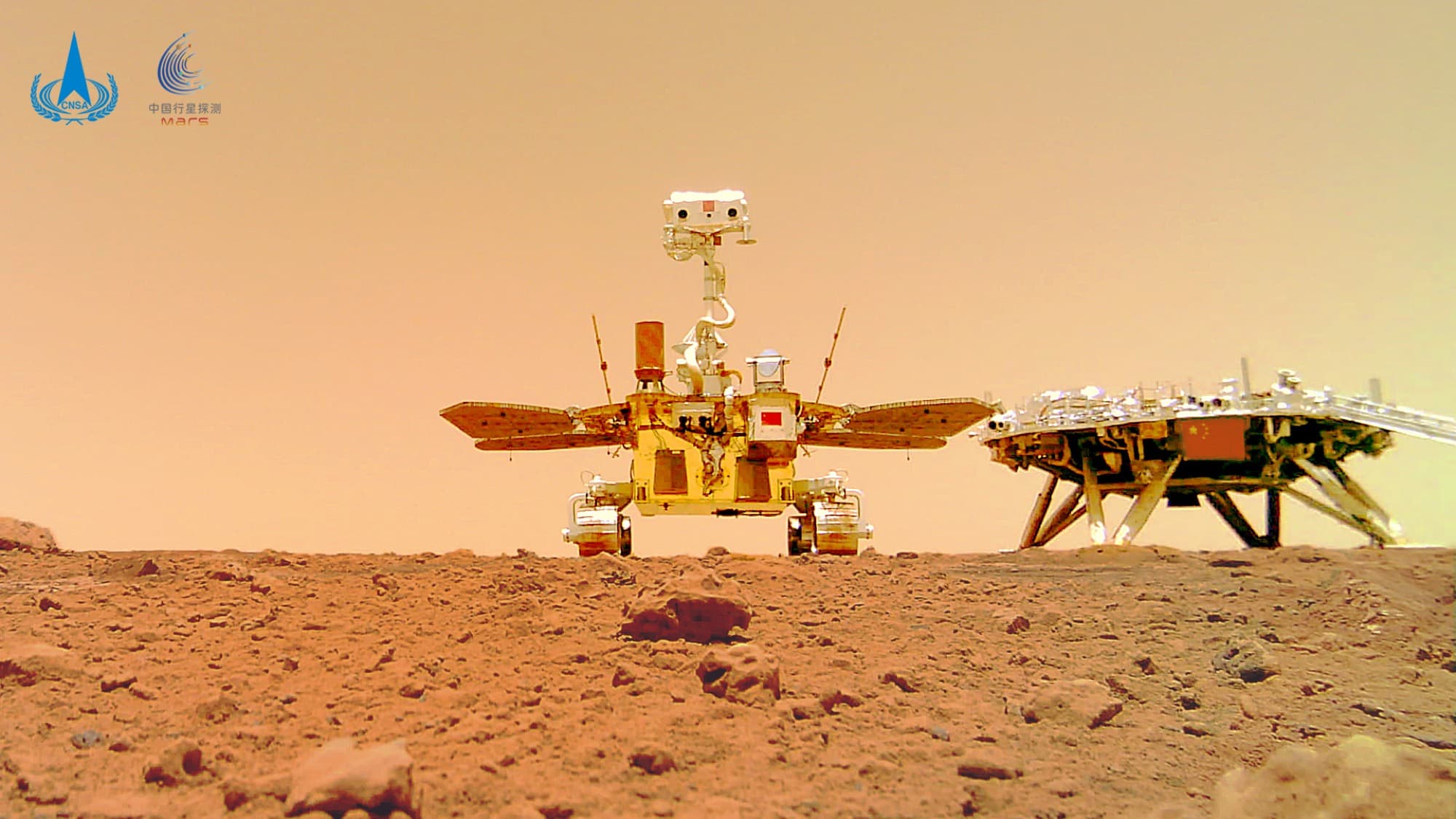
The photograph is famous and the method behind it is not. On 1 June 2021 the Zhurong rover, ten days after driving off its landing platform, drove about ten metres south of the platform it had landed on and stopped. A small camera mounted on the underside of the rover dropped onto the ground. The rover then reversed, back towards the landing platform, and parked next to it. From ground level the camera photographed the rover as it moved, then took a head-on portrait of the rover and the platform together, and then, after the rover pivoted to present its flank, a second portrait from the side. The frames went to the rover over a wireless link and from the rover to Earth by way of the Tianwen-1 orbiter, which was by then flying a relay orbit for exactly this purpose. CNSA's own account, published on 27 June 2021, records that the team worked backwards from the camera's field of view and focal length to decide where the camera should be dropped and what path the rover should drive. That is the part worth pausing on. This was not a snapshot. It was a shot list, planned on Earth, executed by a rover that could not see what it was posing for, on a planet where the one-way light time was about nineteen minutes.
The camera itself is close to anonymous. CNSA calls it the 分离相机, the separation camera, or in the 27 June release the WIFI 分离相机. It has published no mass, no dimensions, no sensor, no resolution, no radio specification and no battery life for it. The only hardware numbers we could find anywhere come from Jonathan McDowell's deep space catalogue, which lists the object as Fenli xiangji, an ejectable camera released from Zhurong, built by the Shanghai Academy of Spaceflight Technology, of about one kilogram and roughly a tenth of a metre on a side. That is thinner sourcing than we would like for an object sitting permanently on another planet, and it is worth stating plainly rather than papering over. What is well established is where it is. Zhurong's landing platform was fixed at 109.925 degrees east, 25.066 degrees north, at an elevation of 4,099.4 metres below the reference surface, from sub-metre images taken by Tianwen-1's own High Resolution Imaging Camera on 2 June 2021, the day after the portrait was made. The camera lies about ten metres south of that, which is a smaller offset than the precision of the fix, so on any map of Mars the two are the same point.
Tianwen-1 did this twice more in space, though the record of the second time is thinner than it should be. On 1 October 2020, China's National Day, CNSA released images of the spacecraft in interplanetary space taken by a camera it had ejected on the cruise, with two wide-angle lenses shooting an image a second and radioing the frames back over a wireless link. That one is well attested. The second is murkier. On 1 January 2022 CNSA published a New Year greeting containing four pictures, the first of which shows the whole Tianwen-1 orbiter flying above the Martian north polar cap, solar wings and radar antenna deployed, with the ice below it. Nothing but a separated camera can take that picture. Yet the release, in both its CNSA website version and the version published through the 中国探月工程 account, describes the scene in detail and never says how it was taken. Chinese press coverage does: a press report of 5 January 2022, drawing on the Shanghai Academy of Spaceflight Technology team behind the camera, says a separation measurement sensor built by the academy's Institute 803 was again released under ground control and photographed the orbiter while slowly drifting away from it, and in February Xinhua called it another separation camera. English-language sources, including Wikipedia, state that a second deployable camera was released on 31 December 2021 and give both orbiter cameras the designations TDC-1 and TDC-2. Those names are not CNSA's, and we could not trace the 31 December date to a Chinese primary source.
It is easy to be cynical about all this, and worth resisting. Every one of these releases is timed to a date in the Chinese political calendar: the deep space selfie on National Day, the surface portrait about three weeks before the Communist Party's centenary, the orbiter over the north pole on New Year's Day. The technique is also plainly reusable propaganda, and China has reused it: McDowell's catalogue records a mobile camera released by Chang'e-6 on the lunar far side in 2024 for the same purpose. But there is real engineering underneath. Getting a useful third-person image of a spacecraft you are operating is genuinely hard, and the alternatives are worse. NASA's rovers photograph themselves with an arm-mounted camera and stitch out the arm, which produces an image with no true external viewpoint. Orbital reconnaissance gives you a few pixels from three hundred kilometres up. A one-kilogram camera thrown on the ground gives you a photograph, and it costs almost nothing. The frames of Zhurong reversing and turning, which CNSA describes as the first imagery humans obtained of a rover in motion on the Martian surface, would be difficult to get any other way.
What remains is small and quiet. The camera did its work on a single day, 1 June 2021, and there is no published record of it ever being used again; it has no visible power source beyond whatever it carried, and CNSA has released nothing from it since. It joins a very short list of objects deliberately placed on the surface of Mars and then walked away from, alongside the sample tubes Perseverance laid down at Three Forks and, in a different sense, the discarded heat shields and backshells of every mission that has landed there. It is a camera lying on its side in Utopia Planitia, ten metres south of a landing platform, having produced one of the most widely reproduced images of the Chinese Mars programme. As for the wider mission, the last figures in the CNSA releases used here are from the very end of 2021: the orbiter 526 days into flight and about 350 million kilometres from Earth, Zhurong 225 Martian days into a ninety-day design life with 1,400 metres on its odometer, and about 560 gigabytes of raw science data on the ground. What happened to the rover after that belongs to the Zhurong entry.
Mission facts
What CNSA actually said
The 11 June 2021 release describes the image it calls 着巡合影, the lander and rover group photo, like this: the rover drove to a point about 10 metres south of the landing platform, released the separation camera installed on the underside of the vehicle, then reversed back to the vicinity of the landing platform. The camera photographed the rover moving and photographed the rover together with the landing platform. The images were sent by wireless signal to the rover, and the rover relayed them to the ground through the orbiter.↗
How the shot was planned
CNSA's follow-up release of 27 June 2021 calls the device the WIFI 分离相机, the WiFi separation camera, and explains the choreography. Working from the camera's field of view and focal length, the team planned where the camera would be dropped and what route the rover would drive. The rover went to the separation point, released the camera, reversed to the photo point for a head-on portrait with the landing platform, then turned so that its flank faced the camera for a second, side-on portrait.↗
When it happened
1 June 2021, per the 27 June release. That is ten days after Zhurong rolled off the platform on 22 May and ten days before CNSA unveiled the picture. The same release states that the camera also recorded the rover reversing and turning in place, which CNSA describes as the first time humans obtained imagery of the process of a rover moving on the Martian surface.↗
What the picture shows
The landing platform with a Chinese flag on its flank, sitting on flat, rock-strewn ground, with the six-wheeled rover parked beside it and its solar panels spread. Because the camera is on the ground the viewpoint is low, roughly at wheel height, which is why the image reads as a photograph of two objects rather than as engineering documentation.↗
Not the same picture
The other widely circulated flag image, 中国印迹 or China's imprint, was not taken by the dropped camera. CNSA's 11 June release says the rover drove to a point about 6 metres from the landing platform in the direction CNSA writes as 东偏南60°, that is 60 degrees south of east, and photographed the platform from there with a camera on the rover itself. The two images are routinely swapped in captions.↗
Where it is
The Zhurong landing platform sits at 109.925 E, 25.066 N at an elevation of -4,099.4 m, a position determined from sub-metre images taken by Tianwen-1's own High Resolution Imaging Camera on 2 June 2021 and published by Liu and colleagues. The camera is about 10 metres south of that, which is finer than the published precision of the fix.↗
The only hardware figures we found
Jonathan McDowell's deep space catalogue lists the object as Fenli xiangji, ejectable camera, JCAT D01086, released from Zhurong, built by the Shanghai Academy of Spaceflight Technology (SAST), with a mass of about 1 kg and a box shape roughly 0.1 m on a side. CNSA has published no mass, dimensions, sensor type, resolution, radio specification or battery life for it that we could locate.↗
The first one, in deep space
On 1 October 2020, China's National Day, CNSA released images of Tianwen-1 in interplanetary space taken by a small camera the spacecraft had ejected. Spaceflight Now, reporting the release, describes two wide-angle lenses programmed to take one image a second, with the pictures returned to Tianwen-1 over a wireless radio link and downlinked from there. The images show the solar wings, the high-gain dish, the white entry capsule and a red Chinese flag on the side of the cruise stack.↗
The names TDC-1 and TDC-2
English Wikipedia and much of the English-language coverage call the two orbiter cameras Tianwen-1 Deployable Camera 1 and 2, and the rover's camera the Tianwen-1 Remote Camera. Those designations are useful and they are what a reader will search for, but we did not find them in any CNSA document. CNSA's own Chinese wording for the rover camera is 分离相机 or WIFI 分离相机, and its 1 October 2020 release calls the orbiter camera a 分离测量传感器, a separation measurement sensor, which is also the name Jonathan McDowell's catalogue gives the two objects it lists as released from the orbiter.↗
The second one, and a gap in the record
CNSA's New Year release of 1 January 2022 published four images, the first of them captioned 环绕器与火星合影, the orbiter photographed with Mars, showing the whole orbiter flying above the north polar region with its solar wings and radar antenna deployed. That is a viewpoint only a separated camera can produce. But the release itself, in both its CNSA and its 中国探月工程 versions, describes the picture without saying how it was taken. English sources date the release of a second deployable camera to 31 December 2021; CNSA's own text does not. Chinese press coverage supplies the method but not the date: a press report of 5 January 2022, drawing on the Shanghai Academy of Spaceflight Technology team behind the camera, says a separation measurement sensor built by the academy's Institute 803 was again released under ground control and took one picture a second while slowly drifting away from the orbiter, and on 10 February 2022 Xinhua said the New Year pictures were taken by another separation camera.↗
The selfie stick, partly confirmed
A second orbiter self-imaging method is widely described: a boom of shape-memory composite, said to weigh 0.8 kg and to extend to 1.6 m, carrying cameras at its tip. English Wikipedia sources that description entirely to posts on a social media account, one of which, dated 30 January 2022, says the boom unfolded by itself when heated after Mars orbit insertion. The builder confirmed part of it: Xinhua, quoting a designer at the Shanghai Academy of Spaceflight Technology's Institute 803 on 10 February 2022, says the boom stayed folded through launch and cruise, was heated open from four folded sections after arrival in Mars orbit and reaches up to 1.6 m, and that the picture it took of the orbiter's flag with the Beijing 2022 Olympic and Paralympic emblems reached Earth on the day the Games opened. We found no CNSA or builder statement of the 0.8 kg mass or the shape-memory material, and we do not repeat those as fact.↗
The relay chain
CNSA describes the pictures going from the dropped camera to the rover by 无线信号, wireless signal, and from the rover to the ground through the orbiter acting as a relay. Apart from the WiFi in the camera's name in the 27 June release, no frequency, data rate or range has been published in the releases we read. The orbiter had moved into its relay orbit after the landing and was providing communications for the rover.↗
Sound, released the same day
The 27 June 2021 release also carried audio: a recording device on Zhurong captured the sound of the rover driving off the landing platform on 22 May 2021. CNSA attributes the sound to the drive mechanism, to the wheels on the ramp and to the wheels on the ground. It does not describe the device as an atmospheric microphone and publishes no specification for it.↗
A Chinese habit, not a one-off
Deliberately jettisoning a small camera to photograph your own spacecraft is a technique China has used repeatedly. McDowell's catalogue also records a Chang'e-6 mobile camera, JCAT D01165, carried by the Chang'e-6 lander. The May 2024 date in that catalogue row belongs to the launch. Chang'e-6 landed on the far side on 1 June 2024 UTC and the camera was put down there in early June. The Tianwen-1 cameras are the Mars members of a family.↗
Mission context, as CNSA counted it
On 11 June 2021, when the portrait was published, the orbiter was in its relay orbit and Zhurong had worked 28 Martian sols. On 27 June, the orbiter had been flying 338 days, Mars was 360 million km from Earth, and the rover had worked 42 sols and driven 236 m. The last of these releases, published on 1 January 2022, gives figures current to 31 December 2021: the orbiter 526 days in flight, about 350 million km away with a 19.5 minute one-way light time, and Zhurong 225 sols in with 1,400 m on its odometer and about 560 GB of raw science data returned.↗
Timings, in two clocks
CNSA publishes in Beijing time, which is UTC plus eight hours. The landing is 15 May 2021 at 07:18 Beijing, which is 14 May at 23:18 UTC. Zhurong drove onto the surface on 22 May; the 10:40 Beijing time usually quoted for that (02:40 UTC) is not in any of the CNSA releases used here, which give only the date. Almost every discrepancy between Chinese and Western accounts of Tianwen-1 dates is this eight-hour offset crossing midnight.↗
Mission timeline
- 23 Jul 2020Tianwen-1 launches from Wenchang on a Long March 5, carrying an orbiter, an entry capsule with a lander and the Zhurong rover, and at least one small camera meant to be thrown away.
- By 1 Oct 2020A camera is ejected from the cruise stack. Spaceflight Now, reporting the release, has the spacecraft nearing the halfway point of its seven-month journey; no source we found gives the ejection date. Two wide-angle lenses take an image a second and radio the frames back to the spacecraft.
- 1 Oct 2020CNSA publishes the deep space self-portrait on China's National Day, showing Tianwen-1 with its solar wings, its dish, the white entry capsule and a red flag, against nothing at all.
- 10 Feb 2021Tianwen-1 brakes into Mars orbit, becoming China's first artificial satellite of another planet. It spends three months surveying the landing region from a parking orbit.
- 14 May 202123:18 UTC (07:18 on 15 May Beijing): the entry capsule lands in southern Utopia Planitia after about nine minutes of aerodynamic braking, parachute descent, powered hover, hazard avoidance and touchdown.
- 22 May 2021Zhurong drives down the ramp onto Mars; CNSA gives the date but no time. A recording device on the rover captures the sound of the drive mechanism and the wheels on ramp and ground, released a month later.
- 1 Jun 2021The rover drives about 10 m south of the landing platform, releases the WiFi separation camera from under its belly, reverses back towards the platform and stops. The camera photographs it moving, then head-on, then side-on after the rover turns.
- 2 Jun 2021Tianwen-1's High Resolution Imaging Camera takes the sub-metre images from orbit that fix the landing site at 109.925 E, 25.066 N, elevation -4,099.4 m.
- 11 Jun 2021CNSA unveils the first batch of surface images in Beijing, including the landing site panorama, the terrain image, China's imprint and the lander and rover group photo. The release states that the publication marks the complete success of China's first Mars exploration mission. Zhurong has worked 28 sols.
- 27 Jun 2021On the eve of the Communist Party's centenary, CNSA releases the descent footage, the drive-off video and its sound, and the separation camera's own footage of the rover reversing and turning. The rover has driven 236 m in 42 sols.
- 31 Dec 2021English-language sources date the release of a second deployable camera in Mars orbit to this day. The CNSA release that carries the resulting images does not mention a camera release.
- 1 Jan 2022CNSA's New Year greeting publishes the orbiter photographed above the Martian north polar cap, a close-up of part of the orbiter, the layered north polar ice, and terrain from Zhurong. The orbiter has flown 526 days; the rover has worked 225 sols and driven 1,400 m.
A filled dot marks something that physically happened. A hollow one marks an announcement, a naming or a target.
In pictures
Tap a photo to enlarge.
Sources
- CNSA (11 June 2021), in Chinese: 天问一号探测器着陆火星首批科学影像图揭幕
- CNSA (27 June 2021), in Chinese: 天问一号任务着陆和巡视探测系列实拍影像发布
- CNSA (1 January 2022), in Chinese: 天问一号探测器传回最新图像
- 中国探月工程 (1 January 2022)
- CNSA (15 May 2021), in Chinese: 我国首次火星探测任务着陆火星取得圆满成功
- Liu et al., Geomorphic contexts and science focus of the Zhurong landing site on Mars, Nature Astronomy 6, 65-71 (2021)
- Jonathan McDowell, General Catalog of Artificial Space Objects, deep space catalogue (deepcat.tsv), entry D01086 Fenli xiangji
- Spaceflight Now (6 October 2020), Stephen Clark: China's Mars-bound probe returns self-portrait from deep space
- English Wikipedia: Tianwen-1
- Chinese Wikipedia: 祝融号火星车
- CNSA (11 November 2011), in Chinese: 搭载“萤火一号”的俄火星探测器未能按计划变轨
- SASTIND (1 October 2020), in Chinese: 国家航天局发布天问一号探测器飞行图像
- 人民政协网 (5 January 2022), in Chinese: 揭秘天问一号火星探测器的“太空自拍秘笈”
- Xinhua (10 February 2022), Zhang Jiansong, in Chinese: 来自“天问一号”的冬奥祝福,原来是“宇宙级自拍”
- JPL Horizons, Earth to Mars range and one-way light time on 1 June 2021
- CNSA (4 June 2024), in Chinese: 嫦娥六号着陆器和上升器合影来了!
Facts on this page were verified on 24 September 2026. Where sources disagree, the disagreement is stated rather than resolved silently.
109.9250 E, 25.0660 N · Southern Utopia Planitia