Zhurong
CNSA (China) · China · Rover · 2021 · Multipolar MarsEnded
Silent since 18 May 2022, when it hibernated for the Martian winter after 358 sols and 1,921 m against a design life of 90. Dust is the likely cause, and as of 24 September 2026 China has declared no formal end.
TL;DR· 11 min read
Zhurong was the first rover any country other than the United States drove on Mars. It landed in southern Utopia Planitia on 14 May 2021, worked 358 sols against a design life of 90 and logged 1,921 m before putting itself into winter hibernation on 18 May 2022. It never woke, and China's planetary exploration chief designer named unforeseen dust on the solar panels as the likely cause. Its data is still producing results, including evidence in March 2026 for buried ice beneath the landing site.
Zhurong was the first rover any country other than the United States drove on Mars, and it did four times its design life before the winter got it. It was never lost, never crashed and never went wrong: it put itself to sleep on schedule on 18 May 2022 with 1,921 metres on the clock, and the sunlight it needed to wake itself never came back through the dust on its solar panels. Its data is still producing results four years later, including evidence in March 2026 for buried ice beneath its landing site.
- 358sols worked, against a design life of 90
- 1,921 mon the odometer when it went into hibernation
- 0signals received since 18 May 2022
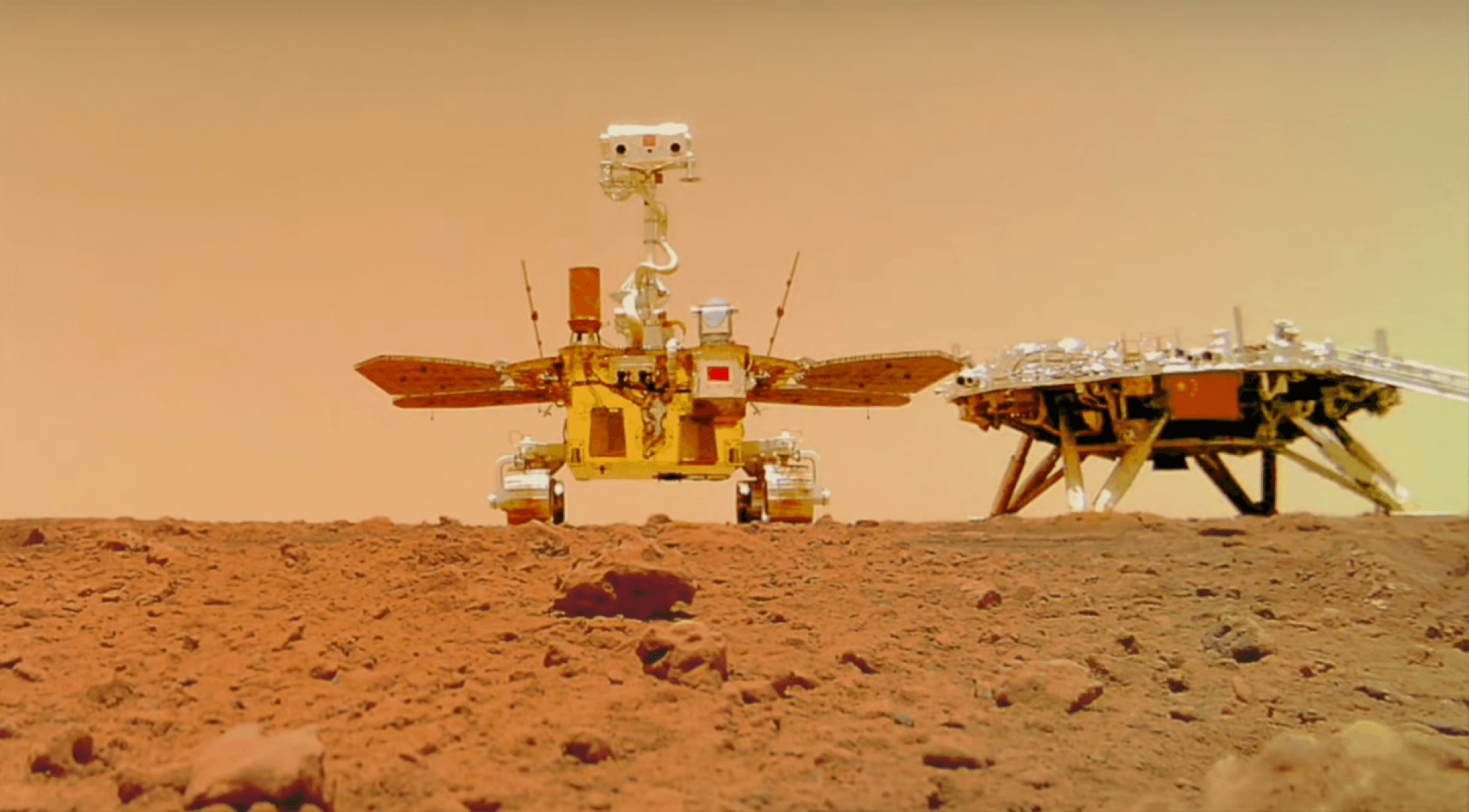
Zhurong came down in southern Utopia Planitia on 14 May 2021 at 23:18 UT, which was breakfast time on 15 May in Beijing. The descent ran for about nine minutes with no human input and no possibility of any, because the signal delay made intervention impossible: trim flaps deployed, a parachute opened, the heat shield and then the backshell fell away, a throttled engine took over, the capsule hovered while it looked for a clear patch, then descended slowly onto a damping landing platform. Where exactly it ended up was worked out afterwards. Using sub-metre images from the Tianwen-1 orbiter's High Resolution Imaging Camera, Liu Jianjun, Li Chunlai and colleagues placed it at 109.925 degrees east, 25.066 degrees north, at an elevation of 4,099.4 metres below datum, and published the fix in Nature Astronomy on 6 December 2021. That is a measured position rather than an estimate, which distinguishes Zhurong from most of the Soviet hardware on Mars. The site sits near the boundary between the southern highlands and the northern lowlands, in a region marked by features that several groups have read as ancient shorelines. Six days after landing the rover finished its checks, and on 22 May at 02:40 UT it drove down the ramp, photographed the platform it had arrived on, and set off south.
The design mission was 90 sols. Zhurong hit that mark on 15 August 2021 with 889 metres behind it and every instrument working, and then simply kept going. It carried six payloads: navigation and terrain cameras, a multispectral camera, a laser and shortwave infrared composition detector called MarSCoDe, a ground-penetrating radar, a magnetometer and a small weather station. The pattern of each sol was routine and productive. Cameras imaged the terrain along the way, the radar and weather station ran while driving, the magnetometer took a reading at each navigation point, and anything interesting enough, a rock, a dune, a crater rim, a trough, got a stop and a close look from the composition detector and the multispectral camera. Nothing was wrong during the month-long silence from late September to late October 2021. It was planned: Mars passed behind the Sun and both rover and orbiter waited it out in safe mode. By 15 May 2022, one Earth year on the surface, Xinhua reported 356 sols worked, 1,921 metres driven and about 940 gigabytes of raw science data returned by the mission as a whole. The rover was four times past its design life and still healthy.
Then winter arrived. Xinhua's May 2022 report already described the conditions: daytime highs in the rover's area falling below minus 20 Celsius, nights reaching minus 100, dust storms becoming frequent, sunlight weakening as the Sun dropped in the sky, and heating demand rising at exactly the moment power was falling. The design called for a winter mode, and on 18 May 2022, at 358 sols, Zhurong put itself to sleep. It was supposed to wake itself around December. Nearly a year later, on 25 April 2023, Zhang Rongqiao, chief designer of China's planetary exploration programme, sat down with CCTV and explained precisely what had to happen for that: the rover's internal temperature had to rise above minus 15 Celsius and its solar panels had to generate 140 watts, the minimum it needed to run for a day. Both conditions together, and it would switch itself on. Neither the season nor the sunlight was the problem by then. The most likely cause, he said, was unforeseen dust accumulation on the panels. He then did something unusual for a mission spokesperson and gave the numbers: dust beyond roughly 20 per cent of the design allowance and the panels would not make enough power, beyond 30 per cent and only peak sunlight would do it, beyond 40 per cent and the rover would never wake at all.
That interview is why Zhurong belongs in the same category as Spirit, Opportunity and InSight rather than with the failures. Nothing broke. The rover completed its mission, quadrupled its life, followed its own power-management logic exactly as designed, and lost a slow argument with Martian dust that its engineers had explicitly anticipated and quantified in advance. Zhang was blunt about it: the team had treated the winter survival as an attempt, and the rover not waking was within their expectations. CNSA has never issued a formal end-of-mission declaration, which is why some trackers still list Zhurong as dormant rather than finished; four years of silence through multiple Martian springs makes the distinction academic. What has not stopped is the science. Zhurong's shortwave infrared spectrometer made what Xinhua called the first in-situ detection of hydrated minerals on Mars by a rover-mounted instrument of its kind, hydrated-sulphate-rich duricrust that argues for relatively recent liquid water at the site. Its radar revealed buried polygonal terrain and, in a result CNSA announced on 3 March 2026, a low-loss layer about seven metres thick at roughly fifteen metres depth, interpreted as dirty ice, in a low-to-mid-latitude basin where the existence of shallow ground ice had been an open question. A rover that stopped moving in 2022 was still making news in 2026.
One number about Zhurong is genuinely unsettled, and it is the headline one. The 1,921 metres that appears everywhere, including in Zhang Rongqiao's own account, is the reading from the onboard odometer, which counts wheel rotations. Wheels slip, especially downhill on loose Martian regolith, and an odometer that trusts them will read short. In March 2025 the Planetary Mapping and Remote Sensing Laboratory at the Chinese Academy of Sciences Aerospace Information Research Institute published an outreach piece on the visual localisation and terrain mapping done for Zhurong, reconstructing the traverse from overlapping stereo panorama images rather than from wheel counts. That piece reported that this method gives 2,009 metres, 88 metres more than the odometer, the discrepancy caused by wheel slippage due to the downslope trend of the traverse, in a study published in the IEEE Journal of Selected Topics in Applied Earth Observations and Remote Sensing. The mission's published 1,921 metres therefore stands as the odometer figure of record, with 2,009 metres as the image-based reconstruction of the same drive. Anyone citing a single number for how far Zhurong drove should know that at least two exist and that they measure different things.
Mission facts
Landing
14 May 2021 at 23:18 UT, which is 15 May at 07:18 Beijing time. The entry capsule separated from the Tianwen-1 orbiter and ran about nine minutes of autonomous entry, descent and landing.↗
Landing site
109.925 E, 25.066 N, elevation -4,099.4 m, in southern Utopia Planitia near the highland-lowland boundary and a set of suspected ancient shorelines. The fix was determined after landing from sub-metre images taken by the orbiter's High Resolution Imaging Camera.↗
Where they were aiming
The pre-landing target was the centre of a landing ellipse to the north; the rover came down about 3.1 km south of the centre of ellipse 16, per English Wikipedia's account of the mission.↗
Rover
About 240 kg, six wheels, fold-out solar panels, a dish antenna on a rear mast and navigation, terrain and multispectral cameras on a front mast. Chinese Wikipedia gives the deployed dimensions as 2.6 m long, 3 m wide and 1.85 m high.↗
Instruments
Six: the Navigation and Terrain Camera (NaTeCam), the Multispectral Camera (MSCam), the Mars Surface Composition Detector (MarSCoDe, a laser-induced breakdown spectrometer with a shortwave infrared spectrometer), the Rover Subsurface Penetrating Radar (RoPeR), the Mars Rover Magnetometer (RoMAG) and the Mars Climate Station (MCS).↗
Drive-off
22 May 2021 at 02:40 UT (10:40 Beijing). It imaged the landing platform, took a group portrait with it using a deployed camera, and started south.↗
Design mission complete
By 15 August 2021 Zhurong had worked 90 sols, about 92 Earth days, and driven 889 m, completing its planned survey with all payloads operating. Everything after that was extended mission.↗
Solar conjunction
Both the rover and the orbiter went quiet from late September to late October 2021 while Mars passed behind the Sun as seen from Earth, an expected and planned outage. CNSA confirmed on 22 October 2021 that both had come through it safely.↗
Total distance
1,921 m on the onboard odometer. Xinhua, carrying People's Daily, reported the figure on 16 May 2022 at 356 sols; Zhang Rongqiao gave the same 1,921 m against 358 sols after hibernation. A March 2025 outreach article from the Chinese Academy of Sciences planetary mapping laboratory reported a visually reconstructed traverse: the rover travelled 2,009 m in total, 88 m more than the 1,921 m recorded by the onboard odometer, the discrepancy caused by wheel slippage due to the downslope trend of the traverse, in a study published in the IEEE Journal of Selected Topics in Applied Earth Observations and Remote Sensing. So 1,921 m is the odometer figure of record and 2,009 m the image-based reconstruction of the same drive; the two measure different things.↗
Data returned
About 940 GB of raw science data across the whole Tianwen-1 mission as of 15 May 2022, per Xinhua. A later Xinhua report of 18 September 2022 gives 1,480 GB. The two figures are four months apart and cover the orbiter as well as the rover.↗
Hibernation
18 May 2022, entered autonomously as the Utopia Planitia winter closed in. English Wikipedia dates it 20 May 2022; Zhang Rongqiao, chief designer of China's planetary exploration programme, said 18 May in an interview broadcast on 25 April 2023, and we follow him.↗
Winter conditions
Xinhua reported in May 2022 that daytime highs in the rover's area had fallen below -20 C, nights to -100 C, and dust events had become frequent, with solar input falling and heating demand rising.↗
Wake-up conditions
Zhang Rongqiao gave two thresholds that both had to be met for autonomous wake-up: internal temperature above -15 C, and solar generation reaching 140 W, the rover's minimum daily need. When both were satisfied the rover would switch itself on.↗
Why it did not wake
Zhang Rongqiao said in April 2023 that the most likely cause was unforeseen dust accumulation reducing power generation below the wake-up threshold. He described the design margins in the same interview: dust beyond about 20 per cent of the design allowance and generation is insufficient, beyond about 30 per cent and it would only work at peak sunlight, and beyond about 40 per cent the rover would never wake. He added that the outcome was within what the team had expected.↗
Water on the surface
Liu Yang's team at the National Space Science Center used MarSCoDe shortwave infrared spectra and camera data to identify rock-like plated duricrust rich in hydrated sulphates at the landing site, published in Science Advances in May 2022. Xinhua described it as the first in-situ detection of hydrated minerals on Mars by a rover-mounted shortwave infrared spectrometer.↗
Ice beneath the site, 2026
On 3 March 2026 CNSA announced that Zhurong's subsurface radar had found a low-loss layer about 7 m thick at roughly 15 m depth, interpreted as dirty ice, published in Earth and Planetary Science Letters as Evidence of shallow subsurface ice at Tianwen-1 landing site. Data returned in 2021 and 2022 is still producing results.↗
Mission timeline
- 14 May 202123:18 UT: the entry capsule lands in southern Utopia Planitia after roughly nine minutes of autonomous descent. China becomes the third country to land a working spacecraft on Mars, after the Soviet Union and the United States.
- 16 to 21 May 2021With the ramp, mast, solar panels and directional antenna already deployed on landing day, the rover senses its surroundings and runs mobility self-checks.
- 22 May 202102:40 UT: Zhurong rolls onto the surface and begins its survey, heading south towards the suspected ancient shoreline.
- 15 Aug 202190 sols complete, 889 m driven, all payloads operating. The design mission is over and the extended mission begins.
- Late Sep to late Oct 2021Solar conjunction. Rover and orbiter both sit in safe mode while Mars is behind the Sun, then resume.
- 15 May 2022One Earth year on the surface: 356 sols worked, 1,921 m driven, about 940 GB of raw science data returned by the mission as a whole. Winter is closing in and the rover is preparing to switch to winter mode.
- 18 May 2022Zhurong hibernates autonomously at 358 sols. It is expected to wake itself around December 2022 once temperature and power both recover.
- Dec 2022The projected wake-up window passes with no signal.
- 25 Apr 2023Zhang Rongqiao tells CCTV the rover is still asleep, gives the two wake-up conditions, and names unforeseen dust accumulation as the most likely reason it has not met them. This is the closest thing to an official end-of-mission statement.
- Mar 2025The planetary mapping laboratory of the Chinese Academy of Sciences Aerospace Information Research Institute publishes the Zhurong visual-localisation result in an outreach article: a reconstructed traverse of 2,009 m against the odometer's 1,921 m, the 88 m difference caused by wheel slippage due to the downslope trend of the traverse. The study is published in the IEEE Journal of Selected Topics in Applied Earth Observations and Remote Sensing.
- 3 Mar 2026CNSA announces that Zhurong's subsurface radar found a roughly 7 m low-loss layer at about 15 m depth in the landing area, interpreted as dirty ice and published in Earth and Planetary Science Letters.
- 15 May 2026Five years since the landing. The rover remains silent, and CNSA's news index, checked on 24 September 2026, carries no statement on Zhurong's status and no formal declaration that the mission is over.
A filled dot marks something that physically happened. A hollow one marks an announcement, a naming or a target.
Where Zhurong drove
- 1,921 mdriven, the figure the mission reports
- 325sols from the first drive to the last
- 110stops in the published path
Path: CNSA / Ground Research and Application System (GRAS), CC BY 4.0. Tianwen-1 NaTeCam PDS4 labels from the RoPeR dataset deposit (figshare 29946872)
Silent, last position 12 April 2022. Every waypoint is on the globe, drawn where it was driven, with the sol it happened on. Positions are in the mission's own NaTeCam label frame, which puts the landing site at 109.9084 E, 25.0833 N. Liu et al. 2022 place the landing 1.36 km away at 109.925 E, 25.066 N from a HiRIC orthophoto. The path is self-consistent; the anchor is not settled. Altitudes in the labels sit about 0.8 km below the MOLA areoid height at this site, so no elevations are shipped and the site frame uses the globe's own terrain.
Replay the driveon the globe →In pictures
Tap a photo to enlarge.
Sources
- Liu, Li et al., Geomorphic contexts and science focus of the Zhurong landing site on Mars, Nature Astronomy 6, 65-71 (published 6 Dec 2021)
- 环球网 relaying CCTV News (25 Apr 2023): 专访中国行星探测工程总设计师张荣桥
- Xinhua carrying People's Daily (16 May 2022): 祝融号行驶总里程1921米 发现火星水活动迹象
- CNSA (3 Mar 2026): 天问一号着陆区发现火星浅层地下水冰证据
- NSSDCA Master Catalog: Tianwen 1, 2020-049A, archived 6 Aug 2025
- Chinese Wikipedia: 祝融号火星车
- Chinese Wikipedia: 天问一号
- Chinese Academy of Sciences, Institute of Geology and Geophysics: 天问一号工程概述
- Planetary Mapping and Remote Sensing Laboratory, Aerospace Information Research Institute, CAS: outreach index
- English Wikipedia: Tianwen-1
- CNSA 要闻动态 news index
- NSSDCA Master Catalog: Mars 3 Lander (1971-049F), archived 15 Aug 2025
- CCTV News (17 Aug 2021): 祝融号火星车完成既定探测任务
- Xinhua carrying CCTV News (22 Oct 2021): 日凌结束 天问一号恢复科学探测
- Xinhua (18 Sep 2022): 我国首次火星探测任务获得丰富科学成果
- Di Kaichang, Aerospace Information Research Institute, CAS (17 Mar 2025): 天问一号工程任务中祝融号火星车的视觉定位与地形制图
- Liu, Wu, Zhao et al., Zhurong reveals recent aqueous activities in Utopia Planitia, Mars, Science Advances (published 11 May 2022)
Facts on this page were verified on 24 September 2026. Where sources disagree, the disagreement is stated rather than resolved silently.
109.9250 E, 25.0660 N · Southern Utopia Planitia