InSight
NASA · United States · Lander · 2018 · The long occupationEnded
Ended on 15 December 2022, four years after landing in Elysium Planitia, when dust cut its solar power by about ninety per cent. It left 1,319 marsquakes, the first seismic catalogue of a planet other than Earth.
TL;DR· 18 min read
InSight landed in Elysium Planitia on 26 November 2018 to listen to Mars from the inside, and it recorded 1,319 marsquakes, the first seismic catalogue of a planet other than Earth. Its German heat probe stalled at about 37 centimetres against a target of 3 to 5 metres, beaten by a cohesive duricrust that would not grip it. Dust cut its solar power by roughly ninety per cent and the last signal came on 15 December 2022, but the seismic archive is still producing results.
InSight was not sent to look at Mars. It was sent to listen to it. A seismometer set on the ground by a robot arm, a heat probe meant to hammer five metres down, and a radio experiment that watched the planet wobble were supposed to answer a question no camera can: what is a rocky planet like on the inside? Two of the three worked, one of them spectacularly. The third never got below about 37 centimetres, defeated by soil that would not grip it. Then the dust that ends most Mars missions ended this one.
- 1,319marsquakes recorded, the first seismic catalogue of a planet other than Earth
- 37 cmdepth the heat probe reached, against a target of 3 to 5 metres
- 90%of its daily solar energy lost to dust between landing and the final year
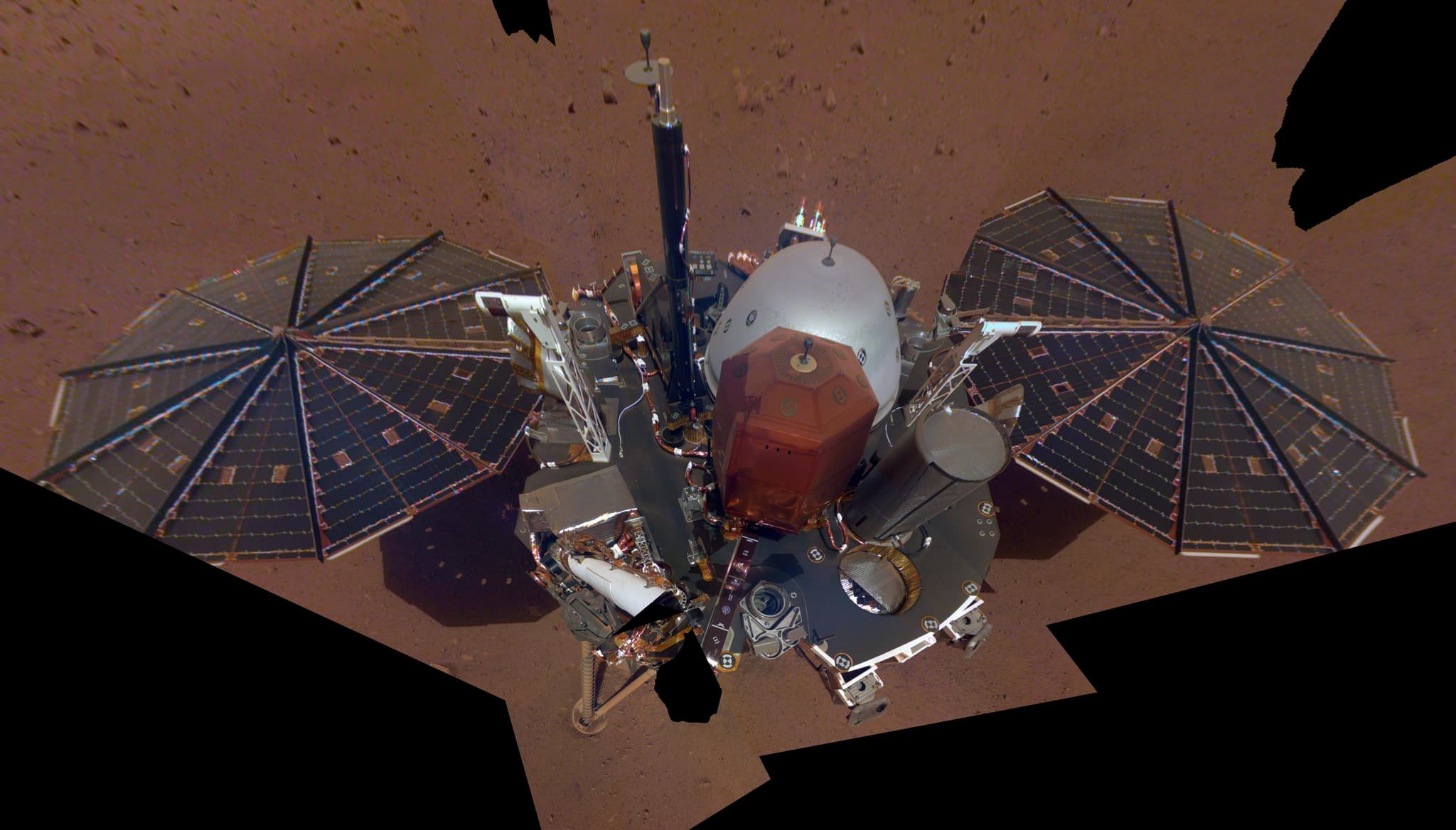
InSight was not sent to look at Mars. It was sent to listen to it. Every earlier American lander had carried cameras and chemistry aimed outward at the surface; InSight carried a seismometer, a heat probe and a radio experiment, and all three pointed downward, at the crust, mantle and core of a planet nobody had ever measured from the inside. NASA's press kit stated the contrast plainly: the only seismometers previously used on Mars stayed on the decks of the two Viking landers in 1976, where they were much less sensitive and far more exposed to wind. InSight's French-built SEIS would instead be lifted off the deck by a robotic arm, set on the ground, and covered with a dome to keep the wind and the temperature swings out. The lander left Vandenberg on 5 May 2018 at 11:05 UTC on an Atlas V 401, the first launch to another planet from the West Coast of the United States, and arrived on 26 November. Entry took about six and a half minutes: atmosphere at roughly 5.5 kilometres per second, peak heating near 1,500 Celsius, a parachute at about 11 kilometres, then twelve descent engines down to a touchdown at about 2.24 metres per second. Confirmation reached Pasadena at 11:52 a.m. PST. The whole spacecraft had weighed 694 kilograms at launch and the part that landed weighed 358. It came to rest in a shallow, sand-filled crater about 27 metres across that the team named Homestead hollow.
The seismometer justified the mission on its own. Placed on the ground on 19 December 2018, it caught its first marsquake on 6 April 2019 and ended with 1,319 events in the catalogue, the first seismic record of a planet other than Earth. From the way those waves bent and bounced came the first direct measurements of the inside of another planet: a crust beneath the lander either 20 or 39 kilometres thick depending on which buried interface is taken as its base, a mantle without the deep bridgmanite layer that Earth has, and a liquid metal core. The core is where the numbers stop agreeing. Seismic reflections gave 1,830 kilometres of radius in 2021; radio tracking of the lander's own wobble gave 1,835 in 2023 and argued that there is no solid inner core at all; two papers in the same October 2023 issue of Nature then inserted a molten silicate layer above the core and shrank it to about 1,650 or 1,675; and in September 2025 a paper in Nature by Bi and colleagues claimed a solid inner core about 613 kilometres in radius after all. The review published in May 2026 by Fernando, Charalambous and Economon says outright that it is not immediately clear how a solid inner core and a basal mantle melt layer are compatible. That is where the question sits in 2026. What is not in doubt is that before InSight there were no numbers to argue about.
The heat probe is the part everyone remembers, and it is usually remembered wrongly. HP3 was a self-hammering steel probe, nicknamed the mole, that was meant to drive itself 3 to 5 metres down while paying out a tether of temperature sensors, so the mission could measure how much heat is still leaking out of Mars. It began hammering on 28 February 2019 and stalled almost at once. What stopped it was not rock. The mole was designed for loose sand that would collapse around it and grip its sides, providing the friction it needed to push against; the soil at Homestead hollow instead behaved as a cohesive duricrust about 20 centimetres thick that clumped, held an open pit around the probe, and gave it almost nothing to hold on to. Nearly two years of remedial work followed: pressing the scoop against the mole's side to pin it, filling the pit, hammering again with the arm moved clear. On 9 January 2021, after a final 500 strokes with no progress, the team stopped. JPL described the top of the mole ending 2 or 3 centimetres under the surface, meaning its back end; the peer-reviewed account puts the depth reached at about 37 centimetres. Tilman Spohn, its principal investigator, said Mars and the mole remained incompatible. The instrument still produced real science, just not the science it was built for: the record of its failure is now one of the best datasets on Martian soil mechanics anyone has.
What killed InSight was dust, and it killed it slowly and visibly. The arrays generated about 5,000 watt-hours per sol when the lander was new. By May 2022 that was about 500, a fall of roughly ninety per cent, with each sol's dust settling and nothing taking it away. Spirit and Opportunity had been repeatedly rescued by gusts that swept their panels clean; InSight sat in a place where that never happened. The team tried what it could, using the robotic arm in what JPL called an innovative way to shed dust from the panels, which bought a little power. Instruments were switched off one by one until only the seismometer was left, and then the seismometer was run in shorter and shorter windows. NASA had decided in advance on a stopping rule: two missed communication attempts and the mission would be declared over. The final image was taken on 11 December 2022, sol 1436, and shows the seismometer sitting on the ground. The last signal came on 15 December. On 21 December NASA declared the mission finished, adding that it would keep listening just in case, but that hearing from the lander was considered unlikely. Nothing was ever heard. In December 2024 NASA published an orbital image of the lander taken that October, by then the same reddish-brown as the plain around it, and said it would stop listening at the end of that year.
The lander is dead and the mission is not. InSight's seismic archive has kept producing results at a rate that outpaces most operating spacecraft. In February 2025 NASA reported that seismic waves from meteoroid impacts travel deeper than expected, through a faster path in the mantle, which means some events had been mislocated. In August 2025 a Science paper led by Constantinos Charalambous used eight marsquakes to map lumps of ancient impactor debris still embedded in the Martian mantle, some of them kilometres across and preserved because Mars has no plate tectonics to stir them away. A 2024 paper in PNAS by Wright, Morzfeld and Manga used the same seismic velocities together with gravity data to argue that the middle crust, roughly 11.5 to 20 kilometres down, is best explained by fractured igneous rock saturated with liquid water; that conclusion is inferred from rock physics. Nothing detected the water, and the paper says so. It is also disputed in print. Bruce Jakosky replied in PNAS in March 2025 under the title 'Results from the InSight Mars mission do not require a water-saturated mid crust', and a further comment by Xiao and colleagues drew a reply from Wright's team in August 2025 conceding that a wet or a dry mid-crust is only part of the question. As of August 2026 this one is open. And in May 2026 Nature Communications published a review whose whole purpose is to lay out which InSight results have held and which are still contested. Judged as a spacecraft, InSight lasted four years and died of dust. Judged as an instrument, it is still working.
Mission facts
Launch
5 May 2018 at 11:05 UTC (04:05 PDT), Atlas V 401 from Space Launch Complex 3-East at Vandenberg, California, with the two MarCO CubeSats riding along. NASA's launch press kit called it the first launch to another planet from the West Coast. NASA's MarCO page gives the shared launch time as 11:05 UTC; English Wikipedia carries the second-level figure 11:05:01 UTC. All times here are UTC unless a local time is given.↗
Spacecraft
About 694 kg for the whole spacecraft at launch: lander 358 kg, aeroshell 189 kg, cruise stage 79 kg, and 67 kg of propellant and pressurant. Each MarCO CubeSat added 13.5 kg. On the ground the lander spanned 6.00 m tip to tip across its two circular solar arrays, with a deck 1.56 m across, a robotic arm 1.8 m long and a deck height of 83 to 108 cm once the legs had compressed. The arrays were expected to make 600 to 700 W on a clear Martian day and 200 to 300 W on a dusty one.↗
Cost
NASA's landing press kit states that US investment in InSight is 813.8 million dollars, with France and Germany contributing roughly 180 million dollars more. The MarCO CubeSats cost a further 18.5 million dollars and were funded separately. A round figure of 830 million dollars for the total is widely repeated, including by English Wikipedia; it is not the number NASA published.↗
Instruments
SEIS, the seismometer, provided by France's CNES with principal investigator Philippe Lognonne of the Institut de Physique du Globe de Paris. HP3, the heat flow and physical properties probe, provided by DLR with principal investigator Tilman Spohn. RISE, a radio science experiment led by William Folkner at JPL, which tracked the lander's X-band signal to measure how Mars wobbles. Plus weather sensors, a magnetometer and two cameras. NASA's press kit set the mole's target depth at 10 to 16 feet, which is 3 to 5 m, described SEIS as able to detect ground motions smaller than the diameter of a hydrogen atom, and stated the precedent plainly: 'The only seismometers previously used on Mars stayed on the decks of two Viking landers in 1976. Those were much less sensitive and more exposed to wind effects than InSight's seismometer will be.'↗
Landing
26 November 2018. Entry at about 5.5 km/s, peak heating near 1,500 C about 90 seconds in, peak deceleration up to 7.5 g, parachute at about 11.1 km altitude and 385 m/s, twelve descent engines, and touchdown at about 2.24 m/s. The whole sequence took about six and a half minutes into a landing ellipse of roughly 130 by 27 km. NASA confirmed touchdown at 11:52 a.m. PST, which is 19:52 UTC. NASA Science's own InSight page, checked on 23 August 2026, carries the second-level value as 11:52:59 a.m. PT, which is 19:52:59 UTC.↗
Landing site
4.502 N, 135.623 E at an elevation of -2,613.43 m, inside Homestead hollow, a degraded impact crater about 27 m across in Elysium Planitia. Determined from HiRISE imaging acquired on 6 December 2018. RISE X-band tracking over the first 34 sols put the lander's inertial position about 220 m to the west, an offset the paper reads as map-tie uncertainty rather than as a competing location. The surface is dust over thin unconsolidated sand over a duricrust of variable thickness.↗
The seismometer on the ground
SEIS was lifted off the lander deck and placed on the surface on 19 December 2018, about as far away as the arm could reach, 1.636 m from the lander, and a dome-shaped wind and thermal shield was later lowered over it to keep out wind and temperature swings. Putting a seismometer on the ground rather than leaving it on the deck is the single design decision the whole mission turned on.↗
Marsquakes
1,319 in the final catalogue. NASA already gave that total in its 21 December 2022 retirement release and was still using it in August 2025. The count was still rising through the mission: NASA cited more than 1,313 in May 2022 and 1,318 in October 2022. The first detection was on 6 April 2019, sol 128. The 2026 Nature Communications review describes more than 1,300 distinct events following a Gutenberg-Richter distribution and split into low-frequency and high-frequency families.↗
The largest marsquake
S1222a, on 4 May 2022 at 23:23:07 UTC, sol 1222. NASA announced it as an estimated magnitude 5 event. The peer-reviewed analysis by Kawamura and colleagues, published in Geophysical Research Letters on 14 December 2022, assigns a moment magnitude of 4.7 plus or minus 0.2 and a seismic moment of 1.4 x 10^16 N m, roughly equal to every other detected event added together. Its coda ran for more than ten hours. The two numbers are not a contradiction: 5 was a first estimate, 4.7 is the refined moment magnitude.↗
How deep the mole got, and why it stopped
It began hammering on 28 February 2019 and reached a depth of about 37 cm, against the 3 to 5 m it was built for. The cause was not rock and not a boulder. The mole needed friction from the surrounding soil to hold it in place between strokes, and Spohn and colleagues attribute the failure to a lack of friction in an unexpectedly thick cohesive duricrust, about 20 cm thick, with a penetration resistance of 0.3 to 0.7 MPa and a cohesion of 2 to 15 kPa. The material clumped and held an open pit around the probe instead of collapsing onto it and gripping it.↗
How the mole campaign ended
On 9 January 2021 the team commanded a final 500 hammer strokes, saw no progress, and stopped; NASA announced it on 14 January 2021. JPL's release describes 'the top of the mole about 2 or 3 centimeters under the surface', which is where the probe's back end finished rather than the depth its tip reached; Spohn's paper puts the back end 1 to 2 cm below the surface and the tip at about 37 cm. Tilman Spohn, the HP3 principal investigator: 'We've given it everything we've got, but Mars and our heroic mole remain incompatible.'↗
The core, which is still argued about
There is no single agreed number. Stahler and colleagues (Science, 23 July 2021) put the liquid core radius at 1,830 plus or minus 40 km from seismic reflections. Le Maistre and colleagues (Nature, published online 14 June 2023) got 1,835 plus or minus 55 km from RISE radio tracking assuming an entirely solid mantle, and argued against a solid inner core. Samuel and colleagues (Nature, 25 October 2023) instead allow a molten silicate layer above the core and get 1,650 plus or minus 20 km; Khan and colleagues in the same issue get 1,675 plus or minus 30 km with a molten layer 150 plus or minus 15 km thick. Bi and colleagues (Nature, 3 September 2025) then claimed a solid inner core, giving its radius as 613 plus or minus 67 km; the paper's title rounds this to 600 km, and the 610 plus or minus 50 km figure that circulates comes from the 2024 preprint version, which the published paper supersedes. Nature issued an author correction to it in December 2025. The May 2026 review states that it is not immediately clear how a solid inner core and a basal mantle melt layer are compatible with each other. The individual papers' titles, authors, figures and publication dates were checked against Europe PMC records on 23 August 2026; the reconciliation of their numbers is the review's, which cites the inner-core paper as Bi et al. and rounds its radius to 600 km. The crust is better behaved but still doubled: beneath the landing site the data fit models with at least two and possibly three interfaces, giving a thickness of 20 plus or minus 5 km if the second is its base and 39 plus or minus 8 km if the third is (Knapmeyer-Endrun et al., Science, July 2021). Scaled globally that is an average Martian crust of 24 to 72 km, the range the 2026 review still quotes.↗
Meteoroid impacts heard, then found
InSight recorded seismic signals from meteoroid strikes and orbital imaging then located the fresh craters. The largest, on 24 December 2021, registered magnitude 4 and left a crater about 150 m across and 21 m deep in Amazonis Planitia, throwing out boulder-sized chunks of water ice from closer to the equator than ice had previously been found. NASA published it on 27 October 2022 alongside two Science papers.↗
Power and dust
The arrays made about 5,000 watt-hours per sol at landing and about 500 by May 2022, a fall of roughly ninety per cent, as dust settled and nothing took it away. The team used the robotic arm in what JPL called an innovative way to remove dust from the panels, which bought enough energy to keep running the seismometer more often. No cleaning gust ever came. Bruce Banerdt: 'We've been hoping for a dust cleaning like we saw happen several times to the Spirit and Opportunity rovers. That's still possible, but energy is low enough that our focus is making the most of the science we can still collect.'↗
End of mission
The last image was taken on 11 December 2022, sol 1436, and shows the seismometer on the ground. The last contact was 15 December 2022. NASA had set the stopping rule in advance, declaring the mission over once the lander missed two communication attempts, which is JPL's wording, and did so on 21 December 2022, adding that the agency 'will continue to listen for a signal from the lander, just in case, but hearing from it at this point is considered unlikely'.↗
Status in 2026
Ended, and confirmed ended. NASA published an orbital image of the retired lander taken on 23 October 2024 and said at the time that it would stop listening for InSight at the end of that year. NASA's InSight mission page, checked on 23 August 2026, still gives 'End of Mission: Dec. 15, 2022' and lists no news item later than August 2025. No source consulted on 23 August 2026 records any signal from the lander since 15 December 2022.↗
Mission timeline
- 5 May 2018Launch at 11:05 UTC on an Atlas V 401 from Vandenberg, the first launch to another planet from the US West Coast, carrying the two MarCO CubeSats as a separate technology experiment.
- 26 Nov 2018Entry at about 5.5 km/s, parachute at about 11 km, twelve descent engines, touchdown at about 2.24 m/s in Elysium Planitia. Confirmation reaches Earth at 11:52 a.m. PST (19:52 UTC), relayed live by the MarCO CubeSats.
- 19 Dec 2018The robotic arm lifts SEIS off the deck and sets it on the ground 1.636 m from the lander, the first seismometer placed directly on the surface of Mars rather than left on a lander deck.
- 28 Feb 2019The HP3 mole starts hammering. It stalls almost immediately, and the next twenty-two months are spent trying to give it enough friction to keep going.
- 6 Apr 2019Sol 128: SEIS records the first marsquake. Philippe Lognonne: 'We've been waiting months for a signal like this. It's so exciting to finally have proof that Mars is still seismically active.'
- 9 Jan 2021After a final 500 hammer strokes with no progress, the mole campaign is abandoned at a depth of about 37 cm. NASA announces it on 14 January.
- 23 Jul 2021Science devotes one issue (vol. 373 no. 6553) to InSight's interior results: Stahler and colleagues report a liquid core of 1,830 plus or minus 40 km radius from seismic reflections, and Knapmeyer-Endrun and colleagues report a crust beneath the lander either 20 plus or minus 5 or 39 plus or minus 8 km thick depending on which buried interface is taken as its base. These are the first measurements of the inside of a planet other than Earth.
- 24 Dec 2021A meteoroid strikes Amazonis Planitia. InSight registers a magnitude 4 event; orbital imaging later finds a crater about 150 m across that has thrown out boulder-sized chunks of water ice unusually close to the equator.
- 4 May 202223:23:07 UTC, sol 1222: S1222a, the largest marsquake of the mission. NASA calls it an estimated magnitude 5; the refined moment magnitude is 4.7 plus or minus 0.2, and its seismic moment roughly equals every other recorded event combined.
- 15 to 21 Dec 2022The last signal from InSight arrives on 15 December, four days after its final image. After two missed communication attempts NASA declares the mission over on 21 December, saying it will keep listening 'just in case, but hearing from it at this point is considered unlikely'.
- 16 Dec 2024NASA publishes a Mars Reconnaissance Orbiter image of the retired lander taken on 23 October 2024, its solar panels now the same reddish-brown as the plain around it, and says it will stop listening for InSight at the end of the year.
- 11 May 2026Nature Communications publishes a review of what InSight settled and what it did not, by Benjamin Fernando, Constantinos Charalambous and Sophia Economon. Impact-generated marsquakes are still forcing reinterpretation of the catalogue more than three years after the lander went quiet.
A filled dot marks something that physically happened. A hollow one marks an announcement, a naming or a target.
In pictures
Tap a photo to enlarge.
Sources
- NASA Science: InSight mission page
- NASA JPL (21 Dec 2022): NASA Retires InSight Mars Lander Mission After Years of Science
- NASA JPL InSight landing press kit: Quick Facts
- NASA JPL InSight landing press kit: Science
- NASA JPL (17 May 2022): NASA's InSight Still Hunting Marsquakes as Power Levels Diminish
- NASA JPL (14 Jan 2021): NASA InSight's 'Mole' Ends Its Journey on Mars
- Spohn, T., et al., The InSight HP3 Penetrator (Mole) on Mars: Soil Properties Derived from Penetration Attempts, Space Science Reviews 218 (9 Dec 2022)
- Golombek, M., et al., Geology of the InSight landing site on Mars, Nature Communications (24 Feb 2020)
- Kawamura, T., et al., S1222a: The Largest Marsquake Detected by InSight, Geophysical Research Letters (14 Dec 2022)
- NASA JPL (28 Aug 2025): NASA Marsquake Data Reveals Lumpy Nature of Red Planet's Interior
- NASA JPL (16 Dec 2024): NASA Mars Orbiter Spots Retired InSight Lander to Study Dust Movement
- Fernando, B., Charalambous, C., and Economon, S., Mars' enigmatic interior: recent findings from InSight and open questions, Nature Communications (11 May 2026)
- Bi, H., Sun, D., Sun, N., Mao, Z., Dai, M., and Hemingway, D., Seismic detection of a 600-km solid inner core in Mars, Nature (3 Sep 2025)
- Wright, V., Morzfeld, M., and Manga, M., Liquid water in the Martian mid-crust, PNAS (12 Aug 2024)
- Jakosky, B. M., Results from the InSight Mars mission do not require a water-saturated mid crust, PNAS (6 Mar 2025)
- Wright, V., Morzfeld, M., and Manga, M., Reply to Xiao et al.: A wet or dry Martian mid-crust, that is only part of the question, PNAS (18 Aug 2025)
- Knapmeyer-Endrun, B., et al., Thickness and structure of the martian crust from InSight seismic data, Science (23 Jul 2021)
- English Wikipedia: InSight
Facts on this page were verified on 23 August 2026. Where sources disagree, the disagreement is stated rather than resolved silently.
135.6230 E, 4.5020 N · Homestead Hollow · position confirmed from orbit