National Mars ambitions
MBRSC and the UAE Space Agency; KASA (South Korea); others · Multinational · Program · 2017 · AnnouncedPlanned
Two national targets with no Mars hardware behind them: the UAE's Mars 2117 settlement programme of 14 February 2017 and South Korea's 2045 robotic landing goal, set 28 November 2022. Both stood on 24 August 2026.
TL;DR· 14 min read
The UAE and South Korea have each put a Mars date into national policy without putting a Mars spacecraft into development. Mars 2117, unveiled on 14 February 2017, is a hundred-year programme run by MBRSC whose first phase is preparing Emirati scientists and engineers, and its Mars Science City has no confirmed opening. President Yoon Suk-yeol promised a robotic Mars landing in 2045, a goal KASA has since restated as Moon and Mars base construction, with 96.8 billion won of exploration budget for 2026.
Two countries have put a Mars date into national policy without putting a Mars spacecraft into a factory. The UAE named 2117, a century out, and handed the programme to a space centre with instructions to build people rather than hardware. South Korea named 2045, the centenary of liberation, and has since folded it into a roadmap that talks about Moon and Mars base construction rather than a landing. Neither is a mission and neither should be filed as one. They are worth recording anyway, because they are how a small space power states an intention, and because the machinery they built is real even when the destination is not.
- 2117UAE target year for a first human settlement on Mars, set on 14 February 2017
- 2045Korean target year for a Mars landing, set on 28 November 2022
- 96.8 bn wonKASA's entire 2026 exploration budget line, against 100 trillion won promised by 2045
The United Arab Emirates announced Mars 2117 on 14 February 2017, at the World Government Summit in Dubai, and the interesting thing about it is what it did not contain. There was no spacecraft, no launcher, no landing site and no intermediate mission. There was a date a hundred years out and a stated final-stage aim of the first inhabitable human settlement on Mars. What the two rulers actually described was an education programme. Sheikh Mohamed bin Zayed put it plainly: the project is long term, and the first objective is to develop the educational system so that Emirati scientists can lead research. Sheikh Mohammed bin Rashid called it a seed planted for future generations to reap. Eight days later he handed it to the Mohammed Bin Rashid Space Centre with instructions to write a hundred-year plan focused on preparing national cadres in space science, research, artificial intelligence, robotics and advanced space technologies, plus a detailed five-year plan and, revealingly, a media plan sized to how well the announcement had been received. MBRSC's own page for the programme organises it under four pillars, Research and Development, Enablement, Education and Collaboration, and its stated mission is to prepare cadres of space scientists and engineers. Read on its own terms, Mars 2117 is a national capability-building programme that uses a Mars settlement as its organising metaphor. Read as a mission announcement, which is how it was widely reported, it is unfalsifiable for the next ninety-one years.
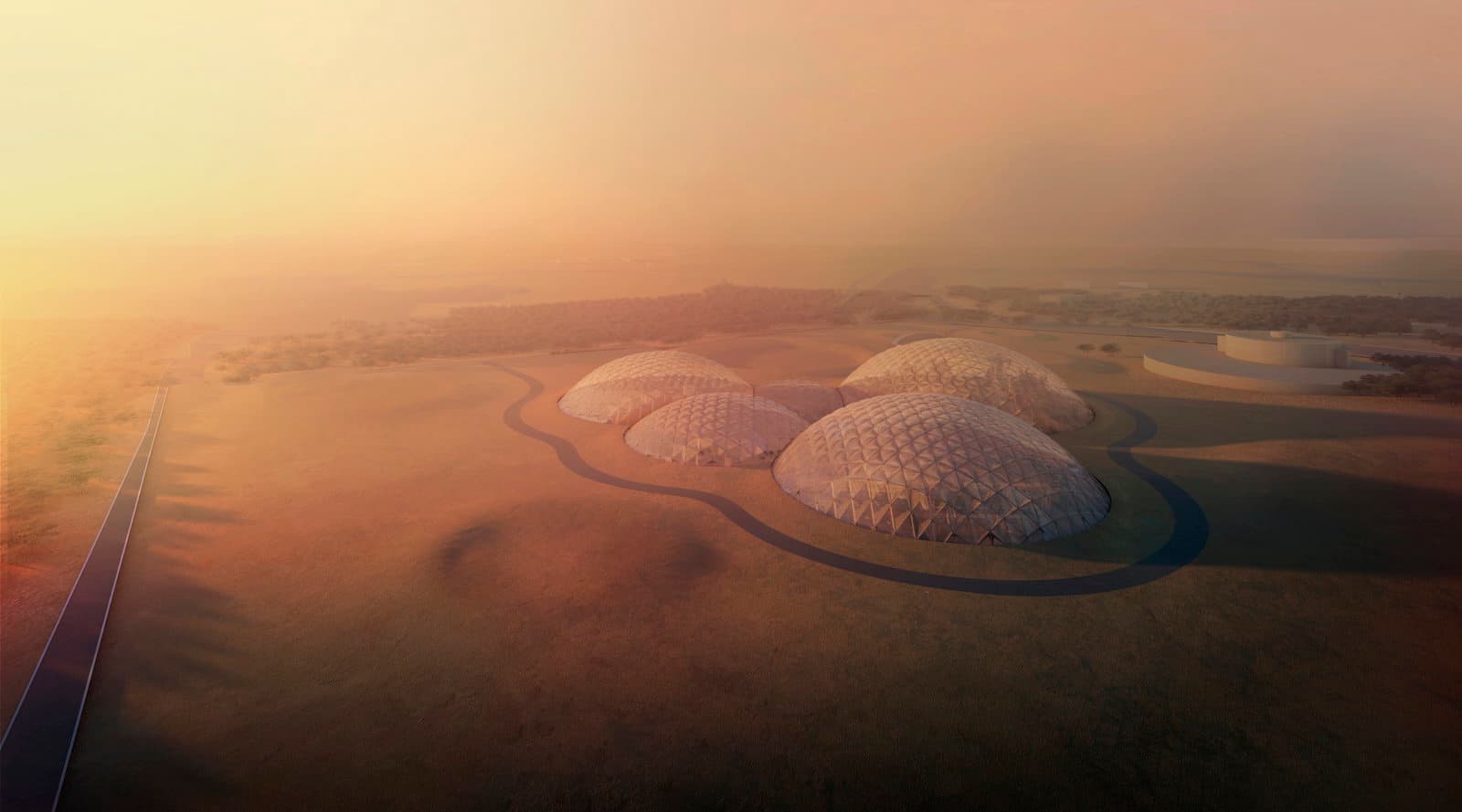
One piece of it was physical. In September 2017 the UAE announced Mars Science City, a planned AED 500 million, 1.9 million square foot complex of domes in Dubai, to be designed with the architects Bjarke Ingels, and to hold laboratories for food, energy and water, a museum with walls 3D printed from Emirati desert sand, and a team sealed inside a simulated Martian environment for a year. That is a checkable claim, and as of August 2026 we cannot check it off. The UAE government's own portal still describes the project in the future tense on a page last updated on 30 December 2024, using the same figures announced in 2017. MBRSC's current Missions and Projects page lists the astronaut programme, the satellite programme, the Rashid rover and the Emirates Airlock, and does not mention Mars 2117 or Mars Science City at all. We found no official statement of construction start, completion or opening. That absence is the entry's most useful fact and also its weakest, because it is an absence. What did happen is smaller and real: MBRSC co-ran the eight-month SIRIUS-21 isolation study in Moscow from November 2021, and in late 2024 put Obaid AlSuwaidi through 45 days in NASA's HERA habitat in Houston, running eighteen human health experiments, six of them led by MBRSC with three Emirati universities.
South Korea's number is nearer and narrower. On 28 November 2022 President Yoon Suk-yeol told the Korea Space Forum that the country would land a robotic spacecraft on the Moon in 2032 and on Mars in 2045, chosen because it is the centenary of liberation from Japanese colonial rule, and said that by 2045 Korea would be able to plant its flag on Mars. He promised to double the space budget within five years and to put at least 100 trillion won into the sector by 2045, against a 2022 space budget of 734 billion won. Two details get lost in the retelling. The target is a robotic lander with nobody aboard. And Mars was a new objective for Korea at that moment, arriving alongside a lunar date that had just slipped from 2030 to 2032. The institutional follow-through was genuine. The Korea AeroSpace Administration opened on 27 May 2024 under a special act, a National Space Council was stood up, and by February 2025 that council had approved strategic plans for launch, satellites and space science exploration aimed at making Korea a top-five aerospace nation.
Then the language changed. On 4 September 2025 KASA announced that its sixth Space Development Promotion Working Committee had approved the Korea Space Exploration Roadmap, a document of mid and long-term goals running to 2045, built on an exploration strategy issued in February 2025. Its vision is stated as expanding human knowledge and expanding the territory of the space economy. Its core goals include use of space resources and 달·화성 기지건설, Moon and Mars base construction. Its programmes are low Earth orbit microgravity, lunar exploration, solar and space science, planetary system exploration and astrophysics. Nowhere in KASA's public vision material that we could read is 2045 attached to a Mars landing; Mars appears as a direction, in the phrase expand exploration beyond the Moon to Mars and deep space. Meanwhile the money is legible. On 2 December 2025 the National Assembly fixed KASA's 2026 budget at 1.1201 trillion won, the agency's first year over a trillion, of which the exploration line is 96.8 billion won. That is the whole of Korean exploration, lunar included, for one year, set against a promise of 100 trillion won by 2045. Both of these programmes are best understood as statements of national direction with real institutions attached, and no Mars hardware behind them.
Mission facts
The Mars 2117 announcement
Unveiled on Tuesday 14 February 2017 in Dubai, on the sidelines of the fifth World Government Summit, by Sheikh Mohammed bin Rashid Al Maktoum, Vice President, Prime Minister and Ruler of Dubai, and Sheikh Mohamed bin Zayed Al Nahyan, then Crown Prince of Abu Dhabi. The Emirates News Agency described a project which "aims at its final stage to establish the first inhabitable human settlement in Mars by 2117".↗
What was promised, in their words
Sheikh Mohammed bin Rashid: "The new project is a seed that we plant today, and we expect future generations to reap the benefits, driven by its passion to learn to unveil a new knowledge." Sheikh Mohamed bin Zayed, on the same day: "The Mars 2117 Project is a long term project, where our first objective is to develop our educational system so our sons will be able to lead scientific research across the various sectors." The first phase was described as preparing human cadres rather than building spacecraft.↗
Who runs it
On 22 February 2017, eight days after the unveiling, Sheikh Mohammed bin Rashid directed the Mohammed Bin Rashid Space Centre to lead Mars 2117 and prepare a hundred-year plan. The centre was told to focus on preparing specialised national cadres in space science, research, artificial intelligence, robotics and advanced space technologies, to produce a detailed five-year plan covering technological, logistical and technical aspects, and to run a parallel media plan at local, regional and international level.↗
The four pillars
MBRSC's own Mars 2117 page organises the programme as Research and Development, Enablement, Education and Collaboration. Its stated mission is "To prepare cadres of space scientists and engineers that can enable the UAE to contribute to the development of space travel and planetary settlement capabilities, in particular the establishment of a human colony on the Red Planet". Its stated objectives are life support systems for human settlements on other planets alongside research addressing food, water and energy security on Earth. No spacecraft, launch or landing is named anywhere on the page.↗
Mars Science City
Announced on Tuesday 26 September 2017 at the UAE government annual meetings in Abu Dhabi. As described that day, in the future tense of a project being launched rather than opened: AED 500 million, 1.9 million square feet, several domes, laboratories for food, energy and water, a museum whose walls would be 3D printed from Emirati desert sand, and a plan for a team to live inside the simulated city for one year. WAM called it the largest space simulation city ever built. The design team was led by MBRSC and Dubai Municipality with the architects Bjarke Ingels.↗
Where Mars Science City stands
Unclear, and that is the honest answer. The UAE government portal still carries the 2017 description and the 2017 figures on a page last updated 30 December 2024, in the future tense: "the UAE will build a complex of buildings called Mars Science City". MBRSC's current Missions and Projects page lists the astronaut programme, satellites, the Rashid rover and the Emirates Airlock, and does not list Mars 2117 or Mars Science City at all. We found no official announcement of construction start, completion or opening.↗
What the UAE has actually done
The concrete Emirati record at Mars is one orbiter. The Emirates Mars Mission probe Hope launched from Tanegashima on 20 July 2020 and reached Mars orbit in February 2021, and has its own entry in this catalogue. The country's other approved deep space project, the Emirati interplanetary mission planned for 2028, goes to the asteroid belt. Mars is not its destination. The Rashid rover went to the Moon and the Emirates Airlock is for lunar Gateway.↗
The analogue programme
The most substantive Mars-directed Emirati activity is human research. Under the UAE Analog Programme, Emirati crew member Obaid AlSuwaidi spent 45 days from 1 November to 16 December 2024 inside NASA's Human Exploration Research Analog at Johnson Space Center, as part of HERA Campaign 7 Mission 4, with communication delays of up to five minutes and a virtual reality Mars walk. The study ran 18 human health experiments, six of them led by MBRSC with UAEU, Mohammed Bin Rashid University of Medicine and Health Sciences and the American University of Sharjah. MBRSC also co-ran the eight-month SIRIUS-21 isolation study in Moscow from 4 November 2021 to 3 July 2022.↗
The Korean announcement
On 28 November 2022 President Yoon Suk-yeol said South Korea would land a robotic spacecraft on the Moon in 2032 and on Mars in 2045, the centenary of liberation from Japanese colonial rule. "By 2045, we will be able to plant our national flag on Mars," he said in a keynote at the Korea Space Forum 2022 in Seoul. He promised to double the government space budget within five years and to funnel at least 100 trillion won, then about 74.7 billion dollars, into the space sector by 2045. South Korea's space budget for 2022 was 734 billion won.↗
It is a robotic target
The 2045 goal as announced is an uncrewed robotic landing, and Mars was a new objective for South Korea at the time; the Moon date had also slipped, from 2030 under the previous administration to 2032. Details were expected in the fourth revision of the Basic Plan for Promotion of Space Development, the five-year plan running to 2027.↗
The agency that followed
The Korea AeroSpace Administration (우주항공청, KASA) opened on 27 May 2024, under a special act on its establishment and operation enacted on 26 January 2024 and taking effect on 27 May. It is based in Sacheon, South Gyeongsang province, and it is the first single Korean agency to hold the state space programmes that were previously spread across several ministries.↗
How KASA states the goal now
KASA's vision page sets the target as becoming one of the five leading aerospace nations, with a government budget of 1.5 trillion won by 2027 and national investment of 100 trillion won by 2045. Under exploration it gives the line 달을 넘어 화성·심우주로 탐사 확대, expand exploration beyond the Moon to Mars and deep space, with sub-items covering an exploration roadmap, lunar science, extending Korea's horizon into deep space, asteroid mining and preparing a crewed space programme. No Mars date appears on the page.↗
The 2025 roadmap
On 4 September 2025 KASA announced that its sixth Space Development Promotion Working Committee, held in writing from 28 August to 4 September, had approved the 대한민국 우주탐사 로드맵, the Korea Space Exploration Roadmap, containing mid and long-term goals and implementation plans to 2045. Its stated vision is expanding human knowledge and expanding the territory of the space economy, and its core goals include use of space resources and 달·화성 기지건설, Moon and Mars base construction. The roadmap covers low Earth orbit microgravity, lunar exploration, solar and space science, planetary exploration and astrophysics. This press release is the fullest account of the roadmap we could read; we could not open the roadmap document itself, and we found no confirmation of when or whether it was published in full.↗
What Korea actually spends
KASA's 2026 budget was fixed at 1.1201 trillion won by a National Assembly plenary vote on 2 December 2025, up 155.2 billion won or 16.1 per cent on 2025's 964.9 billion won, and the first time the agency has passed one trillion won. Of that, 96.8 billion won goes to the exploration line, described as creating future space livelihoods through challenging exploration. The other five lines are transportation, satellites, aviation, industrial ecosystem and workforce. Against a stated 100 trillion won of national investment by 2045, this is the actual annual figure.↗
The other national visions
India's Space Vision 2047, as ISRO chairman S. Somanath set it out in the Sardar Patel Memorial Lecture in New Delhi on 26 October 2024, centres on an Indian landing on the Moon and on the Bharatiya Antariksh space station as a launching point for lunar exploration. In the Press Information Bureau's account of that lecture, Mars appears only as a destination already visited, on the way to future missions to Venus. No Indian Mars date, crewed or robotic, has been announced. China has published far more than either the UAE or Korea and is covered in its own entry in this catalogue.↗
Why we file these as visions
None of them has the three things a mission needs: an approved project, a funded vehicle and a committed date attached to that vehicle. The UAE's target is a century away and is described by its own operators as an education and research programme. Korea's is twenty years away and has been restated in the 2025 roadmap as base construction rather than a landing. Both are policy commitments to a direction. That is a real thing, and it is not the same thing as a spacecraft.↗
Mission timeline
- 14 Feb 2017Sheikh Mohammed bin Rashid Al Maktoum and Sheikh Mohamed bin Zayed Al Nahyan unveil the Mars 2117 Project at the fifth World Government Summit in Dubai, with the stated final-stage aim of the first inhabitable human settlement on Mars by 2117.
- 22 Feb 2017Sheikh Mohammed bin Rashid directs the Mohammed Bin Rashid Space Centre to lead the project and prepare a hundred-year plan, focused on national cadres in space science, research, artificial intelligence, robotics and advanced space technologies, plus a detailed five-year plan and a media plan.
- 26 Sep 2017Mars Science City is launched at the UAE government annual meetings in Abu Dhabi: AED 500 million, 1.9 million square feet, several domes, a year-long crewed simulation and a museum with 3D printed walls made from Emirati desert sand, designed with Bjarke Ingels.
- 20 Jul 2020The Emirates Mars Mission orbiter Hope launches from Tanegashima, the concrete Emirati result at Mars and a separate mission from the 2117 programme.
- 4 Nov 2021 to 3 Jul 2022MBRSC co-runs the eight-month SIRIUS-21 isolation study in Moscow with Roscosmos and NASA, its first long-duration analogue involvement.
- 28 Nov 2022President Yoon Suk-yeol tells the Korea Space Forum in Seoul that South Korea will land a robotic spacecraft on the Moon in 2032 and on Mars in 2045, and promises at least 100 trillion won into the space sector by 2045.
- 27 May 2024The Korea AeroSpace Administration opens in Sacheon, under a special act enacted on 26 January 2024.
- 1 Nov to 16 Dec 2024Emirati crew member Obaid AlSuwaidi spends 45 days inside NASA's HERA habitat at Johnson Space Center as part of Campaign 7 Mission 4, running 18 human health experiments with five-minute communication delays.
- Feb 2025KASA issues 대한민국 우주과학탐사 추진전략, its space science exploration strategy, at the third National Space Committee. This is the document the 2045 exploration roadmap is later built on.
- 4 Sep 2025KASA announces that its sixth Space Development Promotion Working Committee has approved the Korea Space Exploration Roadmap to 2045, whose core goals include Moon and Mars base construction.
- 2 Dec 2025The National Assembly fixes KASA's 2026 budget at 1.1201 trillion won, the agency's first year above one trillion, of which 96.8 billion won is the exploration line.
- 24 Aug 2026Both targets still stand in official material. The UAE government portal's Mars Science City page, last updated 30 December 2024, still describes the city in the future tense, and MBRSC's current projects page does not list Mars 2117. KASA's vision page carries Mars as a direction without a date.
A filled dot marks something that physically happened. A hollow one marks an announcement, a naming or a target.
In pictures
Tap a photo to enlarge.
Sources
- Emirates News Agency (WAM), 14 February 2017: VP, Mohamed bin Zayed unveil "Mars 2117 Project"
- WAM, 22 February 2017: VP tasks Mohammed Bin Rashid Space Centre to lead Mars 2117 project
- WAM, 26 September 2017: VP, Abu Dhabi Crown Prince launch AED 500 mn Mars Science City at UAE Government Annual Meetings
- MBRSC's own Mars 2117 page
- The Official Portal of the UAE Government (u.ae): Space missions
- MBRSC, 17 December 2024: MBRSC Announces Successful Completion of the Final Phase of the Second Analog Study (HERA Campaign 7 Mission 4)
- SpaceNews (Park Si-soo), 29 November 2022: South Korean leader eyes "landing on moon in 2032, Mars in 2045"
- Press Information Bureau (India), 26 October 2024: Dr. S. Somanath Delivers Lecture on 'Indian Space Odyssey' at the Sardar Patel Memorial Lecture 2024
- KASA (우주항공청): 주요연혁, giving the 27 May 2024 launch and the 26 January 2024 special act
- KASA: 비전 및 목표, the vision page with the top-five goal, the 100 trillion won by 2045 figure and the line on expanding exploration beyond the Moon to Mars
- KASA press release, 4 September 2025: 인류 지식과 우주경제 영토 확장을 위한 「대한민국 우주탐사 로드맵」 수립
- KASA press release, 3 December 2025: 우주항공청 '26년도 예산 1조 1,201억원 확정
Facts on this page were verified on 24 August 2026. Where sources disagree, the disagreement is stated rather than resolved silently.