Starship and Mars
SpaceX · United States · Program · 2016 · AnnouncedIn development
SpaceX has never launched anything to Mars. Starship flew thirteen tests without reaching orbit before Flight 14 reached it on 28 September 2026, and as of that date SpaceX's own website offers cargo to the Martian surface no earlier than 2028.
TL;DR· 17 min read
SpaceX has never launched anything to Mars. Starship flew thirteen integrated tests without reaching orbit before Flight 14 reached it on 28 September 2026, and it has never transferred propellant between two vehicles in space, the step every Starship Mars plan begins with. The company gave up the November 2026 window in February 2026 and put the Moon first; its own website now offers cargo to the Martian surface no earlier than 2028 at $100 million per metric ton. Its one contracted Mars launch is a Falcon Heavy to carry ESA's Rosalind Franklin rover, targeted for no earlier than late 2028.
Separating what SpaceX has done about Mars from what it has said about Mars is the whole job of this entry. What it has done: built what it calls the world's most powerful launch vehicle ever developed, flown it fourteen times (the fourteenth flight, on 28 September 2026, was the first to reach orbit), signed one agreement to carry Italian science on a future Mars flight, taken a booking for a private crewed flyby of Mars with no date attached, and won a NASA contract to launch Europe's Rosalind Franklin rover on a Falcon Heavy no earlier than late 2028. What it has said: that uncrewed spacecraft would land on Mars in 2018, then that cargo ships would leave for Mars in 2022, then in 2026, and now that cargo flights start no earlier than 2028. In February 2026 the company abandoned the 2026 window and said the Moon comes first. No Starship has yet left Earth orbit, and none has been refuelled there.
- 1Starship flight to reach orbit in fourteen integrated tests since April 2023: Flight 14, on 28 September 2026
- 2028earliest date SpaceX's own website now gives for cargo flights to the Martian surface
- $100mper metric ton, the advertised price of Starship cargo to Mars
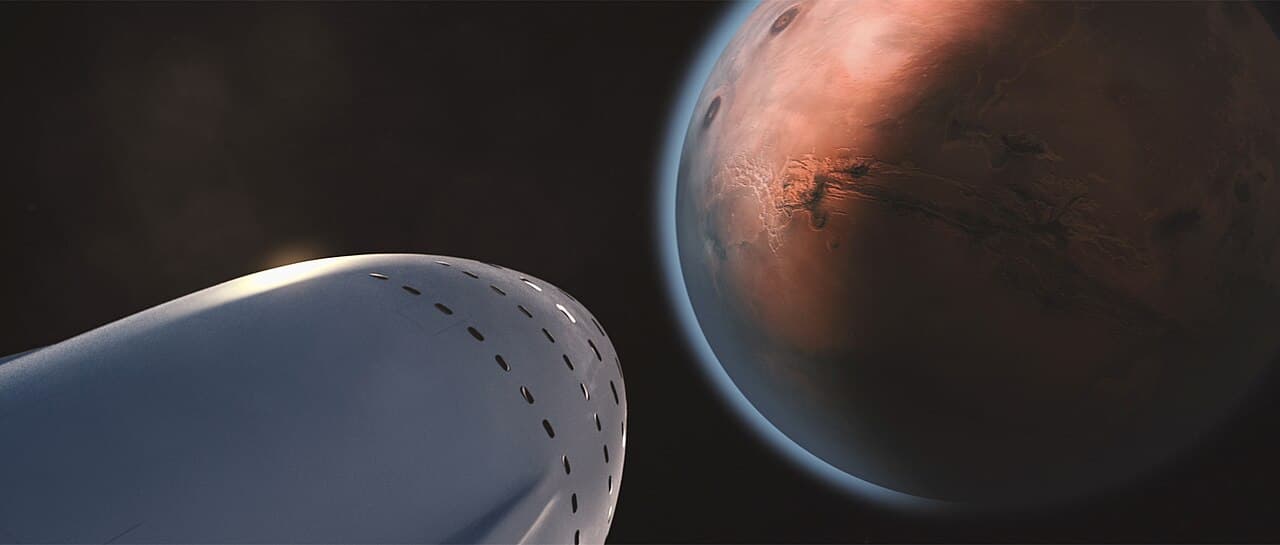
The useful way to read SpaceX and Mars is to keep three columns and never let them merge. In the first column, things that have flown: nothing to Mars. Not one kilogram of SpaceX hardware has ever been sent on a Mars trajectory. The Tesla Roadster launched on the first Falcon Heavy in February 2018 is often miscounted here, but JPL Horizons has it in a heliocentric orbit of perihelion 0.99 and aphelion 1.67 astronomical units whose closest approach to Mars so far, in October 2020, was 7.4 million kilometres. In the second column, things that are contracted: one launch. On 16 April 2026 NASA selected a Falcon Heavy to launch the European Space Agency's Rosalind Franklin rover no earlier than late 2028, for a reported $175.7 million, as part of the support package NASA took on after Europe severed its ExoMars cooperation with Russia in 2022. That is a real Mars launch on a real manifest, and it is a Falcon Heavy carrying somebody else's spacecraft. It is also not secure: NASA's fiscal 2027 budget request proposes cancelling the ROSA project that pays for it, as the 2026 request did before Congress restored the money. There are also two commercial bookings, neither with a date attached: an agreement signed with the Italian Space Agency on 7 August 2025 to fly a plant growth experiment, a weather station and a radiation sensor on the first commercial Starship flights to Mars, and a private crewed flyby of Mars for Chun Wang, commander of the Fram2 Dragon flight, which SpaceX announced on 21 May 2026. In the third column, things that have been announced. That column is very long, and it is the one everything else gets written from.
The engineering position underneath the announcements is easy to state and does not move. Every Starship Mars architecture SpaceX has published since 2016 works the same way: the ship reaches low Earth orbit having burned nearly all its propellant, tanker Starships fill it up again in orbit, and only then does it have the energy to leave for Mars. Starship flew thirteen integrated tests on trajectories deliberately short of orbit before it did the first of those two things: Flight 14, billed as its first attempt to reach orbit at all, reached orbit on 28 September 2026. As of that date ship-to-ship propellant transfer has not been attempted. Gwynne Shotwell called it critical on 4 August 2026, to SpaceX's own ambitions and to the lunar lander it owes NASA. None of this means the vehicle is failing. Flight 13 in July 2026 deployed twenty next-generation Starlink V3 satellites and then survived its splashdown in the Indian Ocean intact, which no previous ship had, and SpaceX towed the thing to Christmas Island to look at the heat shield. Musk's assessment on the earnings call was that the heat shield problem is solved. The programme is visibly progressing. It is simply progressing through the milestones that come before any Mars mission can begin, and has not started on the Mars mission itself.
The dates have their own history, and it is worth laying out because the pattern is so regular. April 2016: an uncrewed Red Dragon capsule lands on Mars as early as 2018. September 2017: Red Dragon is gone, replaced by BFR, and the first two cargo ships target the 2022 window, a date Musk insisted was 'not a typo'. September 2024: five uncrewed Starships leave in the 2026 window, crew two years after that if the landings work. May 2025: the 2026 window is a 50-50 proposition, with orbital refilling the biggest hurdle. February 2026: it is abandoned. Today SpaceX's website advertises cargo to the Martian surface no earlier than 2028 at $100 million per metric ton. Each step moves the target by one or two transfer windows, which is what you would expect from a schedule pegged to celestial mechanics rather than to engineering readiness, and the total is a decade in which the earliest Mars landing has stayed a few years away throughout. It is also not a story of a single vehicle waiting on a pad. The 2018 date belonged to a capsule that was cancelled in 2017. The 2022 date belonged to a rocket whose dimensions, engines, materials and control surfaces all changed before it first flew in 2023, and whose staging method changed after that first flight.
February 2026 is the sharpest turn in the sequence, because every earlier change had moved a date and this one changed the order of destinations. On 6 February the Wall Street Journal reported, in an account relayed by SpaceNews, that SpaceX had dropped its 2026 Mars mission and was redirecting Starship toward an uncrewed lunar landing demonstration as soon as March 2027. On 8 February Musk confirmed it in his own words: SpaceX had 'already shifted focus to building a self-growing city on the Moon, as we can potentially achieve that in less than 10 years, whereas Mars would take 20+ years.' The argument he gave was cadence, and it is a good one. You can go to the Moon every ten days and be there in two; you can go to Mars every twenty-six months and be there in six. If your goal is a city, you want the shorter iteration loop. What makes it striking is that thirteen months earlier, in January 2025, the same person had written 'No, we're going straight to Mars. The Moon is a distraction,' and about seven years before that had complained that we should have had a lunar base by 2017. Mars, he said in February 2026, remains on the list: SpaceX 'will also strive to build a Mars city and begin doing so in about 5 to 7 years.' Meanwhile the window that SpaceX declined opens in late 2026 and will be used, by Japan's MMX and by NASA's two ESCAPADE spacecraft, which are already in space waiting for it.
Mission facts
What SpaceX itself currently offers
The Mars Missions panel on SpaceX's own Mars page reads: 'Starship cargo flights to the Martian surface for research, development, and exploratory missions start no earlier than 2028, at a rate of $100 million per metric ton.' It then invites enquiries about payload masses, pricing and timeframes to sales@spacex.com. The identical sentence appears on the Moon page with 'lunar surface' substituted, and the same 2028 date and price. We read this text directly out of the page data that spacex.com serves, because the page is a client-rendered application that returns no text to a fetcher and its Wayback captures are empty. ScienceBlog reported the same wording, with the same date and the same price, on 15 August 2026.↗
What else that page says
The page is headed 'Mars & Beyond' with the subheading 'THE ROAD TO MAKING HUMANITY MULTIPLANETARY'. Its 'A City on Mars' panel states that a self-sufficient city will require upwards of one million people and millions of tonnes of cargo, delivered by 'launching more than 10 times per day to maximize transfer windows that open up every approximately 26 months', with 'several thousand Starships' ultimately involved. Its 'Landing on Mars' panel states that Starship will enter the Martian atmosphere at 7.5 km/s and decelerate aerodynamically, and that higher levels of atomic oxygen are expected to make entry harsher than at Earth. Unlike the pricing sentence, this panel text has no second source: it was last read out of the same page data on 28 September 2026 and cannot be checked by opening the link.↗
The vehicle, in SpaceX's own numbers
124 metres tall, 9 metres in diameter, designed to carry more than 100 metric tonnes to orbit in a fully reusable configuration, with a Super Heavy booster and a Starship upper stage both built from stainless steel and burning methane and oxygen. Methane was chosen partly because it can in principle be synthesised on Mars from atmospheric carbon dioxide and water ice.↗
Flight record
Thirteen integrated flight tests from April 2023 to July 2026, none of which reached orbit; Flight 14, on 28 September 2026, was the first that did. Flight 12 on 22 May 2026 was the debut of the Block 3 or V3 vehicle and the first use of the second Starbase pad; its booster relit only 20 of the 33 engines intended for the boostback burn, aborted it, and hit the water hard when only one engine lit for landing, while the ship reached its planned cutoff, deployed 20 mass simulators and two modified Starlink satellites, and flew a nominal reentry and landing flip. Flight 13 on 24 July 2026 deployed 20 Starlink V3 satellites on a suborbital trajectory, so they reentered with the ship.↗
The ship that floated
Flight 13's upper stage survived splashdown and tipping over in the Indian Ocean instead of exploding, which had never happened before. After about 24 days at sea, SpaceX announced on 18 August 2026 that its recovery team had brought it to calmer water off Christmas Island, and on 27 August the company said it had been loaded onto a semi-submersible ship for a voyage of several months back to Starbase. At the company's 4 August 2026 earnings call Elon Musk said of the heat shield: 'I think we consider the heat shield problem solved at this point.'↗
The two prerequisites
Orbit and orbital propellant transfer. Flight 14 was billed as Starship's first attempt at low Earth orbit; announced on 4 August 2026 for the end of that month, it slipped into September, and on 20 August Musk said SpaceX would 'probably catch the ship with the tower in a few months', dropping the catch from that flight. It reached orbit on 28 September 2026. Propellant transfer between two vehicles has not been demonstrated. Gwynne Shotwell on 4 August 2026: 'propellant transfer in orbit is critical to both our internal SpaceX as well as our HLS ambitions.'↗
Why refuelling is the gate
A Starship that reaches low Earth orbit has spent almost all its propellant getting there. Every Mars architecture SpaceX has published since 2016 depends on filling it up again in orbit from tanker Starships before it departs. In May 2025 Musk put the odds of making the 2026 window at 'a 50/50 chance', naming refuelling in orbit as the biggest hurdle.↗
The date history
In April 2016 SpaceX said it would land an uncrewed Red Dragon on Mars as early as 2018. In September 2017 the first two cargo missions were targeted at the 2022 window, a date Musk said was 'not a typo'. On 7 September 2024 he said the first uncrewed Starships would leave in the 2026 window and, if those landings went well, 'the first crewed flights to Mars will be in 4 years', that is about 2028. In May 2025 he gave the 2026 window a 50 per cent chance. SpaceX's website now says no earlier than 2028. The architecture changed completely at least once along the way, so these dates do not all belong to one vehicle.↗
Red Dragon
The 2016 plan was a modified Dragon 2 capsule launched on a Falcon Heavy and landing propulsively on its SuperDraco thrusters, with NASA supplying technical support under an unfunded Space Act Agreement in exchange for entry, descent and landing data. It was cancelled in 2017 when SpaceX abandoned propulsive landing for Crew Dragon and redirected its Mars work to the much larger vehicle that became Starship. No Red Dragon was built for flight.↗
The 2026 window, and who is using it
The published table of Mars transfer opportunities gives this one as November to December 2026. SpaceX will not use it. SpaceNews reported on 9 February 2026, relaying a Wall Street Journal story of 6 February that we did not read directly, that the company had abandoned a 2026 Mars mission in favour of an uncrewed lunar landing demonstration as soon as March 2027, and that Musk confirmed the reprioritisation two days after the newspaper report. The window is not going unused: JAXA's MMX is set to launch on 20 October 2026, a little ahead of the table's dates, and NASA's two ESCAPADE spacecraft, already in a loiter orbit, are to fly past Earth in November 2026 and use its gravity to slingshot toward Mars.↗
The February 2026 reversal, in Musk's words
On 8 February 2026 he wrote: 'For those unaware, SpaceX has already shifted focus to building a self-growing city on the Moon, as we can potentially achieve that in less than 10 years, whereas Mars would take 20+ years.' His reasoning was cadence: 'It is only possible to travel to Mars when the planets align every 26 months (six month trip time), whereas we can launch to the Moon every 10 days (2 day trip time).' He added that SpaceX 'will also strive to build a Mars city and begin doing so in about 5 to 7 years, but the overriding priority is securing the future of civilization and the Moon is faster.'↗
The Mars customers so far
On 7 August 2025 Teodoro Valente, president of the Italian Space Agency, announced an agreement to fly Italian experiments on the first commercial Mars flights of Starship. ASI's statement listed a plant growth experiment, a meteorological monitoring station and a radiation sensor, gathering data during the roughly six-month cruise and afterwards on the surface. SpaceX president Gwynne Shotwell posted: 'Get on board! We are going to Mars! SpaceX is now offering Starship services to the Red Planet.' No launch date has been attached to it. On 21 May 2026 SpaceX announced a second Starship Mars customer: Chun Wang, commander of the private Fram2 Dragon flight, is to fly on Starship's first crewed interplanetary mission, a two-year trip that flies past Mars and returns to Earth without landing. SpaceX gave no date for it either.↗
The Mars launch SpaceX actually has
On 16 April 2026 NASA announced it had approved its Rosalind Franklin Support and Augmentation (ROSA) project for implementation and selected a SpaceX Falcon Heavy to launch the European Space Agency's Rosalind Franklin rover from Kennedy Space Center, targeting no earlier than late 2028. The launch is reported to cost $175.7 million. The launcher is a Falcon Heavy, the payload is ESA's, and no Starship is involved. SpaceNews added on 17 April that NASA's fiscal year 2027 budget request contains no funding for ROSA and proposes cancelling it, and that ROSA was already targeted for cancellation in 2026 before Congress restored the money. Asked why the fiscal 2027 request shows no money for the mission, NASA Administrator Jared Isaacman told House appropriators on 27 April 2026 that the launch funding is coming out of the fiscal 2026 budget; he gave no details for the other items NASA is to supply the mission, such as the radioisotope heater units and the braking engines. The launch contract is real; the project it belongs to is not safe.↗
What is actually funded
SpaceX's funded Starship work beyond Earth orbit is all lunar. It won a NASA Human Landing System contract in 2021 for a Starship variant to land astronauts on the Moon, and Shotwell's stated sequence on 4 August 2026 was the Artemis III docking test, then an uncrewed direct-to-lunar cargo mission, then 'boots on the moon in 2028'. We found no government contract, appropriation or milestone payment anywhere for a Starship mission to Mars.↗
The Roadster is not a Mars mission
The Tesla Roadster launched on the first Falcon Heavy on 6 February 2018 is frequently described as having been sent to Mars. JPL Horizons records it in a heliocentric orbit with perihelion 0.99 au and aphelion about 1.67 au. Its closest approach to Mars so far was on 7 October 2020 at 0.0495 au, about 7.4 million kilometres, and the next nominal encounter is 22 April 2035 at 0.016 au. It has never been near Mars and was never intended to arrive there.↗
Musk on the Moon, over time
The current lunar priority is the third position in nine years. In a July 2017 speech: 'To really get the public real fired up, I think we've got to have a base on the moon.' At that year's International Astronautical Congress he complained: 'It's 2017; we should have a lunar base by now.' In January 2025, responding to a proposal to make Starship propellant from lunar oxygen: 'No, we're going straight to Mars. The Moon is a distraction.' In February 2026 the Moon came first again.↗
Mission timeline
- 27 Apr 2016SpaceX announces Red Dragon, a modified Dragon capsule that would land uncrewed on Mars as early as 2018, with NASA providing technical support under an unfunded agreement.
- Sep 2016At the International Astronautical Congress, Musk unveils the Interplanetary Transport System, the design that becomes Starship, and says that if things go to plan people could launch in 2024 and arrive in 2025.
- Sep 2017The BFR presentation targets the first two cargo missions at the 2022 window, followed by two cargo and two crew ships in 2024. Musk says 2022 is 'not a typo' while calling it aspirational. Red Dragon is cancelled the same year when propulsive landing is dropped from Crew Dragon.
- Apr 2023Starship's first integrated flight test, months after the 2022 window in which the 2017 plan had the first cargo ships leaving for Mars, and a year before the crewed launch promised in 2016.
- 7 Sep 2024Musk says the first uncrewed Starships will launch for Mars in the window opening in two years, to test the reliability of landing intact, with the first crewed flights in four years, about 2028, if the landings work.
- 29 May 2025At Starbase, Musk presents a schedule scaling from about 20 ships in the 2028 to 2029 window to about 500 in 2033, and puts the odds of making the 2026 window at 50-50, with refuelling in orbit the biggest hurdle.
- 7 Aug 2025The Italian Space Agency signs an agreement to fly a plant growth experiment, a weather station and a radiation sensor on the first commercial Starship flights to Mars. Gwynne Shotwell: 'Get on board! We are going to Mars!'
- 6 to 9 Feb 2026A Wall Street Journal report, relayed by SpaceNews, says SpaceX has abandoned a 2026 Mars mission in favour of an uncrewed lunar landing demonstration as soon as March 2027. On 8 February Musk confirms the shift and says a Mars city would begin in about five to seven years.
- 16 Apr 2026NASA selects a SpaceX Falcon Heavy to launch ESA's Rosalind Franklin rover no earlier than late 2028, a launch reported at $175.7 million. It is the first Mars launch SpaceX has ever had on the books, and it is not a Starship.
- 21 May 2026During the countdown for the first Flight 12 attempt, SpaceX announces a private crewed Mars flyby: Chun Wang, commander of the Fram2 Dragon flight, is to fly on Starship's first crewed interplanetary mission, a two-year trip past Mars and back. No date is given.
- 22 May 2026Flight 12, the debut of the V3 vehicle and of the second Starbase pad. Only 20 of 33 engines relight for the booster's boostback burn and only one for its landing burn, and it hits the water; the ship completes its suborbital profile, deploys 22 payloads and reenters successfully.
- 24 Jul 2026Flight 13 deploys 20 Starlink V3 satellites on a suborbital trajectory and the ship survives splashdown intact, floating in the Indian Ocean. About 24 days later SpaceX's recovery team brings it to calmer water off Christmas Island.
- 4 to 21 Aug 2026At SpaceX's first earnings call as a public company, Musk says Flight 14 will be Starship's first orbital mission and will attempt a tower catch of the ship. By 21 August the ship catch has been deferred to a later flight and the launch has slipped into September.
- 28 Sep 2026Flight 14 becomes the first Starship to reach orbit and deploys 26 Starlink satellites.
A filled dot marks something that physically happened. A hollow one marks an announcement, a naming or a target.
In pictures
Tap a photo to enlarge.
Sources
- SpaceX: Mars & Beyond
- SpaceNews (Jeff Foust, 9 Feb 2026): Musk says SpaceX focus is on the moon rather than Mars
- SpaceNews (Jeff Foust, 21 Aug 2026): SpaceX scales back plans for next Starship launch
- SpaceNews (Jeff Foust, 17 Apr 2026): NASA selects Falcon Heavy to launch ESA Mars rover mission despite budget threat
- SpacePolicyOnline (Marcia Smith, 4 Aug 2026): Next Starship Will Deliver Operational V3 Starlinks to Orbit, Maybe Catch Ship
- English Wikipedia: List of Starship launches
- English Wikipedia: SpaceX Mars colonization program
- Space.com (Mike Wall, 18 Apr 2026): This life-hunting rover may be SpaceX's 1st-ever Mars launch
- Space.com (Mike Wall, 7 Aug 2025): SpaceX signs deal to fly Italian experiments to Mars on Starship's 1st commercial Red Planet flights
- ScienceBlog (15 Aug 2026): a decade of SpaceX Mars deadlines, 2016 to 2028
- JPL Horizons object record for the Tesla Roadster (-143205), revised 3 January 2025
- English Wikipedia: Exploration of Mars
- SpaceX: Starship vehicle page
- SpaceX: Starship Flight 14 mission page
- Space.com (Tariq Malik, 22 May 2026): This cryptocurrency billionaire will fly SpaceX's 1st private Starship to Mars, but when?
- Space.com (Mike Wall, 9 Feb 2026): A city on the moon: Why SpaceX shifted its focus away from Mars
- Space.com (Mike Wall, 30 May 2025): Elon Musk says SpaceX will launch its biggest Starship yet this year, but Mars in 2026 is '50/50'
- Space.com (Mike Wall, 8 Sep 2024): SpaceX will start launching Starships to Mars in 2026, Elon Musk says
- NASA Science (16 Apr 2026): NASA Begins Implementation for ESA's Rosalind Franklin Mission to Mars
- SpaceX update (21 May 2026): First Starship interplanetary human spaceflight mission
- SpaceX update (15 Sep 2026): Starship to Orbit
- Space.com (Mike Wall, 20 Aug 2026): SpaceX will try for 1st Starship tower catch 'in a few months,' Elon Musk says
- Space.com (Mike Wall, 27 Aug 2026): Starship is coming home! SpaceX loads floating spacecraft onto huge ship in the Indian Ocean (photos)
- Space.com (18 Aug 2026): report on Flight 13's ship reaching Christmas Island
- Payload (Elizabeth Howell, 19 Apr 2026): SpaceX Won A Mars Mission That Might Get Cancelled
- Payload (Douglas Gorman, 9 Feb 2026): SpaceX Delays Mars Plans in Favor of the Moon
- CNN (Jackie Wattles, Hadas Gold and John Liu, 8 Feb 2026): Elon Musk says SpaceX prioritizing the moon, pivots away from his Mars settlement ambition
- Space.com (Mike Wall, 19 Jul 2017): Elon Musk Calls for Moon Base
- Space.com (Mike Wall, 29 Sep 2017): Elon Musk Wants Giant SpaceX Spaceship to Fly People to Mars by 2024
- Space.com (Mike Wall, 29 Sep 2016): SpaceX's Mars Colony Plan: By the Numbers
- Space.com (September 2016): report on the unveiling of the Interplanetary Transport System
- JAXA (20 Aug 2026): Launch schedule of the Martian Moons eXploration (MMX) spacecraft aboard H3 Launch Vehicle flight No.10
- NASA Science: ESCAPADE mission page
- NASA Science (7 Jan 2026): NASA's ESCAPADE Spacecraft Completes Trajectory Maneuver
- SpacePolicyOnline (Marcia Smith, 27 Apr 2026): Top House NASA Appropriator Calls Budget Request 'Disappointing'
Facts on this page were verified on 28 September 2026. Where sources disagree, the disagreement is stated rather than resolved silently.