MarCO A and B
NASA · United States · Flyby · 2018 · The long occupationSuccess
In orbit around the Sun and silent since 4 January 2019. The two CubeSats relayed InSight's landing live from about 3,500 km out on 26 November 2018, then stopped answering within six weeks.
TL;DR· 11 min read
MarCO-A and MarCO-B were two briefcase-sized CubeSats that launched with InSight on 5 May 2018 and flew past Mars about 3,500 km away on 26 November, carrying the landing telemetry to Earth across a light trip of 8 minutes and 7 seconds. NASA calls them the first CubeSats to fly to deep space. They cost 18.5 million dollars, and both fell silent within six weeks of the flyby, MarCO-B on 29 December 2018 and MarCO-A on 4 January 2019.
The relay that carried the news of InSight's landing was not a half-tonne orbiter. It was two boxes the size of a large briefcase, built for 18.5 million dollars, steering with the same gas that fills a fire extinguisher and talking through a flat folding antenna. MarCO-A and MarCO-B were a technology demonstration that NASA was careful to say InSight did not depend on. They worked anyway, and then, their job done, they coasted past Mars into the Sun's orbit and stopped answering.
- 1stCubeSats to fly to deep space, on NASA's own account
- 8 min 7 sone-way light time their live relay of the landing had to cross
- 13.5 kgeach, in a box 36.6 by 24.3 by 11.8 cm before deployment
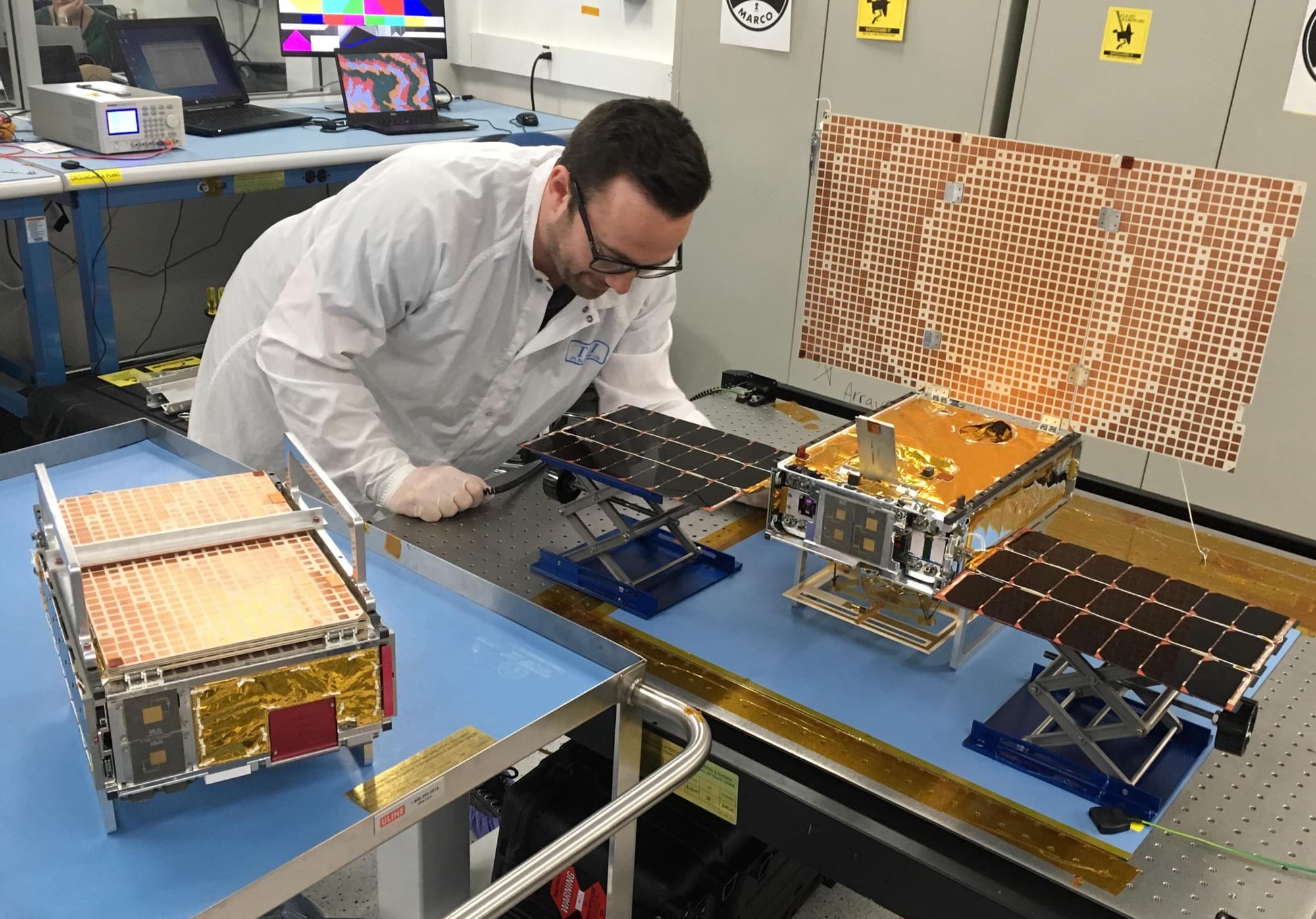
A CubeSat is a satellite built to a standard unit of ten centimetres cubed, a format invented so that university students could fly hardware in low Earth orbit cheaply. MarCO was the same idea taken to another planet. Each of the two spacecraft was six of those units, about 36.6 by 24.3 by 11.8 centimetres before anything unfolded, and weighed 13.5 kilograms. The pair cost 18.5 million dollars, which is roughly two per cent of what NASA spent on InSight. They steered with eight thrusters running on compressed R236FA, the gas used in fire extinguishers, and talked to Earth through a flat folding panel called a reflect array standing in for a dish. They carried a UHF antenna to hear InSight and two smaller X-band antennas besides the main one. Their entire job was to sit near Mars on landing day, listen to the lander on UHF, reformat the stream and push it to Earth at eight kilobits per second, so that flight controllers could follow the descent as it happened instead of waiting for an orbiter to record it and play it back later. NASA was careful, repeatedly and in writing, to say that InSight's success was independent of its CubeSat tag-alongs, and that Mars Reconnaissance Orbiter and Mars Odyssey held the primary telecommunications responsibility. MarCO was a demonstration wearing an operational costume.
They were heard from within hours of launch on 5 May 2018, both reporting deployed solar panels and working radios, which drew from chief engineer Andy Klesh the line that both said 'Polo!'. Then they had to fly themselves to Mars. Each performed its own trajectory correction manoeuvres, the first ever made by a CubeSat, and each took pictures on the way: Earth and the Moon early on, and on 3 October 2018 the first image of Mars ever returned by a CubeSat, taken by MarCO-B's wide-angle camera as an exposure test from about 12.8 million kilometres out with its own antenna hardware in the corners of the frame. Not everything went cleanly. MarCO-B, the one nicknamed Wall-E, had been leaking propellant almost since liftoff, which made holding an attitude harder and more expensive in gas than it should have been. JPL said so publicly four days before the landing rather than after it. Klesh's assessment of the other, EVE, was that she followed her namesake and had been flying beautifully. Both arrived. Both were pointed correctly. Both worked.
On 26 November 2018 the two CubeSats flew past Mars about 3,500 kilometres away while InSight went down through the atmosphere below them. Mars was about 146 million kilometres from Earth that day, which is eight minutes and seven seconds at the speed of light, and that number is the whole point of the mission. Everything the world saw of InSight's landing in something close to real time came through two objects that would fit in an overhead locker. The parachute, the heat shield, the twelve descent engines, the touchdown at 11:52 a.m. PST: each event was reported as it was happening plus the light time, rather than being reconstructed an hour or two later. MarCO-B also turned a camera on Mars during the pass. The distance NASA gives for that photograph is worth a footnote, because NASA gives two: the JPL mission page says about 4,700 miles or 7,600 kilometres, and NASA Science's MarCO page says about 4,700 miles or 6,000 kilometres. Four thousand seven hundred miles is 7,564 kilometres, so the second is a conversion error rather than a second measurement. Andrew Klesh's flight-results paper, filed with NASA's technical reports server the following year, records that both spacecraft performed beyond expectations and provided a real-time link through what the agency calls the seven minutes of terror.
Then they stopped. Having no way to slow down, both carried on past Mars into orbit around the Sun, receding from Earth and from the Sun on trajectories nobody had planned to use for anything. MarCO-B was last heard from on 29 December 2018, about a month after the flyby; MarCO-A on 4 January 2019. NASA's own mission page still records those two dates and nothing after them. English Wikipedia adds that a campaign in September 2019 tried to raise them when the geometry improved and heard nothing, and that NASA announced the mission formally over on 2 February 2020; the report it cites for that is one we could not open on 23 August 2026, so it is offered here as Wikipedia's account rather than as a NASA statement read directly. Nothing has come from either since. What they proved is the part that outlived them: that a spacecraft costing under ten million dollars a copy can navigate itself to another planet, hold an attitude accurately enough to point a high-gain antenna, and do useful work when it gets there. NASA's press kit calls them the first CubeSats to fly to deep space. On the evidence, they were also the cheapest useful thing in the sky above Mars that afternoon.
Mission facts
What they were
Two identical six-unit CubeSats, officially MarCO-A and MarCO-B. NASA's landing press kit names them 'MarCO-A and MarCO-B, also nicknamed EVE and Wall-E', in that order, after the two robots in the Pixar film. Each measured about 36.6 by 24.3 by 11.8 cm stowed and weighed 13.5 kg, with deployable solar arrays and antennas.↗
Catalogue numbers
MarCO-A is 2018-042B and MarCO-B is 2018-042C, both launched with InSight, which is 2018-042A. NASA's NSSDCA master catalogue, the usual place to check this, was offline for maintenance when we tried on 23 August 2026, so these designations come from Gunter's Space Page.↗
Launch
5 May 2018 at 11:05 UTC on the Atlas V 401 that carried InSight, from Vandenberg. Both were heard from the same day, at 12:15 p.m. and 1:58 p.m. PST, confirming their solar panels had deployed and their radios were alive. Chief engineer Andy Klesh: 'Both MarCO-A and B say Polo!'↗
Radios
A UHF antenna to receive InSight's transmissions during entry, a flat X-band high-gain reflect array to send them onward to Earth, and two smaller X-band antennas, low-gain and medium-gain. The relay ran at 8 kilobits per second.↗
Propulsion
Eight thrusters using compressed R236FA, described by NASA as a common propellant in fire extinguishers. They made the first trajectory correction manoeuvres ever performed by CubeSats, each steering itself toward Mars.↗
The leak
MarCO-B, the one nicknamed Wall-E, leaked propellant almost from liftoff. Andy Klesh, four days before the landing: 'WALL-E has been leaking fuel almost since liftoff.' Of the other he said 'EVE seems to follow her namesake and has been flying beautifully throughout the [mission].' Controllers worked around the leak and MarCO-B still made its flyby and its relay.↗
The firsts NASA claims
NASA's landing press kit says MarCO 'is the first deep space mission for CubeSats', that the pair 'became the first CubeSats to fly to deep space', and that they were 'the first CubeSats to provide images of Earth, its moon and Mars'. These are NASA's formulations and we have not independently audited every one of them.↗
First picture of Mars from a CubeSat
Taken on 3 October 2018 by the wide-angle camera on top of MarCO-B as a test of exposure settings, from roughly 12.8 million km out, with parts of the high-gain antenna visible on either side of the frame. NASA released it on 22 October 2018.↗
What they did on landing day
Each flew past Mars about 3,500 km away as InSight entered the atmosphere, receiving InSight's UHF stream, reformatting it and sending it Earthward across about 146 million km, a trip of 8 minutes and 7 seconds at the speed of light. That is why the landing could be followed almost live rather than reconstructed afterwards from a recording.↗
Whether it worked
It did. The abstract of Andrew Klesh's flight-results paper, filed with NASA's technical reports server on 21 October 2019, states that 'the MarCO spacecraft successfully flew by Mars while relaying entry-descent-and-landing telemetry for the InSight vehicle' and that both craft 'performed beyond expectations and were able to provide a realtime link for the so-called seven minutes of terror'.↗
InSight did not depend on them
NASA said so before the fact. The landing press kit states that 'InSight's success is independent of its CubeSat tag-alongs' and that Mars Reconnaissance Orbiter and 2001 Mars Odyssey held primary telecommunications responsibility for the landing. MarCO shortened the wait for news; it was not the only way the news could arrive.↗
The flyby picture, and a NASA arithmetic slip
MarCO-B photographed Mars during the flyby on 26 November 2018. NASA's two current pages disagree on how far away it was: the JPL mission page says 'about 4,700 miles (7,600 kilometers)' and NASA Science's MarCO page says 'about 4,700 miles (6,000 kilometers)'. 4,700 miles is 7,564 km, so the metric figure on the NASA Science page is a bad conversion of the same distance.↗
Last contact
MarCO-B on 29 December 2018 and MarCO-A on 4 January 2019, as listed in NASA's own key dates for the mission. That is roughly a month and six weeks after the flyby respectively.↗
The attempt to get them back
English Wikipedia records a NASA campaign in September 2019 to re-establish contact once the geometry improved, and states that on 2 February 2020 NASA announced the mission had formally ended. The underlying report it cites is a Space.com article we could not open on 23 August 2026, so we present this as Wikipedia's account rather than as a NASA statement we have read. NASA's own MarCO page lists no event after 4 January 2019.↗
Where they are now
In orbit around the Sun, past Mars, silent. They were on flyby trajectories and never had the propulsion to enter Mars orbit, so they carried straight on. Nothing consulted on 23 August 2026 records a signal from either since 4 January 2019.↗
Cost and team
18.5 million dollars, built and managed by NASA's Jet Propulsion Laboratory. Joel Krajewski was project manager and Andrew Klesh project engineer and chief engineer.↗
Mission timeline
- 5 May 2018Launch at 11:05 UTC on InSight's Atlas V 401 from Vandenberg. Both CubeSats report in the same afternoon, at 12:15 and 1:58 p.m. PST, with solar panels deployed and radios working.
- 3 to 22 Oct 2018MarCO-B's wide-angle camera takes the first picture of Mars from a CubeSat on 3 October, from about 12.8 million km, as a test of exposure settings. NASA releases it on 22 October.
- 22 Nov 2018Four days out, JPL confirms publicly that MarCO-B has been leaking propellant almost since liftoff, and that controllers have worked around it. Its twin is reported to be flying beautifully.
- 26 Nov 2018Both CubeSats fly past Mars about 3,500 km away, catch InSight's UHF signal through the entry and landing, and pass it to Earth across 146 million km, a light trip of 8 minutes and 7 seconds.
- 26 Nov 201811:52 a.m. PST (19:52 UTC): touchdown confirmation reaches JPL by way of the two CubeSats. MarCO-B also photographs Mars during the flyby.
- 29 Dec 2018Last contact with MarCO-B, the leaky one, about a month after the flyby.
- 4 Jan 2019Last contact with MarCO-A. Nothing has been heard from either since.
- Sep 2019NASA runs a campaign to re-establish contact as the two drift into a more favourable position relative to the Sun and Earth. Nothing answers. This account comes from English Wikipedia rather than from a NASA release we have read.
- 21 Oct 2019Andrew Klesh files the flight-results paper with NASA's technical reports server, recording that both spacecraft performed beyond expectations and provided a real-time link through the landing.
- 2 Feb 2020English Wikipedia records NASA announcing that the Mars Cube One mission has formally ended. NASA's own MarCO page carries no event after 4 January 2019.
- 23 Aug 2026NASA's MarCO mission page still lists 29 December 2018 and 4 January 2019 as the last contacts and describes the mission in the past tense. No source consulted today records any signal from either spacecraft since.
A filled dot marks something that physically happened. A hollow one marks an announcement, a naming or a target.
In pictures
Tap a photo to enlarge.
Sources
- NASA Science: Mars Cube One (MarCO) mission page
- NASA JPL InSight landing press kit, Appendix: Mars Cube One
- NASA JPL InSight landing press kit, Introduction
- NASA JPL (5 May 2018): NASA's First Deep-Space CubeSats Say 'Polo!'
- NASA JPL (22 Oct 2018): NASA's First Image of Mars from a CubeSat
- Phys.org (22 Nov 2018): Big things in small packages
- NASA NTRS: Andrew T. Klesh, MarCO: Flight Results from the First Interplanetary CubeSat Mission (21 Oct 2019)
- NASA (26 Nov 2018): NASA InSight Lander Arrives on Martian Surface to Learn What Lies Beneath
- NASA JPL: Mars Cube One (MarCO) mission page
- NASA JPL InSight landing press kit, Quick Facts
- English Wikipedia: Mars Cube One
- Gunter's Space Page: MarCO
Facts on this page were verified on 23 August 2026. Where sources disagree, the disagreement is stated rather than resolved silently.