The HP3 Mole
DLR / NASA · Multinational · Penetrator · 2018 · The long occupationFailure
Failed: abandoned on 9 January 2021 at a tip depth of 37 cm against a 3 m minimum, so the heat flow measurement was never made. The mole is intact, wholly underground in Elysium Planitia and tilted about 30 degrees.
TL;DR· 16 min read
The HP3 mole was a self-hammering nail meant to bury temperature sensors five metres into Mars so InSight could measure the heat leaking out of the planet. It stopped at a tip depth of 37 cm because the ground was cohesive rather than sandy and never pressed in to absorb the recoil of each stroke. Nothing on the mole broke. After two years of rescue work with the lander's robotic arm the team gave up on 9 January 2021, leaving it wholly underground and tilted about 30 degrees.
The HP3 mole was a self-hammering nail 40 cm long and 850 g in mass, designed to bury a string of temperature sensors five metres into Mars and let InSight measure how much heat is leaking out of the planet. It never got deeper than its own length. The reason turned out to be almost absurdly mundane: the Martian ground at the landing site was cohesive rather than sandy, so it would not press in around the mole's flanks, and without that friction every hammer stroke simply bounced the mole back out again. What followed was a two-year rescue campaign fought with a robotic arm that had never been designed to touch the instrument at all.
- 37 cmfinal tip depth, against the 3 m minimum needed for the measurement it was built to make
- 12,000hammer strokes performed on Mars with no sign of mechanical degradation
- 5.4 Nthe friction the Martian soil had to supply to stop the mole recoiling back out, and did not
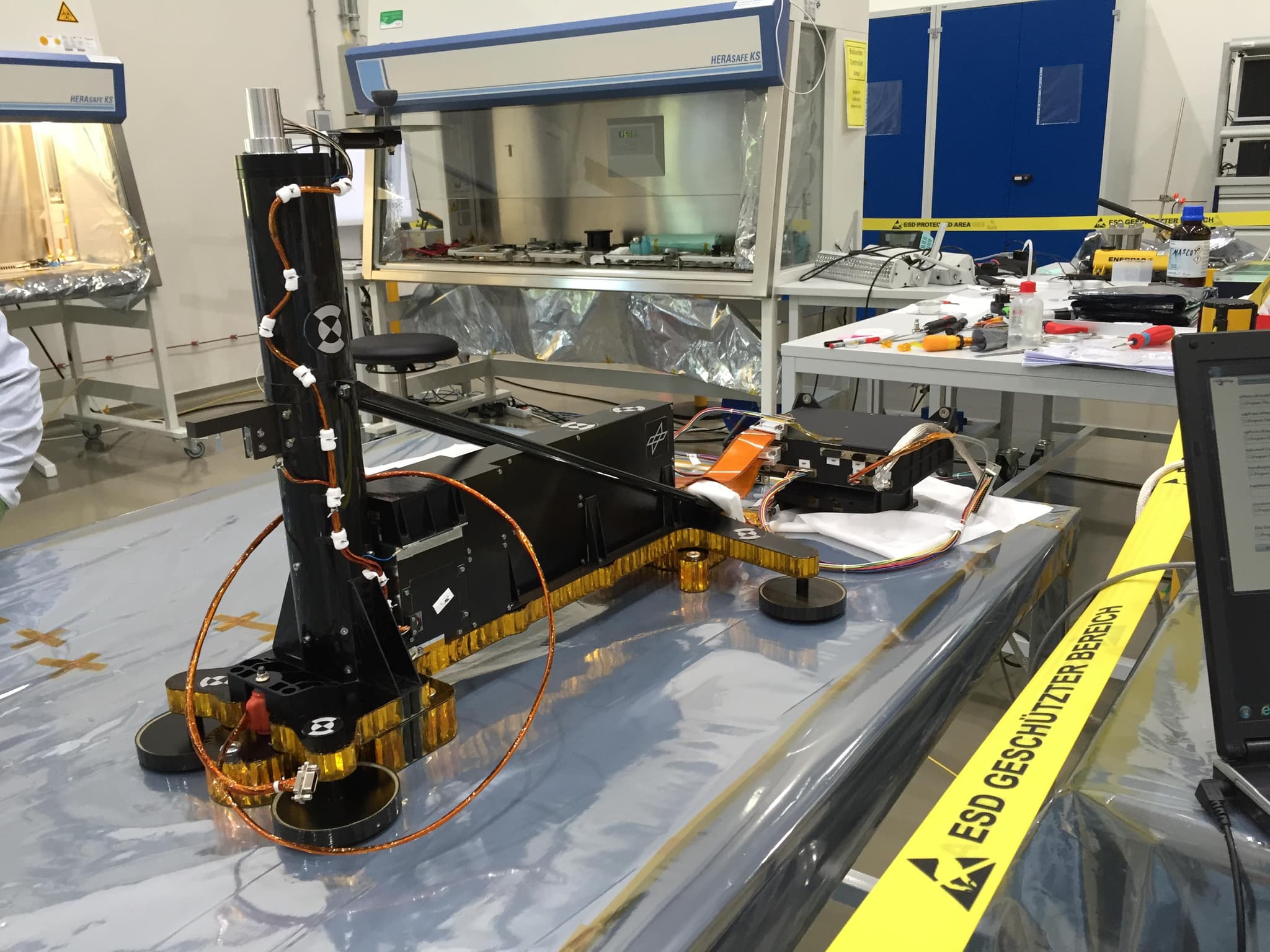
Measuring the heat coming out of a planet sounds simple and is not. You need the temperature gradient and the thermal conductivity, and on Mars the gradient is only a few kelvin per metre because the whole planet is leaking perhaps 25 milliwatts per square metre. The daily and annual temperature swings at the surface swamp a signal that small, so the sensors have to go deep: three metres as an absolute minimum for the accuracy HP3 was promising, five metres as the target. Rotary drilling that deep costs mass, and worse, it dumps heat into exactly the ground whose temperature you are trying to read. So DLR built a nail that hammers itself in. The mole was 40 cm long, 2.7 cm across and 850 g all in, with a spring storing 0.7 joules, a hammer, a counterweight and a cam-driven motor to cock it, striking about once every 3.7 seconds and dragging a flat ribbon of temperature sensors behind it. The concept dated to a 1997 Russian design and had flown once already, as the PLUTO mole on Beagle 2, which was lost. Astronika and the Polish Academy of Sciences' Space Research Centre redesigned the hammering mechanism for DLR from late 2013, through six units in three years, designing out a clutch spring that fatigued at 15,000 strokes along the way. On Earth it did everything it was asked to do: three metres into Mars simulant inside a day of hammering, tens of thousands of strokes without wear.
It was set on the ground on Sol 76 and released from its launch lock on Sol 87, dropping about a centimetre into the soil under its own weight. On Sol 92 the team commanded it to hammer until it reached 70 cm or four hours elapsed. Ground tests said half an hour. It hammered for the full four hours, 3,881 strokes, and reported nothing at all, because of a design decision that only became painful at that moment: the optical device that read depth off the tether sat halfway down the support tube behind a 29 cm loop of slack, so no depth data existed until the mole tip passed 54 cm. The only real measurement from that session was the back cap tripping a contact switch 77 strokes in. Suspecting a stone, the team ran a second session on Sol 94, five hours and 4,720 strokes. Nothing moved. What the tilt sensors did show was the mole rocking laterally, and footprints in the sand showed the whole support structure had shifted and then rotated. Two facts had to be reconciled: a mole that was demonstrably working, and a mole that was going nowhere. Between them those two sessions delivered 8,601 strokes into essentially the same patch of ground.
The diagnosis took most of a year and required lifting the support structure off, which was itself a risk, because the science tether could have snagged. What it revealed was the shape of the answer: a steep-walled open pit, 7 cm deep, its wall standing at 87 degrees. Loose sand does not do that. The ground at Homestead hollow was cohesive, a duricrust that pre-flight thermal inertia data had said was not there, and cohesion is precisely what a mole cannot cope with. The mole's hammer imparts a small backward kick to its casing, about 5.4 newtons' worth on Mars, and the design assumed friction from sand pressing in around the hull would absorb it. In a cohesive soil the lateral pressure on a cavity wall falls to zero near the surface, so nothing presses in. The mole bounced in place, precessed, and reamed out a cavity until roughly a fifth of its length was touching nothing. A first pinning campaign in autumn 2019, in which the scoop simply held the mole against the side of its pit, produced about 5 cm of progress in four short hammerings and settled the argument: there was no stone. The problem was that Mars would not hold on.
The rescue turned into a two-year campaign, and it was fought with an arm that had never been designed to touch the instrument at all. Pinning worked, but only while the scoop was in contact, and when the team backed off to protect the tether the mole reversed catastrophically, hammering itself 18 cm back out of the ground on Sols 322 and 325 and tilting nearly seven degrees further over. A second pinning campaign recovered the depth; a second, smaller reversal of 5 cm followed. From January 2020 the team switched to pressing directly on the mole's back cap, which meant putting the scoop in the path of the rebound, and spent eight months on twelve hammerings totalling 1,280 strokes, repositioning the arm each time. By Sol 645 the back cap was about 2 cm under the original surface and the arm could go no further. Scrapes and tamps then piled regolith on top. On 9 January 2021 the team ran the Free Mole Test: maximum preload on the soil, 500 strokes, a number picked so that no result could be argued with. The mole did not move. Grains in the scoop jumped around, which is what hammering into the underside of a scoop looks like. JPL announced the end five days later.
What survives is not nothing. Fully buried, the mole became the near-surface thermal probe it had always been capable of being, and heating its own hull gave the first in-situ measurement of Martian soil thermal conductivity at this site: 0.039 plus or minus 0.002 W/mK averaged over 3 to 37 cm, implying grains mostly finer than about 150 micrometres, a bulk density near 1,211 kg per cubic metre and a porosity around 63 per cent. That result is itself interesting, because a conductivity that low argues for very little cementation while the pit walls and the arm pushes argue for a great deal, and nobody has fully reconciled the two. The engineering yield is larger. Spohn and his co-authors listed six lessons and four fixes: measure the mole's progress properly during the first, critical mole-length of penetration; anchor or weight the support structure so the mole cannot lift it; give the mole more energy and make that energy adjustable; and, above all, spend mass. A two-kilogram mole could have cancelled its recoil almost entirely. A motorised tape boom following the mole down could have held it against rebound for the first two mole lengths. None of that was available inside a one-kilogram, 40-centimetre allocation under a lander backshell. The mole is still where they left it, tilted about thirty degrees from vertical, wholly underground, and silent.
Mission facts
What it was
The mole was one part of HP3, the Heat Flow and Physical Properties Package, provided to NASA's InSight lander by the German Aerospace Center (DLR) with Tilman Spohn as principal investigator. Measuring the heat flowing out of Mars was a Level 1 science goal of the package and of the mission. Heat flow is the product of the near-surface temperature gradient and the thermal conductivity, and HP3 was built to measure both.↗
Why five metres
Mars's average surface heat flow is thought to be no more than about 25 mW per square metre, which for a soil conductivity of order 0.01 W/mK means a gradient of only a few kelvin per metre. Daily and annual surface temperature swings drown that signal near the top. For the targeted accuracy of plus or minus 5 mW per square metre the team calculated a minimum tip depth of 3 m; mass, volume and planetary protection rules capped the target at 5 m.↗
The mole
A cylinder 40 cm long and 2.7 cm in diameter with a total mass of 850 g. Inside: a drive spring storing 0.7 J, an 0.11 kg hammer, an 0.46 kg suppressor mass on a brake spring, and 0.28 kg of casing and everything else. A motor and cam compress the drive spring, its release drives the hammer onto an anvil in the casing, and the suppressor mass flies the other way. Forward strike force is 1,180 to 1,350 N for less than a tenth of a millisecond, at roughly one stroke every 3.7 seconds.↗
Who built the hammer
The hammering mechanism was developed by Astronika and the Space Research Centre of the Polish Academy of Sciences (CBK) in Warsaw, under contract to and in close cooperation with DLR. The lineage runs from a 1997 concept by Gromov and colleagues, through the PLUTO mole flown on Beagle 2 in 2003, through a proposal for ExoMars, to InSight. The redesign ran from late 2013: concept change in November, design freeze in December, a working pre-flight model by February 2014, six units built between 2013 and 2015. The prototype failures came during that development rather than before it, among them a clutch spring that fatigued after 15,000 strokes against a 45,000-stroke qualification level and was deleted from the later models.↗
It passed every written requirement
The flight model was required to reach 3 m in Mars simulants, to survive at least 20,000 strokes, and to reach 3 m within 24 cumulative hours of hammering under Earth ambient conditions. It met all three. On Mars it went on to perform 12,000 hammer strokes with no measurable loss of hammer force, and life tests on flight-equivalent units passed 60,000 strokes. Nothing about the mole broke.↗
Deployment
HP3 was lifted off the lander deck and set on the ground by InSight's instrument deployment arm on Sol 76. Spohn and colleagues date that to 12 February 2019 UTC in the introduction of their 2022 paper and to 11 February 2019 in the appendix of the same paper. The mole was released from its launch lock on Sol 87 and dropped under gravity, pushing its tip about 1 cm into the ground.↗
The first two hammerings
On Sol 92 the mole was commanded to hammer to a 70 cm tip depth or for four hours, whichever came first. Terrestrial tests said thirty minutes. It ran the full four hours, 3,881 strokes, and reported nothing. A second session on Sol 94 ran five hours and 4,720 strokes with no sign of progress. The dating of Sol 92 is itself inconsistent: JPL and the paper's own appendix say 28 February 2019, while the paper's introduction says 1 March 2019 UTC.↗
Why nobody could tell how deep it was
Depth was to be read optically from markings on the science tether as it passed through a tether length monitor. Because of packaging constraints that monitor sat halfway down the support tube, with a 29 cm service loop of tether above it, so no tether would move through it until the mole tip reached about 54 cm. The mole never passed 43 cm measured along its own axis, so the monitor never engaged. The only hard datum from the first session was the back cap tripping a contact switch 4.6 minutes and 77 strokes in.↗
The duricrust
When the support structure was lifted off on Sol 227 the mole was found in a steep-walled open pit, 7 cm deep at its deepest and with an 87 degree wall. Slope stability analysis of that wall gave a cohesion of 5.8 kPa assuming a 30 degree internal friction angle; the mole's own penetration resistance implies 4 to 25 kPa for friction angles of 30 to 40 degrees. Estimates of the crust's thickness run from at least 7 cm (visual) to about 20 cm (from the length of the back-out event) to possibly the whole 37 cm.↗
Why cohesion is fatal
The mole's hammer transfers a small recoil to the casing, and something has to resist it. The design assumed friction from cohesionless sand pressing in on the hull. In a soil with cohesion, the lateral pressure on a cavity wall falls to zero above a certain depth, so the soil simply does not push in. The force needed to balance the recoil is 5.4 N on Mars nominally and up to 6.9 N in bad cases. Once the mole left the friction springs in its support tube, the ground gave it nothing, and it hammered in place, precessing and widening its own cavity until about a fifth of its length had no soil contact at all.↗
The second problem
The soil was also much harder to push through than any simulant. Initial penetration on Mars ran at 0.5 to 1.2 mm per stroke and fell to no more than 0.11 mm per stroke below 31 cm, against about 2.4 mm per stroke at equivalent depths in quartz sand in the Bremen test bed. Converted to resistance that is 0.5 to 1 MPa near the surface and more than 5 MPa between 31 and 37 cm, against 0.2 to 0.5 MPa in the test bed. The cause is not known. Candidates are the cemented crust itself, a lens of crater ejecta, and self-densification by the 8,601 strokes the mole delivered at one depth on Sols 92 and 94.↗
The support structure was too light
The structure that held the mole weighed 2 kg, which on Mars is a weight of only 7.4 N, which Spohn and colleagues note is only a little more than the friction force the guide springs in its tube could apply to the mole. The team concluded that the mole's own hammering ratcheted the structure up off the ground during at least the first 77 strokes. Footprints left in the sand show the structure shifted about 1.75 cm towards the lander during the first session and rotated about 4 degrees during the second. The mole went in tilted and got worse.↗
What the arm could and could not do
The recovery used the scoop on InSight's arm to press the mole sideways against the wall of its pit, at most about 40 N vertically and 25 N horizontally, the maximum measured safe force on the flight-spare arm in the JPL testbed. Pressing the mole directly worked. Pressing the soil next to it did not: on Sols 322 and 325, 354 strokes drove the mole backwards out of the ground by about 18 cm, with the tilt jumping nearly 7 degrees in the last hundred strokes. A second, smaller reversal of about 5 cm followed on Sol 407.↗
The end
After eight months and twelve sessions of pushing directly on the mole's back cap, totalling 1,280 strokes, the cap reached about 2 cm below the original ground surface on Sol 645, the deepest the arm could follow it. Scrapes and tamps then packed loose regolith over the buried mole. The final test on Sol 754, 9 January 2021, applied maximum preload to the soil above the mole and commanded 500 strokes, a number chosen so the result would be unambiguous. There was no downward motion. Grains in the scoop jumped around, which is what a mole bouncing off the underside of a scoop looks like.↗
What NASA said
JPL announced the end on 14 January 2021. Tilman Spohn: "We've given it everything we've got, but Mars and our heroic mole remain incompatible." Troy Hudson, the JPL scientist and engineer who led the recovery: "The mole is a device with no heritage. What we attempted to do, to dig so deep with a device so small, is unprecedented." NASA's science chief Thomas Zurbuchen framed it as the cost of doing business: "This is why we take risks at NASA."↗
What was actually measured
With the whole mole finally underground it became a near-surface thermal probe, which is what it had always been able to do. Heating its own hull as a line source gave an average soil thermal conductivity of 0.039 plus or minus 0.002 W/mK over the 0.03 to 0.37 m depth range. That low value implies 85 to 95 per cent of particles smaller than 104 to 173 micrometres and, awkwardly, very little cementation, which sits badly with the cemented crust the images and the pit walls appear to show. Compatible soil densities are 1,211 kg per cubic metre (+149, -113), giving porosities around 63 per cent.↗
Mission timeline
- 26 Nov 2018InSight lands in Elysium Planitia with HP3 bolted to its deck. (The appendix of the 2022 lessons-learned paper misdates this landing to 18 November; the introduction of the same paper has it right.)
- 11 to 12 Feb 2019Sol 76: the robotic arm lifts HP3 off the deck and sets it on the ground south of the lander. The two dates come from two different sections of the same paper.
- 28 Feb 2019Sol 92: first hammering. Commanded to stop at 70 cm or four hours, the mole runs the full four hours and 3,881 strokes. The tether length monitor reports nothing, because it cannot report anything until 54 cm. The back cap trips a contact switch after 4.6 minutes.
- Mar 2019Sol 94: a second session of five hours and 4,720 strokes, on the theory that a stone is in the way. No progress. The tilt settles around 18 degrees and the support structure is found to have rotated about 4 degrees.
- Jul 2019Sol 227: the support structure is grappled and lifted away, exposing the mole in a steep-walled pit 7 cm deep. Every diagnostic says the mole is healthy. That leaves two suspects, an obstruction or a lack of friction.
- Sep to Oct 2019Sols 291 to 318: the first pinning campaign. The scoop presses the mole against the side of its pit and it moves about 5 cm in four short hammerings. This conclusively rules out a stone: the arm is only loading the mole sideways, so the downward progress is the mole's own.
- Oct 2019Sols 322 and 325: with the scoop moved off the mole to protect the science tether, 354 strokes drive it backwards out of the ground by about 18 cm. The tilt jumps nearly 7 degrees in the last hundred strokes.
- Nov 2019 to Jan 2020Sols 329 to 407: a second pinning campaign recovers almost all the lost depth in five short hammerings, then a vertical-only preload on Sol 407 pulls 5 cm back out again.
- 11 Jan 2020 to 19 Sep 2020The back cap push campaign: twelve hammerings, 1,280 strokes, each followed by repositioning the scoop. On Sol 645 the mole's back cap is about 2 cm below the original surface, the deepest the arm can follow it into the pit.
- 19 Dec 2020Sol 734: the last of the scrapes and tamps that pack loose regolith into the pit and over the mole. Power and thermal margins are tightening as dust builds on InSight's panels and Mars approaches aphelion.
- 9 Jan 2021Sol 754: the Free Mole Test. Maximum preload on the soil above the mole, 500 strokes commanded. No downward motion, tilt wandering between 32 and 29.5 degrees, and grains jumping in the scoop as the mole bounces up into it.
- 14 Jan 2021JPL announces that the heat probe portion of the mission is over. The rest of InSight keeps working until December 2022.
A filled dot marks something that physically happened. A hollow one marks an announcement, a naming or a target.
In pictures
Tap a photo to enlarge.
Sources
- Spohn et al., The InSight-HP3 Mole on Mars: Lessons Learned from Attempts to Penetrate to Depth in the Martian Soil, Advances in Space Research 69 (2022) 3140-3163
- Full text of the same paper (PDF)
- NASA JPL (14 January 2021): NASA InSight's 'Mole' Ends Its Journey on Mars
- Grott et al., Thermal Conductivity of the Martian Soil at the InSight Landing Site From HP3 Active Heating Experiments, J. Geophys. Res. Planets, 2021, doi:10.1029/2021JE006861
- Golombek et al., Geology of the InSight landing site on Mars, Nature Communications 11, 1014 (2020)
- Grygorczuk et al., Hammering Mechanism for HP3 Experiment (InSight), European Space Mechanisms and Tribology Symposium 2016
- English Wikipedia: Heat Flow and Physical Properties Package
- NASA science mission page: InSight
- NASA ADS / Crossref record for Spohn et al. 2022
- Semantic Scholar record for Grott et al. 2021
Facts on this page were verified on 27 August 2026. Where sources disagree, the disagreement is stated rather than resolved silently.
135.6230 E, 4.5020 N · Homestead hollow