The Impulse and Relativity Mars lander
Impulse Space and Relativity Space · United States · Lander · 2022 · AnnouncedPlanned
Dormant rather than cancelled: announced on 19 July 2022 for a launch as soon as late 2024, moved to 2026 in May 2023, and unmentioned by either company since. No hardware, customer or payload has ever been shown.
TL;DR· 12 min read
Impulse Space and Relativity Space announced on 19 July 2022 that they would put the first commercial payload on the surface of Mars, as soon as the late 2024 window, with Impulse building the cruise vehicle, entry capsule and lander and Relativity launching it on Terran R. The date moved to 2026 in May 2023, and neither company has discussed the mission publicly since. No hardware, customer, payload or price was ever made public, and no cancellation has been announced either, so we file it as dormant.
Two companies that had never flown anything announced in July 2022 that they would deliver what they called the first commercial payload to the surface of Mars, as soon as the late 2024 window. Impulse Space would build the cruise vehicle, the entry capsule and the lander; Relativity Space would launch it on a rocket still on the drawing board. The date slipped to 2026 in May 2023. Since then there has been nothing: no design, no hardware, no customer, no price and no cancellation. The most accurate thing that can be said about this mission in 2026 is that both companies have quietly gone somewhere else.
- 19 Jul 2022announcement date, for a launch as soon as the late 2024 Mars window
- May 2023the last time either company publicly discussed the mission
- 0customers, payloads, prices or hardware ever made public
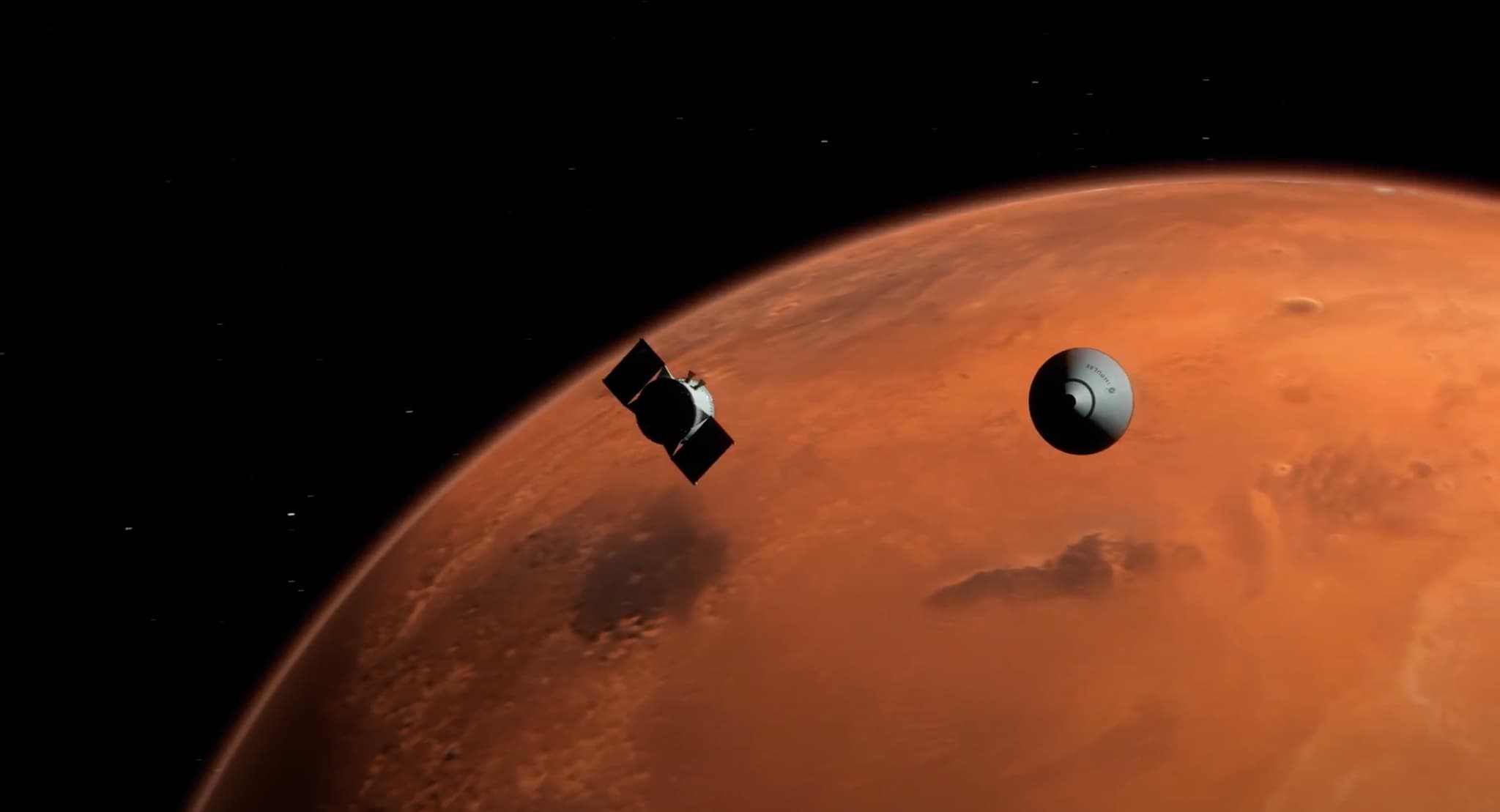
In July 2022 two companies that between them had launched nothing announced that they would land what their own release called the first commercial payload on Mars. Impulse Space, founded the previous year by Tom Mueller, whom the announcement describes as a SpaceX founding member, would build the Mars Cruise Vehicle, the entry capsule and the lander. Relativity Space would launch the stack on Terran R, a rocket that existed as a design and a set of 3D printers. The anticipated window started in 2024. The architecture was conventional and deliberately so: cruise for more than six months, inject the capsule onto a landing trajectory, separate, brake on a heatshield, deploy parachutes, then land propulsively on Impulse-built engines. Mueller named the hard part himself, the aeroshell that has to keep a lander alive through entry. Almost nothing else was disclosed. No mass, no dimensions, no payload capacity, no customer, no price. Asked about cost, the companies would say only that it would be significantly less than previous Mars missions because they were building on JPL's work; SpaceNews put the obvious benchmark next to that, InSight at 814 million dollars to NASA including launch. One detail from the announcement reads differently now than it did then. The companies planned to launch in 2024 but wrote their exclusive agreement to run to 2029, explaining that with windows every two years this allowed for multiple launch options should they need them. They needed them.
The plan was never really about one lander. At the Humans to Mars Summit in May 2023 the two companies described a series: a mission at every window, roughly every 2.2 years, with a published catalogue of payload options that would determine which missions actually flew. Josh Brost of Relativity called it a "constant supply chain to Mars" and made the argument that frequency changes what science is possible, because a payload that fails can be reflown rather than mourned. Barry Matsumori of Impulse said they had seen commercial interest, including from customers wanting to fly things for marketing reasons, and that they hoped NASA would eventually buy deliveries the way it buys lunar ones through Commercial Lunar Payload Services. There was real engineering underneath it. Impulse had just qualified Saiph, a five pounds-force thruster that would handle the Mars cruise manoeuvres, and was developing Rigel at 180 pounds-force for the landing itself. The lander would borrow from InSight, including its heat shield, because as Brost put it, a clean-sheet lander design is a monumental engineering feat. But the same conference produced the first slip. The mission had moved from 2024 to 2026, with no reason offered, a month after Relativity had confirmed that a redesigned Terran R would not debut until 2026.
Then it stopped. There has been no public statement about the Mars lander from either company since May 2023, and the absence is documented rather than inferred. SpaceNews noted in October 2025, reporting Impulse's pivot to a lunar cargo lander, that Terran R had yet to fly and there had been no recent updates on the Mars project. It repeated the point in June 2026, describing the Impulse lander as the different, pre-Schmidt Mars mission on which neither company had provided recent updates. Impulse's own website tells the same story more starkly. Its public update index, 48 items running from March 2022 to 13 August 2026, contains exactly one Mars item: the announcement of 19 July 2022. Its vehicle line-up in August 2026 is Helios, Mira and Rideshare, and the flights it advertises reach low Earth orbit, geostationary orbit and, from 2028, the lunar surface. There is no Mars vehicle and no Mars mission anywhere on it. In June 2026 the company raised 500 million dollars to build in-space mobility infrastructure, and the roadmap that money serves reaches geostationary orbit and the Moon.
Relativity travelled further. Eric Schmidt took over as chief executive in March 2025, and on 17 June 2026 the company announced an Interplanetary Sciences Program whose first mission is a Mars science and telecommunications orbiter for late 2028, carrying a NASA Ames instrument suite and reportedly funded by an undisclosed philanthropic organisation. That is a different spacecraft with a different partner, a different payload and a different funding model, and SpaceNews drew the line between them explicitly. So Relativity still intends to go to Mars, and Impulse still intends to build landers, and the specific joint mission they announced in 2022 has no visible existence. The launch trackers reflect the confusion rather than resolving it: NextSpaceflight, checked on 24 August 2026, lists the mission with a liftoff time of no earlier than 2028, while aggregator sites that mirror older data still carry 31 December 2026, which is a year-only placeholder with a status of to be determined. No schedule sits behind it. We file this entry as dormant rather than cancelled because that is what the record supports. No cancellation has been announced. No hardware has been shown. The exclusive agreement runs to 2029, which leaves the 2028 window formally within reach for a rocket that has not yet flown once.
Mission facts
The announcement
19 July 2022, from El Segundo, California, issued jointly by Impulse Space and Relativity Space and described as the first commercial mission to Mars. The anticipated launch window started in 2024, and Relativity held an exclusive agreement to launch the mission from Cape Canaveral running through 2029.↗
Division of labour
Impulse Space would build the Mars Cruise Vehicle, the entry capsule and the lander itself. Relativity Space would launch the stack on Terran R, then described as fully reusable and entirely 3D printed, and later redesigned as partially reusable.↗
The architecture
As described by the companies in 2022 and by NextSpaceflight's listing, all in the future tense: a cruise vehicle would carry the encapsulated lander for more than six months, inject the entry capsule onto a landing trajectory and detach; the capsule would use a heatshield and parachute to slow down; the lander would then perform a propulsive landing using purpose-built engines developed in-house at Impulse. None of that hardware has been shown.↗
What the founders said
Tom Mueller, Impulse founder and chief executive: "One of the most challenging aspects of landing on Mars is the 'glide stage,' which involves an aeroshell to encapsulate the lander for the survival of Mars entry." Tim Ellis, then Relativity co-founder and chief executive: "With the delivery capabilities of Terran R coupled with Impulse's in-space transportation, we are bringing humanity one step closer to making Mars a reality."↗
What was never disclosed
Lander mass, dimensions, payload capacity, payload identity, customers, price and total cost. On cost the companies would say only that it would be "significantly less than previous Mars missions" by building on JPL's work. For scale, SpaceNews noted that InSight, the most recent JPL static lander, cost NASA 814 million dollars including launch but excluding partner instruments.↗
The delay was anticipated
The companies planned a 2024 launch but wrote the exclusive agreement to run to 2029. Their own explanation, in a written response to SpaceNews in July 2022: "With launch windows occurring every two years, extending the agreement to 2029 allows for multiple launch options should we need them."↗
The slip
Reported by SpaceNews on 24 May 2023 from the Humans to Mars Summit: executives from both companies said the mission was now scheduled for 2026. No reason was given. Relativity had announced in April 2023 that a redesigned Terran R would debut in 2026, two years later than previously planned.↗
The propulsion
Impulse announced on 10 May 2023 that it had completed qualification testing of Saiph, a five pounds-force thruster, for its first low Earth orbit mission; Barry Matsumori, then Impulse chief operating officer, said the same thruster would handle the Mars lander's cruise manoeuvres. A larger engine, Rigel, at 180 pounds-force, was to perform the landing.↗
The business plan around it
Not one lander but a series. Josh Brost, then senior vice president of revenue operations at Relativity, called it a "constant supply chain to Mars." Matsumori: "We will take advantage of the window every 2.2 years and take at least one mission up," with a catalogue of payload options driving which missions actually flew. The companies hoped NASA would become a customer, in the way it buys lunar deliveries through Commercial Lunar Payload Services.↗
The heritage claimed
The companies said in May 2023 that they planned to leverage designs and technologies from NASA's InSight lander, including its heat shield. Brost: "We're not trying to reinvent the wheel," adding that "doing a clean-sheet design of a lander is an insane, monumental engineering feat." This was a stated intention. Nothing was delivered.↗
The silence, first reported
SpaceNews, 14 October 2025, in an article about Impulse's new lunar cargo lander: the companies said in 2022 that the first Mars mission could launch as soon as 2024, "but Terran R has yet to make its debut flight, and there have been no recent updates on the Mars lander project."↗
The silence, confirmed
SpaceNews, 17 June 2026, reporting Relativity's new Mars orbiter: "Before Schmidt took over Relativity Space, the company pursued a different nongovernmental Mars mission. Relativity and Impulse Space announced in 2022 plans for a Mars lander mission that would launch on Terran R, with the lander itself built by Impulse. The companies said in 2023 they were planning to launch the mission as soon as 2026, but neither has provided recent updates on those plans."↗
What Impulse is doing instead
As of 24 August 2026 the company's own site lists three vehicles, Helios, Mira and Rideshare, none of them for Mars, and the flights it advertises run to low Earth orbit, geostationary orbit and, from 2028, the lunar surface. There is no Mars mission and no Mars vehicle on it. The company's public update index, 48 items from March 2022 to 13 August 2026, contains exactly one Mars item: the announcement of 19 July 2022.↗
What Relativity is doing instead
Eric Schmidt became chief executive in March 2025. On 17 June 2026 the company announced the Interplanetary Sciences Program, whose first mission is a Mars science and telecommunications orbiter for late 2028 carrying a NASA Ames instrument suite. It is a different spacecraft, a different partner and a different funding model from the Impulse lander.↗
The listings disagree
NextSpaceflight, checked on 24 August 2026, lists "Impulse Space's Mars Mission" on Terran R from Launch Complex 16 with a liftoff time of "No Earlier Than 2028." Aggregator sites that mirror older data still carry a launch date of 31 December 2026 with a status of "To Be Determined," which is a year-only placeholder rather than a schedule. On lookingforwardto.com the row's own "last source update" stamp reads 10 August 2024, and its window opens and closes at the same instant, 31 December 2026 00:00 UTC.↗
The rocket
Terran R has still never flown. Relativity's July 2026 company update, published 11 August 2026, reports stage one structural qualification complete and the second stage cryoproofed at NASA Stennis, but gives no first flight date. Industry sources told SpaceNews in June 2026 they expected the debut to slip to 2027.↗
Mission timeline
- 19 Jul 2022Impulse Space and Relativity Space announce a commercial Mars lander with an anticipated launch window starting in 2024, and an exclusive launch agreement running through 2029. Neither company has flown a mission of any kind.
- 20 Jul 2022SpaceNews reports the announcement, notes that no size, mass, payload capacity, customer or cost was disclosed, and records the companies' own acknowledgement that the 2029 end date on the agreement exists to allow for multiple launch windows should they need them.
- Mar 2023Relativity's Terran 1 makes its only flight and fails to reach orbit. The company shelves it to focus on Terran R, the vehicle the Mars mission depends on.
- Apr 2023Relativity announces that a redesigned Terran R will debut in 2026, two years later than previously planned. The Mars mission's 2024 window becomes unreachable.
- 10 May 2023Impulse announces that it has completed qualification testing of Saiph, a five pounds-force thruster, for its first low Earth orbit mission. Impulse says the same thruster will handle the Mars lander's cruise manoeuvres, and that a 180 pounds-force engine called Rigel will do the landing.
- 24 May 2023SpaceNews reports from the Humans to Mars Summit that executives from both companies now put the mission in 2026, with no reason given for the delay. They describe a series of landers at every window, a payload catalogue, and InSight heat shield heritage. This is the last time either company discusses the mission in public.
- Mar 2025Eric Schmidt becomes chief executive of Relativity Space while making a significant investment. Company communications thereafter concentrate on Terran R hardware.
- 14 Oct 2025Impulse announces a lunar cargo lander instead, capable of three tonnes to the lunar surface from 2028, built around its Helios transfer vehicle. In the same article SpaceNews records that there have been no recent updates on the Mars lander project.
- 3 Jun 2026Impulse announces a 500 million dollar Series D to build in-space mobility infrastructure. Its published mission roadmap covers low Earth orbit, geostationary transfer and lunar delivery. Mars is absent from it.
- 17 Jun 2026Relativity announces a NASA-instrumented Mars science orbiter for 2028 under a new Interplanetary Sciences Program. SpaceNews frames the Impulse lander as the different, pre-Schmidt Mars mission on which neither company has provided recent updates.
- 24 Aug 2026Checked: Impulse's public vehicle and mission lists contain no Mars element; its update index carries exactly one Mars item, from July 2022. NextSpaceflight lists the mission as no earlier than 2028. Aggregator trackers still show a placeholder of 31 December 2026. Terran R has not flown.
A filled dot marks something that physically happened. A hollow one marks an announcement, a naming or a target.
In pictures
Tap a photo to enlarge.
Sources
- Relativity Space press release (19 Jul 2022): Impulse Space and Relativity Space Announce First Commercial Mission to Mars
- Impulse Space press release (19 Jul 2022)
- SpaceNews, Jeff Foust (20 Jul 2022): Impulse and Relativity announce proposal for joint Mars landing mission
- SpaceNews, Jeff Foust (24 May 2023): Impulse and Relativity target 2026 for launch of first Mars lander mission
- SpaceNews, Jeff Foust (14 Oct 2025): Impulse Space announces lunar lander plans
- SpaceNews, Jeff Foust (17 Jun 2026): Relativity Space to privately develop Mars orbiter mission
- NextSpaceflight: Impulse Space's Mars Mission on Terran R, listing checked 24 Aug 2026
- lookingforwardto.com: Terran R Mars Lander
- Impulse Space: updates index, March 2022 to August 2026
- Impulse Space: home page vehicle and mission lists, checked 24 Aug 2026
- Relativity Space: July 2026 Company Update (published 11 Aug 2026)
- Space.com (19 Jun 2026)
Facts on this page were verified on 24 August 2026. Where sources disagree, the disagreement is stated rather than resolved silently.