Red Dragon
SpaceX with NASA Ames Research Center (United States) · United States · Lander · 2011 · The long occupationCancelled
Cancelled on 19 July 2017, when Musk dropped propulsive landing for Dragon: the capsule was to land on Mars on its own engines with no parachute, announced by SpaceX on 27 April 2016. None was ever built.
TL;DR· 15 min read
Red Dragon was a plan to land a modified SpaceX Dragon capsule on Mars using its own SuperDraco engines, with no parachute at any point in the descent. It began as a NASA Ames study in 2011 and was announced by SpaceX on 27 April 2016 under an unfunded Space Act Agreement in which NASA supplied support and no money. It ended on 19 July 2017 when Elon Musk said SpaceX would stop developing propulsive landing for Dragon. None was ever built.
Red Dragon was a good idea that lost its landing gear. Every Mars lander faces the same problem: the atmosphere is thick enough to burn you and too thin to stop you, and parachutes alone cannot bring down large payloads. SpaceX was building Dragon 2 with SuperDraco engines set into its side walls so it could land on Earth like a helicopter, and NASA Ames noticed that the same engines could fire into a supersonic airstream at Mars and fly a capsule all the way to the ground with no parachute at all. For six years it was, on paper, the nearest thing to a route for putting a tonne of hardware on Mars outside a government programme, though it never got past study and announcement. Then SpaceX decided not to land Dragons propulsively anywhere, and the whole thing evaporated in an afternoon.
- 0Red Dragons built or launched
- $32mNASA's own estimated cost of supporting a mission it paid SpaceX nothing for
- >1,000 kgpayload NASA Ames calculated a Red Dragon could put on sites 3 km below the MOLA datum
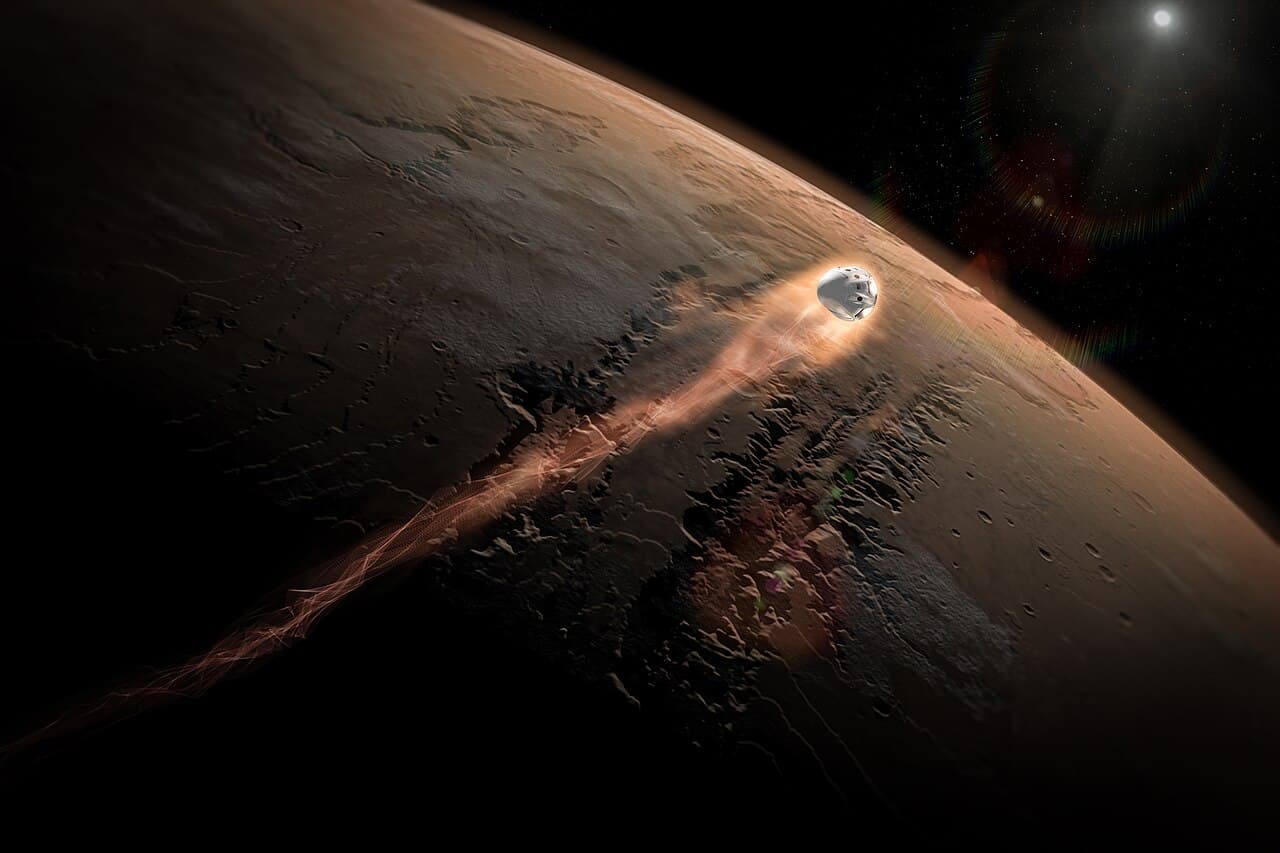
The problem Red Dragon was invented to solve is the one that has shaped every Mars lander ever flown. Mars has an atmosphere about one per cent as dense as Earth's. That is enough to heat a spacecraft to the point where it needs a heat shield, and nothing like enough to slow it down to a survivable speed. Everything that has landed successfully has therefore used a chain of devices: aeroshell, supersonic parachute, then rockets or airbags for the last part. The parachute is the weak link, because supersonic parachutes at Mars do not scale, and above roughly a tonne of landed payload the chain stops working. SpaceX, meanwhile, was building Dragon 2 for NASA's commercial crew programme with SuperDraco engines set into the walls of the capsule, so that it could abort off a failing rocket and, eventually, land on Earth on its engines rather than in the sea. NASA's Ames Research Center did the obvious sum in 2011 and concluded that those engines would be powerful enough to fire forward into a supersonic airstream at Mars and decelerate a capsule from hypersonic entry all the way to the surface with no parachute at any point. That is supersonic retropropulsion, and on the Ames analysis it would lift the parachute mass ceiling and allow landings at higher elevations, because you are not waiting for enough air to fill a canopy. It has never been flown at Mars by anyone, then or since.
For five years Red Dragon was a study rather than a project, and it is worth saying exactly how far it got, because the popular account has it as a cancelled SpaceX mission. It was a NASA Ames concept, done with SpaceX's cooperation, and its numbers were published at workshops. In June 2012 Karcz and fifteen co-authors presented it at the Concepts and Approaches for Mars Exploration workshop in Houston. In June 2013 the same team told the International Planetary Probe Workshop that a Red Dragon lander was feasible and could deliver more than 1,000 kg of payload to sites three kilometres below the Mars Orbiter Laser Altimeter reference datum, which covers most of the northern plains and Hellas. Two months later Carol Stoker and Larry Lemke presented an architecture in which a single Falcon Heavy launch delivers the return spacecraft assets: a Dragon carrying an ascent vehicle, an Earth return stage and sample hardware, with the samples gathered by a pre-landed asset, parked in a Moon-trailing Earth orbit and retrieved later by a crewed Dragon. Their published conclusion is narrower than the shorthand it usually gets: a single launch is feasible for delivering the return assets, not for the whole campaign. The intended route to flight was NASA's Discovery programme, with Red Dragon as the delivery vehicle for the Icebreaker life-detection mission. English Wikipedia says SpaceX planned to propose it for funding in 2013 and again in 2015, as Discovery mission 13, and that no proposal was submitted. We could not match those years to specific Discovery announcements of opportunity, so they are best read as intentions rather than as missed deadlines. Red Dragon was studied, costed and published, and it was never formally proposed to a NASA selection board.
Then on 27 April 2016 SpaceX announced it was going to actually do it. The company said on Facebook that it planned to send Dragons to Mars as early as 2018 and that Red Dragon missions would inform the Mars architecture it would unveil later that year. Musk tweeted that Dragon 2 was designed to be able to land anywhere in the solar system and that the Red Dragon mission was the first test flight. The vehicle would go up on a Falcon Heavy from pad 39A, into the May 2018 window, and reporting at the time described a capsule about twenty feet tall and twelve feet across able to carry two to four tons of equipment to Mars. That figure sits awkwardly against the thousand kilograms the Ames analysis had derived, and no source we consulted defines its terms well enough to reconcile the two. The interesting part of the announcement was the agreement behind it. NASA signed an unfunded Space Act Agreement: deep space communications and telemetry, navigation, entry, descent and landing analysis, aerodynamic data and planetary protection consultation, given to SpaceX for free, in exchange for the data from an actual propulsive Mars landing. Jim Green put the split plainly afterwards: NASA had agreed to navigate to Mars and get the spacecraft to the top of the atmosphere, and it was up to SpaceX to land. NASA expected the support to cost it about 32 million dollars over four years, roughly a tenth of the mission's total.
It ended in a single afternoon, at a conference, for a reason that had nothing to do with Mars. On 19 July 2017 at the ISS Research and Development Conference in Washington, Musk said SpaceX would not pursue powered landings for Dragon, because qualifying them for safety, particularly for crew transport, would take a tremendous amount of effort, and because the approach was no longer in line with what the company believed was the optimal way to land on Mars. Dragon 2 would come home under parachutes. A Dragon that does not land on its engines cannot land on Mars at all, because there is no other way down. The same day, replying to a journalist on Twitter, Musk wrote that powered landings on Mars would happen for sure, but with a vastly bigger ship. That ship became Starship. A month later Jim Green confirmed that Red Dragon was on the back burner, adding that NASA remained available to talk and was not pushing. Six weeks after that, Jennifer Heldmann and colleagues put Red Dragon Drill Missions to Mars online, registered with Crossref on 2 October 2017 and printed in the December 2017 issue of Acta Astronautica, arguing that the platform was well suited to drilling at least two metres into the Martian subsurface, deeper than anything had managed. It is a good paper about a vehicle that had already ceased to exist, and it is the neatest illustration of what Red Dragon was: a serious piece of mission design that was always downstream of a commercial decision nobody in it controlled.
Mission facts
What it was
A design for an uncrewed Dragon 2 capsule, modified for interplanetary flight and Martian entry, that would have been launched on a Falcon Heavy and landed on Mars using its own SuperDraco engines. None was built and none flew. It was never a SpaceX product line: for most of its life it was a NASA Ames study of what could be done with a commercial vehicle somebody else was already paying to build.↗
Where it came from
A 2011 feasibility study by SpaceX and NASA's Ames Research Center, aimed at searching for biosignatures on Mars, past or present. The attraction was arithmetic rather than ambition: Dragon existed, its development was funded by other customers, and a Mars lander that does not have to be designed from scratch is a fundamentally different budget problem.↗
The landing trick
The 2012 Ames abstract puts it carefully: the Dragon's high-thrust SuperDraco engines "suggest the possibility of a parachute-free, fully-propulsive deceleration at Mars from supersonic speeds to the surface." That is supersonic retropropulsion, firing engines forward into an oncoming hypersonic flow. On the study's analysis it would remove the parachute, which is the component that limits how much mass anyone can land on Mars, and would allow landings at higher elevations than a parachute system can reach. No spacecraft has done it at Mars.↗
The capability number
Karcz and colleagues, in an abstract for the International Planetary Probe Workshop held in San Jose from 17 to 21 June 2013, concluded that "a Red Dragon lander is feasible and that it would be capable of delivering more than 1000 kg of payload to sites at elevations three kilometers below the Mars Orbiter Laser Altimeter (MOLA) reference", which covers most of the northern plains and the Hellas basin. That is the number this entry uses, because it is the one with a published derivation behind it.↗
The payload figures disagree
Three numbers circulate. English Wikipedia describes the 2011 concept as a 3.6 metre, 6.5 tonne vehicle carrying up to one tonne of Mars-landed payload. The 2013 Ames analysis gives more than 1,000 kg to sites 3 km below the MOLA datum. When SpaceX announced the mission in April 2016, contemporaneous reporting described a vehicle that could carry two to four tons of scientific equipment to Mars. We cannot reconcile these: they may measure useful science payload, total delivered mass and best-case capability at a favourable landing site respectively, but no source we consulted defines its own terms clearly enough to say so.↗
The Discovery route that never happened
The 2013 Ames abstract describes Red Dragon as "an option for the Icebreaker Discovery Program mission concept." English Wikipedia says SpaceX "initially planned to propose Red Dragon for funding in 2013 and 2015 as the United States NASA Discovery mission #13 for launch in 2022, but it was not submitted." We have not been able to match those two years to specific Discovery announcements of opportunity, so read them as intentions rather than as entries in a named competition. No proposal was ever submitted, and Red Dragon never received NASA mission funding. This matters for how far it got: Red Dragon was studied, costed and presented, and it was never once formally proposed to a NASA selection board.↗
The sample return variant
Carol Stoker and Larry Lemke of NASA Ames presented an architecture at the 16th Mars Society Convention in Boulder, 15 to 18 August 2013, in which one Falcon Heavy delivers a Dragon carrying a Mars Ascent Vehicle, an Earth Return Vehicle and sample collection hardware; samples are collected by a pre-landed asset, possibly the then-proposed 2020 rover, then lifted to a Moon-trailing Earth orbit and retrieved by a later, crewed Dragon. Their conclusion, quoted in full because the short form overstates it, was that "a single Mars launch sample return mission is feasible using current commercial capabilities to deliver the return spacecraft assets."↗
The announcement
27 April 2016. SpaceX said on Facebook that it planned "to send Dragons to Mars as early as 2018" and that "Red Dragon missions will help inform the overall Mars architecture that will be unveiled later this year." Musk tweeted that "Dragon 2 is designed to be able to land anywhere in the solar system" and that the "Red Dragon Mars mission is the first test flight."↗
The launch plan
A Falcon Heavy from pad 39A at Kennedy Space Center, into the May 2018 Mars window. The vehicle was described as about 20 feet tall and 12 feet wide. Falcon Heavy had not yet flown when the mission was announced.↗
The Space Act Agreement
Unfunded, meaning no money changed hands in either direction. NASA agreed to provide deep space communications and telemetry, navigation support, entry, descent and landing analysis, aerodynamic data and planetary protection consultation. In exchange it would receive entry, descent and landing data from a real Mars landing, which no agency had ever obtained for a propulsive descent. NASA's statement described the collaboration as potentially providing valuable EDL data for its own journey to Mars while supporting American industry.↗
What that support was worth
About 32 million dollars over four years, which NASA put at roughly 10 per cent of the total cost of the first Red Dragon mission. That is one of the few public numbers that lets anyone estimate the whole thing, and it implies a mission in the region of 300 million dollars.↗
Who was responsible for what
Jim Green, then head of NASA's planetary science division, described the division of labour exactly: "Through the Space Act Agreement, we'd agreed to navigate to Mars, get him to the top of the atmosphere, and then it was up to him to land." NASA would fly the cruise. SpaceX owned the six minutes that kill Mars landers.↗
The slip
In February 2017 the launch moved to no earlier than 2020, missing the window the mission had been announced for. That is normal for a first flight of anything, and in this case it moved the mission past the decision that killed it.↗
The cancellation, in Musk's words
Speaking at the International Space Station Research and Development Conference in Washington on 19 July 2017, Musk said: "The reason we decided not to pursue (powered landings) heavily is it would have taken a tremendous amount of effort to qualify that for safety, particularly for crew transport." He added that the original Dragon approach was "no longer in line with what we were confident was the optimal way to land on Mars." Dragon 2 would come down under parachutes, and a Dragon that cannot land propulsively cannot land on Mars at all.↗
And in a tweet the same day
Replying to the SpaceNews journalist Jeff Foust on 19 July 2017, Musk wrote: "Plan is to do powered landings on Mars for sure, but with a vastly bigger ship." That ship became Starship. Red Dragon was not abandoned because Mars got harder; it was abandoned because SpaceX decided to skip a size class.↗
The obituary NASA gave it
On 18 August 2017 Jim Green said SpaceX had put Red Dragon "back on the back burner", adding that "We're available to talk to Elon when he's ready to talk to us... and we're not pushing him in any way." Six weeks later Red Dragon Drill Missions to Mars, by Heldmann and nine colleagues, went online: Crossref registers it on 2 October 2017, and it appeared in Acta Astronautica volume 141, dated December 2017, pages 79 to 88. It argues that the platform was well suited to drilling deeper on Mars than anything had managed, at least 2 metres. The science case for the vehicle was published after the vehicle was dead.↗
Mission timeline
- Jul 2011The Red Dragon concept surfaces publicly: a SpaceX and NASA Ames feasibility study for a low-cost Mars lander built on a capsule somebody else is already paying to develop, aimed at searching for biosignatures.
- 12 to 14 Jun 2012Karcz and fifteen colleagues present Red Dragon: Low-Cost Access to the Surface of Mars Using Commercial Capabilities at the Concepts and Approaches for Mars Exploration workshop in Houston. The core claim is parachute-free, fully-propulsive deceleration at Mars from supersonic speeds to the surface.
- 17 to 21 Jun 2013At the International Planetary Probe Workshop in San Jose, the Ames team concludes a Red Dragon lander is feasible and could deliver more than 1000 kg to sites 3 km below the MOLA reference. The abstract names the Icebreaker Discovery Program mission concept as the intended route to flight. No Discovery proposal is ever submitted.
- 15 to 18 Aug 2013Stoker and Lemke present a single-launch Mars sample return architecture built on Red Dragon at the Mars Society convention in Boulder, concluding that it is feasible using current commercial capabilities to deliver the return spacecraft assets.
- 27 Apr 2016SpaceX announces it will send Dragons to Mars as early as 2018, on a Falcon Heavy from pad 39A. NASA signs an unfunded Space Act Agreement: navigation, deep space communications, EDL analysis, aerodynamic data and planetary protection advice in exchange for entry, descent and landing data. No money moves.
- Feb 2017The launch slips to no earlier than 2020, missing the window the mission was announced for.
- 19 Jul 2017At the ISS Research and Development Conference in Washington, Musk says SpaceX will not pursue powered landings for Dragon, because qualifying them for crew safety would take a tremendous amount of effort. The same day he tweets that powered Mars landings will happen but with a vastly bigger ship. Red Dragon has just lost its only means of reaching the ground.
- 18 Aug 2017Jim Green of NASA says SpaceX has put Red Dragon back on the back burner, and reveals that NASA had expected to spend about 32 million dollars over four years supporting it, roughly 10 per cent of the mission's total cost.
- 2 Oct 2017Red Dragon Drill Missions to Mars, by Heldmann and colleagues, is registered with Crossref on this date and appears in the December 2017 issue of Acta Astronautica, making the science case for a platform that no longer exists: a lander able to drill at least 2 metres into Mars.
- May 2018The window Red Dragon was announced for opens and closes. NASA's InSight launches into it on 5 May 2018 and lands successfully on parachutes and rocket engines the following November.
- Jul 2020The second window, the one Red Dragon slipped to, is used by Perseverance, Tianwen-1 and Hope. No commercial Mars lander flies in it.
- 24 Aug 2026No Red Dragon was ever built and none exists. Musk's stated successor in 2017 was a vastly bigger ship, and this entry deliberately makes no claim about SpaceX's current Mars plans, which we did not verify against a source dated 2026.
A filled dot marks something that physically happened. A hollow one marks an announcement, a naming or a target.
In pictures
Tap a photo to enlarge.
Sources
- Stephen Clark, SpaceX announces plan to send mission to Mars in 2018, Spaceflight Now, 27 April 2016
- Stephen Clark, Propulsive landings nixed from SpaceX's Dragon spaceship, Spaceflight Now, 19 July 2017
- Stephen Clark, SpaceX informed NASA of slowdown in its commercial Mars program, Spaceflight Now, 18 August 2017
- Karcz et al., Red Dragon: Low-cost Access to the Surface of Mars using Commercial Capabilities, Concepts and Approaches for Mars Exploration, Houston, 12 to 14 June 2012 (NTRS 20120013431; record read via the NTRS API)
- Karcz et al., Feasibility of a Dragon-Derived Mars Lander for Scientific and Human-Precursor Missions, International Planetary Probe Workshop, 17 June 2013 (NTRS 20140000206)
- Stoker and Lemke, Mars Sample Return Landed with Red Dragon, 16th Annual International Mars Society Convention, Boulder, 15 to 18 August 2013 (NTRS 20140009130)
- Heldmann et al., Red Dragon Drill Missions to Mars, Acta Astronautica vol. 141, accepted manuscript dated 2 October 2017 (NTRS 20170012502)
- Heldmann et al., Red Dragon Drill Missions to Mars, DOI 10.1016/j.actaastro.2017.10.002
- English Wikipedia: SpaceX Red Dragon
- Eric Ralph, SpaceX skipping Red Dragon for "vastly bigger ships" on Mars, Musk confirms, Teslarati, 19 July 2017
Facts on this page were verified on 24 August 2026. Where sources disagree, the disagreement is stated rather than resolved silently.