Curiosity (Mars Science Laboratory)
NASA · United States · Rover · 2012 · The long occupationOperating
Operating as of 9 October 2026: fourteen years and past 5,000 Martian days, a milestone NASA's Curiosity blog dates to Saturday 29 August 2026, on a mission whose prime phase was one Martian year. The newest waypoint in NASA's MMGIS traverse file, last modified 21 September 2026, is sol 5021, a 1.02 m move to bring a drill target in range, with a cumulative drive distance of 38,383.67 m in that file's dist_total_m field, against 38.07 in the same record's dist_km field. NASA's raw images through sol 5039 (9 October 2026) show the rover at the same position.
TL;DR· 16 min read
Curiosity landed in Gale crater on 6 August 2012, lowered on cords by a rocket-powered sky crane because airbags do not scale to 899 kg. Seven months later, on a mudstone slab at Yellowknife Bay, it answered its central question: ancient Gale crater had once been habitable. Fourteen years on it is still working, 38 km driven and more than a kilometre above where it landed, on wheels that began tearing open in 2013.
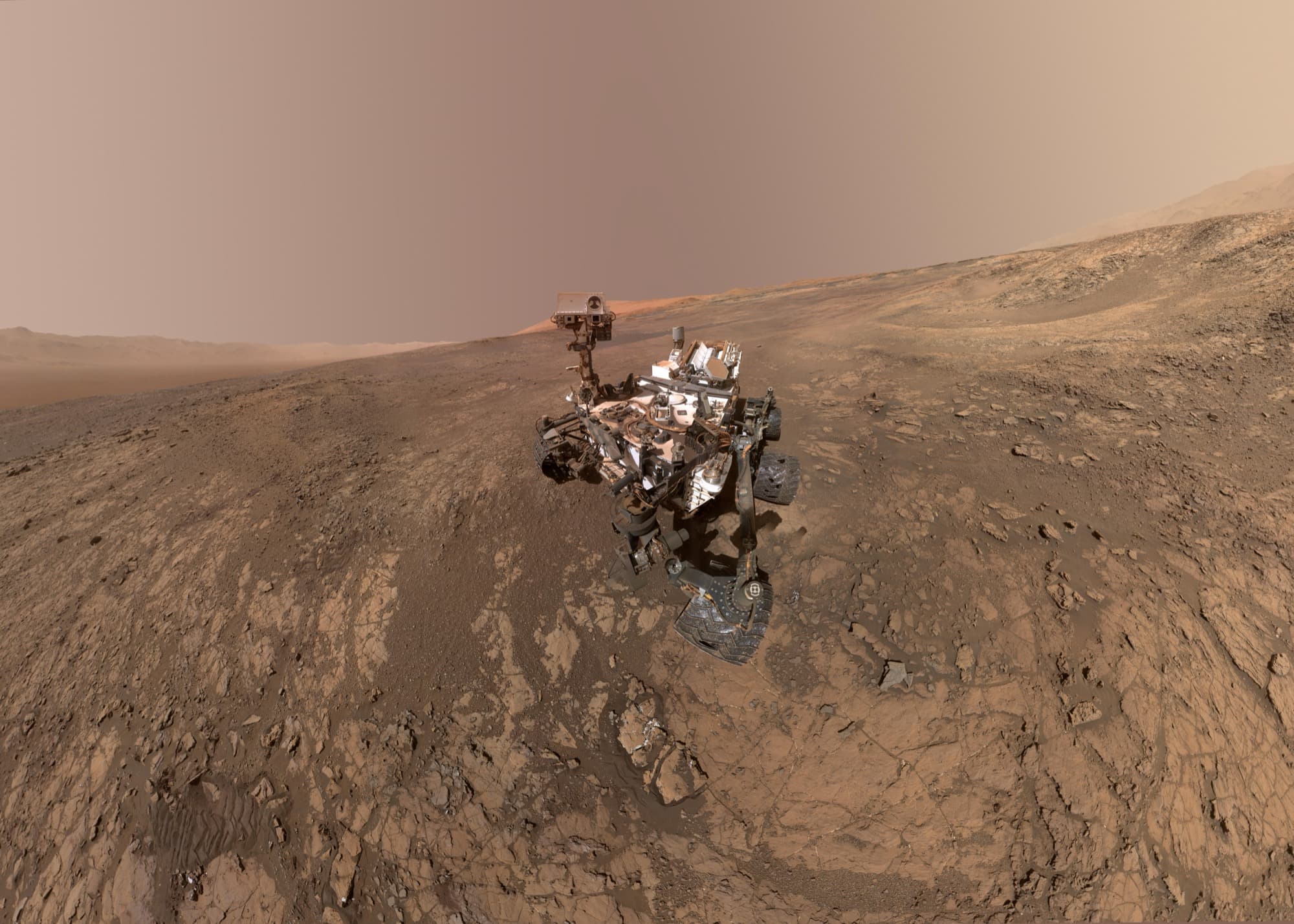
Curiosity is a nuclear-powered geology laboratory the size of a small car, and in 2012 NASA had no proven way to land it. Airbags had worked for Pathfinder and the Mars Exploration Rovers but do not scale to 899 kg, so the Mars Science Laboratory project built the sky crane: a rocket stage that descends slowly and lowers the rover on cords. The seven minutes that followed atmospheric entry on 6 August 2012 were entirely autonomous, because the one-way radio delay that day was 13.8 minutes. It worked. Seven months later, on a slab of mudstone in a low spot called Yellowknife Bay, Curiosity answered the question it had been sent to ask: Gale crater had once been habitable. It has spent the years since driving to, and then up, the mountain in the middle of the crater, on wheels that started tearing open in 2013.
- 38.38 kmdriven across 1,384 logged waypoints from sol 3 to sol 5021, read from NASA's MSL traverse file on 9 October 2026 (last modified 21 September)
- 1,021 mclimbed above the landing site, from -4,500.97 m to -3,479.91 m on the areoid at the sol 5021 waypoint, measured from the same file on 9 October 2026
- Sol 182the John Klein drill hole, cut six months after landing, whose sample answered the mission's central question about ancient habitability
Curiosity is an 899 kg field laboratory, and in 2012 there was no proven way to put that much mass on the Martian surface. Airbags had worked three times, for Pathfinder in 1997 and for Spirit and Opportunity in 2004, but a bouncing ball big enough to hold Curiosity was not buildable. So the Mars Science Laboratory project invented the sky crane. The spacecraft met the atmosphere at about 5,900 m/s and flew a guided, lifting entry, throwing off tungsten ballast to shift its centre of mass and firing thrusters to steer. A 16 m parachute opened at roughly 11 km, the heat shield fell away, and about 1.6 km up the backshell was cut loose and eight throttleable rockets took over. Twenty metres above the ground, with about twelve seconds left, the descent stage paid the rover out on three nylon bridles and an umbilical, held 0.75 m/s until the wheels took the weight, severed the cords and flew off to crash at least 150 m clear. From cruise-stage separation to bridle cut the vehicle passed through six configurations and fired 76 pyrotechnic devices, every one of them on its own schedule. The whole thing took about seven minutes. The one-way light time that day was 13.8 minutes, so by the moment Earth heard that entry had begun, Curiosity had already been on the ground, or in pieces, for close to seven minutes. NASA's own pre-landing publicity called that stretch the seven minutes of terror, and the phrase escaped into the language. It worked. Touchdown came at about 05:17 UTC on 6 August 2012.
The mission was not sent to look for life. It was sent to ask whether Gale crater had ever been a place where life could have lived, and it answered inside seven months. Rather than head straight for the mountain, the team turned east to a shallow depression called Yellowknife Bay, where the rover found fine-grained mudstone instead of the basalt sand it had been driving over. On sol 182 the drill cut its first hole, into a slab named John Klein after an MSL deputy project manager who had died in 2011. NASA's dates for it differ by a day depending on time zone: 8 February 2013 Pacific, 9 February UTC. CheMin, the X-ray diffractometer, found the sample was at least a fifth clay minerals, which principal investigator David Blake reported as at least 20 percent. Those clays form in water of near-neutral pH and low salinity. SAM found sulfur, nitrogen, hydrogen, oxygen, phosphorus and carbon, and its principal investigator Paul Mahaffy pointed out that the pairings included sulfates and sulfides, a usable chemical energy source. NASA announced the result on 12 March 2013. Michael Meyer, lead scientist for the Mars Exploration Program, said that whether Mars could have supported a habitable environment was the fundamental question of the mission, and that from what was then known the answer was yes. Project scientist John Grotzinger called it a very ancient but strangely new grey Mars. The prime mission was 687 Earth days. The headline was in hand on day 218.
The wheels are the mission's visible scar. Each is 50 cm across, milled out of a single block of aluminium, with a skin about 0.75 mm thick spanning the gaps between the zigzag treads, called grousers, which stand 7.5 mm proud of the skin and sit 15 degrees apart around the rim. That thinness was deliberate mass-saving, and Mars punished it. The first large puncture appears in imagery on sol 411, in late 2013; by sol 463 a long rip had opened. Two separate mechanisms were at work. On hard bedrock the skin flexes and fatigues until it fractures near the chevron tips. Separately, cemented, wind-sharpened rocks that will not move punch straight through when the rocker-bogie suspension drives a wheel down onto them. JPL responded by driving shorter and more deliberately, reversing where reversing reduced the downward force, choosing routes across sand identified from orbital spectra, and eventually uploading software that lets each wheel turn at its own rate so a wheel hanging over a rock is not dragged across it. When two grousers snapped on the left middle wheel in early 2017, NASA said Earth testing put a wheel at about 60 percent of its useful life once three of its grousers had gone, and that it did not expect this to affect operations. It did not. Nine years after that, the blog for sols 4982 to 4987, dated 23 August 2026 and still the mission's latest post when this page was rechecked on 3 September, notes only that the left front wheel was perched on a small rock, enough of a slip risk that the team dropped the dust-removal brush from the plan, though MAHLI and APXS still worked two bedrock targets. The wheels have now carried the rover 38 km.
Methane is the argument that will not close. SAM's Tunable Laser Spectrometer has reported a background of roughly 0.4 to 0.5 parts per billion by volume in Gale crater, with occasional spikes, the largest about 21 ppbv in June 2019, dropping back under 1 ppbv within days. ESA's Trace Gas Orbiter, a far more sensitive instrument sampling the column at around 5 km up, has reported none at all. Three families of explanation have been offered. In 2021 NASA published a timing argument from John Moores of York University: TLS samples mostly at night, when the Martian boundary layer is still and any seepage pools near the ground, whereas the orbiter sees a churned daytime column, and Paul Mahaffy reported that two daytime measurements came back near zero as Moores had predicted. In 2024 a NASA Goddard group led by Alexander Pavlov proposed that methane sits sealed beneath brittle salt crusts that crack under temperature swings, or under the weight of a passing rover. Then in April 2025, Sebastien Viscardy, David Catling and Kevin Zahnle published a reanalysis arguing that the instrument's foreoptics chamber holds methane three to four orders of magnitude above the levels reported from the sample cell, that housekeeping pressure data show unexplained gas exchange, and that leaks of less than 0.1 percent of the foreoptics methane would reproduce every reported detection. They also object to the retrieval method, which averages three spectral lines separately rather than fitting the triplet. They proposed a specific two-night experiment to settle it. As of August 2026 no published rebuttal from the SAM team had appeared. Nothing here is resolved.
What Curiosity is actually doing in August 2026 is climbing. Since 2014 it has been working its way up Aeolis Mons, the 5 km mound at the centre of the crater. The IAU approved that name on 16 May 2012; NASA has called it Mount Sharp ever since, informally, for the Caltech geologist Robert P. Sharp. The traverse file read on 3 September 2026 puts the rover 1,002 m above where it landed, and NASA marked that kilometre of elevation gain on 26 August 2026. Most of 2025 and early 2026 went into the boxwork terrain, a field of 1 to 2 m ridges that look from orbit like spiderwebs and that formed when groundwater ran through fractures and left minerals behind, implying, as Rice University's Tina Seeger put it, that the groundwater table had to be pretty high, and that habitable conditions lasted later than orbital data had suggested. In April 2026 a drilled rock named Atacama lifted clean out of the ground stuck on the drill sleeve, which NASA said had never happened before, and took until 1 May to shake off. In June the rover photographed a valley floored with 4 to 8 cm polygons that project scientist Ashwin Vasavada said took the team's breath away. Meanwhile the plutonium keeps decaying. The MMRTG's stated design goal was to hold up power for a minimum of 14 years, and Curiosity passed 14 years on 6 August 2026. It is still driving, still drilling, and still going uphill.
Mission facts
Launch
26 November 2011 at 15:02 UTC (10:02 a.m. EST) on an Atlas V 541 from Launch Complex 41, Cape Canaveral Air Force Station, Florida. Cruise to Mars took a little over eight months.↗
Landing
6 August 2012. The press kit predicted an Earth-received touchdown time of 05:31 UTC plus or minus a minute with a one-way light time of 13.8 minutes, which puts the actual touchdown at Mars at about 05:17 UTC, give or take a minute. 05:31 minus 13.8 minutes is 05:17:12, so the seconds-precise 05:17:57 that circulates online is not what this arithmetic gives and no NASA primary consulted here states it; do not quote a time to the second. NSSDCA lists the landing as 05:32 UTC. That is the Earth-received time; the wheels took the weight earlier. In California it was 10:31 p.m. on 5 August PDT, which is why so many sources date the landing to 5 August.↗
Masses
3,893 kg at launch, made up of an 899 kg rover, a 2,401 kg entry, descent and landing system (aeroshell plus fuelled descent stage) and a 539 kg fuelled cruise stage. The rover is 3.0 m long not counting the arm, 2.8 m wide and 2.1 m to the top of the mast, with 0.5 m wheels and a top speed of about 4 cm per second. NSSDCA's summary box lists a single figure of 750 kg, which matches none of these and should not be quoted as the rover mass.↗
Power
One Multi-Mission Radioisotope Thermoelectric Generator holding 4.8 kg of plutonium-238 dioxide, 45 kg, 64 cm across by 66 cm long, producing slightly more than 110 W of electricity at the start of the mission, charging two lithium-ion batteries of about 42 amp-hours each. NSSDCA instead states 125 W at start of mission. The MMRTG's stated design goal was optimising power over a minimum lifetime of 14 years, a mark Curiosity passed on 6 August 2026.↗
Science payload
75 kg in ten instruments: APXS, ChemCam, CheMin, DAN, MARDI, MAHLI, Mastcam, RAD, REMS and SAM. MEDLI, an eleventh instrument suite, measured the heat shield and atmosphere during entry only.↗
Cost
$2.5 billion as stated in the 2012 landing press kit, including $1.8 billion for spacecraft development and science investigations, with the remainder for launch and operations. That figure is in 2012 dollars and does not include fourteen years of extended operations since.↗
Prime mission versus actual
One Martian year, 687 Earth days, described in the press kit as 98 weeks. Sol 4989 is about 7.5 Martian years and just over 14 Earth years after landing.↗
Traverse, as measured today
NASA's MSL_waypoints.json, read on 9 October 2026 (last modified 21 September 2026), contains 1,384 waypoints running from sol 3 to sol 5021, with a final cumulative odometry of 38,383.67 m. The same file carries a second odometry column, dist_km, which ends at 38.07 and disagrees with the metre column by about 0.31 km; that column also contains at least one clear glitch, a row at sol 3708 reading 39.37 km where the running total is 29.67 km. The metre column is the one to quote. Earlier downloads ended sooner: at 1,377 waypoints, sol 4998 and 38,176.61 m on 3 September 2026, at 1,374 waypoints, sol 4989 and 38,088.03 m on 23 August, and at 1,372 waypoints, sol 4983 and 38,015.78 m a week before that, which is where the widely repeated 38.02 km comes from.↗
Elevation gained
The traverse file's first waypoint sits at -4,500.971 m and the sol 4998 waypoint at -3,498.516 m, a climb of 1,002.46 m. NASA marked the kilometre of elevation gain on 26 August 2026. The lowest point on the whole traverse is -4,521.311 m, so the total ascent from the bottom of the route is about 1,023 m.↗
Drill samples
NASA's published grid of drill holes, dated 27 August 2024, shows 42 holes from John Klein (9 February 2013, sol 182) to Kings Canyon (3 August 2024, sol 4263). NASA has not published an updated total since, and its own mission page (science.nasa.gov/mission/msl-curiosity, checked 3 September 2026) still said 42, although the rover has demonstrably drilled more holes in the meantime (see the Atacama entry in the timeline below). Treat 42 as a floor. The true total is higher.↗
The habitability result
Announced 12 March 2013. The John Klein mudstone contained at least 20 percent clay minerals by CheMin's measurement, formed in water of near-neutral pH and low salinity, and SAM identified sulfur, nitrogen, hydrogen, oxygen, phosphorus and carbon. NASA's conclusion was that ancient Gale crater could have supported microbial life. It did not claim that life was there.↗
Largest organics found so far
Decane (37 plus or minus 7 pmol), undecane (41 plus or minus 8 pmol) and dodecane (19 plus or minus 4 pmol), detected by SAM in the Cumberland mudstone sample from Yellowknife Bay and published in PNAS on 24 March 2025 by Caroline Freissinet and colleagues. The authors state the origin is uncertain and could be abiotic or biological.↗
Methane, as measured
SAM's Tunable Laser Spectrometer has reported an average near 0.5 ppbv in Gale crater with occasional spikes that NASA has described as reaching about 20 ppbv; the largest single reading, in June 2019, was about 21 ppbv. ESA's Trace Gas Orbiter, a far more sensitive instrument sampling the column at around 5 km altitude, has reported none. In 2021 NASA published a timing argument from John Moores of York University: TLS samples mostly at night, when the boundary layer is calm and seepage can pool near the ground, while the orbiter sees a churned daytime column. Paul Mahaffy reported that two daytime measurements matched Moores's prediction of near zero.↗
Methane, proposed sources
A NASA Goddard group led by Alexander Pavlov proposed in 2024 that methane can sit sealed under brittle perchlorate salt crusts that form in Martian regolith within three to 13 days in the lab, and that these crack under temperature swings or under the weight of a passing rover, releasing puffs. That would make some of the spikes an artefact of Curiosity's own presence rather than a global signal.↗
Methane, the reliability challenge
Viscardy, Catling and Zahnle (JGR Planets, accepted 28 March 2025) argue the spectrometer's foreoptics chamber holds methane three to four orders of magnitude above the reported sample-cell levels, that housekeeping data show unexplained pressure changes, and that leaks of under 0.1 percent of that foreoptics methane would reproduce every reported detection. They also fault the retrieval, which averages three R3-triplet lines separately instead of fitting the triplet. They propose a two-night experiment to test it. No published rebuttal from the SAM team was found as of 23 August 2026.↗
Radiation
RAD measured an average galactic-cosmic-ray dose equivalent rate of about 0.67 mSv per day on the Gale crater surface and about 1.8 mSv per day inside the spacecraft during cruise, implying roughly 0.66 Sv for the round-trip transit alone and about 1 Sv in total for a mission that adds a 500-day surface stay to that transit. Published 9 December 2013.↗
Mission timeline
- 26 Nov 2011Launch at 15:02 UTC on an Atlas V 541 from Complex 41, Cape Canaveral, bound for Gale crater, which NASA had selected in July 2011 after a five-year process that weighed about 60 candidate sites and involved roughly 150 scientists. Total launch mass 3,893 kg, of which 899 kg is the rover itself.
- 6 Aug 2012Entry at about 5,900 m/s, a guided lifting entry steered by dumping tungsten ballast, a 16 m parachute at roughly 11 km, then eight throttleable rockets and the sky crane. Touchdown at about 05:17 UTC; confirmation reaches Earth around 05:31 to 05:32 UTC. MRO's HiRISE camera, aimed about a minute before touchdown, catches the spacecraft hanging under its inflated parachute in image ESP_028256_9022.
- 22 Aug 2012NASA names the landing spot Bradbury Landing on what would have been Ray Bradbury's 92nd birthday, and Curiosity makes its first drive the same sol (sol 16): forward about 4.5 m, a 120-degree turn, then back about 2.5 m. The traverse file logs 7.01 m of odometry for it.
- 9 Feb to 12 Mar 2013On sol 182 the drill cuts its first hole, into a mudstone slab called John Klein in Yellowknife Bay, named for an MSL deputy project manager who died in 2011. JPL's release dates the drilling to 8 February in Pacific time. Five weeks later NASA announces that ancient Gale crater could have supported microbial life. Michael Meyer: 'A fundamental question for this mission is whether Mars could have supported a habitable environment. From what we know now, the answer is yes.' Day 218 of a 687-day prime mission.
- Oct to Nov 2013Wheel damage becomes serious. The first large puncture shows up in imagery on sol 411; by sol 463 a long rip has opened. JPL slows down, drives backwards where it helps, and starts routing over sand.
- 11 Sep 2014NASA announces Curiosity has reached the base of Mount Sharp, the mountain it was sent to climb. Deputy project manager Jennifer Trosper notes that the wheel problem pushed the rover farther south sooner than planned.
- 23 Jun 2019SAM reports about 21 ppbv of methane, the largest reading of the mission. Follow-up sampling drops back below 1 ppbv. ESA's Trace Gas Orbiter, in science orbit for over a year by then, has still detected none.
- 24 Mar to 17 Apr 2025Three weeks that reframed the mission's chemistry. On 24 March PNAS publishes the detection of decane, undecane and dodecane in the Cumberland sample, the largest organic molecules yet found on Mars. In April, Viscardy, Catling and Zahnle publish a reanalysis in JGR Planets (accepted 28 March, announced by their institute on 14 April) arguing that Curiosity's methane detections may be instrument artefacts, and proposing a two-night experiment to settle it. On 17 April NASA reports siderite, an iron carbonate, identified by CheMin in samples from three drill sites in the sulfate-bearing layers of Mount Sharp and published in Science by Benjamin Tutolo of the University of Calgary and colleagues. NASA presents it as a possible answer to the missing-carbonate problem, and does not call it a first.
- 23 Feb 2026After roughly six months inside the boxwork terrain, NASA publishes close-up results on the ridges: 1 to 2 m high, crisscrossing for miles, with mineral-filled central fractures. Rice University's Tina Seeger says the groundwater table 'had to be pretty high', pushing habitable conditions later than orbital data suggested.
- 25 Apr to 1 May 2026Curiosity drills a rock nicknamed Atacama, about 46 cm across, 15 cm thick and roughly 13 kg, and when the arm retracts the whole rock comes up with it, hanging off the fixed sleeve around the drill bit. NASA says drilling has fractured rocks before but never carried one away. Vibrating the drill on 29 April does nothing; tilting, rotating and vibrating on 1 May shakes it loose, and it breaks on landing.
- 29 Jul 2026NASA releases a panorama shot on sols 4930 and 4931 (19 to 20 June 2026) of Valle Grande, a valley floored with polygonal fractures 4 to 8 cm across. Project scientist Ashwin Vasavada: 'this sea of polygons took our breath away.'
- 23 Aug 2026Curiosity is climbing above an erosional contact on Mount Sharp, doing contact science with MAHLI and APXS, shooting ChemCam at nearby bedrock, and watching the sky for dust storms as autumn comes on. The traverse file, read the same day, records a 25.27 m drive on sol 4989 for a cumulative 38,088.03 m.
A filled dot marks something that physically happened. A hollow one marks an announcement, a naming or a target.
Where Curiosity drove
- 38.48 kmdriven, the figure the mission reports
- 5,043sols from the first drive to the last
- 1,386stops in the published path
Path: NASA/JPL-Caltech. NASA MMGIS Mars Science Laboratory traverse and waypoint layers
Still driving, as of 15 October 2026. Every waypoint is on the globe, drawn where it was driven, with the sol it happened on. MMGIS ships the Curiosity traverse without a time field, so each vertex is dated by matching the geometry to the mission waypoints and their odometry. Sols are exact at every waypoint and interpolated between them.
Replay the driveon the globe →In pictures
Tap a photo to enlarge.
Sources
- NASA MMGIS: MSL_waypoints.json
- NASA Curiosity raw-image API, queried 9 October 2026
- JPL: Mars Science Laboratory Landing press kit, July 2012 (PDF)
- NSSDCA Master Catalog: Mars Science Laboratory (2011-070A), archived 20 August 2025
- NASA Science: Curiosity Blog, Sols 4982 to 4987, 23 August 2026
- NASA Science: Curiosity Blog, Sols 4995 to 5001, 5,000 Martian Days on Mars, 9 September 2026
- NASA: First You See It, Then You Don't, Scientists Closer to Explaining Mars Methane Mystery, 29 June 2021
- JPL: NASA Rover Finds Conditions Once Suited for Ancient Life on Mars, 12 March 2013
- The Planetary Society: Curiosity wheel damage, the problem and the solutions (Emily Lakdawalla)
- NASA Science: Break in Raised Tread on Curiosity Wheel, 21 March 2017
- JPL: NASA's Curiosity Mars Rover Discovers Field of Honeycomb Textures, 29 July 2026
- JPL: NASA's Curiosity Rover Sees Martian 'Spiderwebs' Up Close, 23 February 2026
- Viscardy, Catling and Zahnle (2025): Questioning the Reliability of Methane Detections on Mars by the Curiosity Rover, JGR Planets 130, e2024JE008441 (open-access PDF)
- Freissinet et al. (2025): Long-chain alkanes preserved in a Martian mudstone, PNAS, 24 March 2025
- NASA Science: Curiosity's 42 Drill Holes, 27 August 2024
- NASA Science: Mars Science Laboratory (Curiosity) mission page
- JPL: NASA's Curiosity Rover May Have Solved Mars' Missing Carbonate Mystery, 17 April 2025
- NASA Science: NASA's Curiosity Rover Frees Its Drill From a Rock, 5 May 2026
- NASA Science: Why Is Methane Seeping on Mars? NASA Scientists Have New Ideas, 22 April 2024
- JPL: Curiosity's Mars Methane Mystery Continues, 23 June 2019
- JPL: NASA Mars Rover Begins Driving at Bradbury Landing, 22 August 2012
- HiRISE (University of Arizona): MSL descent under parachute, image ESP_028256_9022
- JPL: NASA's Mars Curiosity Rover Arrives at Martian Mountain, 11 September 2014
- IAU Gazetteer of Planetary Nomenclature: Aeolis Mons and Aeolis Palus, both adopted 16 May 2012
- Phys.org: Scientists publish first radiation measurements from the surface of Mars, 9 December 2013
Facts on this page were verified on 21 September 2026. Where sources disagree, the disagreement is stated rather than resolved silently.
137.4416 E, -4.5895 N · Bradbury Landing