Fobos-Grunt 2, Boomerang and Mars-Grunt
Roscosmos · Russia · Program · 2012 · AnnouncedCancelled
Paper only, and dormant with no announced end as of 27 August 2026: Boomerang reached technical proposals in 2019 and stopped there for want of money. No hardware was built and no cancellation was ever announced.
TL;DR· 17 min read
Russia's answer to the loss of Phobos-Grunt was a pair of proposals: Boomerang, a Phobos sample return, and Mars-Grunt, a sample return from the surface of Mars. Boomerang passed its technical proposals in 2019 and stopped there when the funding did, and no cancellation was ever announced. No flight hardware was ever built, and the Russian national space project running to 2036 names no Mars mission at all.
No Russian-built spacecraft has left for Mars since 8 November 2011, and nothing in Russia's published plans changes that before 2036. Russia has kept a hand in: a Proton carried Europe's Trace Gas Orbiter there in 2016, with two Russian instruments aboard. It is not that no successor was proposed. Two were. Boomerang would have landed on Phobos and brought a sample container home to Russian soil, and Mars-Grunt would have done the same from the surface of Mars itself. Both were line items in a state programme with money attached, and both had a prime contractor. Neither ever became metal. This is the anatomy of a mission that died of budget cycles rather than of any single decision, and of the moment a partner walked away.
- 0pieces of flight hardware built: the project stopped at technical proposals
- 0.6 kgof Phobos the Boomerang sample container was specified to hold
- 2036horizon of Russia's current national space project, which names no Mars mission
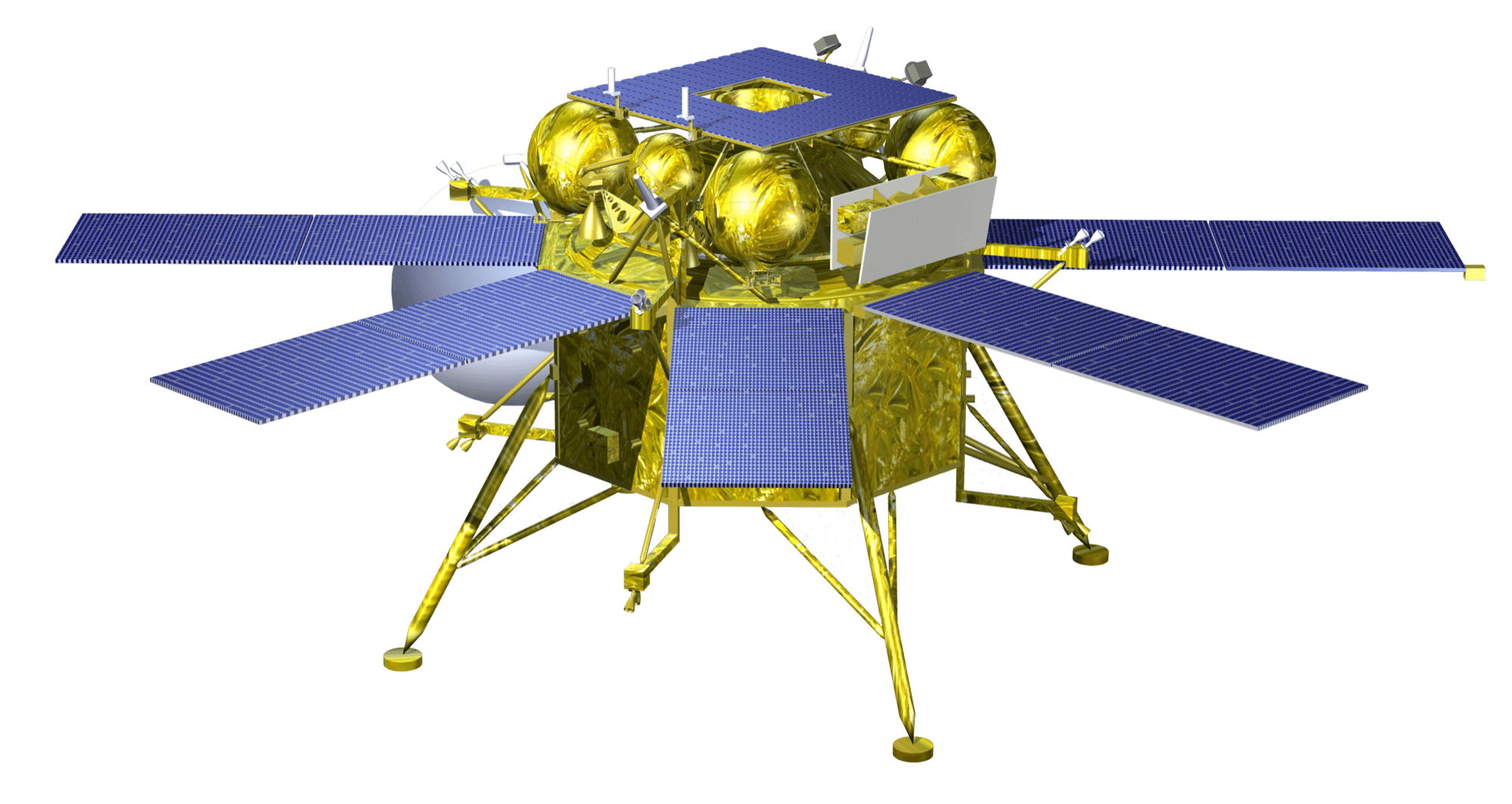
The Soviet Union sent spacecraft toward Mars again and again and landed almost nothing, and Russia inherited both the ambition and the record. Phobos-Grunt was meant to end that: fly to Mars, settle on its inner moon, scoop up a sample and bring it home. It reached low Earth orbit on 8 November 2011, never fired for Mars, and burned up on 15 January 2012. The recovery began before the wreckage had finished falling. Within nine days NPO Lavochkin and the Russian Academy of Sciences had said publicly that they would try again. Lavochkin's general director Viktor Khartov argued that no other international programme would return Phobos material within a decade and that Russia had no other road. Lev Zelyony, director of the Space Research Institute, made the more revealing point: Phobos-Grunt had four tasks, to reach Mars, to land on Phobos, to launch back toward Earth and to deliver a capsule, and not one of them had ever been rehearsed. The successor would be simpler, would carry fewer instruments, would use a complete Fregat upper stage rather than the truncated one blamed for 2011, and would inherit systems proven first on the Luna-Glob and Luna-Resurs lunar missions. It acquired a formal identity too. Inside the Federal Space Programme it became part of a development work called Expedition-M, and the spacecraft itself was renamed Boomerang, a name that describes exactly one thing about it: the intention that something would come back.
The most concrete description of Boomerang is not a press release but a procurement document. In October 2016 the technical assignment for the advance project appeared on the Russian state procurement site, and TASS reported its contents. A spacecraft of 6.5 tonnes would launch on an Angara from Vostochny, cross to Mars, enter orbits around Mars, Phobos and Deimos and survey all three, then soft-land on Phobos, take samples and send a return vehicle back to land on Russian territory. Flight control would use the antennas at Yevpatoria, Kalyazin and Ussuriysk and the deep space centre at Medvezhi Ozera, together with ESA ground stations. The sample requirement was written as a container specification rather than a science goal: the vessel had to accommodate at least 100 cubic centimetres of Phobos material weighing at least 0.6 kg, six times the 100 grams TASS attributed to the 2011 mission. Roscosmos was ready to spend 150.316 million roubles on the advance project. The programme as a whole carried 10,151 million roubles for Phobos research, up from 5.1 billion in the previous year's draft and around 3 billion when the idea was first floated in 2012. Attached to that allocation was a footnote that turned out to matter more than any of the numbers: the work would be carried out only with the participation of the European Space Agency.
It never got past paper. The tender was run in 2016 and won by NPO Lavochkin, and in 2019 the Phobos half of Expedition-M cleared its first formal stage, the submission of technical proposals, which is the step that comes before preliminary design. A provisional science payload and a ballistic scheme existed. Then it stopped. In February 2020 Alexander Zakharov of IKI, who had worked on Phobos 1, Phobos 2 and Phobos-Grunt, told N+1 that a Roscosmos representative had said at a meeting at Lavochkin that there would be no continuation of the work that year because there was no money, and that it was deferred by four years, to 2024. He noted that the Roscosmos leadership had not announced this. That is the whole cause of death, and it is a second-hand account of a meeting rather than a decision. The schedule kept moving on its own after that. In October 2016 Zelyony twice put the launch at 2024, on the 5th and again on the 11th, when he denied press reports of a slip to 2025. In July 2017 he said it would be after 2025, which put it outside the very programme funding it. In September 2023, TASS cited Lavochkin materials putting the launch after 2030. Nothing in the design changed across those seven years. Only the year did.
Boomerang was never the point. It was the rehearsal for Mars-Grunt, the surface sample return that Expedition-M existed to reach. Zakharov set out the logic cleanly: almost every element of a Mars sample return also appears in a Phobos sample return, and the single element Phobos does not exercise is a rocket launching from the surface of Mars. Get Phobos right and most of the harder mission is qualified. Mars-Grunt itself never left the planning stage, and what has been published about it does not agree with itself. Russian Wikipedia describes a 5,200 kg spacecraft with a 752 kg landing platform and an ascent rocket of about 1,700 kg. English Wikipedia describes a 4,100 kg launch mass, a 2,750 kg landing mass including a 450 kg ascent vehicle, a robotic arm collecting roughly 0.2 kg, and rendezvous with an orbiter in a 500 km circular orbit. Both describe the same unusual entry approach, an inflatable braking cone and retro-rockets instead of parachutes, on the grounds that parachutes work badly in an atmosphere that thin. A 1,700 kg ascent rocket and a 450 kg ascent vehicle are not the same object, and neither article rests on a Lavochkin document we were able to open. These are design study figures of uncertain vintage, and should be read that way.
What finally closed the door was not a decision about Mars. ESA ended its ExoMars cooperation with Roscosmos during 2022, and our Kazachok entry gives the Council decisions and their dates. That removed the European partner the programme's own footnote had made a condition of the Phobos work. Then the Federal Space Programme for 2016 to 2025 simply ran out of years. Its successor is the national project for the development of space activity to 2030 with a perspective to 2036, and Mars is not in it. Speaking to Troitsky Variant in November 2025, the analyst Alexander Khokhlov put it flatly: in the ten-year national project, to 2036, there is no mention of Mars and no Martian projects. In June 2026 Rossiyskaya Gazeta published the priorities in a draft presidential decree on state space policy prepared by Roscosmos: to 2036, the Moon, a lunar nuclear power plant, an orbital station, launchers, constellations and GLONASS; after 2036, Venus, nuclear propulsion, lunar and asteroid resources. IKI director Anatoly Petrukovich, listing the science directions in the same article, named near-Earth space, the Sun, Venus, the distant universe, medical and biological missions and the lunar programme. Mars is absent from both lists. Meanwhile JAXA's MMX, which JAXA said on 20 August 2026 is set to launch on 20 October 2026, is bound for Phobos to do the thing Boomerang was designed for. Zakharov saw it coming in 2020: we had that chance, he said, and we let it slip.
Mission facts
Status on 27 August 2026
Dormant with no announced end. We found no Roscosmos, Lavochkin or IKI statement dated 2024, 2025 or 2026 giving Boomerang a launch date, a design phase or a budget. The most recent schedule statement we could trace is from September 2023 and says only that launch would be after 2030. Russian Wikipedia's own article carries a banner flagging its contents as current as of October 2016.↗
Three names, one project
Фобос-Грунт 2 is the informal successor name used from January 2012. Бумеранг (Boomerang) is the spacecraft name that replaced it. Экспедиция-М (Expedition-M) is the state development work, the ОКР, inside which it sat. Alexander Zakharov of IKI, who worked on Phobos 1, Phobos 2 and Phobos-Grunt, told N+1 in February 2020 that Expedition-M contained two missions: one to Phobos with sample return, called Boomerang, and a second to Mars, also with sample return. TASS in 2015 instead printed the development work as Экспедиция-М (Марс-Грунт), which is why English sources sometimes treat Mars-Grunt and Expedition-M as the same thing.↗
Where it came from
Phobos-Grunt reached low Earth orbit on 8 November 2011 UTC, never fired for Mars, and re-entered on 15 January 2012. Work on a Fobos-Grunt 2 began at NPO Lavochkin with the Russian Academy of Sciences almost immediately. Speaking at the Korolev Readings at Bauman Moscow State Technical University on 24 January 2012, Lavochkin's general director Viktor Khartov said the task of returning soil from Phobos remained current, Russian scientists believed no other international programme would solve it within ten years, and "У нас нет другого пути: Россия должна решить задачу полёта на Марс" ("We have no other road: Russia must solve the task of the flight to Mars").↗
What would have been different
NTV reported on 23 January 2012 that IKI director Lev Zelyony said the project would be updated but simplified, with some of the Mars-observing instruments moved onto ESA's ExoMars if an agreement could be reached, and made the point that Phobos-Grunt had four tasks (fly to Mars, land on Phobos, launch back to Earth, deliver the return capsule) and that not one of them had ever been rehearsed. Russian Wikipedia records the intended engineering changes: a substantially revised service module with an improved control system, roughly six years of rework, fewer instruments, systems proved first on the Luna-Glob and Luna-Resurs missions, and a full Fregat upper stage instead of the truncated version widely blamed for 2011.↗
Not started in 2013
Asked at the MAKS-2013 air show whether work on a new Phobos mission had begun, Khartov answered plainly on 27 August 2013, in reply to a RIA Novosti question: "Нет, не началась работа по новому «Фобосу». Мы сейчас все силы бросаем на проект «ЭкзоМарс»" ("No, work on the new Phobos has not begun. We are throwing all our forces at the ExoMars project right now"). He added that experience from the lunar programme was needed first and that the lessons of the Phobos-Grunt launch had to be absorbed.↗
The technical assignment, 2016
The clearest description of Boomerang comes from the technical assignment for the advance project, published on the Russian state procurement site and reported by TASS on 25 October 2016. A 6.5 tonne spacecraft would reach Mars, enter orbits around Mars, Phobos and Deimos and study them remotely, soft-land on Phobos and take samples, and send a return vehicle back to land on Russian territory. The document specified that the descent vehicle's sample container "должен обеспечивать размещение не менее 100 кубических сантиметров вещества Фобоса массой не менее 0,6 кг", at least 100 cubic centimetres of Phobos material weighing at least 0.6 kg. TASS added that the 2011 Phobos-Grunt had been meant to return 100 grams, the low end of the 100 to 200 gram range usually quoted for that mission.↗
Launcher and ground segment
The same 2016 assignment named an Angara from the Vostochny cosmodrome. Phobos-Grunt had flown on a Zenit from Baikonur. Control in flight was to use the antennas at Yevpatoria, Kalyazin and Ussuriysk and the deep space communications centre at Medvezhi Ozera, together with ground stations of the European Space Agency. Russian Wikipedia's infobox instead lists Proton-M or Angara-A5 and gives the launch site as unknown.↗
The money
The estimate climbed and the work did not. Russian Wikipedia records roughly 3 billion roubles in 2012, 5.1 billion in the 2014 draft programme, and 10.3 billion in the draft Federal Space Programme for 2016 to 2025. The approved programme carried 10,151 million roubles for Phobos research. Separately, Roscosmos was prepared to spend 150.316 million roubles on the advance project alone. None of these figures is a spend; they are allocations and ceilings in successive documents.↗
The European condition
The Federal Space Programme's own footnote said the Phobos work would be carried out only with the participation of the European Space Agency. TASS reported that condition twice, on 11 and 25 October 2016. Zelyony described Boomerang as the logical continuation of ExoMars 2016 and ExoMars 2020, contingent on how the ExoMars work went. In 2022 ESA ended its ExoMars cooperation with Roscosmos, which removed the only partner the programme's own paperwork allowed for. Our Kazachok entry covers that decision and its dates.↗
Five launch dates
January 2012: not before 2018. May 2015: the draft Federal Space Programme set 2024 for the Expedition-M launch. 5 and 11 October 2016: Zelyony confirmed 2024 and denied press reports of a slip to 2025. 15 July 2017: Zelyony said that because of funding cuts the mission would launch only after 2025. 2 September 2023: TASS, citing NPO Lavochkin materials, said after 2030. Each of those is a statement about a future that then moved again.↗
How far it actually got
The tender for the work was run in 2016 and won by NPO Lavochkin, and in 2019 the Phobos expedition passed its first stage: the submission of technical proposals. Zakharov described that as the very first stage of work, the one that comes before preliminary design. At that stage the science payload composition was provisionally fixed, with instruments expected to be better than the 2011 set, and the ballistic scheme was determined. That is as far as it went. No spacecraft structure, no engineering model and no flight hardware were ever built.↗
Why it stopped
Zakharov told N+1 in February 2020 that, on his information, a Roscosmos representative had said at a meeting at NPO Lavochkin that there would be no continuation of the work in 2020 because there was no funding, and that further work had been deferred by four years, to 2024, with no development expected in the meantime. He added that the Roscosmos leadership had not announced this publicly. This is the closest thing to a stated cause of death that the project has, and it is a second-hand account of a meeting rather than a decision document.↗
Mars-Grunt, the second half
Mars-Grunt was the Mars surface sample return that Expedition-M was ultimately for. It was proposed to Roscosmos by IKI, with NPO Lavochkin as manufacturer, and never advanced beyond planning. English Wikipedia describes a cruise stage derived from Fregat-M, a lander using an inflatable braking cone and retro-rockets rather than parachutes, a robotic arm collecting about 0.2 kg, and a Mars ascent vehicle rendezvousing with an orbiter in a 500 km circular orbit, launched by Angara A5 from Vostochny. Russian Wikipedia describes controlled aerodynamic braking on the same grounds, that parachutes work poorly in the thin Martian atmosphere.↗
Mars-Grunt's numbers do not agree
The two published descriptions are not compatible. Russian Wikipedia gives a launch mass of 5,200 kg with a 752 kg landing platform and an ascent rocket of about 1,700 kg. English Wikipedia gives a launch mass of 4,100 kg, a landing mass of 2,750 kg including a 450 kg ascent vehicle, and a 450 kg orbiter dry mass. A 1,700 kg ascent rocket and a 450 kg ascent vehicle are not the same object. Neither article cites a Lavochkin document we could open, and Russian Wikipedia's article was nominated for deletion in August 2023. Treat every Mars-Grunt number as a design study figure of uncertain vintage.↗
Why Phobos first
Zakharov's argument for the ordering is the most useful engineering statement anyone has made about this programme. A Mars sample return and a Phobos sample return share almost all their elements, he said, and the only element Phobos does not exercise is the ascent rocket from the surface of Mars. Going to Phobos first was therefore not a consolation prize but a rehearsal. He also said he was certain a Phobos expedition would eventually happen, because the programme it belongs to includes Mars sample return, which must happen sooner or later. The open question, in his words, was when.↗
Someone else is going
JAXA's Martian Moons eXploration is now the mission set to fly the Phobos sample return that Boomerang was designed to be. As of a JAXA news item dated 20 August 2026, MMX is scheduled to launch on 20 October 2026 at 04:41:03 Japan time on an H3 from Tanegashima, reach Mars about a year later, sample Phobos, and return to Earth in Japanese fiscal 2031. Zakharov's response in 2020 to the Japanese schedule was that the two missions do not duplicate each other, and that he had hoped the first Phobos sample return would be Russian: "у нас такая возможность была, но мы ее упустили" ("we had that chance, and we let it slip").↗
Mission timeline
- 15 Jan 2012Phobos-Grunt, stranded in Earth orbit since 8 November 2011, re-enters the atmosphere. Russia's first interplanetary launch in fifteen years is over, and it remains, in 2026, the last Russian-built spacecraft launched toward another planet.
- 23 to 24 Jan 2012Within nine days of the re-entry, NPO Lavochkin and IKI say publicly that they intend to repeat the mission. Khartov: Russia must solve the task of the flight to Mars. Zelyony: the design will be simplified, and none of Phobos-Grunt's four tasks had ever been rehearsed before it flew.
- 27 Aug 2013At MAKS-2013 Khartov states that work on the new Phobos mission has not begun, because everything is going into ExoMars and because the lunar programme has to come first.
- 4 May 2015TASS reports that the draft Federal Space Programme for 2016 to 2025 sets the launch of the development work Экспедиция-М (Марс-Грунт) for 2024, with 10.3 billion roubles across the decade, double the 5.1 billion in the previous year's draft, which had assumed 2025.
- 25 Oct 2016Two weeks after Lev Zelyony tells TASS the launch has not been postponed and remains 2024, the technical assignment for the advance project appears on the state procurement site: a 6.5 tonne spacecraft, an Angara from Vostochny, orbits of Mars, Phobos and Deimos, a soft landing, and a container able to hold at least 100 cubic centimetres and 0.6 kg of Phobos. Roscosmos is ready to spend 150.316 million roubles on the advance project. The programme carries 10,151 million roubles for Phobos research, with a footnote that the work will happen only with European participation.
- 15 Jul 2017Zelyony says that because of reduced funding the mission will launch only after 2025, which puts it outside the Federal Space Programme that was paying for it.
- 2019The Phobos expedition passes the stage of submitting technical proposals, the first step before preliminary design. A provisional instrument set and a ballistic scheme exist on paper. This is the high-water mark of the whole programme.
- 21 Feb 2020Alexander Zakharov of IKI tells N+1 that a Roscosmos representative said at a meeting at NPO Lavochkin that there will be no continuation of the work in 2020 for lack of funding, and that it is deferred four years to 2024. Roscosmos never announces this.
- 2022Soon after the start of Russia's military operation in Ukraine, RBC records, the European side refused further cooperation and ESA turned to the United States. Roscosmos called that a threat to Mars exploration, and its head Yuri Borisov asked who would gain from it, Russia or the Europeans, and answered that everyone would lose. The Federal Space Programme footnote had made European participation a condition of the Phobos work.
- 2 Sep 2023TASS, citing NPO Lavochkin materials, reports that Boomerang will be launched after 2030. RBC repeats the mission profile unchanged from 2016: 6.5 tonnes, Angara, Vostochny, a return capsule landing in Russia. This is the last schedule statement we could find.
- 18 Nov 2025In Troitsky Variant, space analyst Alexander Khokhlov says of Russia's ten-year national space project: "У нас в нацпроекте на десять лет вперед, до 2036 года, нет никакого упоминания Марса, никаких марсианских проектов" ("In our national project ten years ahead, to 2036, there is no mention of Mars, no Martian projects at all").
- 26 Jun 2026Rossiyskaya Gazeta reports a draft presidential decree on state policy in space activity, prepared by Roscosmos and published on the federal portal for draft legal acts. Its concentration of resources to 2036 lists the Moon, a lunar nuclear power plant, an orbital station, launchers, constellations and GLONASS. After 2036 it lists Venus, nuclear propulsion and lunar and asteroid resources. Mars appears nowhere.
A filled dot marks something that physically happened. A hollow one marks an announcement, a naming or a target.
In pictures
Tap a photo to enlarge.
Sources
- Russian Wikipedia: Фобос-Грунт 2
- Russian Wikipedia: Марс-Грунт
- English Wikipedia: Mars-Grunt
- TASS, 25 Oct 2016: Российская станция «Бумеранг» должна будет доставить с Фобоса 600 г грунта (archived)
- TASS, 11 Oct 2016: ИКИ: запуск аппарата «Бумеранг» к Фобосу не переносился (archived)
- TASS, 4 May 2015: Роскосмос организует новую экспедицию взамен неудачной миссии «Фобос-Грунт» в 2024 году (archived)
- N+1, 21 Feb 2020: Будет ли второй подход к Фобосу? Ilya Ferapontov's interview with Alexander Zakharov of IKI (archived)
- RBC, 2 Sep 2023: В «Роскосмосе» оценили сроки запуска миссии к спутнику Марса
- Троицкий вариант (ТрВ-Наука) no. 442, 18 Nov 2025: Alexander Khokhlov interviewed by Alexey Ognev on the national space project 2026 to 2036
- Rossiyskaya Gazeta, 26 Jun 2026: Наталия Ячменникова on the draft presidential decree and Anatoly Petrukovich on the science programme (archived)
- InoSMI, 22 Sep 2025: translation of Brandon Weichert in The National Interest
- JAXA MMX mission site, news item dated 20 Aug 2026
- RIA Novosti, 27 Aug 2013: Проектирование «Фобос-Грунт-2» отложено из-за проекта «ЭкзоМарс»
- НТВ, 23 Jan 2012: Ученые обещают реинкарнацию «Фобос-Грунта»
- Khartov at the Korolev Readings, 24 Jan 2012, as reproduced at planeta.moy.su: НПО имени Лавочкина рассчитывает на проект «Фобос-Грунт-2» (archived)
Facts on this page were verified on 27 August 2026. Where sources disagree, the disagreement is stated rather than resolved silently.