Mars One
Mars One Foundation (Netherlands) and Mars One Ventures AG (Switzerland) · Europe · Program · 2012 · The long occupationCancelled
Cancelled: a one-way Mars settlement announced in 2012 for a 2023 landing, funded by broadcast rights. Nothing was built, and a Basel court declared the for-profit arm, Mars One Ventures AG, bankrupt on 15 January 2019.
TL;DR· 15 min read
Mars One promised to land four people permanently on Mars in 2023 and pay for it by selling the broadcast rights. It built nothing: every contract it signed with an aerospace company was for a concept study, SpaceX confirmed it had no Mars One launch on its manifest, and an MIT team calculated the first settler would suffocate after about 68 days. A court in Basel declared the for-profit arm, Mars One Ventures AG, bankrupt on 15 January 2019.
Mars One is the hardest entry in this catalogue to write fairly, because a great many people believed it, some of them staked years of their lives on it, and the reasons it could not work were public early. It was not a hoax in the sense of a fake spacecraft. It was a real Dutch organisation that commissioned real concept studies from real aerospace contractors, and whose founder appears to have believed his own plan. It was also a proposal to land four people permanently on Mars for six billion dollars, funded by television, with no launch vehicle, no lander, no life support system and no money. Both of those things are true at once, and the second is why it ended in a Swiss bankruptcy court.
- 2,761completed applications, against the 200,000 figure Mars One publicised
- $6bnLansdorp's own estimate for landing the first four settlers; it was never raised
- 0pieces of flight hardware built and launch contracts signed
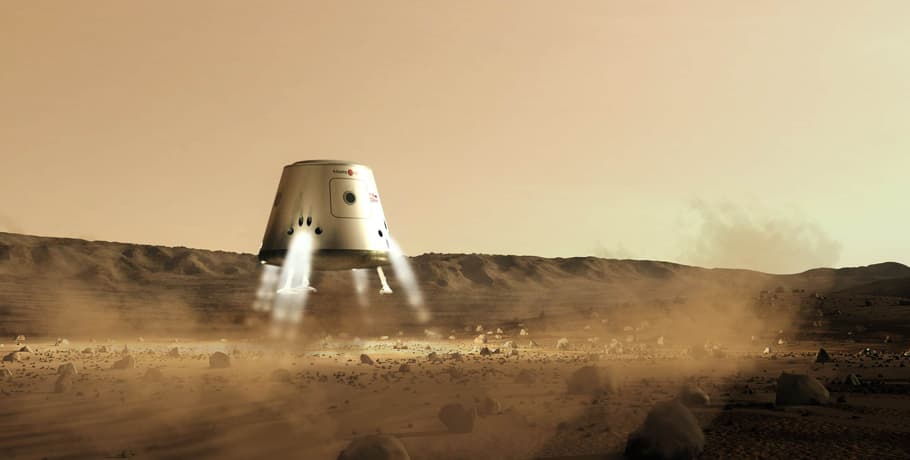
The proposition was simple enough to explain in a sentence, which was most of its power. Send four people to Mars, do not bring them back, send four more every twenty-six months, and pay for all of it by selling the world the right to watch. Bas Lansdorp, a Dutch engineer who had built and sold a wind-energy business, and Arno Wielders, his co-founder and technical lead, put this to the public in 2012 with a first landing in 2023. The one-way design was not carelessness. Returning from Mars requires a vehicle that can launch from the Martian surface, which is the single most expensive item in every government Mars architecture ever drawn, and deleting it genuinely does halve the problem. What it does instead is transfer the whole burden onto the surface systems, which must then work indefinitely with no possibility of retreat. That is the part Mars One never costed, and the part every serious critic went after. It is worth being precise about what the organisation was and was not, because the popular account has flattened it. It was two entities: a Dutch non-profit, the Mars One Foundation, and later a Swiss for-profit, Mars One Ventures AG, which held the commercial rights and was listed on the Frankfurt exchange. It employed people. It signed contracts. It was not a man with a website.
It was, however, a man with a website compared with what it needed to be. What Mars One bought with the money it raised was paper. Paragon Space Development Corporation was contracted on 12 March 2013 for life support concept studies. Lockheed Martin produced a demonstration lander concept study based on the design of NASA's Phoenix, which really had landed on Mars in 2008. Surrey Satellite Technology Limited produced a communications orbiter concept study. Those are real companies and those were real contracts, and every one of them was a study rather than a build. There was no launch agreement. SpaceX, routinely named in coverage as the launch provider, confirmed it had no contract with Mars One and no Mars One launch on its manifest. Set against that, the published figure for the first four-person landing was six billion dollars, an estimate English Wikipedia attributes to Lansdorp himself and for which Mars One never released working. What actually came in is harder to pin down than it should be: English Wikipedia records 928,888 dollars from donations and merchandise up to 4 July 2016 and 313,744 dollars from an Indiegogo campaign run between December 2013 and February 2014, while the same article elsewhere carries an estimate that the venture received tens of millions in total. Those two accounts cannot both be complete and we could not reconcile them. Either way the gap to six billion was to be closed by broadcast rights, and Lansdorp is reported to have told a 2015 audience that Mars One could earn eight times what the Olympics earns from television. The only television deal it ever had, with Endemol's Darlow Smithson Productions, was under discussion from June 2014 and over by February 2015.
The applicant numbers are where the story turns from optimism into something harder to defend. Mars One announced that more than 200,000 people had applied to go, and that figure did more work than any other single fact in the project's history: it was the proof that an audience existed, and therefore that the funding model was real. In March 2015 Joseph Roche, an astrophysicist at Trinity College Dublin who had reached the hundred-strong shortlist, said publicly that the number of completed applications was 2,761. English Wikipedia records that Mars One afterwards confirmed that figure in a YouTube video. Both numbers can be technically defensible, because they measure different things: one counts people who began a form, the other counts people who finished one. Only the larger was ever put in a press release. Roche's other statements were harder to explain away. He described a regional interview process that had shrunk to a ten minute Skype call, containing factual recall questions and no psychological or psychometric assessment of any kind, for a mission whose entire premise is that the crew will never come home. He described shortlisted candidates being asked to donate to Mars One whatever they earned from media appearances. His stated motive for speaking was that he did not want to be attached to something that would damage the public's trust in science.
The engineering verdict arrived first and was largely ignored. In October 2014 an MIT team presented an independent analysis at the International Astronautical Congress in Toronto. MIT News names Olivier de Weck as the leader of the group, with the graduate students Sydney Do, Koki Ho, Andrew Owens and Samuel Schreiner; Do is the lead author of the paper. Simulating the habitat Mars One described, they found the first settler would suffocate after about 68 days. The mechanism is instructive because it is not the obvious one. The crops required to feed the colony would push the oxygen concentration to dangerous levels; controlling that requires continuously introducing nitrogen to dilute it; the nitrogen supply would deplete; and the habitat would then have nothing left with which to make up its own leaks. They also calculated that fifteen Falcon Heavy launches would be needed to deliver the initial supplies where Mars One assumed six. De Weck was careful about what he was claiming: not that Mars One was infeasible, but that it was not feasible under the assumptions it had made. Do put it more bluntly, calling the plan inherently unsustainable. A year later, at a public debate reported by Dwayne Day in The Space Review, Lansdorp is described as conceding that the published plan was not really the plan, that he said different things to journalists than at technical conferences, and that there was no detailed technical plan at all.
It ended in a courtroom nobody was watching. Mars One Ventures AG, the Swiss for-profit that held the commercial rights, was declared bankrupt by a court in Basel on 15 January 2019. No announcement was made. The fact was found a month later by a member of the public reading the Swiss commercial register, and reached the press on 11 February. Trading in the Frankfurt-listed shares had been suspended on 5 February for non-compliance. Lansdorp said he was working with other parties to find a solution, and that the Mars One Foundation still existed but could not act without further investment; it did not act again. What was and was not real can now be stated plainly. Real: the organisation, the contracts for concept studies, the candidates, the fees they paid, the years some of them arranged their lives around it, and, as far as anyone can demonstrate, Lansdorp's own belief. Not real: any spacecraft, any launch agreement, any life support system, any funding, and the 200,000 applicants. The most useful thing about Mars One is not that it failed but why so many people wanted it not to. It offered a date. Every government Mars programme offers a decade, and always has, and Mars One's genuine insight was that a specific year in the near future is worth more attention than any amount of engineering credibility. That insight was correct, and it is the reason the entry needs writing carefully rather than dismissively.
Mission facts
What it proposed
A permanent human settlement on Mars, established by crews of four arriving every two years, with no return vehicle in the plan at all. That was not an oversight. Mars One argued that leaving out the return halves the problem, and it is true that it does. It also means that everything which follows has to work forever, which is the part that was never costed.↗
Who ran it
Bas Lansdorp, a Dutch mechanical engineer who had previously founded a wind-energy company, as chief executive, and Arno Wielders as chief technical officer and co-founder. English Wikipedia dates the founding to 2012, and international coverage describing the plan was running by early June that year.↗
The funding idea
Broadcast rights. Mars One's public argument was that the selection, training and journey of the first settlers would be the largest media event in history and that the rights would fund the mission. Speaking at a public debate in August 2015, Lansdorp is reported to have claimed Mars One could make eight times what the Olympics makes from television.↗
The published roadmap
As it stood after the December 2013 announcement of a robotic precursor: a demonstration lander and a communications satellite in 2020, rovers in 2022, six cargo missions in 2024, the first crewed landing in 2025 and a second crew in 2026. Earlier statements had put the first landing in 2023. No element of this schedule was ever met, and no element of it was ever begun as hardware.↗
The roadmap, revised twice
On 19 March 2015 Lansdorp announced the first crew would not land until 2027. On 7 December 2016 Mars One published an updated roadmap moving the first crewed mission to 2032, with the first robotic lander pushed to 2029. In roughly four years the first landing moved nine years further away, which is a faster rate of retreat than the calendar advances.↗
What it actually bought
Paper. What Mars One contracted for was concept studies: Paragon Space Development Corporation for life support concept studies, contracted 12 March 2013; Lockheed Martin for a demonstration lander concept study based on the NASA Phoenix design; and Surrey Satellite Technology Limited for a communications orbiter concept study. These were real contracts with real companies and they were studies. No metal was cut.↗
No launch provider
SpaceX was mentioned as a possible launch provider and there was contact in 2014, but SpaceX confirmed it had no contracts with Mars One and no Mars One launches on its manifest. A settlement plan with no signed launch agreement is a plan for a poster.↗
The applicant numbers, as advertised
Mars One said more than 200,000 people had applied, and that figure went round the world. Over 100,000 was being reported by August 2013 and the final claim settled at over 200,000. The number was central to the project's credibility: it was the evidence that the audience for the television show existed.↗
The applicant numbers, as disputed
Joseph Roche, an astrophysicist at Trinity College Dublin who reached the Mars 100 shortlist, said in March 2015 that the true number of completed applications was 2,761 rather than 200,000. English Wikipedia records that Mars One later confirmed the 2,761 figure in a YouTube video; the TechSpot report cited here does not say so. The two numbers are not the same measurement, and that is the point: one counts people who started something online, the other counts completed applications, and only the larger of the two was ever publicised.↗
What else Roche said
That what was supposed to be a regional interview process had been reduced to a ten minute Skype call, in which he was asked factual recall questions and given no psychological or psychometric testing; and that shortlisted candidates were asked to donate money they earned from media appearances back to Mars One. His stated reason for going public was that he did not want to be part of something that could damage the public perception of science.↗
The selection rounds
On 30 December 2013 Mars One named 1,058 candidates from 107 countries, 586 men and 472 women. In February 2015 that was cut to the Mars 100, fifty men and fifty women, after medical screening of 660. None of them were ever trained on flight hardware, because there was none.↗
The television deal that collapsed
Discussions with Endemol's Darlow Smithson Productions began in June 2014 for a reality series following the selection and training. The arrangement ended in February 2015, with a statement that the parties had been unable to reach agreement on the details. The funding model lost its only concrete commercial partner four years before the money ran out.↗
The engineering verdict
In October 2014 an MIT team presented an independent analysis. MIT News names Professor Olivier de Weck as its leader, working with the graduate students Sydney Do, Koki Ho, Andrew Owens and Samuel Schreiner; Do is the lead author of the paper. The analysis was presented at the International Astronautical Congress in Toronto. Their simulation had the first settler suffocating after an estimated 68 days, because the crops needed to feed the colony would drive oxygen levels dangerously high, the nitrogen needed to dilute the oxygen would be steadily consumed, and the habitat would eventually run out of gas to make up leaks. They also found that 15 Falcon Heavy launches would be needed for the initial supplies where Mars One assumed six.↗
How MIT phrased it
De Weck: "We're not saying, black and white, Mars One is infeasible," and "But we do think it's not really feasible under the assumptions they've made." Do, quoted in the same piece: "Our finding is the Mars One plan is inherently unsustainable and is hence infeasible." That distinction, between Mars being impossible and this plan being impossible, is the one most subsequent coverage lost.↗
What Lansdorp conceded in public
At a public debate against the MIT team in August 2015, reported by Dwayne Day in The Space Review, Lansdorp is described as admitting that the plan Mars One published was not really the plan it would use, acknowledging that he said different things to the press than at technical conferences, and conceding that he had no detailed technical plan.↗
The bankruptcy
Mars One Ventures AG, the Swiss for-profit arm which held the commercial rights, was declared bankrupt by a court in Basel on 15 January 2019. The collapse was not announced; it was noticed by a member of the public reading the register and reported in February. Trading in the shares, listed on the Frankfurt exchange, was suspended on 5 February 2019 for non-compliance with exchange rules over a 2017 share increase. That suspension date is not in the Engadget or BGR reporting cited here; it comes from English Wikipedia. Lansdorp said he was working with other parties to find a solution, and that the non-profit Mars One Foundation continued to exist but could not act without further investment.↗
Mission timeline
- Jun 2012Mars One becomes publicly visible. By early June international coverage is describing a Dutch venture that will land four people on Mars in 2023 and pay for it by selling the television rights. Bas Lansdorp is chief executive, Arno Wielders chief technical officer.
- 12 Mar 2013Paragon Space Development Corporation is contracted for life support concept studies. Lockheed Martin and Surrey Satellite Technology follow with lander and communications orbiter concept studies. All three are paper studies, and they are the closest Mars One ever comes to engineering.
- 30 Dec 2013Mars One names 1,058 candidates from 107 countries, 586 men and 472 women, selected from an applicant pool it describes as over 200,000.
- Jun 2014Discussions begin with Endemol's Darlow Smithson Productions for a reality series following the selection and training of the settlers. This is the funding model becoming real for the first and only time.
- Oct 2014Olivier de Weck, Sydney Do and colleagues present their independent feasibility analysis at the International Astronautical Congress in Toronto: first fatality by suffocation at an estimated 68 days, and 15 Falcon Heavy launches required against the six Mars One assumed.
- Feb 2015Two things happen in the same month. Mars One announces the Mars 100 shortlist, fifty men and fifty women. And the Endemol arrangement ends, the parties unable to agree the details. The publicity peaks and the business model dies in the same four weeks.
- 16 to 18 Mar 2015Joseph Roche, a shortlisted candidate and an astrophysicist at Trinity College Dublin, goes public: 2,761 completed applications rather than 200,000, a ten minute Skype call in place of a regional interview, no psychological testing, and requests that candidates donate media earnings back to the organisation.
- 19 Mar 2015Lansdorp announces that the first crew will not land until 2027.
- Aug 2015Mars One and the MIT team debate in public. Dwayne Day's account has Lansdorp conceding that the published plan is not the plan, that he says different things to journalists and to engineers, and that there is no detailed technical plan.
- 7 Dec 2016An updated roadmap moves the first crewed mission to 2032 and the first robotic lander to 2029. The first landing has now retreated nine years in four.
- 15 Jan 2019A court in Basel declares Mars One Ventures AG bankrupt. Nobody involved announces it.
- 5 to 11 Feb 2019Trading in Mars One Ventures shares is suspended in Frankfurt on 5 February, a date sourced to English Wikipedia rather than to the contemporaneous reporting. The bankruptcy is spotted by a member of the public reading the Swiss register and reported on 11 February. Lansdorp says he is working to find a solution; the Mars One Foundation survives on paper and does nothing further.
A filled dot marks something that physically happened. A hollow one marks an announcement, a naming or a target.
In pictures
Tap a photo to enlarge.
Sources
- English Wikipedia: Mars One
- MIT News, Mars One (and done?), 14 October 2014
- Dwayne Day, Red planet rumble, The Space Review, 17 August 2015
- The Space Review, Is there a business case for Mars?, 10 October 2016
- Shawn Knight, Mars One finalist breaks silence, claims organization is a total scam, TechSpot, 16 March 2015
- Daniel Cooper, Mars One is dead, Engadget, 11 February 2019
- Mike Wehner, The Worst Mars Mission Ever Conceived Is Now Dead, BGR, 11 February 2019
- Commercial register of the Canton of Basel-Stadt, entity CHE-375.837.130 (Mars One Ventures AG in Liquidation)
Facts on this page were verified on 24 August 2026. Where sources disagree, the disagreement is stated rather than resolved silently.