Inspiration Mars
Inspiration Mars Foundation (United States) · United States · Flyby · 2013 · The long occupationCancelled
Never flew: Dennis Tito's 2013 plan to loop two people past Mars on a 501-day free return from 5 January 2018. NASA declined his 700 million dollar request in November 2013 and the foundation's website went dark in late 2015.
TL;DR· 13 min read
Dennis Tito proposed on 27 February 2013 to launch two people on 5 January 2018 onto a 501-day free-return loop that would pass about 100 miles above Mars and come home without entering orbit or landing. By November 2013 he was asking NASA for 700 million dollars of a roughly one billion dollar total. NASA declined, the plan shifted to a longer 2021 route past Venus and Mars, and the foundation's website went dark in late 2015. Nothing was built.
Inspiration Mars was an argument dressed as a mission. Dennis Tito, the engineer turned investment manager who in 2001 flew to the International Space Station as a paying visitor, noticed that in January 2018 Earth and Mars would line up for an unusually short free-return trajectory. Fire once, coast past Mars, coast home. 501 days, no orbit insertion, no landing, no second burn to get wrong. He proposed to put two people on it. The point was never the science. The point was to demonstrate that a crewed Mars mission was something that could be done now rather than in the 2030s. Nothing was built, and the window passed empty.
- 501 daysthe free-return loop, launching 5 January 2018 and returning to Earth
- 100 milesplanned closest approach to the Martian surface, about 160 km
- $700mthe share of a roughly $1bn mission Tito asked NASA to pay in November 2013
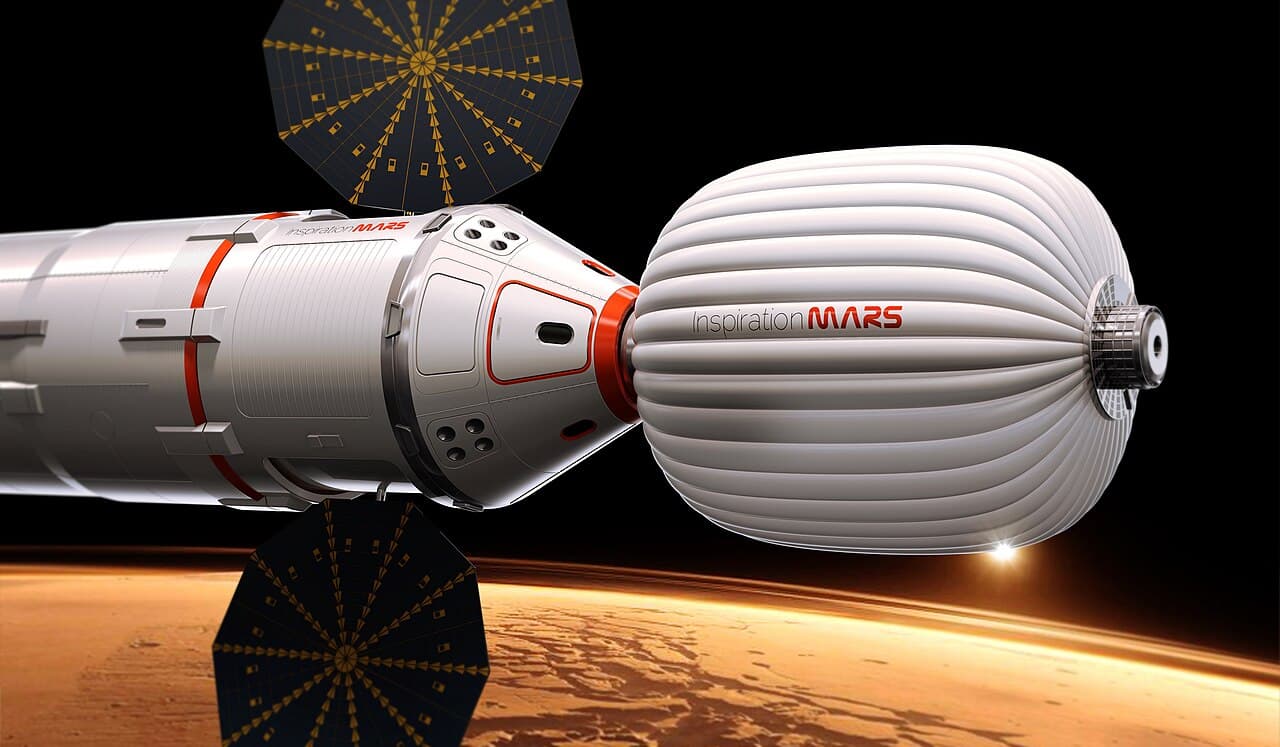
Dennis Tito's insight was about geometry rather than engineering. A free-return trajectory is one where a single departure burn puts you on a path that swings past a destination and comes back to where you started without any further propulsion. Apollo used the idea around the Moon; applied to Mars it is much rarer, because the alignment has to be right in a way that the ordinary 26-month transfer window does not guarantee. In January 2018 the alignment would be right, and the resulting loop would be unusually short: 501 days from launch to Earth return, passing about a hundred miles above the Martian surface. Tito, who in 2001 had paid his own way to the International Space Station and who was an aerospace engineer by training before he was an investor, proposed simply to put two people on that path. He announced it on 27 February 2013 at the National Press Club, having trailed it a week earlier. The plan was for an American man and an American woman, preferably a married couple, in what he called a simple spacecraft. No landing. No orbit insertion. No docking, no spacewalks, no rendezvous. Air and water recycled to keep the launch mass down. And, as the contemporaneous account of that press conference put it plainly, once the journey starts there is no turning back. Tito's own metaphor was a boomerang, which is exactly right: the trajectory does the work and the spacecraft just has to survive.
The people around him made it hard to dismiss. Jane Poynter and Taber MacCallum of Paragon Space Development Corporation had both lived sealed inside Biosphere 2, which is the closest anyone had come to the actual experience being proposed. Jonathan Clark, a former NASA flight surgeon, was chief medical officer. Joe Rothenberg, a former NASA associate administrator for spaceflight, chaired the advisory board. The technical paper, presented at the IEEE Aerospace Conference in March 2013, carried eleven names including that of S. Pete Worden, then the director of NASA's Ames Research Center. They were candid about the hard parts in a way that is rare in this genre. Radiation was to be handled by informed consent rather than shielding: the crew would be told their increased cancer risk and asked to accept it, a bargain the chief medical officer Jonathan Clark compared at the press conference to a person choosing to smoke. That is why the crew concept specified an older couple, since the latency of radiation-induced cancer works in favour of people who are already middle-aged. Tito set a requirement of 0.99 probability of returning the crew alive, which is worth reading against the profile: 501 days, no abort, no rescue, no resupply, and an Earth re-entry faster than any crewed vehicle had ever flown. What he did not have was a spacecraft, a launch vehicle, or, in February 2013, a cost estimate. He said so.
By November 2013 he had the estimate and it had changed the nature of the project. Testifying to Congress, Tito put the mission at about one billion dollars and asked NASA for 700 million of it, with 300 million from private and philanthropic sources. That is a seventy per cent government mission, which is the opposite of what had been announced nine months earlier, and it happened because the 2018 window was closing and no commercial vehicle existed that could fly it. NASA said no, in a statement that offered technical and programmatic expertise but not money, called the proposed schedule a significant challenge on life support, radiation, habitats and the psychology of over 500 days in a small spacecraft, and offered to talk about a later mission. The later mission became the 2021 route: launch in November 2021, a Venus flyby in April 2022, a Mars flyby in October 2022, home in June 2023, 589 days rather than 501 on English Wikipedia's figure, and to be flown on the Space Launch System and Orion. On 27 February 2014 the House Science Committee held a hearing on it. Four witnesses appeared and nobody from NASA was invited. Sandy Magnus, the former astronaut, delivered the sentence that outlasted the proposal: a Mars flyby can only be discussed in the context of a larger strategy, and any plan is doomed without the resources to support it. The committee was, by then, less interested in flying past Mars than in using the idea to attack NASA's Asteroid Redirect Mission.
That is how it died, and it is worth being exact because the usual account has it simply fading. On 3 April 2014 Administrator Charles Bolden called the 2021 flyby a one time feat that did not help NASA get people onto the surface of Mars, and said it was not inspirational. Representative Lamar Smith accused him of misrepresenting a mission that the hearing's own witnesses had said would use the Space Launch System, the very architecture NASA was building for a Mars landing. Neither man was arguing about the trajectory any more. After that there was a student design competition in August 2014, won by a joint Purdue and Keio University team, and then nothing. SpaceX had already said in March 2014 that more work would be needed and this was not their focus. The website went defunct in late 2015 with no announcement, no closure report and no formal cancellation, which is how most proposals actually end. On 5 January 2018 the launch date passed with nothing on any pad. What Inspiration Mars left is an argument rather than an artefact: that the hard part of a crewed Mars mission is not the trajectory, which is free, and not the vehicle, which mostly existed in pieces, but the fact that no organisation on Earth is structured to spend a billion dollars on a mission with no landing, no science programme and no second attempt.
Mission facts
The organisation
The Inspiration Mars Foundation, incorporated in Delaware on 25 January 2013 and founded by Dennis Tito. It was a non-profit rather than a company, and it never had a spacecraft programme in the sense of a contract to build one.↗
The announcement
27 February 2013, at the National Press Club in Washington, with the plan trailed publicly about a week earlier. Tito presented it as a high risk, low cost, fast paced human mission to Mars, and was explicit that the risk was real.↗
The trajectory
Launch from Earth on 5 January 2018, 501 days out and back on a free return trajectory, closest approach about 100 miles from the Martian surface. Tito's own image for it was a boomerang: the shape of the path does the work, and the spacecraft does almost nothing.↗
What a free return means
No propulsive burns after departure, minimal propellant, no landing, no docking and no spacewalks. It also means no abort. In the words of the contemporaneous account of the press conference, once the journey starts there is no turning back. A free return is the only Mars trajectory on which a failure of the main engine is not fatal, because there is no main engine burn left to fail.↗
Why 2018 specifically
Earth and Mars line up for a transfer roughly every 26 months, but not all alignments are equal, and the free-return geometry that gives a short loop is rarer than the transfer window itself. Testifying to Congress in November 2013, Tito described 2018 as one of the very best opportunities, of a kind that comes around only every fifteen years. That is the whole argument for the urgency, and it is also why the effort could not simply slip a year.↗
The crew concept
Two people in what Tito described as a simple spacecraft: an American man and an American woman, preferably a married couple. Two people because life support mass scales with crew size and a free return has no margin, and a couple because 501 days in a small volume with one other human being is a problem of relationships rather than engineering. No crew was ever selected.↗
The people behind it
Dennis Tito as chief executive and funder. Jane Poynter and Taber MacCallum of Paragon Space Development Corporation, both veterans of the sealed Biosphere 2 experiment, on life support. Jonathan Clark, a former NASA flight surgeon, as chief medical officer. Joe Rothenberg, a former NASA associate administrator for spaceflight, chairing the advisory board. This was not a group of amateurs, which is why the proposal was taken as seriously as it was.↗
The technical paper
Feasibility Analysis for a Manned Mars Free-Return Mission in 2018, presented at the 2013 IEEE Aerospace Conference in March 2013, DOI 10.1109/AERO.2013.6497413. Eleven authors: D. A. Tito, Grant Anderson, John Carrico, Jonathan Clark, Barry Finger, Gary Lantz, Michel Loucks, Taber MacCallum, Jane Poynter, Thomas Squire and S. Pete Worden, who was then director of NASA's Ames Research Center. The paper is paywalled; we confirmed its title, authorship and venue through Crossref and Semantic Scholar rather than reading it in full.↗
The radiation problem
Handled by consent rather than by shielding. The crew would be told the increased cancer risk and asked to accept it. At the press conference the comparison to a person accepting the increased cancer risk of smoking came from Jonathan Clark, the chief medical officer. Tito did not make it. This is the honest version of a problem that no crewed Mars proposal has ever solved cheaply, and it is why the crew concept specified older people.↗
The reliability target
Tito stated a requirement of 0.99 probability of returning the crew safely. It is worth holding that number against the mission profile: no abort, no rescue, no resupply, 501 days, and a re-entry at a speed no crewed vehicle had ever attempted.↗
The cost, before and after
At the February 2013 press conference Tito said he did not know how much the mission would cost, but called it chump change compared with previous human Mars estimates, and undertook to fund the early years himself. By his congressional testimony in November 2013 he had a number: about one billion dollars, of which he wanted NASA to provide 700 million and the private and philanthropic sector 300 million.↗
NASA's answer
NASA issued a statement declining to fund it. The statement said the agency was "willing to share technical and programmatic expertise with Inspiration Mars, but is unable to commit to sharing expenses with them," called the proposed schedule "a significant challenge due to life support systems, space radiation response, habitats, and the human psychology of being in a small spacecraft for over 500 days," and closed by saying NASA remained "open to further collaboration as their proposal and plans for a later mission develop." In plain terms: no money, the schedule is not credible, and we will talk about 2021.↗
The 2021 alternative
A different and longer route: launch November 2021, Venus flyby April 2022, Mars flyby October 2022, Earth return June 2023. English Wikipedia gives the duration as 589 days, 88 days longer than the 2018 loop, with the Venus pass coming within 800 kilometres of the surface. This version was to fly on NASA's Space Launch System and Orion, which is why it moved from being a private proposal to a congressional argument.↗
The congressional hearing
On 27 February 2014 the House Science, Space and Technology Committee held a hearing on the possibility of a human Mars flyby in 2021. The witnesses were Scott Pace of the Space Policy Institute, retired General Lester Lyles, Doug Cooke and the former astronaut Sandy Magnus. Nobody from NASA was invited to testify. Magnus's warning was the one that stuck: a Mars flyby can only be discussed in the context of a larger strategy, and any plan is doomed without the resources to support it.↗
How NASA killed it
On 3 April 2014 NASA Administrator Charles Bolden called the 2021 flyby a one time feat that did not advance the goal of landing people on Mars, and said it was not inspirational. He defended the Asteroid Redirect Mission instead. Representative Lamar Smith, the committee chairman, accused Bolden of misrepresenting the flyby and pointed out that the witnesses had testified it would use the Space Launch System, which is the architecture NASA intended for a Mars landing anyway. The exchange is where the idea stopped being a proposal and became a political argument about ARM.↗
How it ended
It was never formally cancelled. There was no closure announcement, no final report and no wind-up statement. SpaceX said in March 2014 that additional work would be required and that this was not their focus. The foundation's website became defunct in late 2015. The 5 January 2018 launch date passed with nothing on any pad.↗
Mission timeline
- 25 Jan 2013The Inspiration Mars Foundation is incorporated in Delaware.
- 20 Feb 2013The plan is trailed publicly a week ahead of the press conference, and coverage begins describing a privately funded human flyby of Mars in 2018.
- 27 Feb 2013Tito lays it out at the National Press Club: launch 5 January 2018, 501 days, free return, closest approach about 100 miles above Mars, two crew, preferably a married couple, and no way to turn back once it starts.
- Mar 2013Feasibility Analysis for a Manned Mars Free-Return Mission in 2018 is presented at the IEEE Aerospace Conference, with eleven authors including Pete Worden, then director of NASA Ames, and the Biosphere 2 veterans Jane Poynter and Taber MacCallum.
- 11 Apr 2013Inspiration Mars presents at the 29th National Space Symposium in Colorado Springs, the point at which the proposal is being made to the industry rather than to the press.
- 20 to 21 Nov 2013Tito testifies to Congress with a costed plan: about one billion dollars, NASA to provide 700 million and private and philanthropic sources 300 million. NASA's response the following day declines to fund it while remaining open to a later mission.
- 27 Feb 2014The House Science Committee holds a hearing on a human Mars flyby in 2021, launching November 2021 with a Venus flyby in April 2022, a Mars flyby in October 2022 and an Earth return in June 2023. Four witnesses, none of them from NASA, which was not invited.
- Mar 2014SpaceX indicates that additional work would be required and that the mission is not their focus. The last plausible commercial route to a vehicle closes.
- 3 Apr 2014NASA Administrator Charles Bolden calls the flyby a one time feat and says it is not inspirational, defending the Asteroid Redirect Mission instead. Representative Lamar Smith accuses him of misrepresenting it. The proposal is now a proxy fight over ARM.
- Aug 2014A student design competition run through the Mars Society is won by a joint Purdue and Keio University team. This is the last visible activity of the effort.
- late 2015The Inspiration Mars Foundation website becomes defunct. There is no announcement of any kind: the effort stops rather than ends.
- 5 Jan 2018The launch date passes. Nothing flies. The next comparable free-return opportunity of this quality is, on Tito's own account, roughly fifteen years further on.
A filled dot marks something that physically happened. A hollow one marks an announcement, a naming or a target.
In pictures
Tap a photo to enlarge.
Sources
- Marcia Smith, Tito Outlines High Risk, Low Cost, Fast Paced Human Mission to Mars, SpacePolicyOnline, 27 February 2013
- Marcia Smith, Tito Now Wants NASA Funding for Inspiration Mars, Here's NASA's Response, SpacePolicyOnline, 21 November 2013
- Marcia Smith, House Hearing Scheduled on Possibility of Human Flyby Mission to Mars in 2021, SpacePolicyOnline, 21 February 2014
- Marcia Smith, House Hearing Underscores Lack of Consensus on Next Steps in Human Spaceflight, SpacePolicyOnline, 28 February 2014
- Marcia Smith, Rep. Smith Criticizes Bolden's Defense of ARM Versus Mars 2021, SpacePolicyOnline, 3 April 2014
- English Wikipedia: Inspiration Mars Foundation
- Crossref record for Tito et al., Feasibility Analysis for a Manned Mars Free-Return Mission in 2018, 2013 IEEE Aerospace Conference
- Semantic Scholar record for the same paper
- The paper itself, DOI 10.1109/AERO.2013.6497413, IEEE
Facts on this page were verified on 24 August 2026. Where sources disagree, the disagreement is stated rather than resolved silently.