Mars as an observatory
NASA, ESA and CNSA · Multinational · Program · 2013 · Multipolar MarsOperating
Twice the Mars fleet has been turned round to look outward: at comet Siding Spring on 19 October 2014 and at 3I/ATLAS in October 2025, whose predicted position the Mars astrometry then improved tenfold.
TL;DR· 15 min read
Nothing at Mars was sent there to do astronomy, but the fleet has twice been turned round to look outward. In 2014 it watched comet Siding Spring pass about 139,500 km from the planet, measuring metal ions high in the atmosphere and imaging a nucleus under half a kilometre across. In 2025 it observed the interstellar object 3I/ATLAS, and astrometry from the ExoMars Trace Gas Orbiter cut the uncertainty in the comet's predicted position by a factor of ten.
Nothing at Mars was sent there to do astronomy. The cameras are surface imagers with short exposure limits, fixed mounts and no ability to track a moving target. But Mars is a vantage point Earth cannot buy: hundreds of millions of kilometres of baseline away, hidden behind the Sun from Earth for part of every synodic cycle, and sometimes simply much closer to whatever is passing through. When something worth seeing crosses that neighbourhood, the fleet gets repointed, the exposures get stretched to their limits, and the results have twice been better than anyone had a right to expect.
- 139,500 kmhow close comet Siding Spring came to Mars on 19 October 2014
- 10ximprovement in 3I/ATLAS's predicted position once Mars-based astrometry was folded in
- 1stastrometry from a spacecraft orbiting another planet accepted by the Minor Planet Center
Nothing at Mars was built to do astronomy. HiRISE is a telescope pointed permanently at the ground, tuned to resolve boulders from three hundred kilometres up. CaSSIS on the ExoMars Trace Gas Orbiter photographs bright terrain a few hundred kilometres below. Mastcam-Z is a rover's eyes, bolted to a mast that cannot track anything, with the whole camera fixed in place through a long exposure so that stars trail across the frame. Mars Express's camera cannot expose for longer than half a second. Every one of these instruments is optimised for a target that is close, bright and stationary, which is precisely the opposite of a comet. And yet twice in the last twelve years the entire Martian fleet has been swung around to face outward, because Mars happened to be the best seat in the Solar System. The reasons are worth separating. One is distance: an object crossing near Mars can be ten times closer to a Mars orbiter than to any telescope on Earth. The other is geometry: an observation from Mars supplies a parallax baseline of the order of two hundred million kilometres, and triangulating a Mars measurement against an Earth measurement collapses the uncertainty in an orbit far faster than more Earth-based data would. In October 2025 that second effect turned out to matter more than the first, and it produced a result on a scale ESA says it had not expected.
The first campaign was forced on the fleet. Comet C/2013 A1 Siding Spring, discovered in January 2013, was going to pass about 139,500 kilometres from Mars on 19 October 2014, less than half the Earth-Moon distance and less than a tenth of the closest approach of any known comet to Earth. It was arriving nearly head-on at about 56 kilometres per second, and at that speed a grain half a millimetre across could kill a spacecraft. So NASA spent the summer hiding. Mars Reconnaissance Orbiter adjusted its orbit on 2 July and again on 27 August, Odyssey on 5 August, and MAVEN on 9 October, less than three weeks after it had arrived at the planet, all so that they would be behind Mars during the twenty-minute window of peak risk that began about ninety minutes after closest approach. Mars Exploration Program chief scientist Rich Zurek made the distinction plainly: the hazard was not the nucleus but the trail of debris coming from it. Having taken shelter, the same spacecraft then did the science. NASA counts five orbiters and two rovers at Mars that day, among them MAVEN, which had entered orbit on 21 September, less than four weeks earlier.
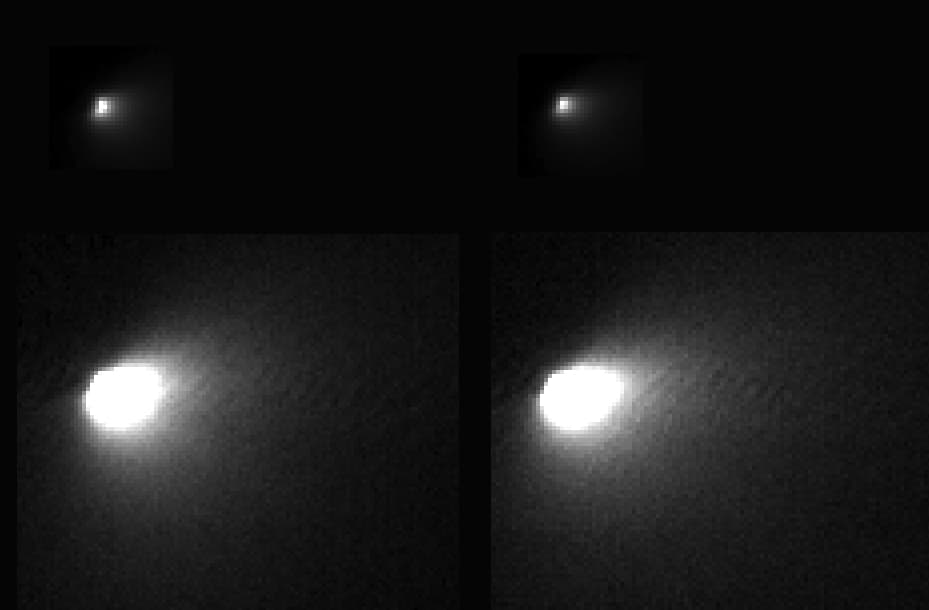
What Siding Spring produced was not really a picture of a comet, it was a measurement of what a comet does to a planet. MAVEN's ultraviolet spectrograph recorded magnesium and iron emission so intense it dominated the Martian ultraviolet spectrum for hours before fading over two days, stronger than anything the most violent meteor storms on Earth have produced. Its mass spectrometer sampled the dust directly and found eight metal ion species, which NASA calls the first direct composition measurements of dust from an Oort Cloud comet. MARSIS on Mars Express saw a large jump in ionospheric electron density a few hours later, at an altitude well below the normal peak. SHARAD on MRO found its own radar images smeared by the temporary ion layer and turned the defect into a measurement, deducing night-side electron densities five to ten times normal. NASA describes the chain from a specific meteor shower to a transient ionospheric layer as a first for any planet, Earth included. HiRISE, meanwhile, imaged the nucleus from 138,000 kilometres and found it far smaller than telescopes had suggested: two or three pixels across the brightest feature, so under half a kilometre, rotating in about eight hours, and by the HiRISE team's account the first nucleus of a long-period comet ever imaged.
Buried in the HiRISE release is a sentence that reads like a footnote and turned out to be the theme of the next campaign. Twelve days before closest approach, the camera took three images in which the comet was barely above the noise, and those frames showed the comet was not quite where it was predicted to be. The team used the new viewing angle to correct the prediction, and states that without the correction the comet might have fallen outside the frame in the closest-approach images. Eleven years later ESA did the same thing deliberately and formally. When 3I/ATLAS, the third known interstellar object, passed 0.194 astronomical units from Mars on 3 October 2025, ESA's ExoMars Trace Gas Orbiter observed it with CaSSIS in five-second exposures, on a target that CaSSIS principal investigator Nick Thomas said was ten thousand to a hundred thousand times fainter than the instrument's usual subject. The planetary defence astronomers at ESA's Near-Earth Object Coordination Centre then reduced those images to astrometry, which meant accounting exactly for where a fast-moving spacecraft was in its orbit around another planet, a correction that is negligible for a telescope on a mountain. They expected a modest improvement in the comet's predicted position. They got a factor of ten.
The 2025 campaign drew in all three agencies that had working spacecraft at Mars. NASA's MRO imaged the comet on 2 October from about 30 million kilometres at roughly 30 kilometres per pixel, MAVEN mapped hydrogen and hydroxyl in the coma and set an upper limit on its deuterium ratio, and Perseverance caught it from the floor of Jezero on 4 October as a smudge in an exposure long enough to trail the stars. ESA's Mars Express tried and, capped at half-second exposures, could not see it in single frames. China's Tianwen-1 imaged it with the orbiter's high-resolution camera, announced by the China National Space Administration on 6 November 2025, from about 30 million kilometres; the Chinese account is unusually frank that the payload had been designed for a bright planetary surface and had never attempted anything so distant and dim, and treats the whole exercise as a rehearsal for Tianwen-2's asteroid work. The astrometry milestone matters beyond one comet: ESA calls it a test case for planetary defence, a demonstration that a spacecraft which happens to be near a threatening object can be pressed into service as an observatory. The fleet also still looks the other way. On 2 July 2026 Perseverance watched Earth, one pixel wide and 314 million kilometres off, slide behind the crescent of Phobos.
Mission facts
Why Mars is worth observing from
Two reasons, and they are different. Proximity: an object passing near Mars can be an order of magnitude closer to a Mars orbiter than to any Earth telescope. Parallax: an observation from Mars gives a viewing angle no terrestrial or near-Earth observatory can, and triangulating the two collapses the uncertainty in a trajectory. ESA got a tenfold improvement in 3I/ATLAS's ephemeris this way, having expected only a modest one.↗
Comet Siding Spring, the encounter
C/2013 A1 was discovered on 3 January 2013 at Siding Spring Observatory in Australia. On 19 October 2014 it passed about 87,000 miles (139,500 km) from Mars, which JPL describes as less than half the Earth-Moon distance and less than a tenth of the distance of any known comet flyby of Earth. Closest approach was around 2:27 p.m. EDT, 18:27 UTC, in JPL's post-encounter release; NASA's own Siding Spring overview page dates the same moment to 2:28 p.m. EDT. Relative velocity was about 56 km/s.↗
Duck and cover
NASA moved its orbiters to the far side of Mars for the dangerous window. Mars Reconnaissance Orbiter adjusted its orbit on 2 July and again on 27 August 2014, Mars Odyssey on 5 August, and MAVEN on 9 October, weeks after arriving. The period of greatest risk began about 90 minutes after closest approach and lasted about 20 minutes, when Mars came nearest the centre of the widening dust trail. Even a half-millimetre grain at 56 km/s could have done serious damage.↗
What Siding Spring did to the atmosphere
MAVEN's Imaging Ultraviolet Spectrograph saw intense magnesium and iron emission high in the atmosphere after the meteor shower, dominating the Martian ultraviolet spectrum for hours and dissipating over two days. Its Neutral Gas and Ion Mass Spectrometer sampled the dust directly and identified eight metal ion species including sodium, magnesium and iron: NASA calls these the first direct measurements of the composition of dust from an Oort Cloud comet.↗
Two radars saw it too
MARSIS, the joint US and Italian sounder on ESA's Mars Express, recorded a large jump in ionospheric electron density a few hours after closest approach, at a substantially lower altitude than the normal peak. MRO's SHARAD found its own images smeared by the temporary ion layer, and used the smearing to work out that night-side electron density was five to ten times normal. NASA describes the direct link from a specific meteor shower to a transient ionospheric layer as a first on any planet, Earth included.↗
The comet itself, seen from Mars
HiRISE on MRO took the highest-resolution images at a minimum distance of 138,000 km, at 138 metres per pixel. Telescopic estimates had put the nucleus at about 1 km on the HiRISE team's account and at 2 km on NASA's; the best HiRISE frames showed only 2 to 3 pixels across the brightest feature, implying under 0.5 km. The HiRISE team describes it as the first nucleus of a long-period comet ever imaged. NASA's post-encounter release adds a rotation period of about eight hours and a CRISM spectrum showing a dusty comet with no strong emission lines at that instrument's sensitivity.↗
The 2014 astrometry lesson
HiRISE acquired three images twelve days before closest approach, when the comet was barely above the noise. Those early frames showed that the comet was not quite where it had been predicted to be. The new viewing angle was used to update the predicted position and timing, and the team states that without the update the comet might have fallen outside the frame in the closest-approach images. The same principle was formalised eleven years later.↗
3I/ATLAS, the object
Reported to the Minor Planet Center on 1 July 2025 by the ATLAS survey telescope at Rio Hurtado, Chile, with pre-discovery observations recovered back to 14 June 2025 from three ATLAS telescopes and the Zwicky Transient Facility. It is the third known interstellar object after 1I/'Oumuamua in 2017 and 2I/Borisov in 2019. NASA puts perihelion around 30 October 2025 at about 1.4 au; English Wikipedia, following JPL's small-body data, gives 29 October 2025 at 1.36 au.↗
The Mars pass
3 October 2025. JPL Horizons puts closest approach to Mars at 04:38 UT at 0.193664 au, about 29 million km, with a three-sigma uncertainty on the approach distance of plus or minus 330 km. The comet's total magnitude at the time was about 12. Because 3I/ATLAS reached solar conjunction on 21 October and perihelion eight days later, it was effectively unobservable from Earth through its most active phase, which made the Mars vantage point unusually valuable.↗
NASA's Mars fleet on 3I/ATLAS
MRO's HiRISE imaged the comet on 2 October 2025 from 19 million miles (30 million km) at roughly 19 miles (30 km) per pixel, showing the coma as a pixelated white ball. MAVEN's IUVS observed on 28 September and 9 October in multiple ultraviolet wavelengths, mapping hydrogen and hydroxyl and yielding an upper limit on the comet's deuterium to hydrogen ratio. Perseverance caught it as a faint smudge with Mastcam-Z on 4 October, in an exposure long enough to trail the stars.↗
ESA's Mars fleet on 3I/ATLAS
Between 1 and 7 October 2025 the ExoMars Trace Gas Orbiter and Mars Express both observed. TGO's CaSSIS camera caught the coma in five-second exposures; CaSSIS principal investigator Nick Thomas: "This was a very challenging observation for the instrument. The comet is around 10 000 to 100 000 times fainter than our usual target." Mars Express, capped at 0.5 second exposures, did not detect it in single frames, and ESA said scientists would try stacking. Spectra were attempted with OMEGA, SPICAM and NOMAD with uncertain results.↗
China's Mars fleet on 3I/ATLAS
The China National Space Administration announced on 6 November 2025 that the Tianwen-1 orbiter had imaged 3I/ATLAS with its high-resolution camera from about 30 million kilometres, describing the spacecraft as one of the closest probes to have observed the object. Liu Jianjun, chief designer of the ground application system for China's first Mars mission, said an animation was assembled from a series of images taken over 30 continuous seconds, and that the images show clear cometary characteristics, a nucleus together with the coma around it, several thousand kilometres across.↗
Pointing a Mars camera at the sky is hard
The Chinese account is unusually candid about it. The target was distant, small, moving fast relative to the orbiter and very faint from Mars orbit, and the optical payload had been designed to photograph a bright planetary surface. The team began preparation in early September 2025, simulated the geometry repeatedly, and pushed the high-resolution camera to its limit. CNSA frames the exercise as a technology rehearsal for Tianwen-2's asteroid work.↗
The Minor Planet Center milestone
ESA states that the astrometry derived from TGO's CaSSIS observations was the first time measurements from a spacecraft orbiting another planet were officially submitted to and accepted by the Minor Planet Center. Producing them required the planetary defence team at ESA's Near-Earth Object Coordination Centre to account for the exact position of a spacecraft in a fast orbit around another planet, a correction that is normally negligible. The result cut the ephemeris uncertainty by a factor of ten.↗
Looking back at Earth
The fleet also observes home. Opportunity photographed Earth as a pale dot in the Martian twilight on its 449th sol, 29 April 2005, about an hour after sunset, in 15 second exposures that elongated the planet as it moved. On 2 July 2026, sol 1907, Perseverance's Mastcam-Z recorded Earth passing behind Phobos at about 7 p.m. local solar time. NASA calls it the first time humanity has captured, from the surface of another planet, an observation of Earth disappearing behind an object.↗
What that took
Mark Lemmon of the Space Science Institute, who planned the observation and assembled the composite: "Phobos crosses the Martian sky three times a day, and Earth is visible for months at a stretch, but catching one directly behind the other takes planning and a little luck." Earth was 195 million miles (314 million km) away and one pixel wide. Phobos, about 27 km across at its widest and, in NASA's wording, orbiting 7,800 km from Mars, appeared roughly a third the width of the Moon seen from Earth.↗
Mission timeline
- 3 Jan 2013Comet C/2013 A1 is discovered at Siding Spring Observatory in Australia. Early orbit solutions raise the possibility of an impact on Mars; refined ones reduce the closest approach to a near miss and the concern shifts to the debris trail.
- 2 Jul to 9 Oct 2014NASA repositions its orbiters to be behind Mars at the peak of the dust hazard: MRO adjusts on 2 July and 27 August, Odyssey on 5 August, and MAVEN on 9 October, less than three weeks after arriving at the planet.
- 7 Oct 2014Twelve days out, HiRISE takes three images in which the comet is barely above the noise, and they show it is not quite where it was predicted to be. The new angle is used to correct the prediction, without which the comet might have missed the frame at closest approach.
- 19 Oct 201418:27 UTC: Siding Spring passes about 139,500 km from Mars at some 56 km/s. Five orbiters and two rovers are at the planet. HiRISE images the nucleus from 138,000 km at 138 metres per pixel, and Mars flies through the coma for hours afterwards.
- 7 Nov 2014NASA publishes the results: magnesium and iron emission from MAVEN's ultraviolet spectrograph, eight metal ion species from its mass spectrometer, an electron-density spike in MARSIS data, smeared SHARAD images implying five to ten times the usual night-side ionisation, and a nucleus under 0.5 km rotating in about eight hours.
- 1 Jul 2025The ATLAS telescope at Rio Hurtado, Chile, reports 3I/ATLAS to the Minor Planet Center. Pre-discovery images are recovered back to 14 June. It is the third known interstellar object, and its path will take it close to Mars while it is hidden from Earth behind the Sun.
- 1 to 7 Oct 2025ESA's ExoMars Trace Gas Orbiter and Mars Express observe. CaSSIS catches the coma in five-second exposures; Mars Express, limited to half-second exposures, cannot see it in single frames. NASA's MRO images the comet on 2 October, Perseverance on 4 October, and MAVEN's ultraviolet spectrograph on 28 September and 9 October.
- 3 Oct 202504:38 UT: 3I/ATLAS makes its closest approach to Mars at 0.193664 au, about 29 million km, roughly ten times closer than it ever comes to Earth. Its total magnitude is about 12.
- 6 Nov 2025The China National Space Administration announces that Tianwen-1's high-resolution camera has imaged 3I/ATLAS from about 30 million km, using a series of frames taken over 30 continuous seconds. Preparation had begun in early September; the camera was built to photograph a bright planetary surface.
- 14 Nov 2025ESA announces that TGO's astrometry has improved the comet's predicted position tenfold, and that it is the first astrometric measurement from a spacecraft orbiting another planet to be accepted into the Minor Planet Center database. ESA frames the whole exercise as a planetary defence rehearsal.
- 19 Nov 2025NASA publishes the Mars images of 3I/ATLAS. HiRISE principal investigator Shane Byrne: "Observations of interstellar objects are still rare enough that we learn something new on every occasion. We're fortunate that 3I/ATLAS passed this close to Mars."
- 2 Jul 2026Sol 1907: Perseverance's Mastcam-Z records Earth passing behind Phobos at about 7 p.m. local solar time from the rim of Jezero crater. NASA publishes the composite on 5 August 2026 and calls it the first observation from another planet's surface of Earth disappearing behind an object.
A filled dot marks something that physically happened. A hollow one marks an announcement, a naming or a target.
In pictures
Tap a photo to enlarge.
Sources
- NASA/JPL (7 Nov 2014): Mars Spacecraft Reveal Comet Flyby Effects on Martian Atmosphere, archived
- NASA/JPL (25 Jul 2014): NASA Mars Spacecraft Prepare for Close Comet Flyby
- HiRISE (University of Arizona): Images of Comet C/2013 A1 Siding Spring
- NASA science overview: Comet C/2013 A1 Siding Spring
- NASA (19 Nov 2025): NASA's Mars Spacecraft Capture Images of Comet 3I/ATLAS
- ESA (7 Oct 2025): ESA's ExoMars and Mars Express observe Comet 3I/ATLAS
- ESA (14 Nov 2025): ESA pinpoints 3I/ATLAS's path with data from Mars
- Xinhua (6 Nov 2025, in Chinese): 新华鲜报丨天问一号"惊鸿一瞥"!神秘阿特拉斯彗星特征明显
- NASA science hub: Comet 3I/ATLAS
- English Wikipedia: 3I/ATLAS
- NASA (5 Aug 2026): NASA's Perseverance Rover Watches Earth Vanish Behind Martian Moon
- NASA Photojournal: Earth as seen from Mars, Opportunity's sol 449 twilight image of 29 April 2005
Facts on this page were verified on 24 August 2026. Where sources disagree, the disagreement is stated rather than resolved silently.