Phobos-Grunt and Yinghuo-1
Roscosmos (Russia) and CNSA (China) · Multinational · Sample return · 2011 · The long occupationFailure
Stranded in low Earth orbit after launch on 8 November 2011: neither Mars burn ever fired, and the stack re-entered over the Pacific on 15 January 2012 with China's Yinghuo-1 still attached.
TL;DR· 18 min read
Phobos-Grunt was to land on Phobos, scoop up 100 to 200 grams of it and fly that home. It reached low Earth orbit on 8 November 2011, neither Earth-departure burn ever happened, and the stack re-entered over the Pacific on 15 January 2012 with Yinghuo-1, the first spacecraft China had built to reach another planet, still attached. The failure commission gave heavy charged particles restarting the onboard computer as the most probable cause, and said 62 per cent of the roughly 95,000 microchips aboard were not space grade.
Phobos-Grunt was the most ambitious robotic mission Russia had attempted since the Soviet Union ended: fly to Mars, land on its inner moon, scoop up 100 to 200 grams of it, and bring that home. It was also Russia's first interplanetary launch in fifteen years. It reached low Earth orbit on 8 November 2011 and then simply stopped. The main engine never fired, neither the first burn nor the second, and the spacecraft drifted for 68 days before burning up. Bolted to the adapter truss was Yinghuo-1, the first spacecraft China had built to reach another planet.
- 0 of 2Earth-departure engine burns that actually happened
- 1stChinese spacecraft built to reach another planet, lost with its ride
- 62%of the 95,000 microchips aboard were not space grade, said the failure commission
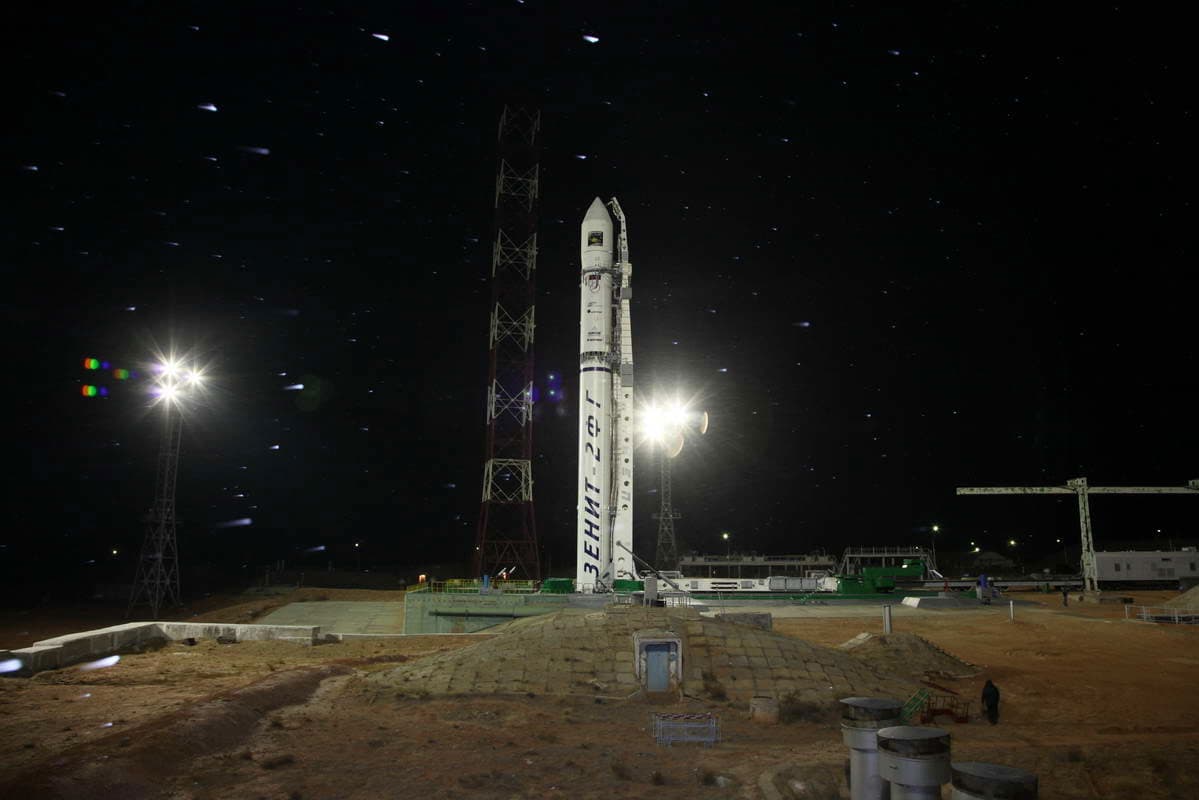
Phobos-Grunt was the largest and most ambitious planetary spacecraft the post-Soviet Russian programme ever built, and it was the first interplanetary vehicle Russia had launched in fifteen years, since Mars 96 fell back to Earth in November 1996. The plan was to reach Mars in September 2012, work from orbit through the winter, land on Phobos in February 2013, scoop 100 to 200 grams of the moon into a small capsule, and fly that capsule home in 2014. Nothing of the kind had been attempted by anyone. What left the pad was four vehicles stacked together: a jettisonable block of propellant tanks, a main propulsion unit derived from the Fregat upper stage, a cruise and landing module with its own engines, and a return vehicle carrying a seven kilogram re-entry capsule. Russian Wikipedia's itemised mass summary sums to 13,505 kg, although the same article's infobox prints NPO Lavochkin's own figure of 13,200 kg. Aleksandr Ilin, writing in Troitsky Variant nine weeks after the launch, put the entire fifteen-year project at about 170 million dollars, and recorded that in the early 2000s it had been funded at ten to fifteen million rubles a year. The mission had already slipped once, out of the October 2009 window, a postponement Chinese accounts record as made at the Russian side's suggestion. Bolted to the adapter truss was a 115 kilogram Chinese microsatellite called Yinghuo-1, Firefly-1, the first spacecraft China had built to reach another planet.
The rocket worked. The Zenit-2SB lifted off from Site 45 at Baikonur at 20:16:03 UTC on 8 November 2011, which was already past midnight in Moscow and four in the morning in Beijing, and this is why Russian and Chinese sources date the mission to the ninth. The spacecraft separated about 688 seconds later into an orbit of roughly 207 by 347 kilometres, deployed its solar panels, turned to face the Sun and reported healthy systems. Then it was supposed to do the one thing that mattered. At 02:55:48 Moscow time, 22:55:48 UTC, the main propulsion unit was to fire and lift the orbit to about 250 by 4,150 kilometres. Two hours after that, a second burn would commit the stack to Mars. Neither burn happened, and for hours nobody on the ground could even find the spacecraft. The following morning at Baikonur, Roscosmos head Vladimir Popovkin told reporters that the engine unit had not worked, in words RIA Novosti carried the same day: there was neither the first firing nor the second. His first guess, offered before any investigation existed, was that the vehicle had failed to turn from Sun-pointing to star-pointing attitude, so the ignition command was never issued. Phobos-Grunt was now carrying more than seven tonnes of propellant it could not use, in an orbit whose low point was already inside the measurable atmosphere.
What happened next exposed an assumption rather than a broken part. The spacecraft was built to talk to Earth from interplanetary distance, and its communications plan assumed it would already be on its way. There was no worked-out procedure for commanding it, or rebooting its computers, while it circled a few hundred kilometres up and crossed a station's sky in minutes. ESA offered its ground network anyway. A dish at Perth in Western Australia, its feed modified for the task, caught a carrier signal at 20:25 UTC on 22 November, which is 00:25 Moscow time on the 23rd and the reason Russian and Western accounts of that night sit a day apart. Telemetry came down on later passes. None of it could be turned into a burn. ESA stopped supporting the recovery on 2 December 2011 and the spacecraft spent six more weeks spiralling down. Even the ending is contested. On 15 January 2012 Russia's Ministry of Defence said the debris came down at 17:45 UTC about 1,250 kilometres west of Wellington Island off Chile. Russian ballistics specialists quoted the same week put it over the Brazilian state of Goias, thousands of kilometres away. The international debris campaign, using US Strategic Command data, placed the 80 kilometre crossing at 17:46 UTC at 46 south, 87 west, close to ESA's own prediction. All three are model outputs. Nobody watched it come down.
The investigation was run by an interdepartmental commission chaired by Yuri Koptev, a former head of the Russian space agency, which worked through more than seven hundred project documents. Its finding, announced by Popovkin on 31 January 2012, was that both working channels of the onboard computing complex had restarted at once, dropping the spacecraft into a minimum-power mode awaiting commands that nobody had arranged a way to send. The most probable trigger, the commission said, was the local effect of heavy charged particles on the memory of the TsVM22 computer, corrupting code and tripping the watchdog timer. That verdict was attacked immediately, most sharply inside Russia. Lenta.ru called it convenient and unprovable, because it blamed a force nobody controls, named nobody, and could never be tested. The commission had already supplied material for a harsher reading: Koptev, its chairman, said that of roughly 95,000 microchips used in building the spacecraft, 62 per cent were Industry-class parts rather than space-qualified ones. A harsher charge, that integrated testing of the systems against the flight software on ground rigs had barely been done and that the software was still being corrected after the vehicle reached Baikonur, came not from Koptev but from an unnamed industry source quoted by RIA Novosti the same day; the commission's published conclusions said the opposite, that the ground testing programme had been completed with positive results. A rival theory that an American radar had disabled the spacecraft, which Popovkin had floated in a January 2012 newspaper interview, was tested against representative components and dropped. Phobos-Grunt remains the last Russian-built interplanetary spacecraft to fly. Russia has put interplanetary hardware into space since, but as a partner rather than a principal: ESA's ExoMars Trace Gas Orbiter, carrying two Russian instruments, went to Mars on a Russian Proton-M in March 2016, and Luna-25 in 2023 was lunar, and crashed. Writing weeks after the loss, Ilin put the question the failure left hanging over the Russian programme: whether a country that had not put a working interplanetary station into flight could still claim the status of a leading space power.
Yinghuo-1 was the smaller loss by mass and the larger one by consequence. Built by the Shanghai Academy of Spaceflight Technology with the Chinese Academy of Sciences' National Space Science Center, with Wu Ji as chief scientist, it weighed about 115 kilograms, measured roughly 75 by 75 by 60 centimetres folded, and carried no propulsion at all. Phobos-Grunt was to release it into an ellipse of 800 by 80,000 kilometres so that its radio links, to Earth and to Phobos-Grunt itself, would repeatedly cut through the Martian ionosphere while it measured the magnetic field, the plasma and the rate at which Mars leaks its atmosphere to space. It was built to ride out seven long passes through Mars's shadow, the longest of them 8.8 hours, on batteries, in surroundings near minus 200 Celsius. Wu Ji said in January 2012 that the loss pushed back the point at which China would understand the Martian space environment, and that the next realistic Chinese window was early 2016. What China did afterwards is usually told as a lesson learned from the failure, and the Chinese-language record is more layered than that. Eighteen days before the launch, at a lunar and Mars exploration forum written up by the Chinese government's own portal on 21 October 2011, Wu Ji said China was building its own deep-space tracking network and already had launch capability enough, and that its next Mars exploration would therefore be fully independent, with international partners invited to take part. Chinese Wikipedia's account of China's Mars missions says the same and adds that the failure confirmed a decision already taken rather than producing it. Guangming Daily made the point its subheading on 10 November 2011: from now on, Mars exploration mainly by ourselves. Formal approval came on 11 January 2016, and Tianwen-1 launched on a Long March 5 on 23 July 2020.
Mission facts
Launch
8 November 2011, 20:16:03 UTC, on a Zenit-2SB (Zenit-2SB41.1) from Site 45, pad 1, at Baikonur. That is 00:16 Moscow time and 04:16 Beijing time on 9 November, which is why Russian and Chinese sources date the launch to the ninth. RussianSpaceWeb gives 00:16:02.871 Moscow; Chinese Wikipedia gives 20:16:03.145 UTC. Every time in this entry is UTC unless it is marked Moscow or Beijing.↗
Spacecraft and launch mass
Built by NPO Lavochkin, with the science led by the Vernadsky Institute (GEOKhI RAN) and the Space Research Institute (IKI RAN). Four elements stacked together: a jettisonable propellant tank block (SBB), a main propulsion unit (MDU) derived from the Fregat upper stage but flown without its own control system, power supply or radio, a cruise and landing module with separate engines, and a return vehicle carrying a 7 kg re-entry capsule. The launch mass is disputed inside a single source: Russian Wikipedia's infobox prints 13,200 kg, sourced to NPO Lavochkin's own site, while its text prints 13,505 kg, sourced to a secondary compilation. Only the second matches the article's itemised summary (capsule 7 kg, return vehicle 287 kg, cruise-module instrument bay 550 kg, cruise-module propulsion 1,270 kg, adapter truss 150 kg, Yinghuo-1 115 kg, main propulsion unit without tanks 7,750 kg, drop-tank block 3,376 kg), which sums to exactly 13,505 kg, so that is the figure used here, with the caveat that the number it displaces is the manufacturer's.↗
Mission plan and payload
Reach Mars in September 2012, observe from orbit into January 2013, land on Phobos in February 2013 (ESA's summary names 14 February), collect regolith with a manipulator arm reaching about one metre, and return the capsule to Earth in 2014. Sample size is given as 100 to 200 grams by Russian Wikipedia and as about 100 cubic centimetres by ESA, which counts eighteen instruments aboard, many developed with European participation. The Planetary Society's Living Interplanetary Flight Experiment, a sealed capsule of microorganisms, was to make the round trip.↗
Earth departure, planned and actual
Two burns of the main propulsion unit. The first was scheduled for 02:55:47.981 Moscow time on 9 November (22:55:48 UTC on the 8th) and was to raise the orbit to about 250 by 4,150 to 4,170 km with a 2.2 hour period; the second, roughly two hours later, was to commit the stack to Mars. Neither took place. Instead the spacecraft stayed where the Zenit had left it, in an orbit given as 207 by 347 km by Anatoly Zak and as 206.5 by 345.2 km by Aleksandr Ilin, after separating about 688 seconds after liftoff.↗
Popovkin at Baikonur
On 9 November 2011, Roscosmos head Vladimir Popovkin told reporters at Baikonur that the propulsion unit had not worked, in the words RIA Novosti carried that day: «Не было ни первого, ни второго включения» (there was neither the first nor the second firing). His first guess, before any investigation existed, was that the spacecraft had failed to reorient from Sun-pointing to star-pointing, so the ignition command was never issued.↗
Why it could not be rescued
The communications design assumed the spacecraft would already be leaving Earth, and there was no worked-out way to command it or reboot its computers from the ground in low Earth orbit. ESA's dish at Perth in Western Australia picked up a carrier at 20:25 UTC on 22 November 2011 (00:25 Moscow on the 23rd, which is why Russian and Western accounts of that night sit a day apart) and downlinked telemetry on later passes, but no burn could be commanded. ESA stopped supporting the recovery on 2 December 2011.↗
Re-entry
15 January 2012. The Inter-Agency Space Debris Coordination Committee ran a prediction campaign; the confirmed figure ESA published from US Strategic Command data puts the 80 km crossing at 17:46 UTC at 46 degrees south, 87 degrees west, near the South American coast. ESA reads that as a pass through 10 km about seven minutes later, close to its own final prediction of 17:45 UTC for the 10 km point. Russian official and Russian ballistics figures published the same week disagree with each other and with this one (see the timeline). None of the three is a sighting.↗
What survived
Roscosmos expected 20 to 30 fragments totalling no more than 200 kg to reach the surface, and said the propellant, more than seven tonnes of it, would burn off near 100 km altitude. The spacecraft carried about 10 micrograms of cobalt-57 in a scientific instrument, which Roscosmos assessed as harmless given the quantity and decay rate. We found no published report of any fragment being recovered.↗
The failure commission and its verdict
An interdepartmental commission chaired by Yuri Koptev, head of the Rostec science and technology council and a former head of the Russian space agency, worked through more than 700 project documents and reported at the end of January 2012. Its finding was a simultaneous restart of both working channels of the onboard computing complex, which dropped the spacecraft into minimum-power mode awaiting commands. Popovkin gave the most probable trigger as «локальное воздействие тяжелых заряженных частиц космического пространства на БВК», a local effect of heavy charged particles on the onboard computer, corrupting code in memory and tripping the watchdog timer of the TsVM22 computer. The affected memory modules used a pair of chips of type WS512K32V20G24M. The commission called this the most probable cause. It was never demonstrated.↗
The microchips
Koptev told reporters on 31 January 2012 that of roughly 95,000 microchips aboard, 62 per cent were Industry-class parts rather than space-qualified ones. Lenta.ru reported the same proportion as chips carrying civilian markings, and argued that the heavy-particle verdict was convenient because it could never be disproved. Popovkin separately said that reliance on imported microchips was not Russia's problem alone, pointing at counterfeit-parts investigations then running at NASA and the US Department of Defense. Counterfeiting was raised in press coverage at the time; the commission's own complaint concerned the grade of the parts, and it alleged no forgery.↗
Ground testing
An unnamed industry source told RIA Novosti on 31 January 2012 that integrated testing of the station's systems against its software on ground rigs had barely been carried out, and that the flight software was still being corrected after the vehicle reached Baikonur. That is a press account. The commission made no such finding. Roscosmos's published conclusions of 3 February 2012 recorded that ground experimental testing had turned up «32 неисправности, 18 дефектов и 48 отступлений от конструкторской документации» (32 malfunctions, 18 defects and 48 deviations from design documentation), all corrected in the established order before launch, and stated that the testing programme had been completed with positive results, confirmed by TsNIIMash. The commission and the press account disagree, and this entry does not resolve them.↗
Cost
Russian Wikipedia gives about 5 billion rubles for the mission and records that the spacecraft itself, valued at 1.2 billion rubles, was fully insured with the Russian Insurance Centre. Aleksandr Ilin, writing in Troitsky Variant in January 2012, put the whole fifteen-year effort at roughly 170 million US dollars, noted that between 2000 and 2003 it ran on only 10 to 15 million rubles a year, and set that against the roughly 2 billion dollars spent on Curiosity.↗
Yinghuo-1
萤火一号, Firefly-1, built by the Shanghai Academy of Spaceflight Technology with the Chinese Academy of Sciences' National Space Science Center, chief scientist Wu Ji (吴季). About 115 kg. A 110 kg figure also circulates; Chinese Wikipedia traces it to the spare payload capacity the Russian side offered in 2005, not to the finished spacecraft. It measured roughly 75 by 75 by 60 cm folded, solar wings spanning close to 8 m, 90 W average power, two-year design life. It carried no propulsion of its own and depended entirely on Phobos-Grunt to place it in Mars orbit. Guangming Daily reported that about two months after reaching Mars orbit it would meet seven long eclipse periods, the longest 8.8 hours, with its panels producing nothing, the spacecraft running on limited batteries and the surroundings near minus 200 Celsius, so that inadequate thermal protection could freeze components.↗
Yinghuo-1's planned orbit and science
An ellipse of 800 by 80,000 km around Mars with a period near 72 hours, chosen so that its radio paths to Earth and to Phobos-Grunt would repeatedly cut through the Martian atmosphere for occultation soundings. Published inclinations disagree: Chinese Wikipedia gives 20 to 30 degrees, while other descriptions give a near-equatorial orbit of about 5 degrees. We did not find a source that reconciles them and flag it as unresolved. Instruments: a plasma package (electron analyser, ion analyser, mass spectrometer), a fluxgate magnetometer, an occultation receiver and two cameras at 200 m resolution. Targets were the magnetic field, ionosphere and particle environment, the rate at which Mars loses atmospheric ions, dust storms and the equatorial gravity field.↗
What the failure cost China
Wu Ji, the mission's chief scientist, said in January 2012 that the loss meant the time at which China would come to understand the Martian space environment would be pushed back. He added that the science would have to be rethought so as not to duplicate NASA's MAVEN, which would now reach Mars first. The same article, attributing it to unnamed people rather than to Wu Ji, reported that Mars windows open roughly every 25.7 months, that the next was late 2013, and that a Chinese mission was more likely in the early 2016 window. In the event China did not launch to Mars until 2020.↗
Status as of August 2026
Nothing survives of either spacecraft, and Phobos-Grunt is still the last Russian-built interplanetary spacecraft to fly. The looser version of that claim, that Russia has launched nothing interplanetary since, does not hold: ESA's ExoMars Trace Gas Orbiter, an ESA and Roscosmos mission carrying the Russian ACS and FREND instruments, left Baikonur on a Russian Proton-M on 14 March 2016, and ESA was still publishing science from it in February 2026. Luna-25, in August 2023, was lunar and crashed. A retrospective published by the Russian space-industry site Prokosmos on 9 November 2025 records only that Russian instruments continue to work aboard other countries' Mars spacecraft and that Russia intends to fly to Mars after proving technologies at the Moon. Re-checked in August 2026 against a current catalogue of Solar System missions, we found no Russian-built interplanetary launch since November 2011.↗
Mission timeline
- 26 Mar 2007CNSA administrator Sun Laiyan and Russian space agency head Anatoly Perminov sign the cooperation agreement that makes Yinghuo-1 a passenger on Phobos-Grunt. Some Chinese reference works date the signing to June 2007 instead, and CNSA describes it simply as a 2007 bilateral agreement.
- Sep 2009The October 2009 launch window is given up because Phobos-Grunt itself is behind schedule. Chinese accounts record that Lavochkin conceded on 20 September that the launch, and Yinghuo-1 with it, would slip to the next Mars transfer window 26 months later, in November 2011; China Daily dates the Russian decision to 29 September. Yinghuo-1 is shipped back to Shanghai and kept powered up intermittently.
- 8 Nov 2011Launch at 20:16:03 UTC on a Zenit-2SB from Site 45 at Baikonur. Separation follows about 688 seconds later into a 207 by 347 km orbit, with the solar panels deployed and the spacecraft Sun-pointing.
- 8 to 9 Nov 2011The two main-engine burns that were to send the stack to Mars, the first at 22:55:48 UTC and the second roughly two hours later, do not happen. Ground stations cannot locate the spacecraft for hours afterwards.
- 9 Nov 2011At Baikonur, Roscosmos head Vladimir Popovkin says the propulsion unit did not work: «Не было ни первого, ни второго включения». He suggests the spacecraft never turned from the Sun to the stars, so the ignition command was never given.
- 11 Nov 2011CNSA confirms that the Russian probe carrying Yinghuo-1 failed to complete the planned orbital manoeuvre, and says Chinese engineers are working closely with Russian counterparts on rescue attempts.
- 22 to 24 Nov 2011ESA's station at Perth picks up a carrier signal at 20:25 UTC on the 22nd and downlinks telemetry on following passes. Nothing can be done with it: there is no procedure for commanding the spacecraft in low Earth orbit.
- 2 Dec 2011ESA stops supporting the recovery effort. The spacecraft spends six more weeks spiralling down.
- 15 Jan 2012Re-entry over the Pacific, and three published answers. Russia's Ministry of Defence says 21:45 Moscow time (17:45 UTC), about 1,250 km west of Wellington Island off Chile. Russian ballistics specialists put it at 310.7 degrees east, 18.2 degrees south, over the Brazilian state of Goias. The IADC campaign puts the 80 km crossing at 17:46 UTC at 46 south, 87 west.
- 31 Jan 2012Popovkin announces the commission's findings: a simultaneous restart of both channels of the onboard computer, most probably caused by heavy charged particles. Koptev, the commission's chairman, tells reporters that of the roughly 95,000 microchips used in building the station, 62 per cent were Industry-class parts.
- 3 Feb 2012Roscosmos's published conclusions record 32 malfunctions, 18 defects and 48 deviations from design documentation found during ground testing, all said to have been corrected before launch.
- 23 Jul 2020China launches Tianwen-1 on its own Long March 5 from Wenchang, nine years after Yinghuo-1. The project had been formally approved on 11 January 2016. It entered Mars orbit on 10 February 2021 and landed the Zhurong rover on 15 May 2021.
A filled dot marks something that physically happened. A hollow one marks an announcement, a naming or a target.
In pictures
Tap a photo to enlarge.
Sources
- Russian Wikipedia: Фобос-Грунт
- RussianSpaceWeb (Anatoly Zak): Phobos-Grunt launch and the first hours in orbit
- RIA Novosti, 9 Nov 2011: Маршевая двигательная установка станции «Фобос-Грунт» не сработала
- RIA Novosti, 31 Jan 2012: «Фобос» сбили космические частицы и некосмические микросхемы
- RIA Novosti, 16 Jan 2012: Миссия «Фобос-Грунта» завершилась неизвестно где и непонятно когда
- Lenta.ru, 31 Jan 2012: Лучи из космоса
- Aleksandr Ilin, «Фобос-Грунт»: гибель мечты, Troitsky Variant no. 1(95), 17 Jan 2012, republished by Elementy
- ESA Space Debris Office, 25 Jan 2012: space debris experts confirm the estimate for the Phobos-Grunt re-entry
- CNSA, 11 Nov 2011: 搭载“萤火一号”的俄火星探测器未能按计划变轨
- Chinese Wikipedia: 萤火一号
- China Daily (Chinese edition), 20 Jan 2012: 萤火一号失败推迟中国火星探测
- Chinese Wikipedia: 中国火星探测任务
- Interfax, 3 Feb 2012: Дефекты «Фобос-Грунта»
- RussianSpaceWeb (Anatoly Zak): Phobos-Grunt re-entry
- ESA science pages: Phobos-Soil mission summary
- Guangming Daily, 10 Nov 2011: “萤火一号”能实现火星之旅吗?
- Chinese government portal (CNSA release), 21 Oct 2011: 航天局:我国“萤火一号”火星探测器将于11月发射
- Prokosmos, 9 Nov 2025: Phobos-Grunt retrospective
- ESA blog, 2 Feb 2026: an unusual dust storm reveals how Mars lost some of its water
Facts on this page were verified on 23 August 2026. Where sources disagree, the disagreement is stated rather than resolved silently.