Visions of Mars
The Planetary Society, with IKI and NASA · Multinational · Artefact · 2008 · The long occupationSuccess
On Mars since 25 May 2008 and still unread: a Planetary Society disc of about 80 Mars works, bolted to the Phoenix lander deck at 68.22 N, 234.25 E. The first copy was lost with Mars 96 in November 1996.
TL;DR· 14 min read
Visions of Mars is a library sent to a planet with no readers: about eighty stories, essays and articles, a gallery of art, Orson Welles's 1938 broadcast of The War of the Worlds and messages from Carl Sagan and Arthur C. Clarke, assembled by The Planetary Society between 1991 and 1996. The first copy was lost with Mars 96 in November 1996. A second, remastered onto silica glass, landed on the deck of the Phoenix lander on 25 May 2008 and has sat there unread ever since.
Visions of Mars is a library sent to a planet that has no readers. The Planetary Society spent five years choosing what a future human on Mars ought to inherit from the century that imagined the place, then encoded about eighty stories, essays and articles, a gallery of art, Orson Welles's 1938 broadcast of The War of the Worlds and recorded messages from Carl Sagan and Arthur C. Clarke, and put it on a disc. The first disc was destroyed a few hours after launch in 1996. The second landed in the Martian arctic in 2008 with a label on it addressed to whoever finds it.
- about 80stories, essays and articles about Mars encoded on the disc
- 2flights: destroyed with Mars 96 in 1996, landed with Phoenix in 2008
- 250,000names of members and members of the public riding on the Phoenix copy
The project began as a much smaller thing. In 1991 Louis Friedman, executive director of The Planetary Society, suggested to Carl Sagan and Bruce Murray that a compact disc holding one story each by Asimov, Bradbury and Clarke might be flown to Mars on the Russian lander then called Mars 94. They called it Project ABC. Once IKI in Moscow agreed, the constraint stopped being storage and started being editorial: an 8 cm CD-ROM could hold far more than three novels, so somebody had to decide what a human being living on Mars in an unknown future ought to inherit from the century that invented the place. The answer, arrived at over five years, was about eighty stories and articles with introductions and a glossary, a gallery of astronomical and science fiction art, Orson Welles's 1938 War of the Worlds broadcast, and recorded messages from Sagan and Arthur C. Clarke. Jon Lomberg, who had been design director for the Voyager Golden Record, ran it. The editorial base was the Merril Collection in Toronto, a public library built on Judith Merril's own science fiction collection, and Merril, who had known and edited most of the field, wrote or expanded most of the introductions. The only qualification for inclusion was that a work had to be about Mars or Martians. The text was proofed in eight languages, and the title screen carries the name of the planet in many more.
Getting it certified to fly was a separate discipline, and the Society hired for it. Gene Giberson, recently retired from JPL where he had managed the Surveyor lunar landers, Mariner 10, Seasat and IRAS, took the disc through the questions that spacecraft hardware has to answer. Would it shatter on a hard landing. Would Martian winter make it brittle. Would the reflective layer react with the atmosphere. What would the lander's own radioisotope heaters do to it, and what would cosmic rays do over centuries. How do you sterilise a disc to planetary protection standards without ruining it, and where on the spacecraft should it be mounted so that it is protected. A French disc manufacturer, Digipress, and Sony's plant in Terre Haute, Indiana, supplied advice and samples for the tests. Meanwhile a second payload was quietly attached to the first: MAPEX, a small microelectronics and photonics experiment carrying the names of 100,000 Planetary Society members, was mounted onto the surface of the disc before the package was shipped to Russia. That decision is why the story splits in two. When Mars 96 failed, a spare MAPEX chip existed and flew on Pathfinder in July 1997, so the names got to Mars eleven years before the library did.
Mars 96 lifted off on 16 November 1996 and never left Earth orbit. The Blok D-2 upper stage did not make its second burn, over the South Atlantic and out of range of any Russian ground station, and the spacecraft came down between roughly 00:30 and 01:30 UTC the next morning along a track running from the eastern Pacific across northern Chile and Bolivia. Nobody went to look; a 2026 review of the case in The Space Review states flatly that a search was never performed. The Planetary Society's own account of the loss says the disc ended up at the bottom of the Atlantic Ocean, and that sentence, written by Lomberg for the disc's own afterword and still on the Society's pages, is simply wrong about the ocean: the re-entry corridor was in the eastern Pacific and over South America, and Chilean witnesses reported a breakup over the Atacama. It is a small error and an instructive one, because it is now travelling to the future on the successor disc. Five weeks after the launch failure Carl Sagan died. His recorded message, made for a disc that had just been destroyed, was still in the archive, and it is the version of him that eventually reached Mars.
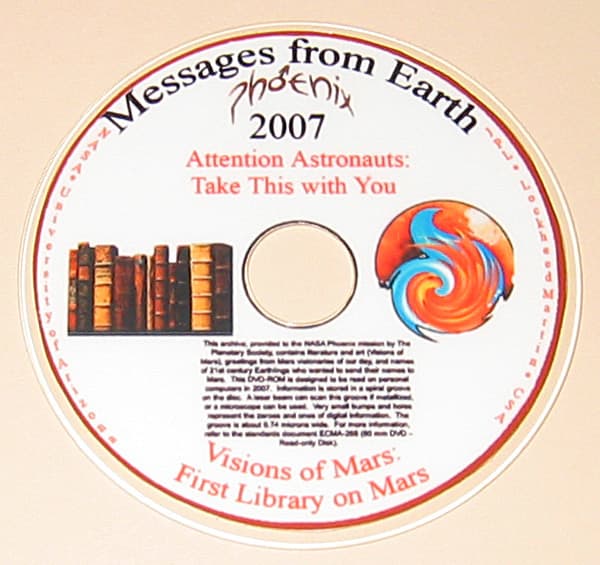
The second flight came through the back door. NASA's Phoenix lander was assembled from the airframe of the cancelled Mars Surveyor 2001 lander, and in 2007 Bruce Betts at The Planetary Society led the work of reformatting the 1996 contents onto an archival silica glass mini-DVD, adding 250,000 names, and deliberately preserving the original selection and interface so that what flew was a 1996 artefact reissued on newer media. The Society provided it at no cost to NASA, Visionary Products supplied engineering support, and Plasmon OMS donated the discs and the data writing. It was bolted to the lander deck, about a metre above the ground, in the field of view of the Surface Stereo Imager. Phoenix touched down at 68.22 N, 234.25 E on 25 May 2008, and within two days the imager had returned pictures of the disc lying on the deck with its label readable: Attention Astronauts, Take This with You. Louis Friedman said seeing it there culminated fifteen years of effort. The Society headed its release Phoenix Takes Image of First Library on Mars, which is its own claim about its own object, and we report it that way rather than asserting it.
What is actually there now is a dead lander with a disc on it. Phoenix went into safe mode on 28 October 2008 when a dust storm cut its power, sent its last signal on 2 November, and was formally written off on 24 May 2010 after four listening campaigns and orbital images showing its solar panels apparently collapsed under carbon dioxide ice. The disc does not care. Estimates of its lifetime vary with who is talking: about 500 years in one Planetary Society release, hundreds if not thousands of years in another. The more honest caveat is on the disc itself, in Peter Smith's introduction, which observes that the technology will be obsolete within twenty years even if the object lasts for millennia. That is the real problem with a library on another planet. Its survival is a materials question, which was solved competently by a retired JPL manager and a French disc maker. Its readability is a civilisational question, and nobody solved that. A future arrival at 68.22 N would find a shiny disc labelled in English, would need a device that no longer exists to get anything out of it, and would be holding an object whose own account of how it came to be there says it went into the Atlantic when it went into the Pacific.
Mission facts
Whose idea it was
Louis Friedman, executive director of The Planetary Society, raised the concept in 1991 with the Society's president Carl Sagan and vice president Bruce Murray. They took it to the Institute for Space Research (IKI) in Moscow, which was building the lander for what was then the Mars 94 mission and later became Mars 96. Friedman's first proposal was modest: one work each by Isaac Asimov, Ray Bradbury and Arthur C. Clarke, which he called the science fiction ABC, and the project's first internal name was Project ABC.↗
The original object
An 8 cm CD-ROM, produced by Time Warner Interactive Group, with Jim Bumgardner as producer, Stephen Johnson as art and design director, Blake Lewin as project manager, Cynthia Woll as editorial director and Esther Gwynne as editor. Bumgardner wrote a page-turning book interface for it; the text was proofed and copy-edited in eight languages. The disc's title screen carries the name of Mars in a range of Earth languages, echoing the convention by which the Martian valles are named for the planet in different cultures.↗
Who chose the contents
Editorially the project ran out of the Merril Collection of Science Fiction, Speculation and Fantasy in Toronto, the public library founded on Judith Merril's donated collection and originally called the Spaced Out Library. Merril wrote or expanded most of the story introductions. Jon Lomberg, who had been design director for the Voyager Golden Record, directed and edited the project; John Robert Colombo built the candidate lists; Lorna Toolis, head of the Merril Collection, ran the acquisition and fact checking. Selections were sent to Carl Sagan for review.↗
What is on it
The Planetary Society's own description runs to Percival Lowell expounding the canals, H. G. Wells's The War of the Worlds, Isaac Asimov, Ray Bradbury, Poul Anderson and many others, each story carrying an introduction, with a glossary and a short history of the twentieth century written for a reader who will not share our references. There is a collection of rare Mars artwork, the recording of Orson Welles's 1938 radio broadcast of The War of the Worlds, and Bob Derkach's composition The Winds of Mars, written after consulting the atmospheric scientist James Pollack on how wind might sound in air that thin.↗
How international it is, and the disagreement about it
The Planetary Society's own numbers do not agree. Its page listing the texts says the authors represent 22 nationalities and cultures and names them, including Babylonian and Inuit. Its press release of 22 May 2008 says 20 nations and cultures. Its press release of 27 May 2008 says nearly 30. The 22 figure is the one attached to an actual list, so it is the one to prefer.↗
The voices
The disc carries recorded messages to future Martians from Carl Sagan, filmed near his home in Ithaca, New York, from Arthur C. Clarke at home in Sri Lanka, from Louis Friedman at the Society's headquarters in Pasadena, and, added for the 2008 version, from Phoenix principal investigator Peter Smith. The team had wanted video greetings; the 1990s disc could not hold moving pictures, so Lomberg and Stephen Johnson converted them into stills and audio.↗
Engineering it to survive
The Society hired Gene Giberson, a recently retired JPL assistant laboratory director who had managed the Surveyor lunar programme, Mariner 10, Seasat and IRAS, to qualify the disc for flight. He tested candidate materials against launch loads, a hard landing, Martian cold, chemical attack on the metallic layer by the atmosphere, radiation from the lander's power units and cosmic rays, and against planetary protection sterilisation requirements. Denis Oudard of the French disc manufacturer Digipress and Michael Stamp at Sony's plant in Terre Haute, Indiana advised and supplied test discs.↗
The names rode on the outside
The Planetary Society mounted MAPEX, a microelectronics and photonics experiment carrying the names of 100,000 of its members, onto the surface of the Mars 96 compact disc before the package was shipped to Russia. When Mars 96 was lost, a spare MAPEX chip went to Mars on Pathfinder in 1997 while Visions of Mars waited another eleven years for a ride.↗
How it was lost the first time
Mars 96 launched on 16 November 1996 at 20:48:53 UTC and was stranded in low Earth orbit when the Blok D-2 upper stage failed to make its second burn. It re-entered between about 00:30 and 01:30 UTC on 17 November along a track running from the eastern Pacific across northern Chile and Bolivia. A 2026 review by Dante Sanaei in The Space Review states that no search was ever conducted and the wreckage has never been found.↗
How many copies were aboard Mars 96
Unresolved. The Mars 96 spacecraft carried two small autonomous surface stations, either of which could in principle have taken a disc, and secondary accounts from 1996 refer to a copy on each of the two small landers. The Planetary Society's own writing about the loss, including Jon Lomberg's project history and its catalogue of flown messages, always speaks of the disk in the singular and never gives a number, so we do not state one.↗
The second object
For the 2007 flight the contents were reformatted and remixed onto an archival silica glass mini-DVD, an effort led by Bruce Betts at The Planetary Society. The Society provided the disc at no cost to NASA; engineering support came from Visionary Products, Inc., and Plasmon OMS donated the discs and the data writing. Lomberg's afterword notes that the format and contents of the original CD were deliberately retained, so what landed on Mars is a 1996 artefact reissued on 2007 media.↗
The label
The disc's label is addressed to whoever finds it. The Planetary Society's release of 27 May 2008, reporting the first images of the disc on the ground, states that the label reads "Attention Astronauts: Take This with You" and that it is legible in the images.↗
How long it is expected to last
The Society's figures vary with the audience. Its release of 22 May 2008 says the disc was expected to endure about 500 years on Mars. Its Phoenix DVD project page says the silica glass disc was designed to last hundreds if not thousands of years. Peter Smith's introduction on the disc itself makes the sharper point that the technology will be obsolete within twenty years even if the object survives for millennia.↗
Where it is now
On the deck of the Phoenix lander at 68.22 N, 234.25 E, about a metre above the arctic plain. Phoenix entered safe mode on 28 October 2008 as a dust storm cut its power, sent its last signal on 2 November 2008, and NASA formally ended the mission on 24 May 2010 after four listening campaigns and HiRISE images suggesting the solar panels had collapsed under carbon dioxide ice. Nothing has come from the site since, and nothing we consulted on 24 August 2026 suggests otherwise.↗
The library claim
The Planetary Society called it the first library on Mars and headed its 27 May 2008 release Phoenix Takes Image of First Library on Mars. That is the Society's claim about its own object and we report it as such. We have not attempted to verify any broader superlative about libraries on other worlds, and note that other collections have been sent to the Moon by other organisations.↗
Mission timeline
- 1991Louis Friedman raises the idea with Carl Sagan and Bruce Murray, and The Planetary Society approaches IKI in Moscow about putting a disc on the Mars 94 lander. The working title is Project ABC, for Asimov, Bradbury and Clarke.
- 1994The disc is cut at Time Warner Interactive with the Merril Collection in Toronto as its editorial base, and the team presents the project at that year's International Astronautical Congress as a cultural and scientific experiment on Mars 96. The congress presentation is not described on the Lomberg project history cited here and needs its own source before publication.
- 16 Nov 1996Mars 96 launches at 20:48:53 UTC and is stranded in low Earth orbit when the Blok D-2 upper stage does not make its second burn.
- 17 Nov 1996The spacecraft re-enters between about 00:30 and 01:30 UTC along a track from the eastern Pacific across northern Chile and Bolivia, taking the first copy of Visions of Mars with it. No search is ever mounted.
- 20 Dec 1996Carl Sagan dies, five weeks after the loss. His recorded message to future Martians, made for the disc, survives and flies on the second copy.
- 4 Jul 1997The spare MAPEX chip, which had been mounted on the surface of the lost disc and carried 100,000 Planetary Society member names, reaches Mars aboard Pathfinder. Visions of Mars does not.
- 2007Bruce Betts leads the reformatting of the 1996 contents onto an archival silica glass mini-DVD, with 250,000 names added and the original format and selection deliberately preserved. Plasmon OMS donates the discs and the writing.
- 4 Aug 2007Phoenix launches from Cape Canaveral at 09:26:34 UT with the disc bolted to its deck.
- 25 May 2008Phoenix lands at 68.22 N, 234.25 E in the arctic plains. Visions of Mars arrives on Mars eleven and a half years after its first attempt.
- 26 to 27 May 2008The Surface Stereo Imager returns the first pictures of the disc lying on the deck, its label legible. Louis Friedman says seeing it there culminates fifteen years of effort; Bruce Betts says the team is ecstatic.
- 2 to 10 Nov 2008Phoenix sends its last signal on 2 November as the arctic autumn takes its sunlight, and NASA declares the surface mission finished on 10 November. The disc has been sitting on a dead lander ever since.
- 24 May 2010After more than 200 Mars Odyssey overflights across four listening campaigns produce nothing, NASA formally ends the mission. HiRISE imagery indicates the solar panels have collapsed under carbon dioxide ice.
A filled dot marks something that physically happened. A hollow one marks an announcement, a naming or a target.
In pictures
Tap a photo to enlarge.
Sources
- The Planetary Society: Visions of Mars project page
- Jon Lomberg, Visions of Mars: Then and Now, The Planetary Society (archived)
- The Planetary Society: Visions of Mars, The Stories
- The Planetary Society: The Phoenix DVD project page (archived)
- The Planetary Society press release (22 May 2008): First Interplanetary Library Will Land on Mars
- The Planetary Society press release (27 May 2008): Phoenix Takes Image of First Library on Mars
- The Planetary Society press release (30 Jul 2007): The Planetary Society's Library for Mars Ready for Launch
- The Planetary Society: Messages from Earth
- Dante Sanaei, The Space Review (6 Apr 2026): Thirty years later, Mars 96 has not been found
- NASA science mission page: Mars Phoenix
Facts on this page were verified on 24 August 2026. Where sources disagree, the disagreement is stated rather than resolved silently.
-125.7500 E, 68.2200 N · Green Valley