Commercial Mars Payload Services and Mars Future Missions
NASA · United States · Program · 2023 · AnnouncedIn development
Two budget lines with no mission selected: CMPS was created in NASA's fiscal 2026 request at $200 million, Mars Future Missions enacted at $110 million in January 2026. The low-cost solicitation is due October 2026.
TL;DR· 14 min read
These are the two budget lines meant to replace Mars Sample Return. Commercial Mars Payload Services is a CLPS-style way of buying, created in NASA's fiscal 2026 request at $200 million inside the human exploration directorate; Mars Future Missions is the science-side account Congress funded at $110 million in January 2026. As of 24 August 2026 neither has selected anything, and the promised low-cost solicitation, capped at $220 million for a 2030 launch, is dated October 2026.
When Congress killed Mars Sample Return it did not leave nothing behind. It left $110 million a year in an account called Mars Future Missions, and NASA had already proposed a second thing called Commercial Mars Payload Services, a Mars version of the lunar CLPS programme run out of the human exploration directorate. Between them they are supposed to replace a flagship with a steady drumbeat of cheap missions. So far they have produced a planned solicitation, a $220 million cost cap, a set of studies, and a helicopter payload that nobody in the science community asked for. The Mars Exploration Program Analysis Group's verdict in July 2026 was that the United States faces a ten-year gap in competed science opportunities at Mars.
- $200mrequested to start CMPS in fiscal 2026, an amount Congress never appropriated under that name
- $110menacted for Mars Future Missions in fiscal 2026, in place of Mars Sample Return
- 10 yearsthe gap in competed Mars science mission and payload opportunities MEPAG warned of in July 2026
These are two answers to the same question, invented in different parts of NASA, and it helps to keep them apart. Commercial Mars Payload Services is an idea about how to buy: take the model of Commercial Lunar Payload Services, where NASA orders a delivery to the Moon from a company that owns the lander and picks its own rocket, and apply it to Mars. It appeared as a line item for the first time in NASA's detailed fiscal 2026 budget request on 30 May 2025, at $200 million, and it was placed in the Exploration Systems Development Mission Directorate rather than in the science directorate that has run robotic Mars exploration since the 1990s. CLPS was moved into the same directorate at the same time. That placement is the most informative thing about CMPS: it says the programme exists to build a supply chain for human Mars missions, and that the science it carries is a passenger. Mars Future Missions is the other answer, and it is a science-side budget account rather than a way of buying. It is older than people assume. In NASA's fiscal 2024 request the same line paid for planning and design studies of a facility to receive Mars samples and for NASA's support of ESA's ExoMars. What changed was that Congress emptied it of its old purpose and gave it a new one.
That happened in January 2026. The fiscal 2026 appropriations minibus, released on 5 January and signed on 23 January, gave NASA $24.438 billion and rejected most of the administration's proposed science cuts, with one conspicuous exception. Its conference report says the agreement does not support the existing Mars Sample Return programme and instead directs NASA to preserve work on key MSR technologies through $110 million allocated to Mars Future Missions. A House bill had wanted $300 million for Mars Sample Return itself. So the account that had paid for studies of a sample receiving facility became the account that pays for what is left of sample return: existing MSR work on entry, descent and landing, radar, spectroscopy and other precursor technologies. Three months later NASA proposed to change it again. The fiscal 2027 request of 3 April 2026 holds the number at $110 million but rewrites the purpose, saying the money will "establish a regular cadence of science-driven, lower-cost mission and hosted instrument opportunities", with hosted payloads costing $25 million to $35 million each and flying on NASA or partner missions "such as the new Commercial Mars Payload Services". The document names one concrete near-term action, and it is a promise rather than an event: a low-cost mission solicitation to be released in October 2026, targeting a 2030 launch, capped at $220 million in lifecycle cost excluding launch.
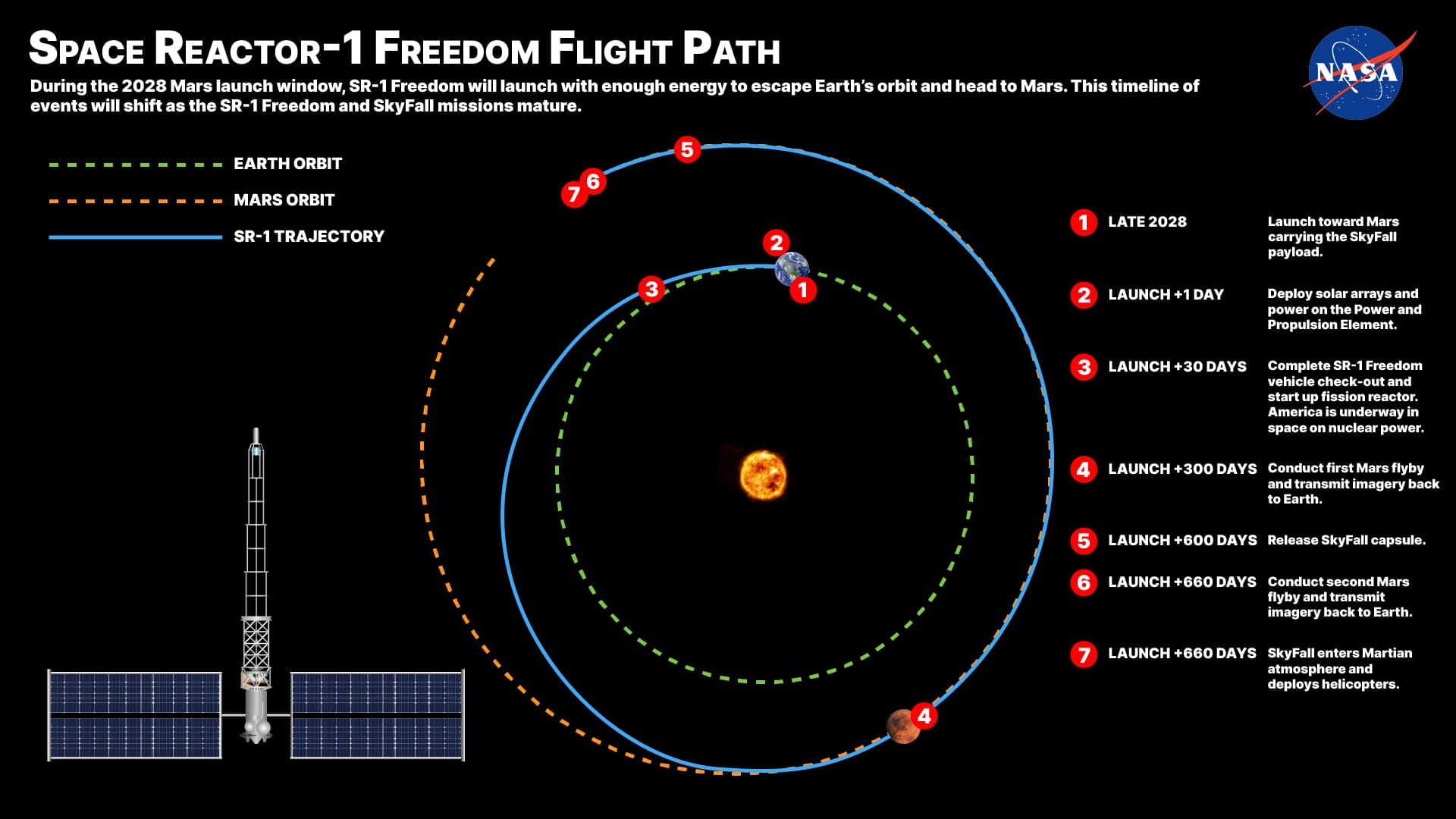
Then the money moved again, and this time the science community objected in writing. On 24 March 2026, at an event NASA called Ignition, the agency announced SR-1 Freedom, a nuclear electric propulsion demonstrator launching at the end of 2028 that would use a 20-kilowatt reactor and a propulsion module still in build at Lanteris Space Systems, ordered for the lunar Gateway that NASA said the same day it intends to pause in its current form, to fly to Mars and release a payload called SkyFall: three helicopters derived from Ingenuity, to photograph a candidate human landing site and hunt for subsurface ice. Nicky Fox described them as very similar to Ingenuity, with cameras, and not heavy science birds. After its April meeting, MEPAG recorded that NASA had assigned Skyfall to the Mars Exploration Program, funded out of the Mars Future Missions line. Its finding says Skyfall is an uncompeted payload that is not a priority in the Decadal Survey or the Mars Future Plan, that no community input was sought on its science objectives, and that plans for instrument maturation programmes intended to feed future low-cost and commercial missions were cancelled as a consequence. It warns that the pressure to launch Skyfall in two years puts the operating missions at Mars at risk too.
The honest summary of where this stands on 24 August 2026 is that a flagship has been replaced by intentions. Nothing has been selected under Commercial Mars Payload Services; NASA's own fiscal 2027 language says it is still being established, with near-term money going into maturing commercial Mars lander concepts, and no separate dollar figure for it appears in the budget document. Nothing has been selected under Mars Future Missions either, and the solicitation that would start that process is dated October 2026. Four senators asked appropriators in April for at least $400 million rather than $110 million, warning of severe and irreversible harm to the United States' ability to land on Mars. MEPAG's July finding is the sharpest statement anyone has put on the record: no new NASA mission has arrived at Mars in six years, every active NASA mission there is in its extended phase, no new competed mission is planned, and the country faces a ten-year gap in competed science mission and payload opportunities at Mars. Whether CMPS becomes the thing that closes that gap depends on questions nobody has answered, starting with the one Rocket Lab and SpaceX both raised in public: at Mars, unlike the Moon, almost nobody expects a customer other than NASA.
Mission facts
What CMPS is
Commercial Mars Payload Services, a services-purchase programme patterned on Commercial Lunar Payload Services, under which NASA would buy delivery of payloads and technology demonstrators to Mars from commercial providers instead of building the missions itself. NASA's fiscal 2027 budget request describes it as "newly established" and says the agency will "continue establishing the similarly structured Commercial Mars Payload Service with plans to begin launching precursor missions and technology demonstrators to the martian surface", with near-term funding focused on maturing commercial robotic Mars lander concepts.↗
Where it sits
Not in the Science Mission Directorate, which has run robotic Mars exploration for decades, but in the Exploration Systems Development Mission Directorate, alongside CLPS, which was moved there from science. In the fiscal 2027 request CMPS sits inside a programme called Commercial Moon and Mars Infrastructure and Transportation, whose total request is $744.1 million for fiscal 2027; no separate dollar figure for CMPS is published in that document.↗
How it was created
NASA's detailed fiscal 2026 budget request, released on 30 May 2025, proposed $200 million for CMPS as part of about $1.13 billion of Mars-focused initiatives. The other large items were $350 million to accelerate Mars technologies at Johnson and Marshall, $200 million for a near-term demonstration of entry, descent and landing for a human-class Mars lander, and smaller amounts for Mars communications relay upgrades, Mars spacesuits, power and computing. Of the $1.13 billion, $930 million was in the exploration directorate, $120 million in science and $80 million in space technology.↗
What came before it
In May 2024 NASA awarded study contracts to nine companies to look at commercial services at Mars, none of them landers. Firefly Aerospace, Impulse Space and Lockheed Martin studied hosting or delivering small payloads to Mars orbit; Astrobotic, Blue Origin and United Launch Alliance looked at large payload hosting and delivery; Albedo Space, Astrobotic and Redwire looked at imagery services; Blue Origin, Lockheed Martin and SpaceX looked at communications relay. Ryan Woolley of JPL explained the omission plainly: "We started these studies with the low-hanging fruit because going to the surface of Mars is very challenging."↗
The strategy underneath
NASA's draft long-term robotic Mars strategy, called Exploring Mars Together and unveiled to the National Academies on 29 March 2023 by Mars Exploration Program director Eric Ianson, proposed a steady cadence of low-cost missions in the $100 million to $300 million range at every launch opportunity, supplemented by occasional New Frontiers-class missions and by payloads of opportunity, with an explicit line about buying commercial services to refresh infrastructure.↗
Mars Future Missions is older than the cancellation
The account existed before Mars Sample Return died. In NASA's fiscal 2024 request the Mars Future Missions line paid for planning and design studies of a sample receiving facility and NASA's support to ESA's ExoMars. What changed in fiscal 2026 was its purpose. The account itself carried on.↗
What Congress actually funded
The fiscal 2026 minibus appropriations text released on 5 January 2026 and signed on 23 January provided $24.438 billion for NASA. Its conference report states that "As proposed in the budget, the agreement does not support the existing Mars Sample Return (MSR) program", and directs NASA to preserve work on key MSR technologies through $110 million allocated to a Mars Future Missions account. The same report approved moving CLPS from science to exploration with at least $250 million.↗
The law itself
The minibus became Public Law 119-74, the Commerce, Justice, Science; Energy and Water Development; and Interior and Environment Appropriations Act, 2026, issued 23 January 2026. The House had passed it 397 to 28 on 8 January and the Senate 82 to 15 on 15 January, in text identical to the version released on 5 January and formally introduced on 6 January.↗
The redirection in fiscal 2027
NASA's fiscal 2027 request, released 3 April 2026, keeps Mars Future Missions at $110.0 million but changes what it buys. The budget document says the investment "will establish a regular cadence of science-driven, lower-cost mission and hosted instrument opportunities that allow for rapid response to discoveries", with hosted instruments and payloads of $25 million to $35 million each flown on NASA or partner missions "such as the new Commercial Mars Payload Services". The run-out is $150.0 million in 2028, $208.0 million in 2029, $175.0 million in 2030 and $113.0 million in 2031.↗
The solicitation that has not happened yet
One sentence in the fiscal 2027 request is the whole near-term plan: "A low-cost mission solicitation will be released in October 2026, targeting a 2030 launch, with a $220 million lifecycle cost (excluding launch)." As of 24 August 2026 we found no evidence that it had been released early, and October 2026 is still in the future.↗
Skyfall
At an event called Ignition on 24 March 2026 NASA announced SR-1 Freedom, a nuclear electric propulsion demonstrator launching at the end of 2028 that would carry a payload called SkyFall to Mars: three helicopters based on Ingenuity, to survey a candidate human landing site and look for subsurface water ice. Nicky Fox, NASA associate administrator for science, said they would be "very, very similar in capabilities to Ingenuity" with cameras but "not going to be full-up heavy science birds".↗
Who pays for Skyfall
MEPAG recorded after its April 2026 meeting that NASA had since announced Skyfall would be managed and funded out of the Mars Exploration Program, under the Mars Future Missions budget line. Its finding is blunt: "Skyfall is an uncompeted payload that is not identified as a priority in the Decadal Survey or Mars Future Plan. No community input has been solicited on Skyfall science objectives." It adds that plans for instrument maturation programmes such as PRIMER, intended to feed future low-cost and commercial missions, were cancelled as a result.↗
The ten-year gap
MEPAG's executive summary, released for community review on 1 July 2026, states that the current set of planned Mars activities "does not reflect the Mars Future Plan or Decadal Survey priorities" and that "the US is facing a 10-year gap in competed science mission and payload opportunities at Mars". It also notes that all active NASA missions at Mars are in extended-mission phase and that no NASA mission has arrived at Mars in six years.↗
The senators' objection
In April 2026 four senators, Adam Schiff and Alex Padilla of California, Mark Kelly of Arizona and Ben Ray Lujan of New Mexico, wrote to the leadership of the Senate appropriations subcommittee that funds NASA asking for at least $400 million for Mars Future Missions in fiscal 2027. SpaceNews noted that the enacted $110 million was significantly less than the $300 million proposed in a House spending bill. They wrote that if the funding trajectory continues "NASA's Mars programs will face severe and irreversible harm, jeopardizing the United States' ability to land spacecraft on the surface of Mars, not just in the near future, but for decades to come."↗
Whether the market exists
The premise of CLPS was that NASA would not be the only customer. Almost nobody argues that for Mars. Nick Cummings of SpaceX put it at an ASCEND panel on 24 July 2025: "Maybe there's not an immediate market at Mars or commercial opportunities. If NASA is the only customer for a system, you can still do firm fixed price development, which you should do. You can still have competition."↗
The cadence problem
Mars transfer windows open roughly once every 26 months, against roughly two CLPS lunar missions a year. Nicky Fox, asked about it in July 2025, said "By that token, CMPS will be a little bit different." Nick Cummings framed the industrial-base question: how do you take advantage of every Mars window while keeping providers alive between them. NASA had not settled the cadence, or even whether CMPS missions would be orbiters or landers, when the programme was announced.↗
Dates and time zone
Budget and legislative dates here are Washington local dates and do not differ from UTC by more than one calendar day. The fiscal 2026 request was released 30 May 2025, the fiscal 2026 minibus text 5 January 2026 and signed 23 January 2026, the fiscal 2027 request 3 April 2026. MEPAG meeting 43 was held 21 to 23 April 2026 and its statements were released for community review on 1 July 2026.↗
Mission timeline
- 29 Mar 2023Eric Ianson presents NASA's draft Exploring Mars Together strategy to the National Academies: a steady cadence of $100 million to $300 million missions at every opportunity after Mars Sample Return, plus commercial partnerships to refresh Mars infrastructure.
- May 2024NASA awards nine companies study contracts on commercial Mars services covering payload delivery to Mars orbit, imagery and communications relay. Deliberately, none of them looks at landing.
- 30 May 2025NASA's detailed fiscal 2026 budget request creates Commercial Mars Payload Services at $200 million, inside the exploration directorate, as part of about $1.13 billion of Mars initiatives. The briefing slide listing them was prepared for a briefing NASA never held.
- 24 Jul 2025At the ASCEND conference Nicky Fox, NASA associate administrator for science, says she is "a huge fan of CLPS" and would love to see the same enabling of companies at Mars, while admitting the agency has not worked out the cadence, the mission types or how to pronounce the acronym.
- 12 Aug 2025At the Small Satellite Conference, Firefly says its Blue Ghost lunar lander fits inside the Perseverance aeroshell and that 70 to 80 per cent of what it learned going to the Moon is directly applicable to Mars. Albedo quotes Mars imagery pricing by the square kilometre. Rocket Lab's Richard French, on the same panel, says he has "been pretty skeptical of non-government customers in those domains" and argues that the value of CLPS is its management model rather than its commerciality. Nobody on the panel argues there is a non-NASA customer.
- 5 to 23 Jan 2026The fiscal 2026 minibus is released, passed and signed. It does not support Mars Sample Return and instead directs $110 million to a Mars Future Missions account to preserve key MSR technologies.
- 24 Mar 2026At the Ignition event NASA announces SR-1 Freedom, a nuclear electric propulsion demonstrator launching in late 2028 carrying SkyFall, three Ingenuity-derived helicopters, to a candidate human landing site. NASA says it intends to pause Gateway in its current form, and its Power and Propulsion Element, still in build at Lanteris Space Systems, is to be repurposed as SR-1's propulsion.
- 3 Apr 2026The fiscal 2027 request keeps Mars Future Missions at $110 million but redirects it from MSR technology to a cadence of low-cost missions and hosted instruments, and the full budget document, posted on 22 April, promises a solicitation in October 2026 for a 2030 launch capped at $220 million excluding launch. Overall NASA science is cut sharply in the same document.
- Apr 2026Four senators ask appropriators for at least $400 million for Mars Future Missions in fiscal 2027, warning of "severe and irreversible harm" to the United States' ability to land on Mars.
- 21 to 23 Apr 2026MEPAG holds its 43rd meeting, in hybrid form. Its later summary welcomes NASA's engagement but warns that the lunar CLPS model will not transfer cleanly to Mars, citing fewer launch opportunities, longer mission durations, higher landing risk and cost, and power and communications challenges, and asks for dialogue with NASA and industry during the early stages rather than after the fact.
- 1 Jul 2026MEPAG releases its findings for community review, with content added after the meeting because of what it calls major changes to the Mars Exploration Program. It records that Skyfall has been assigned to the Mars Future Missions line, that PRIMER instrument maturation has been cancelled, and that the United States faces a ten-year gap in competed Mars science opportunities.
- Oct 2026The date NASA's own budget document gives for the low-cost Mars mission solicitation. As of 24 August 2026 it has not been released and nothing has been selected under either CMPS or Mars Future Missions.
A filled dot marks something that physically happened. A hollow one marks an announcement, a naming or a target.
In pictures
Tap a photo to enlarge.
Sources
- NASA fiscal year 2027 full budget request (April 2026)
- SpaceNews (August 2025 magazine), Jeff Foust: A $1 billion first step? NASA's proposed budget eyes human exploration of Mars
- SpaceNews (9 Sep 2024), Debra Werner: NASA charts path toward commercial services for Mars
- SpaceNews (30 Mar 2023), Jeff Foust: NASA releases draft strategy for long-term robotic Mars exploration
- SpaceNews (5 Jan 2026), Jeff Foust: Minibus provides $24.4 billion for NASA for fiscal year 2026
- Public Law 119-74 (23 January 2026), the fiscal 2026 Commerce, Justice, Science; Energy and Water Development; and Interior and Environment Appropriations Act, at GPO govinfo
- SpaceNews (April 2026), Jeff Foust: Senators seek increased funding for NASA Mars missions
- NASA release (24 Mar 2026): Ignition initiatives, primary source for the Gateway pause wording
- SpaceNews (26 Mar 2026), Jeff Foust: NASA to test nuclear electric propulsion with 2028 mission to Mars
- SpaceNews (5 May 2026), Jeff Foust: Ignition relaunches Artemis plans
- SpaceNews (18 Aug 2025), Jeff Foust: Blue Origin offers Mars communications orbiter concept
- MEPAG Hybrid Meeting 43 findings and statements, released for community review 1 July 2026 (PDF)
- Astrobiology.com (6 Jul 2026), Keith Cowing: Mars Exploration Program Analysis Group (MEPAG) Concerns
- Public Law 119-21, section 40005
- SpacePolicyOnline: Final FY2026 NASA/NOAA Appropriations Bill Clears Senate, White House is Next (15 January 2026, updated 25 January)
- NASA fiscal year 2024 budget estimates (March 2023), Mars Future Missions
- NASA fiscal year 2026 budget request summary briefing (30 May 2025)
- Joint explanatory statement, Division A (Commerce, Justice, Science) of H.R. 6938, the fiscal 2026 minibus
- House Report 119-272 (12 September 2025), Commerce, Justice, Science appropriations bill, 2026
- H.R. 6938 as introduced in the House (6 January 2026), at GPO govinfo
- House roll call 7 (8 January 2026), passage of H.R. 6938
- NASA fiscal year 2027 budget request page (summary 3 April 2026, full budget request 22 April 2026)
Facts on this page were verified on 24 August 2026. Where sources disagree, the disagreement is stated rather than resolved silently.