Idefix (MMX Phobos rover)
CNES and DLR, flying with JAXA · Multinational · Rover · 2023 · AnnouncedIn development
Not launched: bolted to JAXA's MMX at Tanegashima and tested through the northern spring, for a launch set for 20 October 2026. Release onto Phobos from 40 to 100 metres up follows in late 2028 or early 2029.
TL;DR· 14 min read
Idefix is a 23 kilogram French and German rover that is to be dropped onto Phobos from between 40 and 100 metres up, with no engine, no legs and no parachute, because the moon's gravity is about one two-thousandth of Earth's. It has to bounce, work out which way up it is, right itself on its four wheels and unfold its solar panels on its own; if that fails it cannot keep its computer warm and the mission ends. It is bolted to JAXA's MMX spacecraft for a launch set for 20 October 2026, with release due in late 2028 or early 2029.
Idefix is a 23 kilogram French and German rover that is going to be thrown at a moon. It has no descent engine, no landing gear and no parachute, because Phobos has no atmosphere and gravity around one two-thousandth of Earth's. MMX will hover between 40 and 100 metres above the surface and let go. Idefix will fall for several minutes, bounce, come to rest in whatever attitude it happens to be in, and then use its own four wheels to turn itself the right way up and unfold its solar panels. If that autonomous sequence fails, the mission is over before it starts, because the rover cannot keep its computer warm without power. If it works, Idefix would attempt what its own science team describes as the first wheeled locomotion on a small body.
- 23.47 kgdry mass in the rover team's own published papers; DLR's public page says 25 kg
- 40 to 100 mthe height above Phobos it is to be released from, with nothing to slow the fall
- 100 daysplanned working life on a surface no spacecraft has ever touched
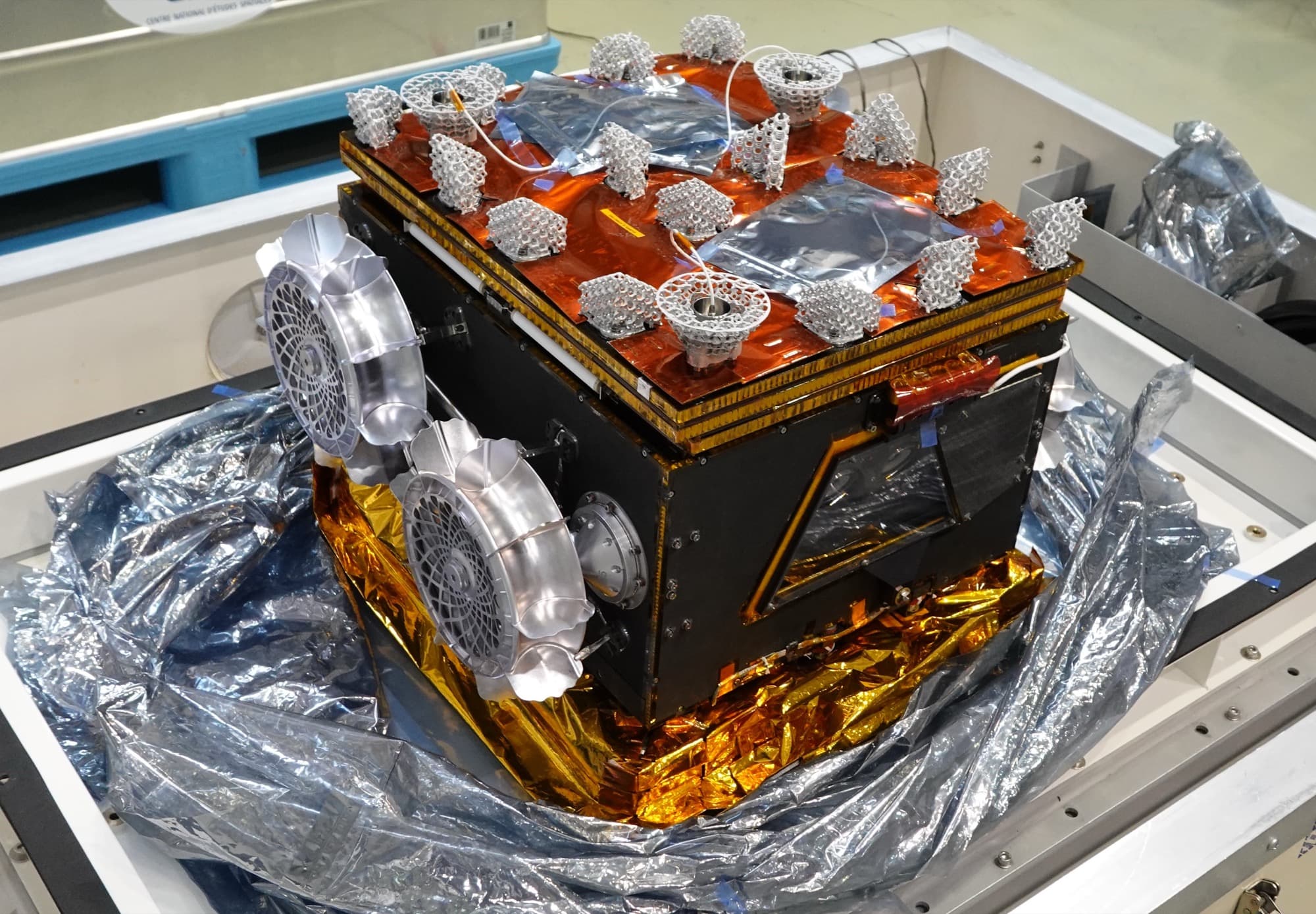
Phobos is a very small place to try to drive on. It is about 26 kilometres along its longest axis, very dark, and it holds onto things so feebly that DLR designed the rover's running gear for a gravitational acceleration between 0.0030 and 0.0068 metres per second squared. That is roughly one two-thousandth of Earth's, and about a six-hundredth of Mars's. Nothing about wheeled driving survives that change unaltered. A wheel that spins too hard does not dig in, it launches the vehicle. Regolith kicked up by a wheel does not fall back, it floats away on ballistic arcs that take a long time to end. There is no way to test any of this properly on the ground, because a representative Earth test would need a rover two thousand times lighter than the real one. So the Franco-German team did the next best thing: they built a physics simulation of the interaction between wheel and regolith, then validated it against a prototype called Prototypix driven around an artificial Phobos yard at DLR's Planetary Exploration Laboratory outside Munich. In late November 2025, four CNES engineers spent four days there running the autonomous navigation software. On the second day they found that the left and right navigation cameras were swapped in the flight software, which meant the stereo pairs the obstacle detector depends on were being assembled backwards. They fixed it and carried on. That is what the last year of this rover's life on Earth actually looked like.
The delivery is the strange part. Idefix has no descent engine, no legs, no parachute and no airbags. MMX is to hold station somewhere between 40 and 100 metres above Phobos and simply release it, in the same way Hayabusa2 released the MASCOT lander at asteroid Ryugu. The fall takes minutes. The rover is expected to bounce, possibly several times, and to end up somewhere inside a landing footprint about 100 metres across, lying in whatever attitude physics chose for it. Everything after that is autonomous, and the sequence has a name: SLUD, for Separation, Landing, Uprighting and Deployment. Using its wheels and legs, the rover has to work out which way up it is and turn itself over, then unfold the four fixed solar panels on its body. CNES states the consequence of failure without dressing it up: if the rover cannot right itself and deploy, it cannot generate power, and if it cannot generate power it cannot keep its own computer and instruments above their survival temperature. There is no second attempt and no help from Earth. Only once the rover is upright and charging would the transparent shutters over the wheel cameras open. Then, at somewhere between a tenth of a millimetre and four millimetres per second, it would begin to drive. None of that has happened yet.
For a 23 kilogram vehicle it carries a lot. RAX is a Raman spectrometer, 81 by 98 by 125 millimetres and under 1.4 kilograms, built by DLR with Spanish and Japanese partners; it fires a green laser at a spot about 50 micrometres across and reads the scattered light between 535 and 680 nanometres, a window chosen to catch both original and altered minerals. miniRAD is an infrared radiometer with six thermopiles staring 25 to 150 centimetres ahead, descended from instruments flown on Rosetta, Hayabusa2 and InSight, and it is built to measure surface temperature closely enough to infer conductivity and layering. Two navigation cameras on the front, 526 grams for the pair, give stereo vision and carry white LEDs so they can work in shadow. The two most unusual instruments point straight down. The WheelCams sit under the deck and watch a wheel and the trench it cuts, at about 100 micrometres per pixel from 30 centimetres away, lit by LEDs at 590, 720 and 880 nanometres so that a track can be compared with untouched ground. From wheel sinkage, slippage, the shape of the trench walls and the collapse of talus, the team expects to derive friction angle, cohesion, shear strength, bearing capacity and grain size distribution down to about 200 micrometres. They also hope to measure the local gravity itself by tracking the flight of grains the wheels loft.
The schedule is the part to be careful with, because the two agencies that built the rover do not agree on it. CNES's own project page, updated on 12 August 2026, gives December 2028 for the release. DLR's mission page says early 2029. The rover team's own July 2025 paper says late 2028 or early 2029. Plenty of live pages still say 2027, which was the plan before MMX slipped from the 2024 launch window to the 2026 one. JAXA has published no rover deployment date at all, only that MMX arrives at Mars in 2027 and that the sample capsule is due back in Japanese fiscal 2031. All of it is downstream of a launch that has not happened. What can be stated with confidence is where the hardware is and what has been done to it. Idefix was handed to JAXA at Kamakura on 7 March 2024, travelled to Tanegashima with the spacecraft at the end of March 2026, was integrated and put through final electrical, radio-frequency and battery tests through the northern spring, and received a new build of its flight software. On 6 August 2026 CNES engineers slid an SD card into it carrying several thousand messages collected from the public, 70 megabytes, an idea JAXA had, intended to sit on Phobos for whoever comes next. Launch is set for 20 October 2026.
Mission facts
What it is
A small four-wheeled solar-powered rover built by France's CNES and Germany's DLR, riding to Mars as a passenger on JAXA's Martian Moons eXploration spacecraft. Its job is to be set down on Phobos ahead of the main spacecraft, characterise the surface it lands on, and reduce the risk in MMX's own landing and sampling. DLR built the structure, the locomotion system, the interface to the spacecraft and both spectrometer-class instruments; CNES built the cameras, the onboard computer, the power system and the communications.↗
Launch
20 October 2026 at 04:41:03 Japan Standard Time, which is 19:41:03 UTC on 19 October 2026, on H3 flight number 10 from the Yoshinobu Launch Complex at the Tanegashima Space Center. The reserve period runs 21 October to 7 November 2026. JAXA published this on 20 August 2026. CNES's French project page, updated 12 August 2026, says only 'octobre 2026'.↗
Mass
Sources disagree by about 7 per cent. The rover team's papers and English Wikipedia give 23.47 kg dry, of which 2.44 kg is scientific instruments. DLR's own facts and figures page says 25 kilograms with a 2.5 kg science payload, and European Spaceflight reported 25 kg when the rover shipped to Japan. A 2024 DLR conference paper comparing small-body landers, reproduced by English Wikipedia, lists the MMX lander system dry mass as 23.1 kg, with 2.96 kg of lander structure and 1.19 kg of interface system. All of these are current; none of them is wrong so much as measured differently.↗
Size and power
A body of 231 by 376 by 415 mm, with four solar panels each 415 by 363 mm, which works out at about 0.60 square metres in total. English Wikipedia's infobox states 0.36 square metres alongside those same panel dimensions, which its own arithmetic does not support, and DLR publishes no array area at all. DLR quotes energy production of at least 60 watt-hours per Phobos day, which lasts about 7 hours. Because the panels are fixed to the body, Idefix has to tilt itself towards the Sun to charge properly, a manoeuvre the team calls the heliotropic sequence.↗
How weak the gravity is
DLR designed the locomotion system for an effective gravitational acceleration of 0.0030 to 0.0068 m/s squared. The published figures for how that compares are all in the same region and none of them match exactly: CNES says about 1,800 times weaker than Earth, English Wikipedia says almost two thousand times lower, and the WheelCam team's 2025 paper expresses it as roughly 600 times smaller than Mars and about 300 times smaller than the Moon.↗
Why it cannot be properly tested
You cannot simulate Phobos gravity on Earth for a 23 kg vehicle. DLR's own explanation is blunt: a representative test would require a rover two thousand times lighter than the flight article. The team's answer was a physics simulation, validated against a prototype nicknamed Prototypix driven around a Phobos-analogue yard at DLR's Planetary Exploration Laboratory in Oberpfaffenhofen, near Munich.↗
Deployment
MMX is to release Idefix from an altitude of between 40 and 100 metres into a landing footprint about 100 metres across. A bounce is expected. What follows is called SLUD, for Separation, Landing, Uprighting and Deployment: a fully autonomous sequence in which the wheels and legs turn the rover the right way up whatever attitude it came to rest in, and the solar panels open. CNES states plainly that failure to do this ends the mission, because the rover must generate enough power to warm its own computer and instruments.↗
When it lands, if it does
Disputed, and the disagreement is between the two agencies that built it. CNES's project page, updated 12 August 2026, says 'Décembre 2028: Largage du rover Idefix'. DLR's mission page says the rover lands on Phobos in early 2029. The WheelCam instrument paper, published 14 July 2025, says late 2028 or early 2029. European Spaceflight's February 2024 report still says 2027. English Wikipedia no longer does: as of 3 September 2026 it says landing is expected in 2029. JAXA has published no rover deployment date at all. Everything downstream of MMX arriving in Mars orbit is a plan; no part of it is a schedule.↗
Where it lands relative to MMX
Idefix goes down first and scouts. Both it and the MMX spacecraft are to come down inside one area of roughly 300 by 300 metres, but with separated landing zones: about 100 metres across for the rover, about 20 by 20 metres for the spacecraft. They must not overlap, because the MMX landing would otherwise disturb or damage the rover's solar panels.↗
Locomotion
Four individually actuated wheels, each with nine blades or grousers and each weighing 190 grams, with a mesh-like structure arrived at by topology optimisation. The locomotion subsystem, LOCO, has four modes: driving, alignment, uprighting and passthrough. DLR quotes a representative speed of about one millimetre per second; the WheelCam paper gives an anticipated range of 0.1 to 4 mm/s and expects the rover to cover 10 to 100 metres in its whole mission. Both DLR and CNES wrote autonomous navigation software, but the first drives will follow plans sent from Earth.↗
RAX, the Raman spectrometer
Built by DLR with INTA and the University of Valladolid in Spain and with JAXA, UTOPS and Rikkyo University in Japan. It is 81 by 98 by 125 mm and under 1.4 kg, uses a green Nd:YAG laser with an opto-mechanical autofocus, analyses a spot about 50 micrometres across and works from 535 to 680 nm, a range chosen to catch both primary and altered mineral phases. It carries a verification target made of a deuterated polyethylene terephthalate pellet. DLR's own RAX page carries the 50 micrometre spot, the green laser and the INTA and Japanese partners, but none of the dimensions, mass or spectral range, which come from English Wikipedia's collection of the instrument papers.↗
miniRAD, the radiometer
An infrared radiometer with six thermopile sensors and a 45 degree field of view, mounted at the front of the rover and observing objects 25 to 150 cm away, to measure surface temperature and from it derive emissivity, thermal conductivity and layering. Its design descends from the MUPUS thermal mapper on Rosetta, the radiometer on MASCOT and the radiometer on InSight.↗
WheelCams
Two downward-facing cameras on the underside of the deck, one watching the left front wheel and one watching the trench that wheel cuts. They use 2048 by 2048 CASPEX sensors built around the CMV4000, tilted about 3 degrees so the focal plane sits near the ground, resolving about 100 micrometres per pixel at 30 cm and staying sharp from roughly 20 to 50 cm. Because the underside is permanently shadowed, each carries four white LEDs plus narrow-band emitters at 590, 720 and 880 nm. In movie mode they shoot about one frame per millimetre travelled at the front and one per centimetre at the rear.↗
NavCams
Two navigation cameras on the top of the front panel, 526 grams for the pair, using a 2048 by 2048 CASPEX detector with a Bayer filter and 5.5 micrometre pixels, developed by 3DPLUS and CNES with wide-angle optics from Lambda-X. They carry white LEDs so they can see at night. English Wikipedia notes the same design and characteristics as the cameras on the Emirati Rashid lunar rover. Their pixel resolution is 0.6 to 0.9 mm at one metre.↗
The name
Idéfix is the French name of Obelix's dog in the Asterix comics, known in English as Dogmatix and in German, where the series has sold almost as many copies as in French, as Idefix. The name was announced at the 2023 Paris Air Show, chosen to connect the rover to Astérix, the first French satellite, launched in 1965. CNES writes it as Idefix with a registered trademark mark; JAXA and DLR usually write it in capitals as IDEFIX.↗
The SD card
On 6 August 2026 CNES announced that its teams in Japan had inserted an SD card inside Idefix carrying several thousand messages collected from the public around the world, taking up 70 megabytes. The idea came from JAXA. CNES's phrasing is that the messages will stay with Idefix on Phobos for the attention of future explorers. It is the last item about the rover in CNES's newsroom as of 3 September 2026. Since then JAXA has shown the finished spacecraft, with Idefix mounted on it, to the public at Tanegashima, and at the end of August 2026 DLR said that mission and rover were ready for launch.↗
Mission timeline
- 21 Jun 2023JAXA, DLR and CNES sign a three-way memorandum of cooperation covering the small rover carried by MMX. The rover's name, Idefix, is announced at the Paris Air Show the same month.
- Jan to Feb 2024The finished rover is shipped from Europe to Japan for integration with the MMX spacecraft. European Spaceflight reports it as a 25 kg vehicle due to reach Phobos in 2027, a date that has since moved.
- 7 Mar 2024Idefix is formally handed over to JAXA at Kamakura, with DLR project manager Markus Grebenstein, CNES project manager Stéphane Mary and JAXA MMX project manager Yasuhiro Kawakatsu present. ISAS announces it on 14 March.
- Nov 2025Four CNES engineers take a prototype called Prototypix to DLR's Planetary Exploration Laboratory yard at Oberpfaffenhofen for four days of autonomous-navigation testing on simulated Phobos terrain. On day two they discover that the left and right NavCams are inverted in the flight software, which breaks stereo acquisition. It is corrected and testing resumes. Idefix system manager Clément Brysbaert wrote the account CNES published on 18 December 2025.
- 28 to 31 Mar 2026The MMX spacecraft, with Idefix aboard, leaves Kamakura by dedicated ship and arrives at the Tanegashima Space Center for protoflight testing.
- 20 May 2026CNES reports that Idefix is integrated with the spacecraft and undergoing final functional tests, that electrical testing will run from late May into early June, that the rover will receive a new version of its flight software, and that radio-frequency and battery-charging tests are planned for mid-June. It also notes that CNES flight dynamics teams are running exercises to select the rover's landing site on Phobos.
- 6 Aug 2026CNES teams in Japan insert an SD card holding several thousand public messages, 70 megabytes in all, inside the rover.
- 20 Aug 2026JAXA publishes the launch schedule: 20 October 2026 at 04:41:03 Japan time on H3 flight 10, with a reserve period to 7 November.
- 20 Oct 2026Planned: liftoff, with Idefix stowed folded against the MMX spacecraft. Nothing about the rover happens for the next year.
- Jul to Sep 2027Planned: MMX arrives in Mars orbit in July 2027 and moves into a quasi-satellite orbit around Phobos in September 2027, according to the schedule the WheelCam team cites from the MMX project manager. Then come many months of observation before anyone chooses where to put the rover down.
- Dec 2028 to early 2029Planned, with the two builders giving different dates: CNES says December 2028, DLR says early 2029, the rover science team says late 2028 or early 2029. Release from 40 to 100 metres, a fall, a bounce, and then the autonomous uprighting sequence that the whole mission depends on.
- 2029Planned: about 100 days of surface operations, covering somewhere between 10 and 100 metres, run alternately from Toulouse and Cologne with weekly handovers, every command and every image passing through the MMX spacecraft. MMX's own landing and sampling would follow in the spring or summer of 2029.
A filled dot marks something that physically happened. A hollow one marks an announcement, a naming or a target.
In pictures
Tap a photo to enlarge.
Sources
- CNES (6 Aug 2026): MMX: Idefix rover to carry messages from Earthlings to Phobos
- CNES (20 May 2026): Final preparations underway for MMX mission to Mars and its moons
- CNES (18 Dec 2025): MMX mission: behind the scenes of Idefix rover testing
- CNES project page: MMX (French)
- DLR: Martian Moons eXploration mission page
- DLR: MMX facts and figures
- DLR: The Raman spectrometer RAX
- English Wikipedia: Idefix (rover)
- N. Murdoch et al., The WheelCams on the IDEFIX rover, Progress in Earth and Planetary Science 12:54 (14 July 2025)
- European Spaceflight (26 Feb 2024): Europe's Martian Moon Rover Arrives in Japan
- JAXA press release (20 Aug 2026): launch schedule for MMX on H3 flight No. 10
- JAXA ISAS (14 Mar 2024): IDEFIX rover handover complete and ready for MMX and the Martian moons
Facts on this page were verified on 3 September 2026. Where sources disagree, the disagreement is stated rather than resolved silently.