Tianwen-1
CNSA (China) · China · Orbiter · 2021 · Multipolar MarsOperating
The orbiter is still working: CNSA said on 20 May 2026 that it is running stably. It reached Mars orbit on 10 February 2021 and landed Zhurong on 14 May 2021; the rover has been silent since May 2022.
TL;DR· 12 min read
Tianwen-1 was China's first independent Mars mission, and it delivered an orbiter, a lander and a working rover in a single launch. It reached Mars orbit on 10 February 2021, landed in southern Utopia Planitia on 14 May and drove the Zhurong rover off the platform on 22 May. The rover has been silent since May 2022, but the orbiter is still working: it imaged interstellar comet 3I/ATLAS in October 2025, and CNSA said in May 2026 that it is running stably.
Tianwen-1 did in one launch what every other Mars programme had built up to over decades. It put an orbiter into Mars orbit, landed a capsule on the surface, and drove a working rover off it, on China's first independent mission to the planet. The Soviet Union had tried the same combination in 1971 and got a wreck, a lander that died in seconds and a rover that never left its cradle. Five years on the rover is gone but the orbiter is still working, and in 2025 it turned its telescope on a comet from another star.
- 1stmission to deliver an orbiter, a lander and a working rover to Mars in a single launch
- 3.5 TBof science data released to scientists worldwide, per CNSA in April 2026
- 29M kmrange at which it imaged interstellar comet 3I/ATLAS in October 2025
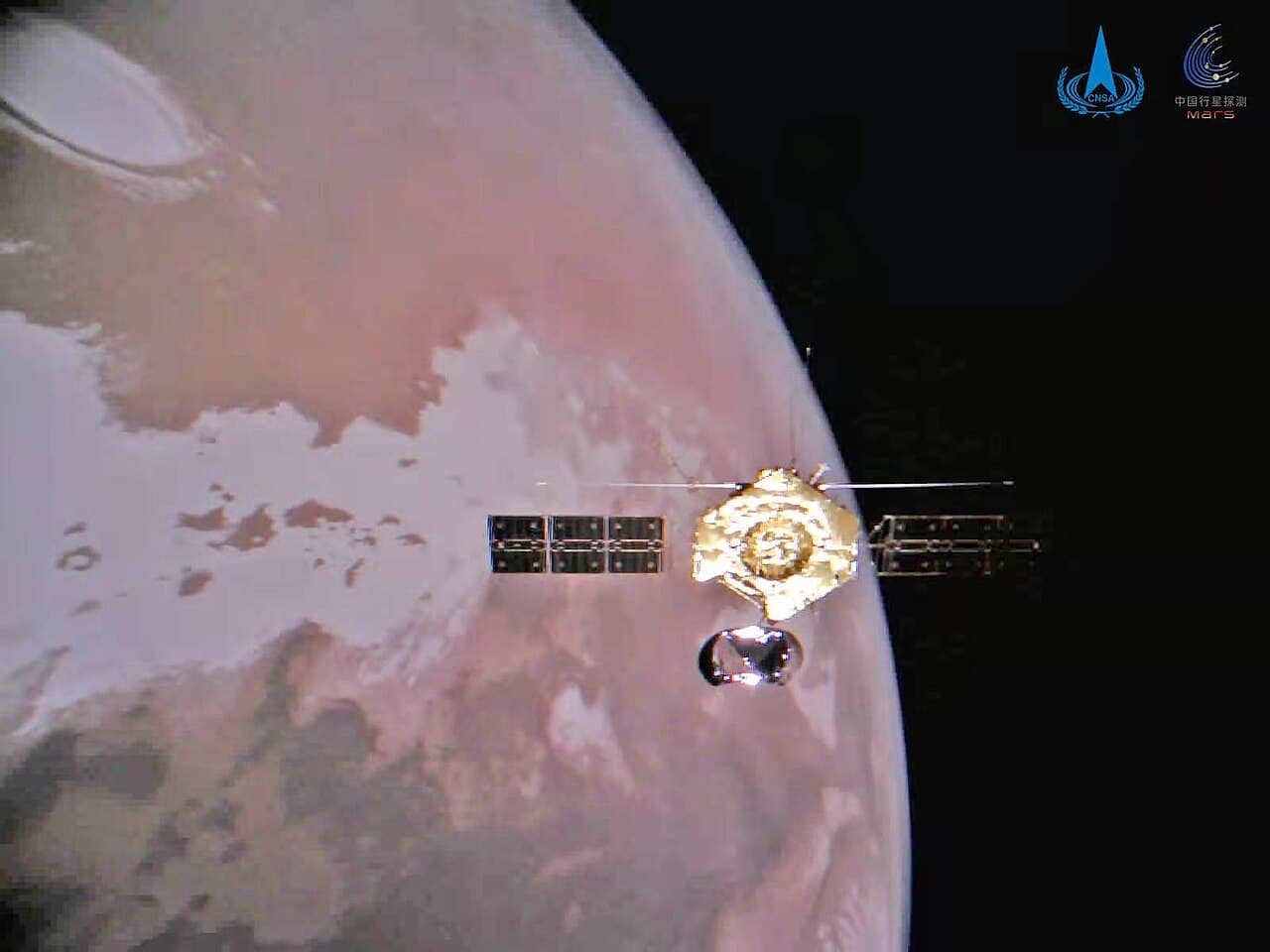
Tianwen-1 is usually described as China's first Mars mission, which is not quite right. China's first Mars spacecraft was Yinghuo-1, a 115 kg orbiter that rode with Russia's Phobos-Grunt in November 2011 and never left Earth orbit when the Russian craft's propulsion failed to fire. Tianwen-1 was the second attempt and the first China flew on its own launcher, its own trajectory and its own deep-space network. It left Wenchang on 23 July 2020 at 04:41:15 UT on a Long March 5, weighing about five tonnes, and took 202 days and roughly 475 million kilometres to reach Mars with four mid-course corrections and one deep-space manoeuvre along the way. The name is taken from Heavenly Questions, a poem by Qu Yuan written more than two thousand years ago, in which the poet interrogates the sky about the origins of everything. On 10 February 2021 the braking burn began at 19:52 Beijing time and China had its first artificial satellite of another planet. NASA's catalogue times the event about 26 minutes later, at 20:18 Beijing, because that figure is Earth-received time at the end of a 14 to 15 minute burn: the burn duration plus the 10 minute 40 second one-way light delay accounts for the whole gap. Light time alone does not. The two numbers are not in conflict; they measure different ends of the same radio link, which is worth knowing before treating either as the arrival time.
What made Tianwen-1 unusual was the combination. Nearly every Mars programme has built up in steps: orbit first, then land, then rove, with years between. The Soviet Union tried to compress that in 1971 with the Mars 2 and Mars 3 pairs, each an orbiter carrying a descent module with a small tethered rover called PrOP-M, and it went badly: Mars 2's capsule crashed, Mars 3's landed and stopped transmitting after about twenty seconds, and no PrOP-M was ever deployed. Tianwen-1 attempted the same architecture and completed it. The step that made it credible was patience. After capture the spacecraft did not go straight for the surface; it changed its orbital plane on 15 February 2021, settled into a parking orbit of about 280 by 59,000 kilometres on 24 February, and spent roughly three months photographing the pre-selected landing region with its high- and medium-resolution cameras before committing. The entry capsule then separated and came down on 14 May 2021 at 23:18 UT, running about nine minutes of fully autonomous entry, descent and landing: trim flaps, parachute, heat-shield and backshell separation, powered descent, a hover while it looked for hazards, then a slow descent onto a damping landing platform. On 22 May the Zhurong rover drove down the ramp.
The orbiter then had a mission of its own, and it is the half that outlived everything else. On 8 November 2021 it moved into a remote-sensing orbit of roughly 275 by 10,749 kilometres inclined 86.3 degrees, a near-polar path that took about seven hours to complete. NASA's catalogue records it more loosely as 265 by 12,000 kilometres. From there it did two jobs at once: relaying Zhurong's data to Earth and mapping the planet itself. By June 2022 its medium-resolution camera had covered the entire surface and all seven instruments had completed global surveys, and on 24 April 2023 CNSA and the Chinese Academy of Sciences released the resulting global image map at 76 metres per pixel. Along the way it released small deployable cameras that photographed it in flight. On 1 December 2021 CNSA and ESA jointly announced a successful relay communication test between ESA's Mars Express and the Zhurong rover, one of the few concrete pieces of China-Europe cooperation at Mars; the orbiter's own contribution there was the relay link it normally provided. None of this appears in JPL Horizons, whose Tianwen-1 entries are all reconstructions by volunteer trackers and stop on 10 February 2021, the day it arrived. That tells you what China publishes to the American ephemeris service; it tells you nothing about the spacecraft, and confusing the two is an easy way to declare a working orbiter dead.
The clearest evidence that it is not dead is recent and official. On 6 November 2025 CNSA announced that the orbiter's high-resolution camera had imaged 3I/ATLAS, the third interstellar object identified in the Solar System, from about 28.96 million kilometres on 3 October 2025, which the release calls the first attempt to photograph so distant and faint a target with a camera built for the bright Martian surface and one of the closest-range observations any probe made of the object; the release noted the probe had been running stably for four years and eight months and framed the exercise as a rehearsal for the Tianwen-2 asteroid mission. On 20 May 2026 CNSA published the scientific result, an Astrophysical Journal Letters paper led by the National Astronomical Observatories with the Tianwen-1 team, Sun Yat-sen University, the Macau University of Science and Technology, the Shanghai Astronomical Observatory and Chile's Universidad Diego Portales. Because the comet passed within 0.194 astronomical units of Mars in October 2025 and Tianwen-1 could view it from the south side of its orbital plane at 35 to 45 degrees, a geometry unavailable from Earth, the team could separate dust grains under different levels of solar radiation pressure: hundreds of microns across, ejected at about 3 to 10 metres per second, at roughly a tonne a second. The release's closing paragraph opens with a sentence worth quoting for its plainness: this fully demonstrates that the Tianwen-1 orbiter is running stably and in good condition.
So where does that leave the mission on 24 September 2026? The rover is silent and has been since 2022. The orbiter is working, on the evidence of the CNSA statement of 20 May 2026 and an April 2026 agency briefing that described the mission as still conducting global and regional exploration and put the volume of publicly released science data at 3.5 terabytes. Beyond that the picture gets murkier, and one claim in particular should be treated with care: several Chinese self-media posts and a Baidu AI summary assert that the orbiter lost contact on 14 April 2026 and recovered after 63 days on 16 June 2026, and that it will be retired on 24 September 2026. We found no news outlet and no CNSA page carrying any of that, we looked again on 24 September 2026 and still found none, and it sits badly against CNSA's own 20 May 2026 statement, which falls inside the supposed outage. We report it here only because it circulates. What is documented is that the orbiter has now outlived its rover by more than four years, and that its most-cited recent work was done on a target nobody planned for.
Mission facts
Launch
23 July 2020 at 04:41:15 UT (12:41 Beijing time) on a Long March 5 (Y4) from launch complex 101 at the Wenchang Space Launch Site, Hainan.↗
Mass
About 5,000 kg at launch. Chinese Wikipedia splits that as an orbiter of 3,715 kg and a rover of 240 kg, leaving roughly 1,285 kg for the entry capsule, landing platform and rover together.↗
Cruise
202 days and about 475 million km, with four mid-course corrections and one deep-space manoeuvre, per the Chinese Academy of Sciences Institute of Geology and Geophysics, which hosts the mission's science pages.↗
Mars orbit insertion
10 February 2021. Chinese sources time the braking burn from 19:52 Beijing (11:52 UT). NASA's catalogue gives about 12:18 UT Earth-received time, or 20:18 Beijing, after a 14 to 15 minute burn with a 10 min 40 s light delay. The first is when the burn started at Mars, the second is roughly when capture was confirmed on the ground.↗
Capture orbit
About 400 by 180,000 km at 10 degrees inclination, period about 10 Earth days. On 15 February 2021 a manoeuvre at apoapsis swung the inclination to 87.3 degrees; on 24 February the spacecraft entered a parking orbit of about 280 by 59,000 km with a period of two Martian sols.↗
Landing-site survey
From the parking orbit the high- and medium-resolution cameras surveyed the pre-selected landing region for about three months before the entry capsule was committed. This is the step that made a first-attempt landing plausible.↗
Landing
14 May 2021 at 23:18 UT, which is 15 May at 07:18 Beijing time, in southern Utopia Planitia. The entry, descent and landing sequence ran autonomously for about nine minutes and included trim-flap deployment, parachute, heat-shield and backshell separation, powered descent, a hover with hazard avoidance, slow descent and touchdown damping.↗
Rover deployment
22 May 2021 at 02:40 UT (10:40 Beijing). Zhurong drove down the ramp, photographed the landing platform, took a group portrait with it and began roving.↗
Remote-sensing orbit
Entered 8 November 2021. Chinese Wikipedia gives 275 by 10,749 km at 86.3 degrees; English Wikipedia adds a period of 7.08 hours. NASA's catalogue instead says 265 by 12,000 km, a looser description of the same polar orbit.↗
Orbiter instruments
Seven: a medium-resolution camera (MoRIC), a high-resolution camera (HiRIC), a magnetometer (MOMAG), a mineralogy spectrometer (MMS), a subsurface sounding radar (MOSIR), an ion and neutral particle analyser (MINPA) and an energetic particle analyser (MEPA).↗
Global mapping
By June 2022 the orbiter had acquired medium-resolution imagery covering the whole of Mars and all its science payloads had completed global surveys. On 24 April 2023 CNSA and the Chinese Academy of Sciences published the resulting global image map at 76 m per pixel.↗
Relay cooperation
On 1 December 2021 CNSA and ESA jointly announced that the Zhurong rover had completed a successful in-orbit relay communication test with ESA's Mars Express orbiter. That date belongs to the joint announcement; the test itself is not dated here. The Chinese partner was the rover rather than the Tianwen-1 orbiter.↗
Interstellar comet, 2025
CNSA announced on 6 November 2025 that the orbiter's high-resolution camera had imaged 3I/ATLAS on 3 October 2025 from about 28.96 million km. The release does not claim a first observation of an interstellar object by a Chinese spacecraft: its own superlative is that this was the first attempt to photograph so distant and faint a target with that camera, and it places Tianwen-1 among the probes that observed the object from the closest range. CNSA described it as a technology test that would feed into the Tianwen-2 asteroid mission, and said the probe had been running stably for four years and eight months.↗
Interstellar comet, 2026 results
On 20 May 2026 CNSA reported an Astrophysical Journal Letters paper based on three imaging runs between 30 September and 3 October 2025. Viewing from the south side of the comet's orbital plane at 35 to 45 degrees, the team constrained coma dust to grains of several hundred microns ejected at about 3 to 10 m/s, at an average of roughly one tonne per second. The release stated that this fully demonstrates that the Tianwen-1 orbiter is running stably and in good condition.↗
Status, April 2026
At CNSA's China Space Day press conference on 17 April 2026, the agency said the Tianwen-1 mission continues to conduct global and regional exploration of Mars and that 3.5 TB of science data has been released to scientists worldwide.↗
Not in Horizons after 2021
JPL Horizons target -9901491 is Tianwen-1, but every trajectory solution it holds was reconstructed by volunteer trackers (Bill Gray and amateur DSN observers), and Horizons serves no ephemeris after 2021-02-10 13:06 TDB, about an hour after the predicted closest approach on arrival day. Its segment table still lists an older solution running to 2021-03-21, but the final one ends on 10 February, and the record says the trajectory stops an hour after closest approach because the spacecraft would likely have been manoeuvred into orbit by then. That reflects what amateurs could track and what China publishes; the spacecraft itself does not come into it. No Chinese ephemeris is supplied to Horizons at all.↗
Mission timeline
- 8 Nov 2011China's first Mars spacecraft, the small orbiter Yinghuo-1, is stranded in Earth orbit when Russia's Phobos-Grunt fails to leave for Mars. Tianwen-1 is therefore China's second attempt at Mars and its first independent one.
- 23 Jul 202004:41:15 UT: launch on a Long March 5 from Wenchang. The name comes from Heavenly Questions, a poem by Qu Yuan.
- 10 Feb 2021Braking burn from 19:52 Beijing puts the spacecraft into a 400 by 180,000 km capture orbit at 10 degrees inclination, period about 10 days. China's first artificial satellite of Mars.
- 24 Feb 2021After a plane change on 15 February to 87.3 degrees, the spacecraft settles into a parking orbit of about 280 by 59,000 km and begins photographing the candidate landing region in detail.
- 14 May 202123:18 UT (07:18 on 15 May in Beijing): the entry capsule lands in southern Utopia Planitia after about nine minutes of fully autonomous descent, the first Chinese spacecraft on another planet.
- 22 May 202102:40 UT: Zhurong drives off the landing platform. China becomes the second country to operate a rover on Mars.
- 8 Nov 2021The orbiter moves into its remote-sensing mission orbit, roughly 275 by 10,749 km at 86.3 degrees, and starts global mapping while continuing to relay for the rover.
- 1 Dec 2021CNSA and ESA jointly announce that the Zhurong rover and ESA's Mars Express have completed a successful in-orbit relay communication test.
- 18 May 2022Zhurong hibernates for the Utopia Planitia winter after 358 sols and 1,921 m. It never wakes. From this point Tianwen-1 is an orbiter mission.
- Jun 2022The orbiter completes medium-resolution imaging covering the whole planet, and all seven payloads have carried out global surveys.
- 3 Oct 2025The high-resolution camera images interstellar comet 3I/ATLAS from about 28.96 million km. CNSA announces it on 6 November, calling it the first attempt to photograph so distant and faint a target with that camera and one of the closest-range observations of the object made by any probe.
- 20 May 2026CNSA publishes the dust-activity results from those observations and states that the orbiter is running stably and in good condition. It is still the most recent official statement on its health, rechecked on 24 September 2026.
A filled dot marks something that physically happened. A hollow one marks an announcement, a naming or a target.
In pictures
Tap a photo to enlarge.
Sources
- NSSDCA Master Catalog: Tianwen 1, 2020-049A, archived 6 Aug 2025
- CNSA (20 May 2026): 天问一号成功观测到星际天体的尘埃活动
- CNSA (6 Nov 2025): 天问一号成功观测到星际天体阿特拉斯
- 央广网 / CCTV News (17 Apr 2026): CNSA China Space Day briefing, 2025 results and 2026 tasks
- Chinese Academy of Sciences, Institute of Geology and Geophysics: 天问一号工程概述
- Chinese Wikipedia: 天问一号
- English Wikipedia: Tianwen-1
- CNSA (3 Mar 2026): 天问一号着陆区发现火星浅层地下水冰证据
- CNSA 要闻动态 news index
- Xinhua carrying People's Daily (16 May 2022): 祝融号行驶总里程1921米
- JPL Horizons system, used on 23 Aug 2026
- 环球网 relaying CCTV News (25 Apr 2023): 专访中国行星探测工程总设计师张荣桥
- JPL Horizons API, target -9901491 (Tianwen-1), queried 24 Sep 2026
Facts on this page were verified on 24 September 2026. Where sources disagree, the disagreement is stated rather than resolved silently.