The Mars Microphone
The Planetary Society / NASA / CNES · Multinational · Artefact · 2021 · Multipolar MarsOperating
Working since February 2021 on Perseverance, at the third attempt: NASA was still publishing new SuperCam audio in August 2026. The first was lost with Mars Polar Lander in 1999, the second never ran on Phoenix.
TL;DR· 16 min read
A microphone reached Mars in 1999, 2008 and 2021, and only the last one worked. The Planetary Society's instrument was lost with Mars Polar Lander; the copy inside Phoenix's descent camera never ran during the landing it was there for, and a late attempt returned nothing. Perseverance recorded the first sound from the Martian surface in February 2021. Mars turned out to be quiet and slow: sound travels at roughly 240 metres per second instead of 340 and arrives about 20 decibels weaker than on Earth.
For most of the space age nobody had heard Mars. Cameras had been standard since 1964 and seismometers since 1976, but a microphone was always the thing that got cut, and when it was not cut the spacecraft carrying it died. The instrument that finally succeeded is a commercial electret capsule about five millimetres across, the same family of part that sits in a hearing aid, bolted to the end of a short aluminium finger on Perseverance's mast. What it found is a planet that is quiet, slow and deaf to its own high notes: sound travels at roughly 240 metres per second instead of 340, arrives about 20 decibels weaker than the same source on Earth, and above a couple of kilohertz it is torn apart by carbon dioxide within a few metres.
- 22 yearsfrom the launch of the first Mars microphone in January 1999 to the first sound recorded on Mars
- 240 m/sspeed of sound near the Martian surface below 240 Hz, against about 340 m/s on Earth
- 20 dBhow much weaker the same source sounds on Mars, from the atmosphere's acoustic impedance
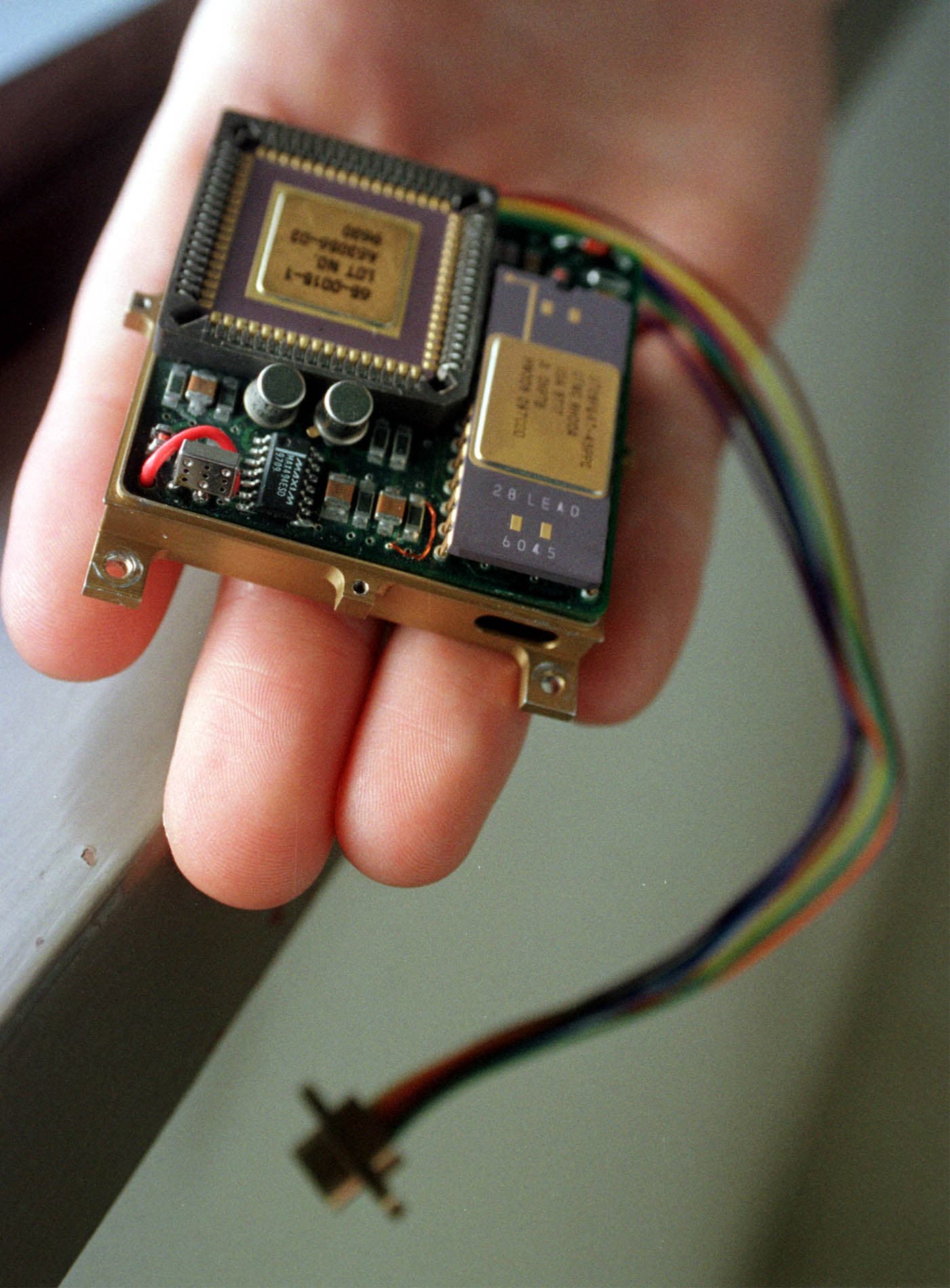
The idea is old and kept nearly happening. In 1996 the Planetary Society funded a group at the University of California Berkeley to build a microphone small enough that a Mars lander project would not notice the mass. What they produced was a two-inch square box, under fifty grams, drawing a tenth of a watt, built almost entirely from parts you could buy: a hearing-aid electret capsule, and an RSC-164 speech-recognition chip from Sensory Circuits of the sort found in talking toys. The whole programme cost about fifty thousand dollars. It could not be a passenger in its own right, so it went to Mars folded inside the Russian LIDAR that the Space Research Institute in Moscow contributed to Mars Polar Lander. Its operating concept says everything about the resources it had: telemetry was so scarce that returning one short clip would take days, so the instrument was told to listen continuously, keep the loudest thing it had heard, and throw that away as soon as something louder arrived. It was radiation-tested, thermally tested from minus 100 to plus 20 Celsius, and pressure-tested to prove a microphone can hear anything at all at six millibars. It was integrated in Denver in October 1998, and the team confirmed it worked by listening to the technicians on the floor. Fourteen months later the lander it was bolted to entered the Martian atmosphere and vanished.
The second attempt is a better story than the usual one-line summary. After Mars Polar Lander, CNES offered the microphone a ride on NetLander, and the redesign for that mission, which never left paper, was genuinely ambitious: a second capsule for stereo, ten times the memory, a direct line to the lander computer so a dust devil could trigger other instruments, and recording all the way down through entry and descent. NetLander died, though the year it died is itself contested; the project's own page says June 2004 and blames the French budget, while the SuperCam microphone paper says 2001. The instrument then found a third home inside MARDI, the descent camera on Phoenix. And then, very late in ground testing, engineers found that MARDI shared an interface card with the inertial measurement unit, and that under a particular combination of conditions reading an image out during entry could interfere with reading the IMU and crash the lander. Phoenix's principal investigator agreed, reluctantly, to leave the camera off. Malin Space Science Systems' announcement of 12 November 2007 puts it in one flat sentence: for those expecting to hear audio from MARDI's microphone, this decision eliminates that possibility too. The detail almost everyone drops is what happened afterwards: Malin's own project page records that late in the mission an attempt was made anyway, and no data came back.
The one that worked went up on Perseverance in duplicate, by two entirely different routes. SuperCam's microphone is the direct descendant: a Knowles EK-23132 electret, five and a half millimetres long, the same commercial part family as 1999 and 2008, potted into an aluminium housing at the tip of a three-centimetre sandblasted finger sticking out of the rover's mast head, two metres above the ground. It exists mainly to listen to SuperCam's own laser, because the pop a laser spark makes when it vaporises rock encodes how hard the rock is. The second microphone arrived almost by accident. The entry, descent and landing camera system was built from commercial hardware, and a microphone was cheap, so the team hung a DPA MMC4006 studio capsule and its digitizer off the side of the rover with the explicit note in the instrument paper that its acoustic performance was not a requirement. That one was supposed to record the landing itself, roughly 287 seconds from parachute deploy to touchdown. It returned nothing usable from the descent. Two days later, sitting still on the floor of Jezero, it recorded sixty seconds of Mars, and about ten seconds in there is a breath of wind. NASA published it on 22 February 2021, twenty-two years and seven weeks after the first Mars microphone left Earth.
What Mars sounds like is stranger than merely quiet, though it is also that. Acoustic impedance, the product of density and sound speed, is about 4.8 on Mars against 413 on Earth in the same units, so any given source arrives around twenty decibels down. Sound moves at roughly 240 metres per second rather than 340, because the air is cold and made of carbon dioxide. The genuinely odd part is that it does not move at one speed. A carbon dioxide molecule can store energy in a bending vibration, and that vibration takes time to relax; below the relaxation frequency the gas behaves as though it has seven degrees of freedom, above it only five, and the sound speed differs by about ten metres per second between the two regimes. On Earth this happens around 40 kHz and nobody notices. At six millibars the relaxation frequency drops to about 240 hertz, which is in the middle of a human voice. Perseverance measured both sides of the split: 240 m/s from the Doppler shift of Ingenuity's 84 hertz rotor tone, and 246 to 257 m/s from the flight time of laser spark pulses above 2 kilohertz. The same molecular process eats high frequencies. An 8 kilohertz sound is 40 decibels down at eight metres; on Earth you would have to walk sixty-five metres to lose that much.
So Mars is a place where a conversation at ten metres would be faint, muffled and slightly out of tune with itself, the consonants gone before the vowels. The scientific yield has been better than the novelty suggested it would be. Because a microphone samples pressure tens of thousands of times a second where a weather station samples it ten times, Perseverance resolved the dissipative regime of Martian atmospheric turbulence, the scale at which molecular viscosity finally converts eddies into heat, which InSight's pressure sensor could only hint at. On 27 September 2021 a dust devil about twenty-five metres wide and at least a hundred and eighteen metres tall walked directly over the rover, and the microphone counted the grains hitting it. Laser sparks recorded at known ranges gave the first in-situ measurement of how Martian air absorbs sound, settling a disagreement between two published models. And the rover's own noises turned out to be diagnostics: wheel screech at 520 to 700 hertz, the heat pump whining at 195 hertz, pumps and mechanisms audible enough that engineers can hear when something changes. As of 27 August 2026 it is still going. NASA's planetary archive released new SuperCam audio on 11 August 2026 covering sols up to May of this year, and the rover was returning images from two days ago.
Mission facts
The 1999 instrument
A box two inches square and half an inch thick, under 50 g, drawing less than 0.1 W at its busiest. Built at the University of California Berkeley Space Sciences Laboratory with funding from the Planetary Society, and flown not as an instrument in its own right but as a passenger inside the Russian LIDAR that the Space Research Institute (IKI) contributed to Mars Polar Lander.↗
What was inside it
A commercial electret microphone and preamplifier feeding an RSC-164 from Sensory Circuits, a general-purpose microcontroller designed for speech recognition, with an 8 KB PROM, 512 KB of RAM and 512 KB of flash on a two-inch square board. Two modes: high frequency sampled at 20 kHz giving 2.6 second clips, low frequency at 5 kHz giving 10.6 second clips. A 12-bit converter with commandable gains of 1, 4, 16 and 64. It also logged integrated sound power in six filter bands, five of them about an octave wide. Telemetry was so tight that returning one clip would take days, so it was told to listen continuously, keep the loudest thing it had heard, and discard that the moment something louder came along.↗
What it cost, and who built it
The project's instrument page puts the whole programme, design, construction and testing, at about 50,000 US dollars, which the team called a bargain for a planetary instrument. Its team page names Louis Friedman, then director of the Planetary Society, as team leader; the Berkeley side was Janet Luhmann, Greg Delory, Forrest Mozer, Henry Primbsch, David Curtis and two technicians. The microphone itself was a part normally used in hearing aids and the processor a part used in talking toys.↗
It was tested and it worked on Earth
Radiation exposure to full mission dose produced no failures or degradation. Thermal testing ran from -100 to +20 degrees Celsius with no malfunctions. Pressure tests confirmed it could hear at Martian pressures once the amplifier gain was raised. It was integrated onto Mars Polar Lander in October 1998 at Lockheed Martin in Denver, where the team verified it worked by listening to the technicians talking.↗
What happened to it
Mars Polar Lander entered the Martian atmosphere on 3 December 1999 and was never heard from. The JPL review board's probable cause was a premature descent engine shutdown at about 40 m, triggered by a spurious touchdown signal generated when the landing legs deployed. Nothing was ever recorded, and no hardware from the lander has ever been identified from orbit.↗
The second chance that evaporated
CNES offered the microphone a flight on NetLander, four small landers then planned for 2007, with the instrument to be redesigned to sit inside the PanCam head DLR was building. It never became hardware. The Berkeley team's own page calls it a design exercise, and no NetLander microphone was ever built, qualified or flown. On paper the design added a second microphone for stereo, ten times the storage, a direct interface so sound could trigger other instruments during dust devils, and recording during entry, descent and landing. NetLander was cancelled. The Berkeley project's status page dates the cancellation to June 2004 and blames CNES funding; Mimoun and colleagues date it to 2001. We have not found a source reconciling the two.↗
Phoenix, 2008
The same commercial sensor rode to Mars a second time inside MARDI, the descent imager built by Malin Space Science Systems. Very late in ground testing a fault was found in the Payload and Attitude Control Interface card that MARDI shared with the inertial measurement unit: under specific conditions, reading a MARDI image out during entry, descent and landing could interfere with reading the IMU, and could crash the lander. MARDI was left powered off. As Malin put it: "For those who were also expecting to hear audio from the MARDI's microphone, this decision also eliminates that possibility."↗
Phoenix, the part usually left out
"Never switched on" is not quite right. Malin Space Science Systems' own project page for Phoenix MARDI states that late in the Phoenix mission an attempt was made to acquire sounds through the MARDI microphone, but no data were received and the mission ended shortly afterwards. Phoenix's last contact was on 2 November 2008.↗
A fourth attempt nobody counts
ISAE-SUPAERO proposed a microphone as an add-on to the DREAMS payload on ESA's Schiaparelli descent module, to listen for convective vortices and saltating sand during the two or three days the lander was expected to survive. ESA raised reservations about the likely science return and it was not implemented. Schiaparelli crashed on 19 October 2016.↗
The SuperCam microphone
A Knowles EK-23132 electret capsule, 5.6 by 3 mm, sensitivity 29.6 mV per pascal at 1 kHz, described by its team as the same commercial sensor used on Mars Polar Lander and Phoenix. It sits outside the mast head on the tip of a 3 cm sandblasted aluminium finger, potted in an aluminium housing with a platinum temperature probe. A protective dust grid was designed and then deleted because it cost too much sensitivity. Its instrument paper gives the expected bandwidth as 100 Hz to 10 kHz and second-stage gains of 2, 4, 16 and 64; the Nature soundscape paper describes the same microphone as recording 20 Hz to 12.5 kHz at a 25 kHz sampling rate, or 50 kHz when sampling at 100 kHz, about 2.1 m above the ground.↗
Who leads it
The microphone was delivered to the SuperCam team in early 2019 and integrated at JPL. The instrument paper is led by David Mimoun of ISAE-SUPAERO in Toulouse, and the author contributions of the Nature soundscape paper name him as the lead of SuperCam's microphone. It belongs to the French half of a split instrument: the Mast Unit that carries it was provided by IRAP with CNES funding, Los Alamos National Laboratory supplied the Body Unit, and the University of Valladolid leads the calibration targets.↗
The other microphone
Perseverance carries a second one, part of the entry, descent and landing camera system: a DPA MMC4006 omnidirectional capsule with a DPA MMA-A digitizer board repackaged into a custom aluminium chassis at JPL. The capsule assembly is about 42 by 40 by 19 mm and 52 g, the digitizer about 56 mm across and 50 g. It records 20 Hz to 20 kHz at 48 kHz and 24 bits, and sits on the port side of the rover body above the middle wheel, behind a custom grid modified for Martian dust. Maki and colleagues do not give its height; the soundscape paper puts it about a metre above the ground. Its acoustic performance was explicitly not a requirement; the only requirement was that it interface simply with the camera system.↗
What actually happened on landing day
The EDL microphone was meant to record from just before parachute deploy through touchdown, about 287 seconds. It did not: JPL's release of 22 February 2021 states plainly that the microphone did not collect usable data during the descent. What it did do was record 60 seconds from the floor of Jezero on 20 February, with a Martian breeze audible for a few seconds about ten seconds in, alongside mechanical noises from the rover. SuperCam's microphone had already been switched on for the first time on Sol 1 with the mast still stowed; both microphones were active by Sol 2.↗
Why Mars sounds wrong
Acoustic impedance is density times sound speed. On Mars that is about 4.76 kg per square metre per second against 413 on Earth, two orders of magnitude, so the same source arrives roughly 20 dB weaker. Sound speed itself is about 240 m/s. And because carbon dioxide molecules take time to relax their bending vibration, the relaxation frequency at 0.6 kPa lands at about 240 Hz, right in the middle of human hearing. Below it the gas has seven active degrees of freedom, above it only five, so the speed of sound jumps by about 10 m/s across a single audible frequency. Perseverance measured both sides: 240 m/s from the Doppler shift on Ingenuity's 84 Hz blade tone, and 246 to 257 m/s in daylight from the time of flight of SuperCam's laser sparks above 2 kHz.↗
And why it goes quiet so fast
The attenuation coefficient measured from laser sparks at different ranges is 0.21 per metre from 3 to 6 kHz, 0.34 from 6 to 11 kHz and 0.43 from 11 to 15 kHz. Put concretely: an 8 kHz sound that is 9 dB down at 2 m is 40 dB down at 8 m. On Earth, where the coefficient at that frequency is about 0.01 per metre, you would have to walk 65 m to lose the same 40 dB. Beyond about 5 m on Mars the atmosphere absorbs more than the spreading of the wavefront does. High notes do not travel.↗
Still recording
NASA's Planetary Data System issued Mars 2020 SuperCam Release 16 on 11 August 2026, adding new calibrated audio covering sols 1740 to 1859, which is 11 January to 13 May 2026. The raw audio collection carries sol directories out to sol 1859. Checked on 27 August 2026, NASA's Mars 2020 raw image feed was returning pictures taken on sol 1961, 26 August 2026 UTC, so the rover carrying both microphones is still working.↗
Mission timeline
- 3 Jan 1999Mars Polar Lander launches with the Planetary Society's Mars Microphone riding inside the Russian LIDAR instrument. It had been integrated at Lockheed Martin in Denver the previous October, where the team listened to technicians talking through it.
- 3 Dec 1999Mars Polar Lander enters the atmosphere and is never heard from. The probable cause is a premature engine shutdown at about 40 m. The microphone records nothing and has never been found.
- 2001 to Jun 2004CNES offers the microphone a second flight on NetLander, and it is redesigned on paper for the PanCam head DLR was building, with a second capsule for stereo and the ability to record during entry and descent. No hardware is built. NetLander is cancelled. Two dates for that cancellation are in print: 2001 in the SuperCam microphone paper, June 2004 on the project's own status page, which blames CNES funding.
- 12 Nov 2007Malin Space Science Systems announces that Phoenix's descent imager will not be operated at all, because a shared interface card could let a MARDI readout corrupt inertial measurement data during landing. The same sentence kills the audio.
- 25 May to 2 Nov 2008Phoenix lands in Vastitas Borealis with the microphone aboard, powered off. Late in the mission an attempt is made to acquire sound through it anyway. No data are received, and Phoenix's last contact comes on 2 November 2008.
- 18 Feb 2021Perseverance lands in Jezero crater. Its EDL microphone, which was supposed to record about 287 seconds from parachute deploy to touchdown, returns no usable data from the descent.
- 19 to 20 Feb 2021Sol 1: SuperCam's microphone is powered on for the first time, with the mast still stowed. Sol 2: both microphones are active, and the EDL microphone records 60 seconds on the floor of Jezero. About ten seconds in, a Martian breeze.
- 22 Feb 2021JPL publishes the clip alongside the landing video. It is the first sound recorded on the surface of Mars, twenty-two years after the first attempt launched.
- 7 Mar 2021Sol 16: the EDL microphone records the rover driving, a sixteen-minute take. Broad screeching in three bands, 520 to 700 Hz, 1.2 to 1.4 kHz and 1.6 to 1.9 kHz, is later attributed to the metal wheel tread grinding across surface rocks, with sharper clanks read as structural resonances.
- 30 Apr 2021Sol 69: SuperCam's microphone hears Ingenuity's fourth flight. The rotor blade passage frequency near 84 Hz, Doppler-shifted as the helicopter moves, later yields the low-frequency speed of sound on Mars: about 240 m/s.
- 27 Sep 2021Sol 215, 11:02 local true solar time: a dust devil about 25 m across and at least 118 m tall passes directly over the rover at roughly 5 m/s, and SuperCam's microphone records it, grain impacts and all.
- 1 Apr 2022Nature publishes the first characterisation of the Martian soundscape: two speeds of sound about 10 m/s apart either side of 240 Hz, the first in-situ acoustic attenuation coefficients, and the dissipative regime of atmospheric turbulence resolved for the first time.
A filled dot marks something that physically happened. A hollow one marks an announcement, a naming or a target.
In pictures
Tap a photo to enlarge.
Sources
- Mars Microphone project site, UC Berkeley Space Sciences Laboratory and The Planetary Society
- D. W. Curtis, Mars Microphone Instrument (UC Berkeley SSL, 1997)
- Malin Space Science Systems (12 November 2007): Mars Descent Imager (MARDI) Update
- Malin Space Science Systems: Phoenix Mars Descent Imager project page
- Mimoun et al., The Mars Microphone onboard SuperCam, Space Science Reviews 219:5 (2023)
- Maurice et al., In situ recording of Mars soundscape, Nature 605, 653-658 (1 April 2022)
- Maki et al., The Mars 2020 Engineering Cameras and Microphone on the Perseverance Rover, Space Science Reviews 216:137 (2020)
- Murdoch et al., The sound of a Martian dust devil, Nature Communications 13, 7505 (2022)
- NASA JPL (22 February 2021): NASA's Mars Perseverance Rover Provides Front-Row Seat to Landing, First Audio Recording of Red Planet
- Report on the Loss of the Mars Polar Lander and Deep Space 2 Missions, JPL Special Review Board (JPL D-18709), 22 March 2000
- NASA Planetary Data System, Mars 2020 SuperCam release notes
- NASA Mars 2020 rover traverse waypoints (M20_waypoints.json), downloaded 27 August 2026
Facts on this page were verified on 27 August 2026. Where sources disagree, the disagreement is stated rather than resolved silently.
77.4509 E, 18.4446 N · Octavia E. Butler Landing