Planetary Protection
Article IX of the Outer Space Treaty bans harmful contamination. COSPAR's voluntary rules set the spore limits that decide what a Mars lander may touch.
TL;DR· 22 min read
No, and the rule that says so is one sentence long. Article IX of the 1967 Outer Space Treaty binds states to avoid the harmful contamination of other worlds, without defining it or setting a single number. The numbers come from the COSPAR Policy on Planetary Protection, which calls itself voluntary and non-legally binding: a Category IVa Mars lander may carry 300,000 spores on its exposed surfaces, while anything that might touch a Special Region is allowed 30. No Special Region has ever been confirmed on Mars.
Not freely, no, and the rule that says so is nearly sixty years old. Article IX of the 1967 Outer Space Treaty binds every signatory state to explore the Moon and other celestial bodies "so as to avoid their harmful contamination", and that single clause is the entire legal foundation of the subject. It does not define harmful contamination, does not mention Mars, does not mention microbes and contains no numbers at all. The numbers come from a separate document that no court has ever enforced: the COSPAR Policy on Planetary Protection, an international standard that is explicitly voluntary. Between them, those two texts decide how clean a Mars lander must be, which patches of ground it may drive onto, and whether the rocks it collects may be allowed to land on Earth.
- 30bacterial spores allowed on the entire landed system of a spacecraft that may touch a Martian Special Region
- 0.5 and -28 Cwater activity and temperature: exceed both at once and a piece of Mars counts as a Special Region
- 20,000 kgof Earth-made material already delivered to the Martian surface and atmosphere by 17 missions, none of it regulated as chemical contamination
The whole of planetary protection law is one sentence long. Article IX of the Outer Space Treaty, opened for signature in Washington, London and Moscow on 27 January 1967 and in force since that October, requires states to conduct exploration of the Moon and other celestial bodies "so as to avoid their harmful contamination and also adverse changes in the environment of the Earth resulting from the introduction of extraterrestrial matter". That is the entire contamination provision. It never defines harmful contamination, never mentions Mars, never mentions microorganisms and contains no numbers whatsoever. A 2026 review in Environmental Science and Technology by Hader and colleagues puts the gap plainly: the exact nature of the harm or contamination the clause covers "was not explicitly defined". What makes it bite on a private company rather than only a space agency is Article VI, which holds each state internationally responsible for national activities in space "whether such activities are carried on by governmental agencies or by non-governmental entities", and requires that non-governmental activities have "authorization and continuing supervision by the appropriate State Party". A commercial Mars lander is therefore its home government's legal responsibility. Whether that government has written a domestic rule converting Article IX into an enforceable licence condition is a separate matter, and in the United States that question is still open. NASA's own independent review board recommended in 2019 that NASA work with the administration and Congress "to identify the appropriate U.S. Government agency to implement a PP regulatory framework" for missions without significant NASA involvement. We could find no public record that any agency has since been given the job.
The numbers, then, come from somewhere with no legal power at all. COSPAR, the Committee on Space Research, maintains a Policy on Planetary Protection that it describes in its own preamble as "an international voluntary and non-legally binding standard". Its current version was approved by the COSPAR Bureau on 7 November 2025 and published in January 2026. It sorts every mission into five categories by target and mission type: Category I for places irrelevant to the origin of life, Category II for places where the risk is remote, Category III for orbiters at sensitive bodies, Category IV for landers at them, and Category V, assigned on top of everything else, for anything bringing material back to Earth. Mars is III, IV and V Restricted. Category IV then splits three ways, and this is where the argument really lives. Category IVa is an ordinary lander with no life-detection payload and no plan to touch anything wet: it may carry up to 500,000 bacterial spores in total, 300,000 of them on exposed surfaces, at an average of 300 per square metre. Category IVb is a mission that looks for life or collects samples for return: 30 spores on the whole landed system, or 30 on the parts that handle the samples. Category IVc, for anything that might reach a Special Region, is the same 30. That is a ten-thousand-fold difference in permitted filth between a rover that drives past a brine and a rover that touches one, and it is decided years before launch. What is at stake is the question behind life on Mars: a false positive from a stowaway would be indistinguishable from the discovery everyone is hoping for.
A Special Region is defined by Earth biology, because nothing else is available. The policy says it is "a region within which terrestrial organisms are likely to replicate", and adds that any region with a high potential to host extant Martian life is also one. It then admits, in the same paragraph, that "in the absence of specific information, no Special Regions are currently identified on the basis of possible Martian life forms". NASA's handbook is blunter: since we have no idea what unknown Martian life would need, "we have no way to define them, except by reference to our knowledge of the terrestrial biosphere". So in practice the definition reduces to two numbers that must be exceeded at the same time: a water activity above 0.5 and a temperature above -28 C. The science behind them, SR-SAG2 in 2014, recommended -25 C, and the National Academies endorsed that in 2015; COSPAR's policy has carried -28 C since at least its June 2020 version and calls both figures conservative margins below the reported limits of terrestrial biology. The test case has always been recurring slope lineae, the dark streaks that grow down warm slopes each summer. Hydrated salts were reported in them by Ojha and colleagues in Nature Geoscience in 2015. Dundas argued in Icarus 343 (2020) that they are dry sand avalanches needing no water at all. A 2025 time-series study of Palikir and Raga craters in Scientific Reports 15, article 25555, instead found their behaviour consistent with melting bedrock aquifers, with hydrated salts present in summer and absent in autumn. NASA's own handbook records the standoff in one sentence: the lack of aqueous involvement in RSL "is not yet demonstrated". The water on Mars page sets out the wider evidence on liquid water today.
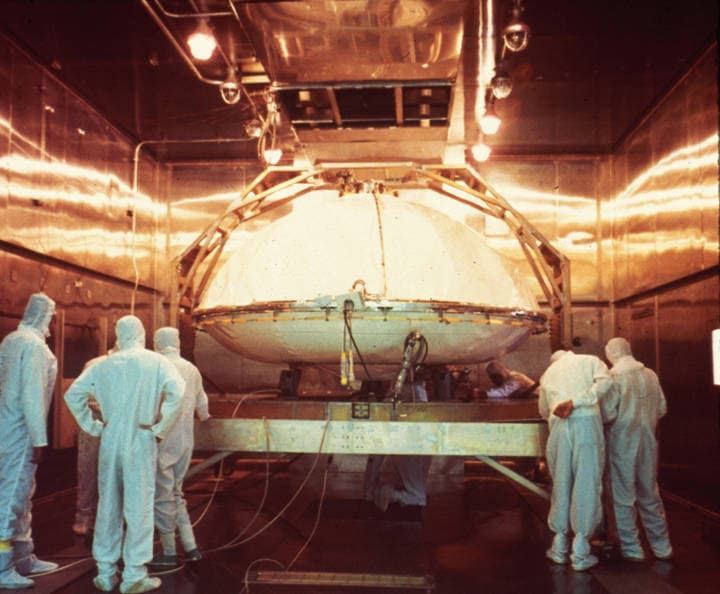
This is why a rover cannot simply go and look. Take Curiosity. It is a Category IVa spacecraft, and it launched carrying 278,000 spores in total and 56,400 on its exposed surfaces, an average of 22 per square metre, all comfortably inside its limits and all roughly two thousand times too dirty for anything classified as special. Nothing can be done about that after launch. A joint workshop reported in Life Sciences in Space Research in 2019 that the standoff distance a Category IVa rover must keep from a Special Region does shrink over time, because the Martian surface is itself a sterilising environment and slowly cleans exposed hardware, but the interior of a rover is not exposed and never gets cleaned. Fixing the problem at the source is genuinely hard. The Viking 1 and Viking 2 landers are the last Mars vehicles baked whole that we can find in the public record, and the Soviet Mars 2 and Mars 3 capsules were sterilised before them. Each Viking lander was sealed inside a bioshield weighing 128 kg in two pieces and cooked in the sterilisation chamber at Kennedy Space Center, the first capsule spending more than 43 hours in heated nitrogen reaching 116.2 C in June 1975. NASA's own history says most of the trouble in developing the lander lay in "building components that could withstand the high temperatures required to kill all terrestrial organisms". Half a century later the problem is unchanged: detectors, lubricants, adhesives, batteries and plastics do not enjoy being cooked. For the Rosalind Franklin rover, ESA baked only the 74 kg descent parachute, at 125 C for 36 hours after a 50-hour preheat, finishing on 1 May 2026.
Backward contamination is stricter than anything on the outbound side, because the thing being protected is us. Any Mars sample return is Category V Restricted Earth Return, and the policy imposes an "absolute prohibition of destructive impact upon return". The mission must break the chain of contact with Mars, meaning no hardware that touched an unsterilised Martian particle may reach Earth uncontained. That constraint shaped Perseverance long before any return vehicle existed: an accounting published in Astrobiology in 2023 sets out the combined biological and organic cleanliness standards its sample tubes had to meet on the ground. NASA's standard sets the particle of concern at 10 nanometres and requires the probability of releasing one to be below one in a million in every mission phase, with impact avoidance demonstrated for a century after the return trajectory begins. Samples go into a facility built to the highest level of biological containment, and life-detection and biohazard testing, or proven sterilisation, is "an absolute precondition" for releasing any of it. If containment fails and sterilisation is impossible, the policy says the sample should be abandoned and the spacecraft should not be allowed to come home. Not everyone thinks this is proportionate. The 2019 review board pointed out that Martian material has been landing on Earth as meteorites for billions of years at a rate orders of magnitude above anything a spacecraft could deliver, and that the quantitative requirements "lack a fully rational basis considering this history". That argument has not been settled, and it may not need to be soon: Mars Sample Return was defunded in January 2026, and Martian meteorites are the natural delivery service that never stopped.
Then there is the part nobody has solved. A spacecraft can be baked; a person cannot. NASA's review board stated the consequence flatly: human missions "will inevitably introduce orders of magnitude more terrestrial microorganisms to Mars than robotic missions have done or will do", and the existing restricted-return requirements "appear to be unachievable for human missions returning from Mars". Its answer was to reconsider how much of Mars really needs Category IV treatment and to designate human exploration zones where contamination would simply be accepted; the page on sending people to Mars covers how far those plans have actually got. COSPAR's answer, written into the policy in force today, is the opposite: "planetary protection goals should not be relaxed to accommodate a human mission to Mars. Rather, they become even more directly relevant". Both documents agree on the physical fact underneath, which COSPAR states without flinching: it will not be possible for all human-associated processes on the surface to be conducted within entirely closed systems. NASA's March 2026 workshop report found that many participants wanted robotic life detection completed before crews arrive, and recorded honestly that "there was not unanimity among attendees on whether it should be mandatory". Meanwhile the ledger keeps growing on its own. Roughly 20,000 kg of Earth-made chemicals and materials have already been delivered to the Martian surface and atmosphere across 17 missions, starting with the Mars 2 crash in 1971, and more than 23,000 kg sits in orbit around it, spread across nine defunct and seven operational satellites. None of it is regulated as contamination at all: the policy counts spores.
What we know
The one sentence that binds
Article IX of the Treaty on Principles Governing the Activities of States in the Exploration and Use of Outer Space, including the Moon and Other Celestial Bodies: "States Parties to the Treaty shall pursue studies of outer space, including the Moon and other celestial bodies, and conduct exploration of them so as to avoid their harmful contamination and also adverse changes in the environment of the Earth resulting from the introduction of extraterrestrial matter and, where necessary, shall adopt appropriate measures for this purpose." Quoted here from the preamble of the current COSPAR policy, which reprints it in full. The treaty was opened for signature in Washington, London and Moscow on 27 January 1967 and entered into force on 10 October 1967.↗
Why a company is not exempt
Article VI of the same treaty makes each state internationally responsible for national activities in space "whether such activities are carried on by governmental agencies or by non-governmental entities", and requires that the activities of non-governmental entities "shall require authorization and continuing supervision by the appropriate State Party to the Treaty". A private Mars lander is therefore its government's legal problem. Whether that government has written a domestic rule turning Article IX into a licence condition is a different question; NASA's own 2019 independent review board recommended that NASA work with the administration and Congress "to identify the appropriate U.S. Government agency to implement a PP regulatory framework" for missions without significant NASA involvement, and we found no public record that one has been designated since.↗
What COSPAR actually is
The Committee on Space Research, a body of the International Science Council. Its Panel on Planetary Protection maintains the policy that every space agency uses. The policy states its own status without ambiguity: COSPAR maintains it "for the reference of spacefaring nations as an international voluntary and non-legally binding standard". Nobody can be prosecuted under it. Agencies bind themselves to it through their own rulebooks, which is where the enforcement actually happens.↗
The version in force
The 2026 version of the COSPAR Policy on Planetary Protection, endorsed by panel members on 6 October 2025, approved by the COSPAR Bureau on 7 November 2025, and published as Space Research Today 224 (January 2026), pages 17 to 39. It replaces the 2024 version validated on 20 March 2024, which replaced the 2021 version. The main change is a new framework for Icy Worlds; the Mars provisions are unchanged in substance. The editorial notes that the new policy "does not apply to missions already en route or in advanced stages of development".↗
The five categories
Category I: no interest for chemical evolution or the origin of life, no requirements. Category II: interest, but only a remote chance contamination could compromise it; documentation only. Category III: flyby or orbiter to a body where the chance is significant. Category IV: probe or lander to such a body. Category V: any mission returning samples to the Earth-Moon system, assigned on top of the outbound category and split into Unrestricted and Restricted Earth Return. Mars is III for orbiters, IV for landers and V Restricted for sample return.↗
What a spore means here
Every Mars bioburden number is expressed in one unit and it is a narrow one. A "spore" means a mesophilic, heterotrophic, aerobic microorganism that survives a heat shock of 80 C for 15 minutes and then grows on tryptic soy agar at 32 C for 72 hours. That assay was devised for Viking, because bacterial endospores were the hardiest thing anyone then knew how to count and the most resistant to dry heat. It counts nothing that will not grow in that dish, which is a known and acknowledged limitation of the whole scheme.↗
Category IVa: an ordinary Mars lander
A lander with no life-detection instruments and no plan to touch a Special Region. Total bioburden across surface, mated and encapsulated hardware no more than 5 x 10^5 bacterial spores; surface bioburden no more than 3 x 10^5 spores; and an average of no more than 300 spores per square metre. On NASA's own mission list, Deep Space 2, Mars Pathfinder, Mars Polar Lander, Spirit, Opportunity, Curiosity and InSight are all Category IVa.↗
Category IVb: looking for life
Everything in IVa, plus this: the entire landed system is held to a surface bioburden of no more than 30 spores, or else the subsystems that acquire, deliver and analyse samples are sterilised to that level with a demonstrated method of preventing recontamination. NASA's table adds a density figure for those elements of 3.0 x 10^-2 spores per square metre, which is about one spore per 33 square metres. The Viking 1 and Viking 2 landers were Category IVb. So is ESA's Rosalind Franklin rover.↗
Category IVc: touching a Special Region
The same 30-spore ceiling, applied either to the whole landed system if the landing site is inside a Special Region, or to whichever subsystems will contact it if the spacecraft gets there by driving or drilling. NASA's standard adds a fourth column for the case where a credible off-nominal landing could itself cause contamination: total bioburden drops to 2 x 10^5 and the surface to 30 spores at 3.0 x 10^-2 per square metre. The policy explains where 30 comes from: it assumes Category IVa cleanliness followed by at least a further four orders of magnitude of microbial reduction. On NASA's published planetary protection mission table, exactly one spacecraft has ever been assigned Category IVc, and it is Phoenix, which landed where ground ice sits centimetres below the soil.↗
Definition of a Special Region
"A Special Region is defined as a region within which terrestrial organisms are likely to replicate. Any region which is interpreted to have a high potential for the existence of extant Martian life forms is also defined as a Special Region." The policy then concedes the hole in that second sentence: "In the absence of specific information, no Special Regions are currently identified on the basis of possible Martian life forms." NASA's handbook is blunter still: because we have no way of knowing what unknown Martian life would need, "we have no way to define them, except by reference to our knowledge of the terrestrial biosphere".↗
The two thresholds, and the disagreement inside them
A place is special if it exceeds both a water activity of 0.5 and a temperature of -28 C at the same time. Water activity is the vapour pressure of water in a material divided by that of pure water at the same temperature, in effect the water a cell can actually use. The COSPAR policy has carried -28 C since at least its June 2020 version and describes both figures as including margin below the reported limits of terrestrial biology. The underlying science report, SR-SAG2, recommended -25 C with no upper limit and water activity from 0.5 to 1.0, and the National Academies endorsed those values in 2015. Doran and colleagues, writing in Life Sciences in Space Research 41 (2024), pages 86 to 99, noted that the policy values "are currently set at 0.5 and -28 C and were originally established for defining Mars Special Regions". NASA's own 2024 handbook prints the threshold as "> 28 C", dropping the minus sign.↗
Which features counted
The June 2020 policy carried an explicit list. Treated as Special Regions until shown otherwise: gullies of taxon 2 to 4 and the bright streaks associated with them, subsurface cavities, anything below 5 metres depth, and confirmed or partially confirmed recurring slope lineae. Treated as indicators: groundwater, a source of methane, geothermal activity, a modern outflow channel. Requiring case-by-case evaluation: dark streaks, pasted-on terrain and candidate RSL. The 2026 policy no longer prints that list in the policy text and instead refers the reader to the underlying literature.↗
How long the protection is supposed to last
Two different clocks. The Period of Biological Exploration for Mars, the window during which contamination is judged to matter, is 50 years from launch; for Icy Worlds it is 1,000 years. The Special Regions analysis instead used a 500-year horizon, chosen in part because that is roughly the time in which a meteorite would randomly land on a given spacecraft's patch of ground with a probability of 1 in 1,000. The general numerical guideline is that the probability of contaminating a body during its exploration period should be no more than 1 in 1,000.↗
The rules for not landing at all
A Mars orbiter has to show a probability of impacting Mars of no more than 1 in 100 for the first 20 years after launch and no more than 1 in 20 from 20 to 50 years, or else be cleaned to Category IVa levels anyway. The launch vehicle's own probability of hitting Mars must be no more than 1 in 10,000 over 50 years. The same calculation applies to any spacecraft that merely uses Mars for a gravity assist. The derelict fleet in Mars orbit shows what has actually accumulated up there.↗
Category V Restricted Earth Return
The strictest regime in the whole policy. There is an "absolute prohibition of destructive impact upon return"; the mission must break the chain of contact with Mars; the outbound leg must meet Category IVb; and life detection and biohazard testing, or a proven sterilisation process, is "an absolute precondition for the controlled distribution of any portion of the sample". NASA's standard puts numbers on it: the particle size of concern is 10 nanometres or greater, and the probability of releasing one or more unsterilised particles of extraterrestrial material must be below 1 in a million for each mission phase, with impact avoidance at the Earth-Moon system demonstrated for 100 years after the return trajectory begins. If containment is compromised and sterilisation is impossible, the policy says the sample should be abandoned and the spacecraft should not be allowed to return to Earth or the Moon.↗
What the rules cost, in real spacecraft
Viking's two landers were baked whole inside sealed bioshields; NASA's own history of the programme gives the bioshield cap and base as 54 and 74 kg. Benardini and colleagues report in Astrobiology 14 (2014) that Curiosity launched with 2.78 x 10^5 spores in total against a 5 x 10^5 limit, 5.64 x 10^4 on exposed landed surfaces against a 3 x 10^5 limit, and an average of 22 spores per square metre; the same team measured the interior of its Atlas V payload fairing at 4.65 spores per square metre against a pre-launch estimate of 500 to 1,000. The Mars 2020 team reported in Astrobiology 23 (2023) that it took more than 16,000 biological samples during assembly and landed a total of 3.86 x 10^4 spores on landed hardware, which the team reports as an 87 percent margin against the required limit. European Spaceflight reported on 1 May 2026 that ESA had baked the 74 kg Rosalind Franklin descent parachute at 125 C in the Netherlands, a 50-hour preheat followed by 36 hours at temperature.↗
What happened, and when
- 1964COSPAR adopts Resolutions 26.5 and 26.7, the two resolutions the policy in force today still cites as its own point of departure. The panel that produced them was called the Panel on Standards for Space Probe Sterilization; it became the Panel on Planetary Quarantine and then, today, the Panel on Planetary Protection.
- 27 Jan 1967The Outer Space Treaty is opened for signature simultaneously in Washington, London and Moscow. Article IX contains the harmful contamination clause; Article VI makes states answerable for their private operators. It enters into force on 10 October 1967 and has been the legal basis of planetary protection ever since, without a single amendment.
- 1969COSPAR issues Decision No. 16. The current policy cites it, together with a 2006 National Academies report, as the origin of the Period of Biological Exploration for Mars: the window during which contamination is judged to matter, still set at 50 years from launch.
- 15 Jun 1975The first Viking lander capsule goes into the sterilisation chamber at Kennedy Space Center, sealed inside its bioshield. It spends more than 43 hours in heated nitrogen reaching 116.2 C. The second capsule follows for almost 50 hours. The design case had been 40 hours at a maximum of 112 C; components had been qualified through five 40-hour cycles and three 54-hour cycles at 121 C. We can find no record of a Mars vehicle being baked whole since.
- 2002The concept of Special Regions enters the COSPAR policy, replacing the assumption that all of Mars is equally sensitive with the idea that only some places on it could support Earth life.
- 2006The US National Research Council's PREVCOM report recommends, in its Recommendation 13, that until Mars can be reliably divided into special and not special, every direct-contact mission be treated as if it were entering a Special Region. That would have imposed 30-spore cleanliness on every Mars lander. NASA instead asks MEPAG to define the boundary, and the first Special Regions Science Analysis Group reports the same year.
- Nov 2014SR-SAG2 publishes its reanalysis in Astrobiology, volume 14, pages 887 to 968. It defines habitability in terms of two measurable parameters, water activity and temperature, identifies which Martian features must be treated as special, and concludes that the majority of modern Mars is not.
- 28 Sep 2015Ojha and colleagues report spectral evidence of hydrated salts in recurring slope lineae, the dark streaks that lengthen down warm slopes in summer, in Nature Geoscience 8, pages 829 to 832; NASA announces it the same day. Neither the paper nor the release says anything about planetary protection, but the finding puts the question directly: if RSL are brine, they are Special Regions, and no rover on Mars is clean enough to go near one.
- 2015A National Academies committee reviews SR-SAG2, supports 29 of its 45 findings, rejects one and revises 13. It endorses water activity of 0.5 to 1.0 and a minimum temperature of -25 C over a 500-year horizon, and classes RSL not as Special Regions but as Uncertain Regions, a category it says should still be treated as Special Regions until proven otherwise. It calls reassessment every two years "both appropriate and essential".
- Oct 2019NASA's Planetary Protection Independent Review Board, chaired by Alan Stern and given 90 days, reports. It recommends reconsidering how much of Mars could be Category II rather than IV, creating designated human exploration zones where contamination would be accepted, and rebuilding the sample return risk case around the fact that Martian meteorites have been arriving on Earth for billions of years.
- 9 Jul 2020NASA issues Interim Directive NID 8715.129, Biological Planetary Protection for Human Missions to Mars, the agency's only dedicated document on the subject. It concurs with COSPAR's principles, promises risk-informed implementation strategies, and carries an expiration date of 9 July 2023. It has not been replaced by a full NPR. NASA's planetary protection policy page now lists four governing documents, and the requirements document among them, NPR 8715.24, is scoped by its own title to robotic extraterrestrial missions.
- 3 Mar 2026NASA's Office of Planetary Protection releases the report of its Science and Planetary Protection in Advance of Human Missions to Mars workshop. A significant segment of participants wanted robotic life-detection attempts before crews land, but the report records that "there was not unanimity among attendees on whether it should be mandatory for such investigations to be completed before the first crewed mission".
In pictures
Tap a photo to enlarge.
Sources
- COSPAR Policy on Planetary Protection, 2026 version, approved by the COSPAR Bureau 7 Nov 2025, Space Research Today 224 (Jan 2026) pp. 17-39
- UN Treaty Collection entry for the Outer Space Treaty
- COSPAR Policy on Planetary Protection, June 2020 version
- NASA-STD-8719.27, Implementing Planetary Protection Requirements for Space Flight, baseline 30 Aug 2022
- NASA Planetary Protection Handbook, NASA/SP-20240016475 (2024)
- NASA Interim Directive NID 8715.129, Biological Planetary Protection for Human Missions to Mars, effective 9 Jul 2020, expiration 9 Jul 2023
- NASA Planetary Protection Independent Review Board report (Alan Stern, chair), Oct 2019
- Rummel et al. 2014, A New Analysis of Mars Special Regions: Findings of SR-SAG2, Astrobiology 14(11) 887-968
- National Academies (2015), Review of the MEPAG Report on Mars Special Regions
- Benardini et al. 2014, Implementing planetary protection measures on the Mars Science Laboratory, Astrobiology 14(1) 27-32
- Ezell and Ezell, On Mars: Exploration of the Red Planet 1958-1978 (NASA SP-4212)
- Hader et al. 2026, Toward Safe Chemicals and Materials on Mars, Environ. Sci. Technol. 60(13) 9744-9760
- NASA SMD, Science and Planetary Protection in Advance of Human Missions Workshop Report, NTRS 20250009522 (Dec 2025, released 3 Mar 2026)
- NASA Office of Safety and Mission Assurance planetary protection page
- Ojha et al. 2015, Spectral evidence for hydrated salts in recurring slope lineae on Mars, Nature Geoscience 8, 829-832
- NASA JPL (28 Sep 2015): NASA Confirms Evidence That Liquid Water Flows on Today's Mars
- Dundas 2020, An aeolian grainflow model for Martian Recurring Slope Lineae, Icarus 343, 113681
- Liu et al. 2025, Time-series variations of recurring slope lineae on Mars compatible with contemporary water activity from bedrock aquifer melting, Scientific Reports 15, article 25555
- Meyer et al. 2019, Report of the Joint Workshop on Induced Special Regions, Life Sciences in Space Research 23, 50-59
- Doran et al. 2024, The COSPAR planetary protection policy for missions to Icy Worlds, Life Sciences in Space Research 41, 86-99
- Paris et al. 2023, Single-cell analysis in hypersaline brines predicts a water-activity limit of microbial anabolic activity, Science Advances 9(51) eadj3594
- Cooper et al. 2023, Planetary Protection Implementation and Verification Approach for the Mars 2020 Mission, Astrobiology 23(8) 825-834
- European Spaceflight (1 May 2026): ESA Completes Sterilisation of ExoMars Parachute
Checked on 24 August 2026. Where the science is unsettled this page says so rather than picking a winner.