Water on Mars
Yes: Mars holds a 34 m global ocean as ice, and its ancient rivers are certain. Liquid water today, from slope streaks to a polar lake, stays contested.
TL;DR· 25 min read
Yes, and a great deal of it, but almost all of it is frozen. Carr and Head's inventory puts a 34 metre global equivalent water layer in the polar caps and shallow ground ice alone, and the case that rivers, lakes and probably seas once ran on the surface is one of the better-established results in planetary science. Whether any liquid water exists there today is unsettled: the two famous candidates, the dark streaks called recurring slope lineae and a claimed lake beneath the south polar ice, are both still argued about.
Asking whether there is water on Mars is really asking three questions with three different answers. Was there liquid water on the surface in the past? Yes, beyond serious dispute: we can point at the riverbeds, the deltas, the wave ripples and the minerals that only form in water. Is there water on Mars now? Yes, in enormous quantity, as ice. It is in the polar caps, in buried mid-latitude glaciers, and a few centimetres under the arctic soil where NASA's Phoenix lander scraped it with a robot arm in 2008. Is there liquid water on Mars now? Nobody knows. The air is so thin that at the melting point pure water would boil, so anything liquid has to be salty enough to stay liquid far below zero, and every specific claim to have found some is contested.
- 34 mdeep global ocean the ice in Mars's polar caps and shallow ground ice would make if melted
- 6.1 mbarpressure below which pure liquid water cannot exist at any temperature; Mars averages 6.36 mbar
- 137 mminimum depth of the global water layer early Mars held, from the deuterium its air still carries
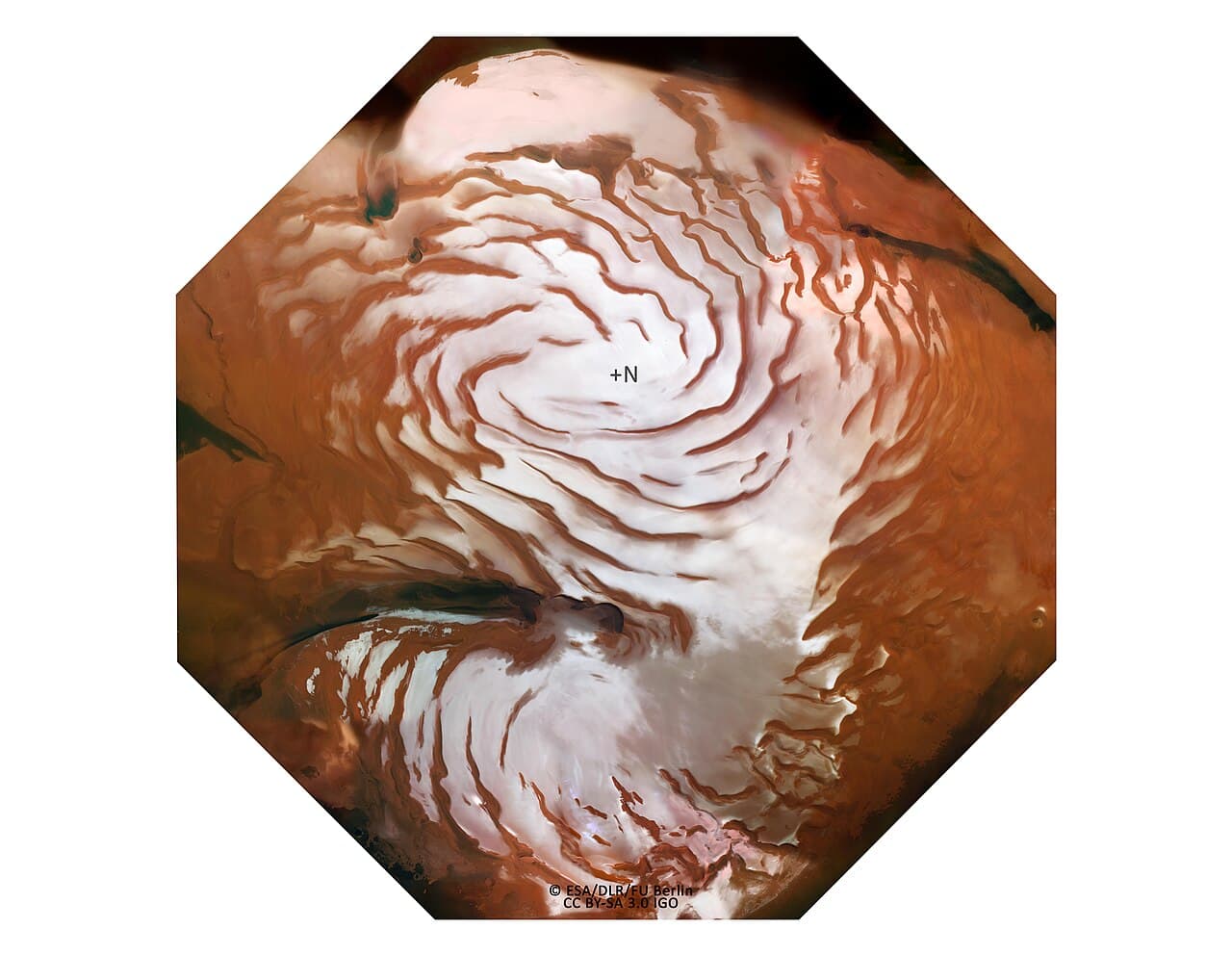
Some of this is not in doubt. Mars is a wet planet that is frozen solid. Carr and Head's inventory puts 34 metres of global equivalent water layer, the depth it would make if you melted it and spread it evenly over the whole planet, in the polar layered deposits and shallow ground ice as of today, and they say plainly that this figure excludes whatever sits deeper as ground ice and groundwater. The south polar layered deposits alone hold about 1.6 million cubic kilometres, which Plaut's team noted is equivalent to a global layer around 11 metres thick, and MARSIS found so little signal loss passing through them that the composition reads as nearly pure water ice. The northern deposits hold roughly half as much, and Grima's radar analysis of one quarter of them found the bulk ice at least 95 percent pure. That is not a trace, a residue or a curiosity. If a person imagines Mars as a dry planet, the mental picture is wrong in a specific way: it is not that the water left, it is that it stopped being liquid. The seasonal white caps you see through a telescope are frozen carbon dioxide, but the permanent caps under them are water ice, which Kieffer's team established from Viking as early as 1976 for the north, and which Titus and colleagues showed with Mars Odyssey is exposed at the edge of the southern cap too. How much has gone is a separate calculation. The deuterium enrichment in the atmosphere implies early Mars held at least a 137 metre global layer, and Scheller's group argues that 30 to 99 percent of it was locked into the crust as hydrated minerals rather than lost to space.
The ancient water is the strongest and least contested part of the story, and it rests on three independent kinds of evidence that would each be weak alone. First, landforms. Mariner 9 found the channels in 1971 and 1972, and Hynek, Beach and Hoke's modern remapping found more than eight times as many valleys as the Viking-era map, at twice the drainage density, mostly formed around 3.8 to 3.6 billion years ago, with characteristics of sustained precipitation and runoff that groundwater sapping alone does not explain. Second, sediments. Malin and Edgett recognised meandering distributary channels and fan deltas from orbit; Curiosity found the lake beds themselves at Yellowknife Bay, neutral in pH and low in salinity, lasting hundreds to tens of thousands of years at minimum; in 2025 Mondro's team described symmetrical wave ripples about 4.5 centimetres across in Gale crater that require shallow water open to the sky and not roofed by ice; and Perseverance walked up to a delta front and confirmed inclined strata advancing into standing water. Third, minerals, which are hardest to argue away because they are chemistry rather than shape. OMEGA on Mars Express mapped a clay era, then an acid sulfate era, then a dry ferric-oxide era from about 3.5 billion years ago, and Opportunity found jarosite at Meridiani, a sulfate that forms in acidic water. The open question is how much of that water gathered in one place. In February 2025 Li and colleagues read Zhurong's ground-penetrating radar in southern Utopia Planitia as a buried prograding shoreline, which no short-lived local melt could build. Carr and Head's budget says the opposite: their Hesperian figures are incompatible with a northern ocean, and their Late Noachian total of about 24 metres of near-surface water is not enough either.
Recurring slope lineae are the best available case study in how a headline outruns its evidence, and the honest way to tell it is as one continuous story rather than as a discovery. In August 2011 McEwen's team described narrow dark markings, half a metre to five metres wide, that grow down steep slopes in the warm season and fade in the cold, and said explicitly that the mechanism and source of water were not understood. In September 2015 NASA held a briefing headlined 'NASA Confirms Evidence That Liquid Water Flows on Today's Mars', on the strength of Ojha's report of spectral signatures of perchlorate salts at four RSL sites. Two things then happened. In November 2017 Dundas and colleagues measured the terrain and found that RSL stop at exactly the slope angle where dry granular flows stop, and that in Eos Chasma they are longest where angle-of-repose slopes are most extensive, which is behaviour of sand. Seepage would not do that. In November 2018 Leask, Ehlmann and colleagues found that a step in the CRISM processing pipeline manufactures absorption-like features at 1.9 and 2.1 micrometres out of noise, and reported that few to none of the published perchlorate detections survive the check. The spectral evidence behind the 2015 headline was, in effect, an instrument artefact. Almost nobody covered the correction. Dundas's own 2020 Icarus paper, which proposes an aeolian grainflow model for RSL, states the position without softening it: it now appears those detections were an artefact.
That is not the same as saying RSL are settled, and anyone who tells you they are dry is also overreaching. In May 2025 Bickel and Valantinas used deep learning to build the first consistent global catalogue of martian slope streaks, 484,019 dark ones and 13,026 bright ones from 86,546 CTX images, and found the geostatistics fit dry formation driven by seasonal dust delivery and energetic triggers, with RSL locations showing below-average wind speed and below-average water-equivalent hydrogen. Their conclusion is that modern Martian slopes do not commonly experience transient flows of water or brines. Two months later Liu, Wu and colleagues published a time-series study of RSL in Palikir and Raga craters over Mars years 32 to 36, found RSL coverage up about 170 percent in Palikir and 65 percent in Raga after the 2018 planet-encircling dust event, noted that the dry model does not account for the absence of aspect spreading they observe, and argued for meltwater from bedrock aquifers on sun-facing slopes. Both are peer-reviewed, both are recent, and they contradict each other. What would settle it is an in-situ measurement at an active RSL, which no mission has made and which planetary protection rules have historically discouraged, and better spectroscopy than CRISM could deliver. There is a second disagreement folded inside the first: Liu's team still cite CRISM hydrated-salt detections in support of their wet case, the same class of detection Leask's artefact paper said few to none of survive, so the two sides are not even working from an agreed evidence base. Until then the defensible statement is that most of the specific evidence for water in RSL has been withdrawn or reinterpreted, and a minority of researchers still argue for it on morphological, seasonal and, contestedly, spectral grounds.
The south polar radar claim is the other live one, and it turns on a number nobody can measure. In July 2018 Orosei's MARSIS team reported a sharply bounded 20 kilometre zone at 193 E, 81 S whose basal reflection implies a dielectric permittivity above 15, which on Earth means water. The objections came fast, and they turn on physics rather than rhetoric. Sori and Bramson showed that no amount of salt melts ice at the base of that cap under normal Martian conditions and that a local geothermal heat flux above 72 milliwatts per square metre is needed, most simply from a magma chamber emplaced within the last few hundred thousand years. Smith's group proposed cold hydrated smectite clays instead; Bierson's group showed a conductivity contrast would do it, with clays, metal-bearing minerals or saline ice as candidates; Khuller and Plaut showed similar bright basal echoes occur widely under the cap and are not unique to the site; and Lalich, Hayes and Poggiali showed in 2022 and again in 2024 that constructive interference between dusty ice layers thinner than the radar's own resolution reproduces the observations without any exotic material at all. On the other side, Arnold's team found a surface topographic anomaly over the site of the kind that sits above terrestrial subglacial lakes, and the MARSIS team's December 2025 review still calls it the first evidence of a stable body of liquid brine. In November 2025 a novel Mars Reconnaissance Orbiter manoeuvre let SHARAD, which works at a higher frequency than MARSIS and had never managed a basal return here, finally sound the same spot; Morgan and colleagues found the response inconsistent with liquid water and better matched by a localised patch of low-roughness dry rock or dust, which leaves the two radars disagreeing with each other. Then in April 2026 Madden and colleagues remeasured smectite at 180 K, a more realistic basal temperature, got a permittivity near 4, and ruled the clays out. The debate is narrower than it was and no closer to a verdict, because everything hinges on the temperature 1.5 kilometres below the ice, which nobody has measured.
Underneath all of it sits one stubborn piece of physics. Below about 6.1 millibars, water's triple-point pressure, pure liquid water cannot exist at equilibrium at any temperature at all; ice goes straight to vapour. The word pure is load-bearing: a salt solution has a lower triple point of its own, which is the only door left open. Mars's mean surface pressure is 6.36 millibars and swings between 4.0 and 8.7 as carbon dioxide freezes onto and off the caps, so the planet sits essentially on that line. Warm a block of pure ice on the Martian surface and it does not melt into a puddle; at the melting point it is also at its boiling point, and it simply leaves. Haberle's team found that 29 percent of the surface does reach pressures and temperatures inside the narrow liquid window at some point in the year, for 37 sols annually in Amazonis, but the same paper cautions that evaporation into air this dry is probably fast enough that melting almost never happens. Which is why every credible proposal for present-day liquid water on Mars is a brine: dissolved salts drop the freezing point far enough to open a real window. Rivera-Valentin and colleagues found that metastable brines can form from the equator to high latitudes for a few percent of the year, up to six hours at a stretch, but only the lowest-eutectic solutions form, putting them below 225 kelvin, about minus 48 Celsius, outside the tolerance of any organism we know. That is the honest shape of the answer: not that Mars is dry, and not that liquid water is impossible, but that anything liquid there is cold, salty, thin, brief and so far unconfirmed.
What we know
The short answer
Mars has a lot of water and nearly all of it is ice. Carr and Head's 2015 budget puts a 34 metre global equivalent water layer, the depth it would make spread evenly over the planet, in the polar layered deposits and shallow ground ice today. Their reconstruction has 62 m at the end of the Hesperian and about 24 m of near-surface water in the Late Noachian, and they note explicitly that substantial further amounts may exist as deep ground ice and groundwater that this budget does not count.↗
The polar caps
MARSIS on Mars Express penetrated more than 3.7 km of the south polar layered deposits and found so little signal loss that Plaut's team read the composition as nearly pure water ice, with a total volume of 1.6 million cubic kilometres, equivalent to a global water layer about 11 m thick. Khuller and Plaut remeasured the same deposit in 2021 at 0 to 3.7 km thick and about 1.60 million cubic kilometres. In the north, Selvans and colleagues put Planum Boreum at 1.3 plus or minus 0.2 million cubic kilometres, of which the north polar layered deposits are 780,000 plus or minus 120,000. Grima's SHARAD analysis of one quarter of the northern deposits found bulk ice at least 95 percent pure, with a mean dielectric constant of 3.10.↗
The caps are water ice, not dry ice
The bright caps that grow and shrink with the seasons are frozen carbon dioxide, but the permanent caps underneath are mostly water. Kieffer and colleagues measured the north residual cap from Viking in late summer at about 205 K with an albedo near 43 percent and concluded it is dirty water ice with no permanent carbon dioxide cap at all. In the south the residual cap does carry a carbon dioxide veneer, but Titus, Kieffer and Christensen used Mars Odyssey's THEMIS to find water ice exposed at its edge, and argued that water ice may be widespread around and under the carbon dioxide.↗
Ground ice, found from orbit in 2002 and touched in 2008
Mars Odyssey's gamma-ray spectrometer found two regions near the poles enriched in hydrogen beneath a hydrogen-poor lid, and Boynton's team concluded the host is ice making up 35 plus or minus 15 percent of the buried layer by weight; Feldman's neutron maps the same day put hydrogen-rich terrain poleward of 60 degrees in both hemispheres. Six years later Phoenix landed at 68.22 N and its descent thrusters blew the soil aside, exposing the ice table under the lander. Peter Smith's team reported ice 5 to 15 cm below the surface. The decisive observation was a trench: bright chunks 1.5 to 2 cm across were dislodged and vanished over the following sols leaving no residue, which fits water ice rather than salt (which would remain) or carbon dioxide ice (which would go far faster). The TEGA oven then confirmed water directly.↗
Ice outside the poles
Dundas and colleagues examined eight eroding scarps in the mid-latitudes and found water ice more than 100 m thick beginning as shallow as 1 to 2 m below the surface, still actively retreating by sublimation, probably laid down as snow during periods of high axial tilt. SHARAD had already sounded lobate debris aprons in eastern Hellas and in Deuteronilus Mensae and found radar properties consistent with massive water ice, settling a decades-old argument in favour of debris-covered glaciers. In 2024 Watters and colleagues argued from MARSIS data that the equatorial Medusae Fossae Formation hides an ice-rich unit under 300 to 600 m of dry cover, amounting to a global layer of about 1.5 to 2.7 m, or 30 to 50 percent of what is in the north polar cap.↗
Water deep in the crust, and the argument about it
Wright, Morzfeld and Manga inverted InSight's seismic velocities and local gravity and concluded in 2024 that a mid-crust of fractured igneous rock saturated with liquid water, between about 11.5 and 20 km depth, best explains the data. Palin, Wade and Dyck replied in the same journal that at Martian geothermal gradients of 12 to 20 degrees C per kilometre those depths sit at roughly 180 to 320 degrees C, firmly in the metamorphic domain, where water would be bound into hydrous minerals rather than sitting free in pores. The exchange did not stop there. Xiao and colleagues argued in PNAS in March 2025 that the InSight results do not require a water-saturated mid crust at all, and again in August 2025 that other pore-filling materials fit equally well; Wright's group replied the same month. In July 2026 Zha, Avseth and Sava redid the inversion across a wider range of rock-physics models and got equivalent water-layer thicknesses anywhere from nearly zero to about 3.2 kilometres, with the most parsimonious combination sitting near zero, and concluded that the present observations do not uniquely constrain mid-crustal liquid water. Nobody has been shown wrong, and the uncertainty is larger today than it was in 2024.↗
How much water Mars lost
Deuterium is a heavy isotope of hydrogen; because ordinary hydrogen escapes to space more easily, water left behind gets progressively enriched in it. Villanueva's team mapped water and its deuterated form across the planet and found the sublimating north polar water enriched about sevenfold relative to Earth's ocean, and the polar reservoir itself at least eightfold, implying early Mars held a global layer at least 137 m deep. Scheller and colleagues then argued that escape to space alone cannot reconcile the numbers: between 30 and 99 percent of Martian water was instead sequestered by chemical weathering into the crust, from an ancient inventory of 100 to 1,500 m global equivalent.↗
The rivers
Mariner 9 found them in 1971 and 1972. Masursky's overview reports large fluvial channels originating in chaotic terrain, possibly by melting of permafrost, and small dendritic channel networks that his overview says imply the collection of rainfall. Hynek, Beach and Hoke remapped them globally with modern data and found more than eight times as many valleys as the Viking-era map, with drainage densities twice as high, and regions previously thought undissected in fact heavily incised. Most formed around the Noachian to Hesperian boundary, roughly 3.8 to 3.6 billion years ago, with minor activity continuing to about 2.8 billion years ago. They concluded that groundwater sapping or impact-generated steam played at most a minor role.↗
The lakes and the deltas
Malin and Edgett identified distributary, channelised, meandering flow and fan-shaped debris aprons from orbit in 2003, indicating persistent flow rather than a flash flood. Curiosity found the rock itself: at Yellowknife Bay, fine-grained lake sediments recording neutral pH, low salinity and a minimum duration of hundreds to tens of thousands of years. In 2025 Mondro and colleagues described symmetrical wave ripples about 4.5 cm in wavelength in Gale's Layered Sulfate Unit, which require water less than 2 m deep, open to the atmosphere and not covered by ice. Perseverance landed at a delta and confirmed from outcrop faces invisible from orbit that inclined strata had advanced into a lake, later overrun by boulder conglomerates from high-energy floods.↗
The minerals, which are the hardest evidence to argue with
Landforms can be made by other things; minerals are chemistry. OMEGA on Mars Express mapped the planet's mineralogy and Bibring's team split Martian history into three eras: a phyllosian, in which clays formed by aqueous alteration in the oldest terrain; a theiikian, in which sulfates formed in acid water; and a siderikian from about 3.5 billion years ago, dominated by slow dry weathering to ferric oxides. On the ground, Opportunity found jarosite (a sulfate that forms in acidic water), magnesium sulfate, haematite concretions and crystal-mould vugs at Meridiani, recording episodic inundation, evaporation and desiccation. In 2025 Curiosity's CheMin identified siderite at 4.8 to 10.5 weight percent through an 89 m section of Gale, water-limited carbonate that implies a partially closed carbon cycle.↗
The ocean question is not settled
Whether the northern lowlands ever held a sea is genuinely open. In February 2025 Li and colleagues reported that the Zhurong rover's ground-penetrating radar imaged subsurface reflectors dipping unidirectionally at 6 to 20 degrees, 10 to 35 m thick, along an uninterrupted 1.3 km traverse in southern Utopia Planitia, and read them as a prograding shoreline requiring a large body of water rather than a local melt event. Carr and Head's water budget points the other way: their Hesperian figures are incompatible with a northern ocean during that era, and their roughly 24 m of Late Noachian near-surface water is insufficient too. There is a separate page on Tianwen-1.↗
The 6 millibar problem
Below water's triple-point pressure, about 6.1 millibars, pure liquid water cannot exist at equilibrium at any temperature: ice sublimates straight to vapour. The qualifier matters, because a salt solution has its own, lower, triple point, which is the loophole every brine argument runs through. Mars's mean surface pressure is 6.36 millibars, varying between 4.0 and 8.7 with the seasons as carbon dioxide freezes onto and off the caps. Mars therefore sits essentially on the line. Haberle's team modelled where pressure and temperature both exceed the triple point and stay below boiling, and found five favourable regions totalling 29 percent of the surface, satisfied for 37 sols a year in Amazonis. But that calculation is explicitly for pure water, and the same paper warns that evaporation into the extremely dry air is likely so fast that melting occurs rarely if at all. For brine solutions, they add, the favourable regions expand and, for highly concentrated ones, could potentially include most of the planet.↗
So any liquid must be brine, and brine has its own problem
Dissolved salts lower the freezing point, which is why every serious proposal for present-day liquid water on Mars is a brine. Rivera-Valentin and colleagues modelled where metastable brines can form and found they can appear from the equator to high latitudes, for a few percent of the Martian year, for up to six consecutive hours at a time. The catch is that only the lowest-eutectic solutions form, so those brines sit below 225 K, about minus 48 degrees C, outside the known tolerance of any terrestrial organism. Chevrier and Slank's 2024 review reaches the same place: low temperature, low pressure and low water vapour pressure hinder most brines, and only a few salts, notably calcium perchlorate, could plausibly form liquid by deliquescence or melting. A newer argument runs the other way and is worth watching rather than believing: in December 2025 Shi and colleagues reported that InSight's seasonal marsquakes switch off in the cold season and resume abruptly in the warm one, and modelled that as ice-to-brine melting at metre-scale depths north of about 30 N raising pore pressure and lubricating faults, with a briny melting point below roughly 250 plus or minus 13 K. It infers water from the seismic record; nothing has detected the water itself, and nothing has yet tested the idea.↗
Recurring slope lineae, 2011
McEwen and colleagues described narrow dark markings 0.5 to 5 m wide on steep slopes of 25 to 40 degrees, which appear and lengthen in late southern spring and summer and fade in cold seasons, between 48 S and 32 S, favouring equator-facing slopes at surface temperatures of roughly 250 to 300 K. The paper's own last sentence is the honest one: liquid brines near the surface might explain the activity, but the exact mechanism and source of water are not understood.↗
The 2015 headline and what happened to it
On 28 September 2015 NASA issued a release headlined 'NASA Confirms Evidence That Liquid Water Flows on Today's Mars', quoting John Grunsfeld saying it appears to confirm that water, albeit briny, is flowing today on the surface. The underlying paper, by Ojha and colleagues, reported spectral signatures of magnesium perchlorate, magnesium chlorate and sodium perchlorate at four RSL sites in the seasons when the lineae were most extensive. In November 2018 Leask, Ehlmann and colleagues reported a previously unidentified artefact in CRISM targeted data, in which a filtering step convolves narrow noise spikes with real atmospheric absorptions to create spurious features at 1.9 and 2.1 micrometres. Their conclusion was blunt: few to none of the perchlorate detections reported in the published literature remain robust.↗
The south polar lake claim
Orosei and colleagues surveyed Planum Australe with MARSIS between May 2012 and December 2015 and found anomalously bright subsurface reflections in a well-defined 20 km wide zone centred at 193 E, 81 S, with a relative dielectric permittivity above 15, matching water-bearing materials. They interpreted it as a stable body of liquid water. Lauro's team reprocessed the fuller dataset with methods borrowed from terrestrial ice-sheet radar, sharpened the main body to roughly 20 by 30 km, identified three smaller patches about 10 km across, and argued for hypersaline perchlorate brines. In 2022 the same group inferred basal temperatures around 200 K from frequency-dependent attenuation, consistent with brines in liquid vein networks. In November 2025 the site was finally sounded at a second frequency: a novel Mars Reconnaissance Orbiter manoeuvre let SHARAD return a basal echo from the putative water body for the first time, and Morgan and colleagues found the radar response inconsistent with liquid water, better matched by a localised patch of low-roughness dry rock or dust. Reconciling MARSIS and SHARAD is now the open problem.↗
What happened, and when
- 15 Jul 1965Mariner 4 passes behind Mars and its radio signal is read on the way in and out. Kliore's team gets a surface pressure of 4.1 to 7.0 millibars, and reports the atmospheric density, temperature and scale height all lower than previously predicted. Pre-Mariner estimates had run an order of magnitude higher. At a stroke, standing liquid water on the surface of modern Mars stops being a reasonable default assumption and becomes something that has to be argued for.
- 1972 to 1976Mariner 9 maps the whole planet and finds large fluvial channels emerging from chaotic terrain, possibly by melting of permafrost, plus small dendritic networks in the equatorial regions that Masursky's overview says imply the collection of rainfall. Then Viking's infrared thermal mapper measures the north residual polar cap at about 205 K and Kieffer's team concludes it is dirty water ice, with no permanent carbon dioxide cap in the north at all.
- 5 Jul 2002Three Mars Odyssey papers publish together. Buried hydrogen is found poleward of about 60 degrees in both hemispheres, under a dry lid, best explained by ice at 35 plus or minus 15 percent by weight. The planet is confirmed to have shallow ground ice over a large fraction of its surface, which is what makes a polar lander worth building.
- Dec 2004 to Apr 2006Ground truth arrives twice. Opportunity's analysis of Meridiani Planum reports jarosite, magnesium sulfate, haematite concretions and crystal-mould vugs recording episodic inundation, evaporation and desiccation. Then OMEGA on Mars Express publishes a global mineral history: clays in the oldest terrain, sulfates next, and from about 3.5 billion years ago slow dry weathering with liquid water playing no major role across the planet.
- 2008In May, Phoenix lands in the Martian arctic and its own descent thrusters uncover the ice table beneath it; a trench dug on sol 20 exposes bright chunks that sublimate away over the following days, and the TEGA oven confirms water. In November, SHARAD on Mars Reconnaissance Orbiter sounds the lobate debris aprons of eastern Hellas and finds radar properties consistent with massive water ice, settling a long argument in favour of debris-covered glaciers.
- 5 Aug 2011McEwen and colleagues publish 'Seasonal Flows on Warm Martian Slopes' in Science, naming recurring slope lineae. The features are real, repeatable and seasonal. The paper says outright that the mechanism and the source of water are not understood.
- 28 Sep 2015NASA announces 'NASA Confirms Evidence That Liquid Water Flows on Today's Mars', built on Ojha and colleagues' paper in Nature Geoscience reporting hydrated salts at four RSL sites. The word 'confirms' is doing more work than the underlying paper supports, and this is the moment the public story about water on Mars parts company with the evidence.
- 17 Nov 2017Dundas and colleagues measure the topography under RSL and find their terminal slopes match the stopping angle for granular flows of cohesionless sand on active Martian dunes. In Eos Chasma the lineae are longest where angle-of-repose slopes are most extensive, which is what dry sand does and not what a water source would do. Liquid water volumes, they conclude, may be small or zero.
- 3 Aug 2018Orosei's MARSIS team reports in Science a 20 km wide zone of anomalously bright reflections beneath the south polar layered deposits at 193 E, 81 S, with a dielectric permittivity above 15, and interprets it as a stable body of liquid water. It is the strongest claim yet made for present-day liquid water on Mars, and it starts an argument that is still running.
- 9 Nov 2018Leask, Ehlmann and colleagues identify an artefact in the CRISM processing pipeline that manufactures absorption-like features at 1.9 and 2.1 micrometres in a small fraction of pixels in most images. Most previously reported minerals survive the check. The perchlorate detections largely do not: few to none remain robust. The spectral leg of the 2015 announcement is gone, and the retraction gets a fraction of the original coverage.
- 19 May and 15 Jul 2025Two months apart, two papers reach opposite conclusions. Bickel and Valantinas catalogue 484,019 dark slope streaks from 86,546 CTX images by deep learning and conclude that modern Martian slopes do not commonly experience transient flows of water or brines. Liu, Wu and colleagues track RSL in Palikir and Raga craters across Mars years 32 to 36, find coverage up about 170 percent in Palikir after the 2018 global dust event, and argue for melting of bedrock aquifers. The question is open, in public, in the literature.
- 2021 to 2026The polar lake is attacked from four directions and defended from two. Sori and Bramson show no salt concentration alone can melt the base of the cap and a local heat flux above 72 mW per square metre is required. Smith proposes cold hydrated smectite clays, Bierson proposes a conductivity contrast from clays, metal-bearing minerals or saline ice, Khuller and Plaut show similar bright basal echoes are widespread and not unique to the site, and Lalich shows in 2022 and again in 2024 that interference between dusty ice layers thinner than the radar resolution reproduces the observations. On the other side, Arnold's team finds a surface topographic anomaly over the site resembling those above terrestrial subglacial lakes, and the MARSIS team's own 2025 review still describes the detection as the first evidence of a stable body of liquid brine. Then in April 2026 Madden and colleagues remeasure smectite at realistic basal temperatures and get a permittivity near 4 at 180 K, ruling smectites out.
In pictures
Tap a photo to enlarge.
Sources
- M. H. Carr and J. W. Head, Martian surface/near-surface water inventory: sources, sinks, and changes with time, Geophysical Research Letters 42, 726-732 (2015)
- J. J. Plaut et al., Subsurface radar sounding of the south polar layered deposits of Mars, Science 316, 92-95 (2007)
- C. M. Dundas et al., Exposed subsurface ice sheets in the Martian mid-latitudes, Science 359, 199-201 (2018)
- P. H. Smith et al., H2O at the Phoenix landing site, Science 325, 58-61 (2009)
- A. S. McEwen et al., Seasonal flows on warm Martian slopes, Science 333, 740-743 (2011)
- NASA news release, 28 September 2015: NASA Confirms Evidence That Liquid Water Flows on Today's Mars
- C. M. Dundas et al., Granular flows at recurring slope lineae on Mars indicate a limited role for liquid water, Nature Geoscience 10, 903-907 (2017)
- E. K. Leask, B. L. Ehlmann et al., Challenges in the search for perchlorate and other hydrated minerals with 2.1 micrometre absorptions on Mars, Geophysical Research Letters 45, 12180-12189 (2018)
- V. T. Bickel and A. Valantinas, Streaks on martian slopes are dry, Nature Communications 16, 4315 (2025)
- S. Liu, B. Wu et al., Time-series variations of recurring slope lineae on Mars compatible with contemporary water activity from bedrock aquifer melting, Scientific Reports 15, 25555 (2025)
- R. Orosei et al., Radar evidence of subglacial liquid water on Mars, Science 361, 490-493 (2018)
- M. M. Sori and A. M. Bramson, Water on Mars, with a grain of salt: local heat anomalies are required for basal melting of ice at the south pole today, Geophysical Research Letters 46, 1222-1231 (2019)
- D. E. Lalich, A. G. Hayes and V. Poggiali, Small variations in ice composition and layer thickness explain bright reflections below martian polar cap without liquid water, Science Advances 10, eadj9546 (2024)
- A. Madden, I. B. Smith, J. A. Isen and M. G. Daly, Refined dielectric properties of hydrated smectites, Icarus 457, 117127 (2026)
- L. Ojha et al., Spectral evidence for hydrated salts in recurring slope lineae on Mars, Nature Geoscience 8, 829-832 (2015)
- C. M. Dundas, An aeolian grainflow model for Martian recurring slope lineae, Icarus 343, 113681 (2020)
- G. A. Morgan et al., High frequency radar perspective of putative subglacial liquid water on Mars, Geophysical Research Letters 52 (17 November 2025)
- R. Orosei et al., Water ice in the subsurface and polar caps of Mars, Space Science Reviews 221 (December 2025)
- I. B. Smith, D. E. Lalich et al., A solid interpretation of bright radar reflectors under the Mars south polar ice, Geophysical Research Letters 48 (2021)
- C. J. Bierson et al., Strong MARSIS radar reflections from the base of Martian south polar cap may be due to conductive ice or minerals, Geophysical Research Letters 48 (2021)
- A. Khuller and J. J. Plaut, Characteristics of the basal interface of the Martian south polar layered deposits, Geophysical Research Letters 48 (2021)
- N. Arnold et al., Surface topographic impact of subglacial water beneath the south polar ice cap of Mars, Nature Astronomy 6, 1256-1262 (2022)
- M. M. Selvans et al., Internal structure of Planum Boreum from MARSIS data, JGR Planets 115 (2010)
- C. Grima et al., North polar deposits of Mars: extreme purity of the water ice, Geophysical Research Letters 36 (2009)
- T. R. Watters et al., Evidence of ice-rich layered deposits in the Medusae Fossae Formation of Mars, Geophysical Research Letters 51 (2024)
- B. M. Hynek, M. Beach and M. R. T. Hoke, Updated global map of Martian valley networks and implications for climate and hydrologic processes, JGR Planets 115 (2010)
- E. L. Scheller et al., Long-term drying of Mars by sequestration of ocean-scale volumes of water in the crust, Science 372, 56-62 (2021)
- G. L. Villanueva et al., Strong water isotopic anomalies in the Martian atmosphere, Science 348, 218-221 (2015)
- R. M. Haberle et al., On the possibility of liquid water on present-day Mars, JGR Planets 106, 23317-23326 (2001)
- E. G. Rivera-Valentin, V. F. Chevrier, A. Soto and G. Martinez, Distribution and habitability of (meta)stable brines on present-day Mars, Nature Astronomy 4, 756-761 (2020)
- C. A. Mondro et al., Wave ripples formed in ancient, ice-free lakes in Gale crater, Mars, Science Advances 11, eadr0010 (2025)
- B. M. Tutolo et al., Carbonates identified by the Curiosity rover indicate a carbon cycle operated on ancient Mars, Science 388, 292-297 (2025)
- T. N. Titus, H. H. Kieffer and P. R. Christensen, Exposed water ice discovered near the south pole of Mars, Science 299, 1048-1051 (2003)
- N. O. Renno et al., Possible physical and thermodynamical evidence for liquid water at the Phoenix landing site, JGR Planets 114 (2009)
- J. Li et al., Ancient ocean coastal deposits imaged on Mars, PNAS 122, e2422213122 (24 February 2025)
- R. M. Palin, J. Wade and B. Dyck, Metamorphism in a wet Martian middle crust, PNAS 121, e2416680121 (22 November 2024)
- W. Xiao et al., Results from the InSight Mars mission do not require a water-saturated mid crust, PNAS 122, e2418978122 (6 March 2025)
- M. Zha, P. Avseth and P. Sava, Rock physics modeling reveals large uncertainty in midcrustal liquid water on Mars, Earth and Planetary Science Letters (21 July 2026)
- J. Shi et al., Near-surface liquid water on Mars inferred from seasonal marsquakes, Nature Communications 17, 1034 (26 December 2025)
- C. M. Dundas, S. J. Conway and G. E. Cushing, Martian gully activity and the gully sediment transport system, Icarus 386, 115133 (2022)
- J. L. Dickson, A. M. Palumbo, J. W. Head et al., Gullies on Mars could have formed by melting of water ice during periods of high obliquity, Science 380, 1363-1367 (29 June 2023)
- V. F. Chevrier and R. Slank, The elusive nature of Martian liquid brines, PNAS 121, e2321067121 (16 December 2024)
Checked on 3 September 2026. Where the science is unsettled this page says so rather than picking a winner.