Martian Meteorites
429 Martian meteorite names are catalogued on Earth, far fewer separate rocks. Gas in one matched Viking's Martian air in 1983. Five were seen to fall.
TL;DR· 22 min read
Yes: 429 Martian meteorite names sat on the Meteoritical Bulletin register on 24 August 2026, 406 kg in all, though pairing cuts that to roughly 150 to 200 separate rocks, launched by about ten asteroid strikes in the past 20 million years. We know they are Martian because gas sealed in shock glass in EETA79001, measured in 1983, matched the air Viking had analysed on Mars in 1976. Five were seen to fall, from Chassigny in 1815 to Tissint in 2011. The rest were found, most of them in the Sahara and the deserts of Arabia.
Yes, and there are more of them than almost anyone expects: about 430 catalogued stones, 406 kilograms of Mars, sitting in museums, university collections and private cabinets, with fragments openly on sale. They were thrown off the planet by asteroid strikes, drifted round the Sun for between about half a million and twenty million years, and landed here. We know they are Martian because gas trapped in shock glass inside one of them, measured in 1983, matched the atmosphere the Viking landers had sniffed on Mars seven years earlier, and nothing else in the Solar System has that signature.
- 429Martian meteorite names in the Meteoritical Bulletin Database on 24 August 2026 (427 approved, one discredited, one undocumented), totalling 406 kg
- 5of them were watched falling out of the sky, from Chassigny in 1815 to Tissint in 2011
- about 10impacts on Mars launched essentially the whole collection, all within the past 20 million years
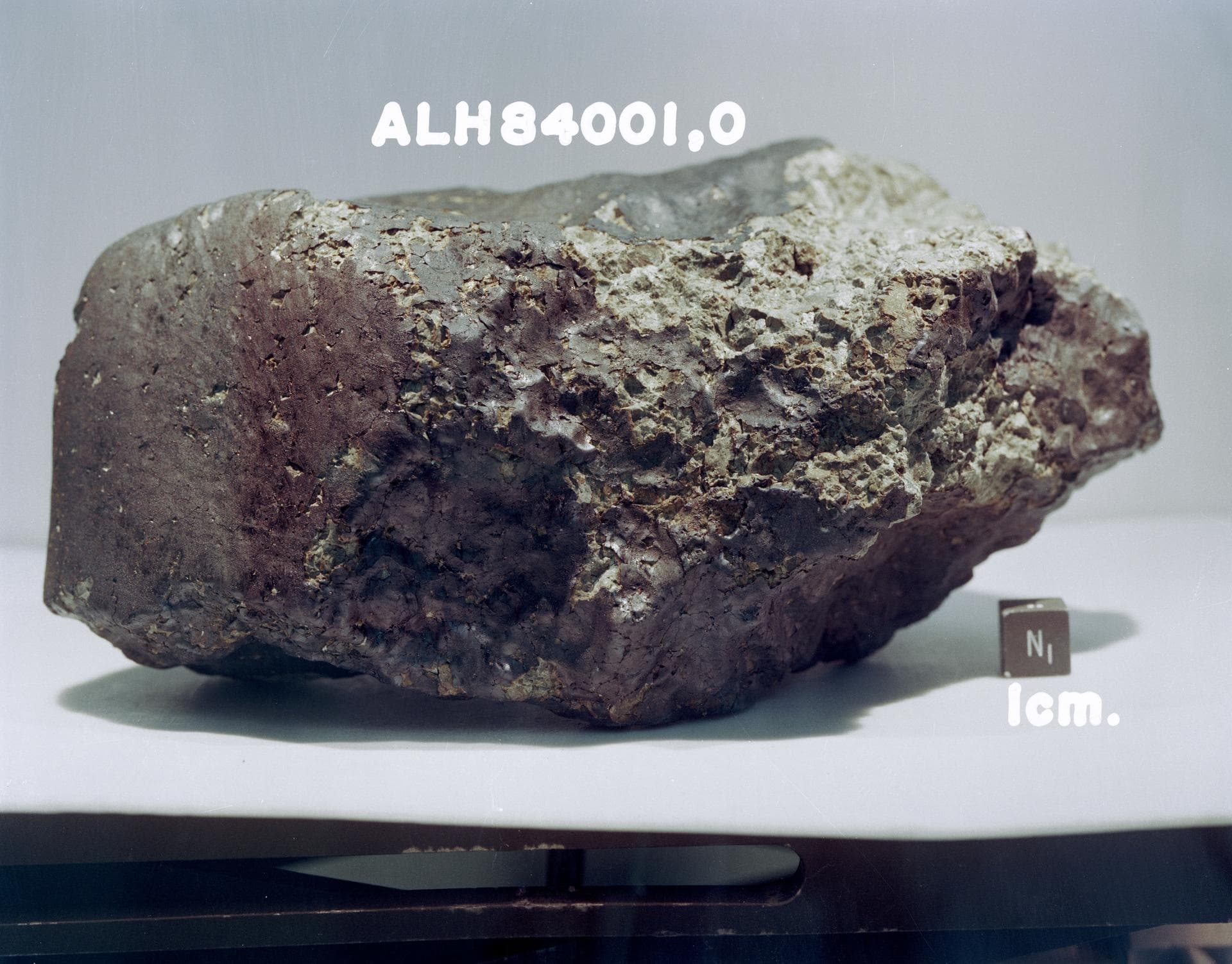
Yes, and there are more of them than almost anyone expects. On 24 August 2026 the Meteoritical Bulletin Database, the register the Meteoritical Society keeps and the only authority on what counts as a meteorite, listed 429 Martian names, 427 of them approved, with a combined weight of 406 kilograms, out of 80,203 valid meteorite names of all kinds. That is roughly one in 190. It is also not the number of rocks. Stones break up in the air and on the ground, and a single fall can be catalogued as forty separate names, so the register counts entries rather than events. Strip out the pairings and you have somewhere between 150 and 200 distinct rocks. Sort those by how long they were exposed to cosmic rays in space, which dates the moment they were launched, and they collapse again into about ten groups. Ten asteroid strikes on Mars, all in the past twenty million years, delivered essentially everything we have. Five of the 429 were watched falling: Chassigny in France on 3 October 1815, Shergotty in Bihar on 25 August 1865, Nakhla in the Nile delta on 28 June 1911, Zagami in northern Nigeria on 3 October 1962 and Tissint in southern Morocco on 18 July 2011. Everything else was found. Thirty-two came off the Antarctic ice, collected by the American, Japanese and Chinese search programmes. The overwhelming majority, more than three hundred, came out of the Sahara and the deserts of Arabia, where a black stone on pale ground is conspicuous and where a trade in finding them has grown up since the late 1990s. Fifteen of them date from the 1990s; 186 date from the 2010s alone.
How do you prove a rock came from a planet nobody has been to? The first clue was age. By the late 1970s it was clear that the shergottites, nakhlites and chassignites had crystallised recently in geological terms, and a body that was still erupting lava a billion years ago has to be large enough to have stayed hot, which rules out asteroids. Walker and Nyquist and their colleagues suggested Mars in 1979 and Wood and Ashwal argued it in detail in 1981, but it remained a suggestion. What settled it was a piece of glass. When a shock strong enough to launch a rock passes through it, pockets of the rock melt, and whatever gas is touching them gets forced in and sealed. In 1983 D. D. Bogard and P. Johnson heated the shock glass in the Antarctic shergottite EETA79001 and measured the argon, krypton and xenon that came out. The proportions matched nothing in the meteorite literature. They matched the air the two Viking landers had analysed on the surface of Mars in 1976, with an argon-40 to argon-36 ratio above 2,000 and a xenon-129 to xenon-132 ratio above 2.0, both wildly unlike Earth's. Clayton and Mayeda showed in the same year that these rocks sit on their own oxygen isotope line, distinct from Earth's and from the asteroid Vesta's. In 1984 R. H. Becker and R. O. Pepin found Viking's heavy nitrogen in the same glass, and the argument was finished. The proof is not that the rocks look Martian. It is that one of them is carrying a bubble of Mars around inside it. The Viking 1 page covers the landers that supplied the reference measurement.
The reference measurement, it turned out, was slightly wrong, and the rocks were right. Viking's argon-40 to argon-36 ratio was published as 2,750 plus or minus 500 in 1976 and 3,000 plus or minus 500 in 1977. When SAM, the mass spectrometer aboard Curiosity, measured the same ratio in 2013, it got 1,900 plus or minus 300, a factor of 1.6 lower, and the paper says plainly that the new value agrees with the meteorites and therefore strengthens the case for their Martian origin. Trapped gas in Tissint gives 1,714 plus or minus 170; glass in the nakhlites gives 1,511 plus or minus 74, which is the atmosphere of 1.3 billion years ago rather than today's. This is worth dwelling on, because it is how the field actually works. A crude number from a lander in 1976 was good enough to identify a class of rocks in 1983; thirty-seven years later a rover on the ground revised the number and the identification survived. The rocks themselves now do the job in reverse. Because a shergottite can be dated in a laboratory to a million years and a Martian surface can only be dated by counting craters against a calibration borrowed from the Moon, the meteorites are one of the few hard anchors in Martian chronology, which is precisely why the two unresolved paradoxes in their ages matter so much.
Those paradoxes are live. The first is that shergottites are young, mostly under 600 million years, while three quarters of the Martian surface is older than 3,400 million years, and no meteorite at all samples the long Hesperian. That one has a widely accepted explanation, that impact launch selects hard, young, unbrecciated lava and rejects the fractured, altered, ancient ground that covers most of the planet, but the 2026 review still lists it as an unresolved paradox rather than a closed question, because nobody has shown the selection to be severe enough to erase the Hesperian entirely. The second has no agreed answer at all. Rubidium-strontium, samarium-neodymium, lutetium-hafnium and argon-argon clocks in the least shocked parts of shergottites mostly give crystallisation ages of roughly 150 to 250 million years, and none above 600 million. Lead-lead systematics in the same rocks give apparent ages above 4,000 million years. Lars Borg's group at Lawrence Livermore reads the young ages as real and the old lead as inherited or contaminated; Audrey Bouvier's group has argued that the lead is the true crystallisation record and the shergottites formed 4.1 to 4.3 billion years ago. The disagreement is not academic: the 2014 proposal by Werner and colleagues that the shergottites came from the ancient crater Mojave depends on the old ages, and Herd's 2024 crater assignments depend on the young ones. A February 2026 review of Martian chronology by Edwards, Gutierrez and Day lists both paradoxes as open and argues that the thing that would settle them is a precisely dated sample from a mapped place, which is what Mars Sample Return exists to provide.
Then there is 1996. ALH 84001 had been picked up in Antarctica on 27 December 1984, filed as a fragment of the asteroid Vesta, and left in a drawer for nine years before oxygen isotopes and an odd iron to manganese ratio revealed it as Martian. On 7 August 1996 President Clinton stood on the South Lawn and said that rock 84001 spoke of the possibility of life; the McKay et al. paper appeared in Science nine days later. It made four claims about carbonate globules in the rock: polycyclic aromatic hydrocarbons that were indigenous, magnetite and sulphide grains resembling bacterial products, textures like microbial carbonate, and shapes resembling fossil cells. Each was tested and each moved. Higher-resolution ion-microscope work by Stephan and colleagues found that the hydrocarbons did not sit with the carbonates at all, and Bada and colleagues showed in 1998 that the amino acids in the same carbonate were dominated by the left-handed form, the signature of living things on Earth today rather than of anything four billion years old. Barber and Scott showed in 2002 that magnetites in the carbonate had grown in crystallographic alignment with it, which is what inorganic growth looks like, although Thomas-Keprta and Gibson, two of the original authors, have gone on arguing that a subset of the grains is not accounted for that way. The cell-like shapes were reported at 20 to 500 nanometres across, well under the size of an ordinary bacterium, and Bradley and colleagues argued in 1997 that they were artefacts of the electron microscopy itself. In 2022 Andrew Steele's group reported on the organics: they are real, they are Martian, and the carbon they analysed was made by water reacting with rock. The honest summary is not that ALH 84001 was contamination. It is that every feature tested has turned out to have a chemical explanation, and that hardly anyone now reads the rock as biological, though the case was narrowed rather than formally closed. The Viking biology results are the other place this argument runs.
The consequences of that August were institutional, and they were large. NASA's Mars Surveyor Program had existed since 1994, so the meteorite did not create it, and anyone who says it did is wrong. What it did was redirect it. The Mars Program Independent Assessment Team, reporting in March 2000 on why two spacecraft had been lost in 1999, put it in one sentence: with the announcement of the Mars Rock in August 1996, interest in an accelerated sample return mission required a change in the Mars Program architecture. The 1995 plan of modest orbiters and landers was replaced in 1998 by an architecture promising a sample on Earth by 2008. The same report notes that heightened public interest brought a deluge of new requirements onto a project office that was already three levels down in the organisation chart. The Mars Surveyor Program page carries that story. And the underlying reason sample return keeps reappearing is the catch in the free samples. A meteorite arrives with no context whatever: no outcrop, nothing above it, nothing beneath it, no idea what it was part of. It has usually spent thousands of years weathering in a desert, so distinguishing Martian alteration from terrestrial alteration is a research project in itself, and sometimes the answer is terrestrial, as it was for the orange alteration patches in Dhofar 019. And there is a hole in the record between 4.1 and 2.4 billion years ago. Mars Sample Return, and the tubes Perseverance has already filled, exist to fix exactly those three problems.
What we know
How many there are
429 names in the Meteoritical Bulletin Database on 24 August 2026, of which 427 are approved, one is discredited and one undocumented, out of 80,203 valid meteorite names of all kinds, so roughly one in 190. Their combined total known weight is 406 kg. By class: 368 shergottites, 34 nakhlites, 18 polymict breccias, 3 chassignites, 1 orthopyroxenite (ALH 84001), 1 augite basalt, 1 vesicular basalt and 3 recorded simply as Martian. For comparison the same database lists 830 lunar meteorites, so the Moon outnumbers Mars roughly two to one.↗
How many separate rocks that actually is
Fewer, and published counts differ because they count different things. The database counts names, and a fall that shatters into forty stones, or a desert strewn field sold to three dealers, generates many names for one event. Herd and colleagues in 2024 put the number of distinct rocks after petrological pairing at about 200. Udry and colleagues in 2025 give more than 350 meteorites. Righter in 2024 gives more than 150 samples. None of these is wrong: 429 is names on a register, roughly 350 is the count of individually catalogued specimens at the time of writing, and 150 to 200 is the count of separate rocks once pairings are stripped out.↗
The five witnessed falls
Chassigny, near Langres in Haute-Marne, France, 3 October 1815, about 4 kg (the Meteoritical Bulletin write-up gives around 10 a.m., the NASA compendium about 8 a.m.). Shergotty, near Sherghati in Bihar, India, 25 August 1865, 9 a.m., about 5 kg. Nakhla, in the Nile delta east of Alexandria, Egypt, 28 June 1911, about 9 a.m., roughly forty stones totalling nearly 10 kg. Zagami, Katsina, Nigeria, 3 October 1962, 18 kg. Tissint, Tata province, Morocco, 18 July 2011, about 2 a.m. local time, about 7 kg. Each of the first three named a whole class of rock before anyone knew where those rocks came from.↗
Where the rest were picked up
222 of the 429 are labelled simply (Northwest Africa), with 48 from Algeria, 38 from Morocco, 20 from Libya, 20 from Oman, 14 from Western Sahara, 14 from Mali, 7 from Mauritania and 32 from Antarctica, collected by the American, Japanese and Chinese Antarctic search programmes. The chronology is stark: by year of fall or find, 15 Martian meteorites date from the 1990s, 76 from the 2000s, 186 from the 2010s and 139 already from the 2020s. The modern collection is overwhelmingly a hot-desert collection, found and traded by people who live there.↗
Why we know they are Martian: the gas
In 1983 D. D. Bogard and P. Johnson heated fragments of the Antarctic shergottite EETA79001 and measured the argon, krypton and xenon released from its shock-melted glass. The mixture did not resemble any gas known in meteorites. It resembled the atmosphere of Mars as measured on the ground by Viking: an argon-40 to argon-36 ratio of at least 2,000, and a xenon-129 to xenon-132 ratio of at least 2.0. A shock strong enough to launch the rock had forced Martian air into pockets of melt and sealed it there. In 1984 R. H. Becker and R. O. Pepin added nitrogen, finding the same heavy nitrogen and the same nitrogen-to-argon ratio Viking had reported, which the NASA compendium describes as clinching the argument.↗
The argon ratio, and how much it has moved
This is the single number the whole identification rests on, and it is not one number. Viking's molecular analysis experiment reported argon-40 to argon-36 as 2,750 plus or minus 500 in its 1976 preliminary paper and 3,000 plus or minus 500 in the 1977 write-up. Curiosity's SAM instrument measured 1,900 plus or minus 300 in 2013, about 1.6 times lower than Viking, and said explicitly that the value agreed with the meteorites and so strengthened the case for their Martian origin. Tissint's trapped gas gives 1,714 plus or minus 170. Nakhlite glass gives 1,511 plus or minus 74 (Cohen and colleagues, 2017), but that is Martian air of 1.3 billion years ago rather than the atmosphere of today. The modern reading is that Viking's number was too high and the meteorites were right.↗
The other two fingerprints
Trapped gas only works on rocks that have shock glass in them, so two chemical tests carry the rest. First, oxygen. Also in 1983 Clayton and Mayeda showed the Martian meteorites plot on their own line in an oxygen three-isotope diagram, offset from Earth's line and from the asteroid Vesta's. Tissint's laser-fluorination analyses give an offset of about plus 0.29 to 0.30 per mil, the standard Mars value. Second, the iron to manganese ratio in olivine and pyroxene, which differs measurably between Mars, the Moon, Earth and the asteroids and is now routine in classification. NWA 7034 is the awkward case: its bulk oxygen offset is plus 0.58 plus or minus 0.05 per mil, off the Mars line, which Agee and colleagues read as evidence of more than one oxygen reservoir on the planet.↗
How a rock gets off Mars without melting
Escape velocity at Mars is about 5 km/s, and no volcano can throw a rock that fast. The mechanism, worked out by H. J. Melosh in 1984 and 1985 and modelled in detail by Head, Melosh and Ivanov in 2002, is spallation. When the shock wave from an impact rebounds off the free surface of the ground, a thin near-surface layer is flung upward at very high speed while experiencing far less shock pressure than the material below it. That is why Nakhla is barely shocked and why the delicate carbonate rosettes in ALH 84001 survived the trip. Herd and colleagues calculate that the launched material came from the top 26 metres of lava flows, that craters as small as about 3 km across can do it, and that only mechanically competent targets work, which is why the collection is so biased toward young, unaltered, unbrecciated lava.↗
Which craters they came from
For most of the history of the subject the answer was nobody knows. In 2021 Lagain and colleagues built a database of 90 million Martian impact craters with an automatic detection algorithm and named Tooting, a 28 km crater on the volcanic plains of Amazonis Planitia about 1,100 km west of the summit of Olympus Mons, as the likely launch site of the depleted shergottites ejected 1.1 million years ago, with the nearby crater Chakpar an alternative within the uncertainties. In 2022 the same group traced NWA 7034 to Karratha crater in Terra Cimmeria, ejected 5 to 10 million years ago. In 2024 Herd and colleagues linked five ejection groups to Chakpar, Tooting, Domoni, Corinto and Kotka, two in Elysium and three in Tharsis. None of these assignments is certain, and an earlier proposal by Werner and colleagues in 2014 that the 55 km crater Mojave was the shergottite source is judged unlikely by the 2024 team.↗
The three families, and the two rocks that fit none of them
Shergottites are basalts and related igneous rocks and make up more than 80 per cent of the collection; nakhlites are clinopyroxene cumulates; chassignites are dunites, almost pure olivine. Together they are the SNC group, named for Shergotty, Nakhla and Chassigny, the three witnessed falls that defined them. ALH 84001 belongs to none: it is an orthopyroxenite, 97 per cent orthopyroxene, and is still the only one. NWA 7034 and its paired stones belong to none either: they are a polymict breccia, a compacted jumble of fragments of many kinds. NWA 7034 was first classified as a basaltic breccia and the database now lists it and 17 relatives as polymict breccias, because the clasts include impact melts and sedimentary rock as well as lava.↗
What ages they sample, and the hole in the middle
Shergottites crystallised within the past roughly 600 million years. The nakhlites record at least four eruptions of one volcano between 1,416 and 1,322 million years ago, and Chassigny, at about 1,360 million years, belongs with them. Augite-rich shergottites are about 2,400 million years old. ALH 84001 crystallised 4,091 plus or minus 30 million years ago. NWA 7034 contains mineral grains as old as about 4,480 million years but was assembled into a rock within the past 1,500 million years. Udry and colleagues point out the consequence: the meteorites sample almost nothing between 4.1 and 2.4 billion years ago, which is exactly the stretch in which Mars is thought to have lost its water and its air.↗
ALH 84001
Picked up on a snowmobile ride in the Far Western Icefield of the Allan Hills, Antarctica, on 27 December 1984 by an ANSMET field team, as field sample 1539, with the note Yowza-Yowza. It weighs 1,931 grams. Because it was the strangest rock of the season it was the first of that summer's haul to be processed, which is how it got the number 001. It was filed as a diogenite, a fragment of the asteroid Vesta, and sat misclassified for nine years until oxygen isotope work and its odd iron to manganese ratio and pyrite content led Score, Mittlefehldt and Clayton to reclassify it as Martian in 1993 and 1994. It spent about 15 million years in space and about 13,000 years in the ice.↗
NWA 7034, Black Beauty
A 320 gram black stone bought from a dealer in Morocco in 2011 after being found in the Sahara, part of it donated to the University of New Mexico. Agee and colleagues reported in 2013 that it released up to 6,000 parts per million of indigenous water on heating, an order of magnitude more than any SNC meteorite, and that its bulk chemistry matches the average Martian crust measured by rovers and orbiters, which no other meteorite does. It carries mineral grains as old as about 4,480 million years, and in 2024 Gillespie, Cavosie and colleagues reported that one shocked zircon in it has the chemical zoning and the nanoscale magnetite inclusions of a crystal grown in hot water, at about 4.45 billion years. They read it as petrological evidence for a wet pre-Noachian crust. No older direct record of liquid water has been reported from any Martian sample.↗
Tissint, the clean one
A fireball over the Oued Draa valley at about 2 a.m. on 18 July 2011, yellow then green, splitting in two, followed by two sonic booms. Nomads began finding fusion-crusted stones that October about 50 km east-southeast of Tata; about 7 kg were recovered. The Meteoritical Bulletin entry records no terrestrial weathering. That is what makes it valuable: Chennaoui Aoudjehane and colleagues were able to identify sulphur and fluorine signatures of genuine Martian surface weathering in the glass veins and distinguish them unambiguously from contamination picked up on Earth, which is very hard to do with a rock that has lain in a desert for thousands of years.↗
The Nakhla dog
The story that a fragment of Nakhla vaporised a dog rests on one sentence, reported from the Arabic newspaper El Ahali, saying a stone "fell on a dog at Denshal, leaving it like ashes in the moment". There are problems with it. Denshal is about 33 km from the strewn field, far outside it. The newspaper gave the wrong date. No other witness reported a meteorite at Denshal. No remains were produced. G. T. Prior's 1912 description for the Mineralogical Society, which draws on the Egyptian Geological Survey's own published reports by Hume in 1911 and Ball in 1912, records the column of white smoke, the several explosions, the roughly forty stones weighing nearly 10 kg between them and the 10 to 80 cm depth of the holes they made, and says nothing about a dog.↗
What a meteorite cannot tell you
Three things, listed by Udry and colleagues in 2025. There is no field context: nobody knows what the rock sat on, what lay above it or what it was part of, so a precise laboratory age cannot be attached to a mapped surface. The lithological range is narrow, because the launch process selects hard young lava and rejects everything soft, altered or sedimentary. And the record has a hole in it between 4.1 and 2.4 billion years ago. A February 2026 review of Martian chronology by Edwards, Gutierrez and Day adds a fourth: two unresolved paradoxes in the dating, which it argues only precisely dated samples from a mapped place can settle.↗
What happened, and when
- 3 Oct 1815A stone falls at Chassigny on the plateau of Langres in France after detonations, watched by a man working in a vineyard. A doctor from Langres, Pistollet, arrives two days later and collects about 4 kg, which is the only reason the fall was not forgotten. Less than a kilogram of it survives today. Nobody will know for 168 years that it is a piece of another planet.
- 28 Jun 1911About forty stones totalling nearly 10 kg fall over 4.5 km of the Nile delta east of Alexandria, preceded by a column of white smoke and several explosions. W. F. Hume of the Egyptian Geological Survey visits the site and takes statements. One of them, or a newspaper report of one, becomes the story of the dog at Denshal.
- 12 Aug 1983Bogard and Johnson publish Martian Gases in an Antarctic Meteorite? in Science. Trapped argon, krypton and xenon in shock glass in EETA79001, collected on the Antarctic ice in the 1979 to 1980 field season, match Viking's measurements of the Martian atmosphere rather than anything in the meteorite literature. In the same year Clayton and Mayeda show the same rocks sit on their own oxygen isotope line.
- Aug 1984Becker and Pepin publish nitrogen and noble gas data from the same EETA79001 glass in Earth and Planetary Science Letters. The heavy nitrogen and the nitrogen-to-argon ratio are Viking's. Their conclusion is that the shergottites, and probably the nakhlites and chassignites too, came from Mars. The argument is essentially over.
- 27 Dec 1984An ANSMET team picks up a 1,931 gram greenish-grey stone in the Far Western Icefield of the Allan Hills. It is processed first because it looks the strangest, and becomes ALH 84001. It is then classified as a diogenite from the asteroid Vesta and put away.
- 1993 to 1994During a study of diogenites, chemists notice that ALH 84001's chromite carries too much oxidised iron, that it contains pyrite rather than troilite, and that its iron to manganese ratio is wrong. Oxygen isotope analysis settles it. Score and Mittlefehldt reclassify it as Martian. At that point about twelve Martian meteorites are known.
- 7 Aug 1996President Clinton speaks on the South Lawn about a NASA announcement, saying that "rock 84001 speaks to us across all those billions of years and millions of miles". He orders further peer review, a bipartisan space summit, and continuation of the robotic Mars plan. The McKay et al. paper appears in Science nine days later, on 16 August.
- 16 Jan 1998Bada, Glavin, McDonald and Becker report in Science that the amino acids in ALH 84001's carbonate are dominated by the left-handed form, the signature of living things on Earth today rather than of anything four billion years old. They are contamination from Antarctic meltwater. Over the next four years the rest of the case is taken apart in the same way.
- 18 Jul 2011Tissint falls in southern Morocco, the first witnessed Martian fall since 1962 and still the last. Stones are picked up that October with no terrestrial weathering on them at all. In the same year a 320 gram black breccia bought in Morocco reaches a laboratory in New Mexico and turns out to be unlike every Martian meteorite before it.
- 19 Jul 2013Mahaffy and colleagues publish Curiosity's SAM measurements of Martian air. The argon-40 to argon-36 ratio is 1,900 plus or minus 300, 1.6 times lower than Viking's. They note that this agrees with the meteorites and adds strong support for their Martian origin: thirty years on, the rover on the ground confirms the rocks, and corrects the lander that started it.
- 14 Jan 2022Steele and colleagues report in Science that the organic carbon in ALH 84001 formed in place on Mars, but by water reacting with rock, through serpentinisation and carbonation, during the late Noachian. The organics are real and Martian. Nothing in what they analysed needs more than chemistry.
- 10 Jun 2026Saper and colleagues publish hydrogen isotope and lead-lead ages from apatite in Teghaza 001, a 799 gram stone found in Mali in 2022 and only now recognised as a 4.1 billion year old gabbroic diorite from crust nothing else has sampled. It is the first new window into Noachian Mars from a meteorite since ALH 84001, and it pushes at the near edge of the 4.1 to 2.4 billion year gap in the collection.
In pictures
Tap a photo to enlarge.
Sources
- Meteoritical Bulletin Database (Meteoritical Society / LPI)
- C. Meyer, Mars Meteorite Compendium (NASA Johnson Space Center)
- D. D. Bogard and P. Johnson, Martian Gases in an Antarctic Meteorite?, Science 221, 651-654 (12 Aug 1983)
- R. H. Becker and R. O. Pepin, The case for a martian origin of the shergottites: nitrogen and noble gases in EETA 79001, Earth and Planetary Science Letters 69, 225-242 (1984)
- T. Owen and K. Biemann, Composition of the Atmosphere at the Surface of Mars: Detection of Argon-36 and Preliminary Analysis, Science 193, 801 (27 Aug 1976)
- P. R. Mahaffy et al., Abundance and Isotopic Composition of Gases in the Martian Atmosphere from the Curiosity Rover, Science 341, 263 (19 Jul 2013)
- J. Gillespie, A. J. Cavosie et al., Zircon trace element evidence for early hydrothermal activity on Mars, Science Advances 10 (22 Nov 2024)
- D. S. McKay et al., Search for Past Life on Mars: Possible Relic Biogenic Activity in Martian Meteorite ALH84001, Science 273, 924-930 (16 Aug 1996)
- A. Steele et al., Organic synthesis associated with serpentinization and carbonation on early Mars, Science 375, 172 (14 Jan 2022)
- C. D. K. Herd et al., The source craters of the martian meteorites: Implications for the igneous evolution of Mars, Science Advances 10, eadn2378 (16 Aug 2024)
- A. Udry, A. Ostwald, J. M. D. Day and L. J. Hallis, Fundamental constraints and questions from the study of Martian meteorites and the need for returned samples, PNAS 122, e2404254121 (6 Jan 2025)
- L. Saper et al., A Noachian hydrosphere component in the 4.1-Ga Martian meteorite Teghaza 001, Science Advances (10 Jun 2026)
- Mars Program Independent Assessment Team Report, NASA, 14 March 2000
- Public Papers of the Presidents: Remarks on the Possible Discovery of Life on Mars, 7 August 1996 (US Government Publishing Office)
Checked on 24 August 2026. Where the science is unsettled this page says so rather than picking a winner.