Life on Mars
No confirmed detection of life on Mars has ever been made. What Viking, ALH 84001, Gale crater and Cheyava Falls showed, and what is still open.
TL;DR· 21 min read
There is no confirmed detection of life on Mars, past or present. Mars has been shown to have been habitable, and organic molecules have been pulled out of rocks three and a half billion years old, but no martian claim has passed step four of the seven-step CoLD scale, the step that rules out non-biological explanations. The strongest candidate is a single sealed core, Sapphire Canyon, drilled by Perseverance on 21 July 2024 and still lying on Mars with no funded ride home.
There is no confirmed evidence of life on Mars, past or present. Nobody has found a cell, a fossil, a metabolism or a molecule that cannot be made without biology, and after half a century of looking the honest answer is that the question is open, not that it has been quietly settled in either direction. That is not the same as nothing having been found. Mars has been shown to have been habitable. Organic molecules have been pulled out of rocks three and a half billion years old. And in September 2025 a peer-reviewed paper described mineral textures in a Jezero crater mudstone that are hard to produce without microbes, and not impossible to produce without them. This page is about the distance between those three sentences, and about what a claim has to do before it becomes a detection.
- 0confirmed detections of life on Mars, in fifty years of looking
- 3 of 7steps of the CoLD confidence scale reached by the strongest candidate, per its lead author
- 1 coreSapphire Canyon, sealed on Mars since 21 July 2024, with no funded ride home
Most of the confusion about life on Mars lives in the words. Habitable means an environment could have supported life. Inhabited means something lived in it. Organic means a molecule built around carbon, whether or not an organism built it. A biosignature is an object, substance or pattern whose presence is better explained by biology than by anything else, and the working standard is stiffer than it sounds: it is not enough for biology to explain the observation, the alternatives have to fail. Those four ideas get flattened into one headline over and over, and the flattening is why so many people believe Mars has already been shown to be alive. On habitability, Mars has genuinely delivered. Writing in Science, John Grotzinger and the Curiosity team reported that the mudstones of Yellowknife Bay in Gale crater record an ancient lake of near-neutral pH and low salinity, holding iron and sulfur in both oxidised and reduced states, with carbon, hydrogen, oxygen, sulfur, nitrogen and phosphorus measured directly, and phosphorus inferred to have been available. In plain terms: drinkable water with a chemical energy gradient a microbe could have lived off, lasting at least hundreds to tens of thousands of years. That is a major result and it is not a life result. On biosignatures, nothing from Mars has yet cleared the bar. The Confidence of Life Detection scale, proposed for the field by James Green and colleagues in Nature in 2021 and pointed to by NASA when it announced the Cheyava Falls result, runs seven steps, and step four is ruling out non-biology. No martian claim has passed it.
The first serious attempt is still the strangest. In 1976 the two Viking landers carried three life-detection experiments, the only instruments ever sent to Mars to look for metabolism directly, and all three produced signals their designers had to take seriously. A fourth instrument, a gas chromatograph mass spectrometer that was not a life detector at all, found no organic compounds of martian origin, and that absence decided the argument: a soil with organisms in it should be visibly dirty with carbon, and Mars looked cleaner than Antarctic desert. Then in 2008 Phoenix found perchlorate in martian soil at 0.4 to 0.6 per cent, an oxidiser that decomposes when heated and can incinerate the very organics an oven is trying to measure, and the tidy verdict came apart. The mainstream position in 2026 is still chemical, and it is a strong position: irradiated perchlorate produces hypochlorite, which oxidises the labeled-release nutrient with roughly the right kinetics and dies at the right temperature. Critics keep returning to one control, the loss of activity after about 141 sols of storage, which they say no published abiotic experiment has reproduced, and in February 2026 Steven Benner, Dirk Schulze-Makuch, Jan Spacek and Clay Abraham argued in Astrobiology that the whole 1976 reading was mistaken. That is a minority view, and the field's flagship journal published it; it is no fringe posting. Nothing flown since 1976 has been able to test it. The full story is on the Viking biology results page.
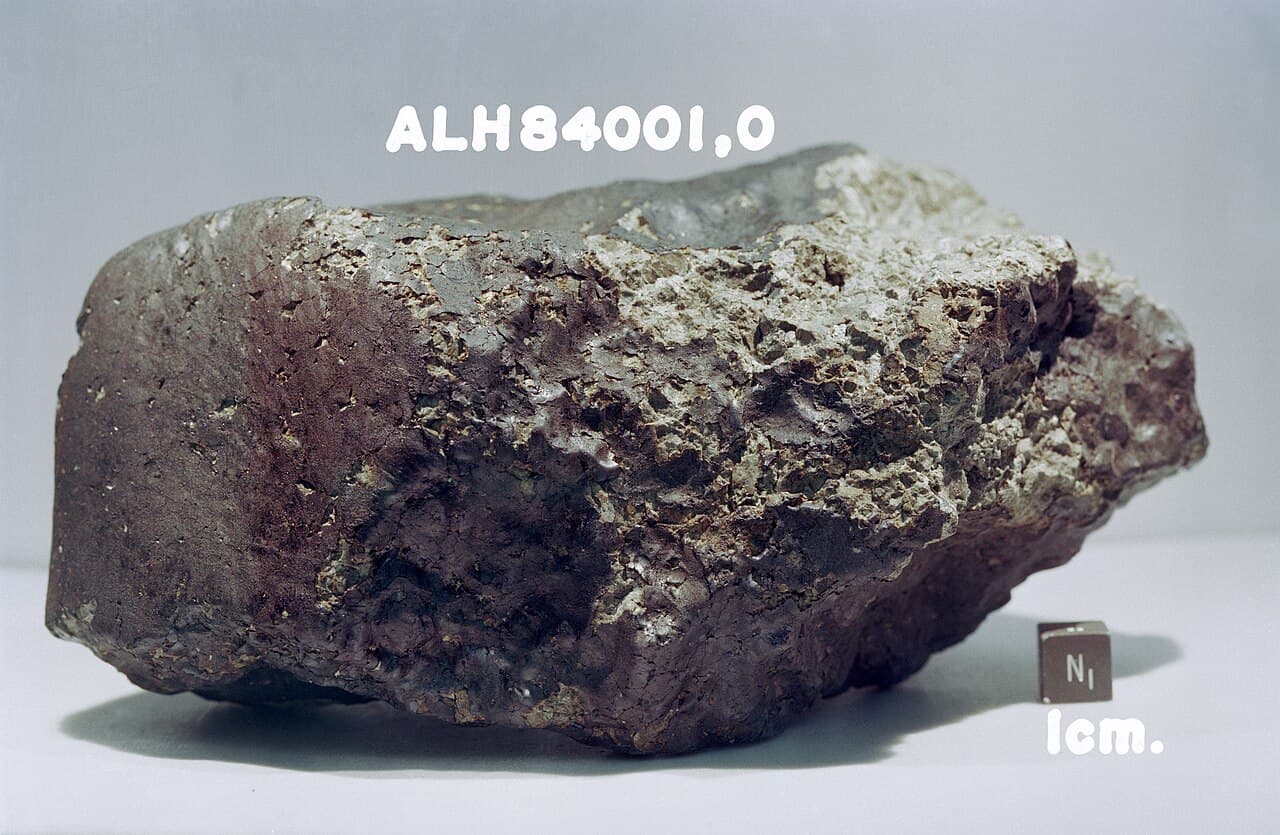
The second attempt is the one everybody remembers, and it is the best available lesson in how a life claim dies. ALH 84001 is a 1,930.9 gram lump of martian orthopyroxenite picked up in the Allan Hills of Antarctica by Roberta Score on 27 December 1984. On 6 August 1996 a NASA-led team announced that carbonate globules inside it might hold traces of ancient martian biology, and published the case days later in Science: globules formed at temperatures life could tolerate, magnetite and iron sulfide grains resembling those grown by magnetotactic bacteria, indigenous polycyclic aromatic hydrocarbons, and features 20 to 100 nanometres across shaped like microfossils. President Clinton made a televised statement. Then each of the four strands drew a rebuttal, one at a time, over twenty-six years, contested at each step by members of the original team. In 1998 two papers in the same issue of Science showed the amino acids matched Antarctic ice contamination and that carbon-14 marked most of the organic carbon as terrestrial. The nanometre features are smaller than any cellular life known when they were reported. In 2004 D. C. Golden and colleagues grew the same elongated magnetite crystals with no biology involved, concluding they are not a robust biosignature, and other groups argued the grains came from shock and heat decomposing the carbonate. Finally in January 2022 Andrew Steele and colleagues traced the indigenous organic carbon itself to abiotic water-rock chemistry, serpentinisation and carbonation, on Mars around four billion years ago. Steele's own framing is the durable part: abiotic organic synthesis is a background signal that every future claim has to beat.
That background is not small, which is why finding organic molecules on Mars, which has now happened many times, settles nothing on its own. Frantseva and colleagues calculate that asteroids deliver roughly fifty tonnes of carbon to Mars a year and comets about thirteen, on top of a larger and more even rain from interplanetary dust. Water-rock reactions make more of it in place. Against that background the detections are still worth having, because they show organics survive on Mars and tell us where. Curiosity's SAM found chlorobenzene in the Cumberland sample in 2015; thiophenic, aromatic and aliphatic matter in 3.5-billion-year-old Murray formation mudstone in 2018; decane, undecane and dodecane in 2025, the last of these the largest molecule yet identified on the surface and plausibly a fragment of a long-chain fatty acid; and in April 2026 more than twenty compounds including benzothiophene and a possible nitrogen heterocycle, from the first run of SAM's tetramethylammonium hydroxide wet chemistry experiment, the first thermochemolysis experiment performed on another planet. Perseverance's SHERLOC has added aromatic signatures on the Jezero floor and, in June 2026, spatially distributed macromolecular carbon across the Bright Angel formation, which its authors call the most robust organic detection in Jezero crater so far. Every one of those papers says the same thing in its own words: the origin of the molecules is not determined by the measurement. Amy Williams and colleagues, reporting the 2026 wet-chemistry result, claim only that the experiment released molecules preserved in ancient martian bedrock through three and a half billion years of diagenesis and radiation; the paper states that the origin of that material is currently unknown.
Which brings the argument to a single rock. On 21 July 2024, sol 1215, Perseverance cored a mudstone called Cheyava Falls in the Bright Angel formation, in the dry river valley Neretva Vallis at the western edge of Jezero crater, and sealed the core as Sapphire Canyon. The rock is speckled with pale, dark-rimmed millimetre spots, nicknamed leopard spots, and finer dark specks nicknamed poppy seeds. On 10 September 2025 Hurowitz and eighty-eight co-authors reported in Nature that these are nodules and reaction fronts of ferrous iron phosphate and iron sulfide, most likely vivianite and greigite, formed at low temperature in reactions in which organic carbon in the mudstone appears to have taken part. On Earth that combination is what iron-reducing and sulfate-reducing microbes leave behind. The abiotic routes exist but are awkward here: Hurowitz has said that making sulfide from sulfate and organic matter without biology is a tougher ask, because the reaction is incredibly slow at room temperature and generally wants heating above roughly 120 to 140 C, and this rock shows no sign of having been cooked. The paper does not claim life. It reviews the alternatives and concludes that the answer needs the core in a laboratory. Since then the picture has thickened rather than resolved. In January 2026 Sev Zielinska, Sean McMahon and colleagues showed experimentally that microbes really do make bleached reduction spots like these in iron-rich sediment within weeks, while warning that this does not make all such spots biological. In June 2026 SHERLOC confirmed macromolecular carbon spread across the same formation.
So what would settle it? Almost everyone involved gives the same answer: the core, in a laboratory, where instruments too heavy to fly can measure carbon isotope ratios, molecular structure and the spatial relationship of organics to minerals at scales a rover cannot reach. That is why Mars Sample Return mattered far beyond its cost line, and why its defunding in January 2026 is a scientific event and not only a budgetary one. Sapphire Canyon is still on Mars. See Mars Sample Return for how that happened, and the Three Forks depot for the ten tubes already lying on the ground. Other routes exist but are slower and aimed elsewhere: Rosalind Franklin, due to launch in 2028, will be the first rover to drill two metres down, below the depth where cosmic rays shred amino acids, and Tianwen-3 aims to return at least 500 grams from a different site around 2031 with the search for biosignatures as its stated primary goal. On present-day life the honest answer is even emptier. The surface is bombarded, oxidising and almost always too cold and too dry for anything to replicate, and the thresholds COSPAR uses to flag a region where terrestrial organisms could replicate, a water activity of at least 0.5 and a temperature of at least minus 28 C, both at once, are met almost nowhere. The subsurface is the plausible habitat and nothing has ever sampled it; see the life-detection missions NASA did not fly for the metabolism experiments that were designed and never launched. As of September 2026 the record stands at zero detections and one very interesting rock.
What we know
The short answer
No result from any Mars mission has ever been accepted by the scientific community as a detection of life. The strongest candidate in September 2026 is the Cheyava Falls mudstone in Jezero crater. Joel Hurowitz of Stony Brook University, who led the paper on it, places the sample at "step three on the CoLD scale", the step that establishes a plausibly habitable environment that could have preserved signatures of biology, and says the team is "trying to put it down on step four, but we're not there yet". On the abiotic side he has said that making vivianite from organic matter and ferric iron without biology feels plausible, but that producing greigite is a tougher ask, because sulfate reacting with organic matter at room temperature is incredibly slow and generally needs heating above roughly 120 to 140 C, for which this rock shows no evidence.↗
What a biosignature has to satisfy
The Confidence of Life Detection (CoLD) scale, proposed by James Green, Tori Hoehler, Marc Neveu, Shawn Domagal-Goldman, Daniella Scalice and Mary Voytek in Nature 598:575-579 (27 October 2021), runs in seven steps: 1, detect a possible signal; 2, rule out contamination; 3, show that biology was possible in that environment; 4, rule out non-biological explanations; 5, find an independent second signal; 6, rule out other hypotheses; 7, get independent confirmation by a separate team or mission. Steps 4 and 6 are where Mars claims have always stopped.↗
The harder version of the same test
NASA also maintains the Ladder of Life Detection, published by Marc Neveu, Lindsay Hays, Mary Voytek, Michael New and Mitchell Schulte in Astrobiology in 2018, which sorts candidate features (metabolic byproducts, biomolecule components, functional molecules and structures, growth and reproduction, Darwinian evolution) by how specific each is to life. NASA is explicit that the ladder does not endorse particular biosignatures and is a starting point for discussion. The working standard behind both frameworks is that an observation must not merely be consistent with biology; the abiotic hypothesis has to fail.↗
Habitable is not inhabited
Curiosity's central result, published by John Grotzinger and colleagues in Science in 2014, is that the Yellowknife Bay mudstones in Gale crater record an ancient lake of near-neutral pH and low salinity, with iron and sulfur present in both oxidised and reduced states, and with carbon, hydrogen, oxygen, sulfur, nitrogen and phosphorus measured directly. The environment lasted at minimum hundreds to tens of thousands of years and would have suited a chemolithoautotrophic biosphere, meaning organisms living off chemical energy in rock and water rather than sunlight. It describes the habitat; it says nothing about occupancy.↗
Organic molecules have been found, repeatedly
Curiosity's SAM instrument found chlorobenzene and dichloroalkanes in the Cumberland drill sample (Freissinet et al., 2015); thiophenic, aromatic and aliphatic matter in roughly 3.5-billion-year-old Murray formation mudstone (Eigenbrode et al., Science 360:1096-1101, 2018); decane, undecane and dodecane in Cumberland, dodecane being the largest molecule yet identified on the surface (Freissinet et al., PNAS 122:e2420580122, 2025); and more than twenty molecules including benzothiophene and a possible nitrogen heterocycle in the first SAM TMAH wet-chemistry run, on clay-bearing sandstone of the Knockfarrill Hill member of Glen Torridon (Williams et al., Nature Communications 17:2748, 2026). Perseverance's SHERLOC has added aromatic signatures on the Jezero crater floor (Sharma et al., Nature 619:724, 2023).↗
Why organics are not life
Organic means built around carbon; it does not mean made by an organism. Mars is dusted with abiotic organic carbon from space: Frantseva and colleagues (Icarus 309:125-133, 2018) calculate about 0.05 million kg a year of carbon delivered by asteroids and about 0.013 million kg a year by comets, which they put at roughly 17 to 71 per cent and 4 to 19 per cent of the flux carried by interplanetary dust. Water-rock chemistry makes more of it in place. Andrew Steele and colleagues concluded in Science in 2022 that the organic material in the meteorite ALH 84001 was synthesised abiotically on Mars by serpentinisation and carbonation, which Steele calls a background signal that has to be taken into account when hunting for evidence of past life.↗
Viking, and the one experiment still argued about
The two Viking landers in 1976 carried the only instruments ever sent to Mars to look directly for metabolism. All three biology experiments produced signals; the separate gas chromatograph mass spectrometer found no organics of martian origin, and that absence settled the argument at the time. The 2008 discovery of perchlorate, which destroys organics in a hot oven, reopened it. The majority position in 2026, argued in detail by Chris McKay, Richard Quinn and Carol Stoker in Icarus in 2025, is that soil chemistry explains the results: hypochlorite accumulated in the soil by cosmic-ray decomposition of perchlorate accounts for the reactivity, and perchlorate decomposing in the ovens accounts for the missing organics. Critics of that reading keep returning to one labeled-release control, the loss of activity after about 141 sols of storage, which they say no published abiotic experiment has reproduced. The Viking biology results page gives the full treatment.↗
The dissent is still in print
Steven Benner, Dirk Schulze-Makuch, Jan Spacek and Clay Abraham argued in Astrobiology 26:148-153 (February 2026) that the Viking gas chromatograph result was misread as an absence of organics, that all three biology experiments reported life-positive data under their own protocols, and that the record is compatible with martian autotrophs respiring stored oxygen in intermittent cold brines. This is a minority view, but it was published in the field's main journal rather than as a fringe posting, and no experiment flown since 1976 has been able to test it.↗
ALH 84001, the rock
A 1,930.9 g orthopyroxenite found in the Allan Hills of Antarctica on 27 December 1984 by Roberta Score of the ANSMET meteorite programme, later shown to be martian. It crystallised about 4.091 billion years ago, was blasted off Mars roughly 17 million years ago and fell to Earth about 13,000 years ago. Carbonate globules inside it formed on Mars, and everything claimed in 1996 was claimed about those globules.↗
The 1996 claim
On 6 August 1996 a NASA-led team announced that ALH 84001 might carry traces of martian life, published days later as McKay, Gibson, Thomas-Keprta, Vali, Romanek, Clemett, Chillier, Maechling and Zare, Science 273:924-930. Four strands were offered together: carbonate globules formed at temperatures life could tolerate; magnetite and iron sulfide grains resembling those made by magnetotactic bacteria; indigenous reduced carbon in the form of polycyclic aromatic hydrocarbons; and 20 to 100 nanometre features shaped like microfossils. President Bill Clinton marked the announcement in a televised statement in the same week.↗
How the four strands came apart
Each drew a published rebuttal over the following twenty-six years, and some of the original authors never accepted them. Jeffrey Bada and colleagues (Science 279:362, 1998) matched the meteorite's amino acids to Antarctic ice contamination; Timothy Jull and colleagues (Science 279:366, 1998) showed by carbon-14 that most of the organic carbon was terrestrial. D. C. Golden and colleagues (American Mineralogist 89:681-695, 2004) grew the same elongated magnetite crystals inorganically, concluding they are not a robust biosignature, while other groups argued the grains formed by shock and thermal decomposition of the carbonate. The nanometre-scale features are smaller than any cellular life known when they were reported. Finally, Steele et al. (Science 375:172-177, 14 January 2022) traced the indigenous organic carbon to abiotic serpentinisation and carbonation. The weight of published opinion now runs against all four strands, which is not the same as any of them having been disproved.↗
Cheyava Falls: the rock and the core
Perseverance cored an arrowhead-shaped mudstone called Cheyava Falls in the Bright Angel formation, in the ancient river valley Neretva Vallis on the western edge of Jezero crater, on 21 July 2024 (sol 1215), and sealed the core as sample 25, Sapphire Canyon. The rock carries millimetre-scale pale spots with dark rims, nicknamed leopard spots, and finer dark specks nicknamed poppy seeds.↗
Cheyava Falls: what the paper actually says
Hurowitz and 88 co-authors, Nature 645:332-340, 10 September 2025. Organic-carbon-bearing mudstones contain nodules and reaction fronts enriched in ferrous iron phosphate and sulfide, likely vivianite and greigite; the organic carbon "appears to have participated in post-depositional redox reactions" that made them, at low temperature. The paper reviews the abiotic routes to the same minerals rather than dismissing them, and its own conclusion is procedural: that analysis of the core "using high-sensitivity instrumentation on Earth will enable the measurements required to determine the origin of the minerals, organics and textures it contains". NASA labelled the result a potential biosignature, its term for something that might have a biological origin but needs more data.↗
Cheyava Falls: what has happened since
Three things by September 2026. In January 2026 Sev Zielinska, Naomi Felton, Philip Vixseboxse and Sean McMahon posted experimental work showing that mixed microbial communities do produce visible bleached reduction spots in iron-rich sediment within weeks, with iron-reducing bacteria concentrated in the bleached zones and no bleaching in sterile controls, while stating that this does not make all such spots biogenic. In June 2026 Ashley Murphy, Kyle Uckert and colleagues reported spatially distributed macromolecular carbon across Bright Angel from SHERLOC (Science Advances 12:eadx0047, 24 June 2026), which the authors call "the most robust organic detection in Jezero crater thus far", while stating that Raman analysis in situ cannot tell an abiotic source from a biotic one. Also in June 2026 a survey of the astrobiology community found opinion had moved, but toward hesitation rather than assent.↗
What the field actually thinks
Peter Vickers, Christopher Cowie, Jesse Hamilton, Sean McMahon and Samantha Mitchell Finnigan surveyed astrobiologists after the two 2025 announcements and published the result in Nature Astronomy 10:774-776 on 5 June 2026. On Cheyava Falls, 15.1 per cent agreed that extraterrestrial life had probably been found, 44.6 per cent disagreed and 40.3 per cent were neutral; strong disagreement fell from 35.1 to 11.1 per cent. On the exoplanet K2-18 b, 6.6 per cent agreed. The authors describe the community as "willing to soften rejection, but hesitant to endorse claims until confidence is strong or overwhelming".↗
Why present-day life is a separate and harder question
The surface is a poor place to be alive or to stay preserved. Cosmic rays penetrate metres into rock, while Curiosity and Perseverance drill only about 5 cm; modelling by Alexander Pavlov and colleagues had already suggested that complex organic molecules in the top 10 cm or so would be hard to preserve once an outcrop had been exposed for more than 300 million years, and their 2022 laboratory work found that at drilling depth amino acids would be destroyed completely within about 20 million years, faster again with perchlorate salts and water. Their 2025 follow-up found pure water ice preserves amino acids far better than rock or soil. Meanwhile COSPAR's planetary protection policy calls a region "special", meaning terrestrial organisms could replicate there, when two thresholds are met at the same time: water activity of at least 0.5 and a temperature of at least minus 28 C. Those numbers rest on the environmental limits reviewed in the 2014 SR-SAG2 analysis led by John Rummel, and both the limits and the margins built on top of them have been revisited as the evidence has changed. Almost nowhere on Mars qualifies.↗
What happened, and when
- 30 Jul 1976Viking 1's labeled release experiment injects carbon-14 tagged nutrient onto martian soil at Chryse Planitia and the beta counter climbs the way a living soil does. Within days the gas exchange experiment has released unexplained oxygen and the pyrolytic release experiment has fixed carbon. Three experiments, three signals.
- 6 to 12 Aug 1976The gas chromatograph mass spectrometer, an instrument that was not looking for life at all, reports no organic compounds of martian origin at detection limits of a few parts per billion. The biology results are read as chemistry, and stay read that way for thirty years.
- 27 Dec 1984Roberta Score picks up a 1,930.9 g greenish rock in the Allan Hills of Antarctica on an ANSMET field season. It is catalogued as ALH 84001 and is later identified as a piece of Mars that crystallised about 4.091 billion years ago.
- 6 Aug 1996A NASA-led team announces that ALH 84001 may carry relic traces of martian biology, on four strands of evidence at once. The paper follows in Science 273:924-930. President Clinton marks it in a televised statement. It is the largest life-on-Mars story ever told, and within two years the counter-papers begin.
- 1998Two papers in the same issue of Science undercut the organic strand: Bada and colleagues match the meteorite's amino acids to Antarctic ice contamination, and Jull and colleagues show by carbon-14 that most of its organic carbon is terrestrial. The magnetite and morphology strands come apart over the following decade.
- 3 Jul 2009Science publishes Phoenix's detection of 0.4 to 0.6 per cent perchlorate in martian soil. A strong oxidiser that wrecks organics when heated had been in the ground all along, unmeasured at either Viking site, and the 1976 verdict has to be reopened.
- Jan 2014Grotzinger and colleagues report in Science (343:1242777) that Yellowknife Bay in Gale crater was an ancient lake of near-neutral pH and low salinity with the biogenic elements present and redox couples available. Mars is shown to have been habitable. It is not shown to have been inhabited, and the distinction is lost in most of the coverage.
- 8 Jun 2018Eigenbrode and colleagues report organic matter preserved in roughly 3.5-billion-year-old mudstone at Gale crater, at least 50 nanomoles of organic carbon, probably macromolecular and partly sulfurised. Organics do survive on Mars. Whether anything made them is untouched by the result.
- 14 Jan 2022Steele and colleagues publish in Science that the organic material in ALH 84001 was made abiotically on Mars by serpentinisation and carbonation between about 4.1 and 3.9 billion years ago. The last strand of the 1996 case is reinterpreted, and the field gains a warning: abiotic organic synthesis is a background signal that any future claim has to beat.
- 21 Jul 2024Sol 1215: Perseverance cores the mudstone Cheyava Falls in the Bright Angel formation and seals the core as Sapphire Canyon. The rock is patterned with millimetre-scale leopard spots.
- 10 Sep 2025Nature publishes Hurowitz and colleagues on vivianite, greigite and organic carbon in Cheyava Falls. NASA calls it a potential biosignature and points at its confidence scale rather than claiming a detection. Project scientist Katie Stack Morgan's line at the announcement is that astrobiological claims require extraordinary evidence.
- 23 Jan 2026Mars Sample Return, the programme built to bring Sapphire Canyon and its companions to laboratories on Earth, becomes unfunded: the fiscal 2026 appropriations bill, passed by Congress in mid-January and signed this month, endorses the administration's proposal to cancel it, directing $110 million to Mars future-mission technology instead. The one measurement everyone agrees would settle the Cheyava Falls question loses its vehicle.
In pictures
Tap a photo to enlarge.
Sources
- Hurowitz et al., Redox-driven mineral and organic associations in Jezero Crater, Mars, Nature 645:332-340 (10 Sep 2025), doi 10.1038/s41586-025-09413-0
- NASA JPL (10 Sep 2025): NASA Says Mars Rover Discovered Potential Biosignature Last Year
- The Planetary Society (1 Oct 2025): A biosignature on Mars? Unpacking Perseverance's Cheyava Falls find
- Green, Hoehler, Neveu, Domagal-Goldman, Scalice and Voytek, Call for a framework for reporting evidence for life beyond Earth, Nature 598:575-579 (2021)
- Neveu, Hays, Voytek, New and Schulte, The Ladder of Life Detection, Astrobiology 18:1375-1402 (2018)
- Murphy, Uckert et al., Spatially distributed complex organic matter detected in an ancient river valley in Jezero crater, Mars, Science Advances 12:eadx0047 (24 Jun 2026), doi 10.1126/sciadv.adx0047
- Zielinska, Felton, Vixseboxse and McMahon, Experimental evidence for a microbial origin of reduction spots in red beds, bioRxiv preprint (13 Jan 2026), doi 10.64898/2026.01.12.699011
- Vickers, Cowie, Hamilton, McMahon and Mitchell Finnigan, Comparing astrobiologists' confidence in extraterrestrial life claims for K2-18 b and Cheyava Falls, Nature Astronomy 10:774-776 (5 Jun 2026)
- Williams et al., Diverse organic molecules on Mars revealed by the first SAM TMAH experiment, Nature Communications 17:2748 (21 Apr 2026), doi 10.1038/s41467-026-70656-0
- Freissinet et al., Long-chain alkanes preserved in a Martian mudstone, PNAS 122:e2420580122 (2025), doi 10.1073/pnas.2420580122
- Steele et al., Organic synthesis associated with serpentinization and carbonation on early Mars, Science 375:172-177 (14 Jan 2022), doi 10.1126/science.abg7905
- McKay, Gibson, Thomas-Keprta, Vali, Romanek, Clemett, Chillier, Maechling and Zare, Search for Past Life on Mars, Science 273:924-930 (1996), doi 10.1126/science.273.5277.924
- Grotzinger et al., A Habitable Fluvio-Lacustrine Environment at Yellowknife Bay, Gale Crater, Mars, Science 343:1242777 (2014), doi 10.1126/science.1242777
- Benner, Schulze-Makuch, Spacek and Abraham, Viking Mars, Now 50 Years Old, Still Needs a Scientific Analysis, Astrobiology 26:148-153 (Feb 2026), doi 10.1177/15311074251404929
- McKay, Quinn and Stoker, The Viking biology experiments on Mars revisited, Icarus (14 Mar 2025)
- Frantseva, Mueller, ten Kate, van der Tak and Greenstreet, Delivery of organics to Mars through asteroid and comet impacts, Icarus 309:125-133 (2018), doi 10.1016/j.icarus.2018.03.006
- Pavlov et al., Slow radiolysis of amino acids in Mars-like permafrost conditions, Astrobiology 25:601-610 (2025), doi 10.1177/15311074251366249
- COSPAR Policy on Planetary Protection (June 2020)
- NASA: Perseverance's rock samples
- Eigenbrode et al., Organic matter preserved in 3-billion-year-old mudstones at Gale crater, Mars, Science 360:1096-1101 (2018), doi 10.1126/science.aas9185
- Pavlov et al., Degradation of the organic molecules in the shallow subsurface of Mars due to irradiation by cosmic rays, Geophysical Research Letters 39 (2012), doi 10.1029/2012GL052166
- NASA (27 Jun 2022): NASA Experiment Suggests Need to Dig Deep for Evidence of Life on Mars
- COSPAR Policy on Planetary Protection, approved 7 November 2025 (Space Research Today 224, January 2026)
- National Post (14 Jan 2022), report on Steele et al. 2022 quoting Andrew Steele on abiotic organics as a background signal
- Bada, Glavin, McDonald and Becker, A Search for Endogenous Amino Acids in Martian Meteorite ALH84001, Science 279:362-365 (16 Jan 1998), doi 10.1126/science.279.5349.362
- Jull, Courtney, Jeffrey and Beck, Isotopic Evidence for a Terrestrial Source of Organic Compounds Found in Martian Meteorites Allan Hills 84001 and Elephant Moraine 79001, Science 279:366-369 (16 Jan 1998), doi 10.1126/science.279.5349.366
- NASA JSC Mars Meteorite Compendium: ALH 84001
- The Planetary Society (30 Jan 2026): NASA is funded. Now what?
- NASA (25 Jul 2024): NASA's Perseverance Rover Scientists Find Intriguing Mars Rock
Checked on 24 September 2026. Where the science is unsettled this page says so rather than picking a winner.